COMM THEORY On the Nature of Theory John


- Slides: 22
COMM THEORY: On the Nature of Theory John A. Cagle, Ph. D. Communication California State University, Fresno
COMM 100 l Theories of Human Communication is a course designed to introduce upper division students to communication theory from a scientific perspective.
THEORY l A theory is a scientific account of phenomena. l At a minimum it is a strategy for handling observations in research, providing a conceptual system for describing and explaining.
Darnell's definition of theory l "A theory is a set of statements, including some lawlike generalizations, systematically and logically related such that the set implies something about reality. l It is an argument that purports to provide a necessary and sufficient explanation for a range of phenomena.
l It must be capable of corrigibility--that is, it must be possible to disconfirm or jeopardize it by making observations. l A theory is valuable to the extent that it reduces the uncertainty about the outcome of a specific set of conditions. "
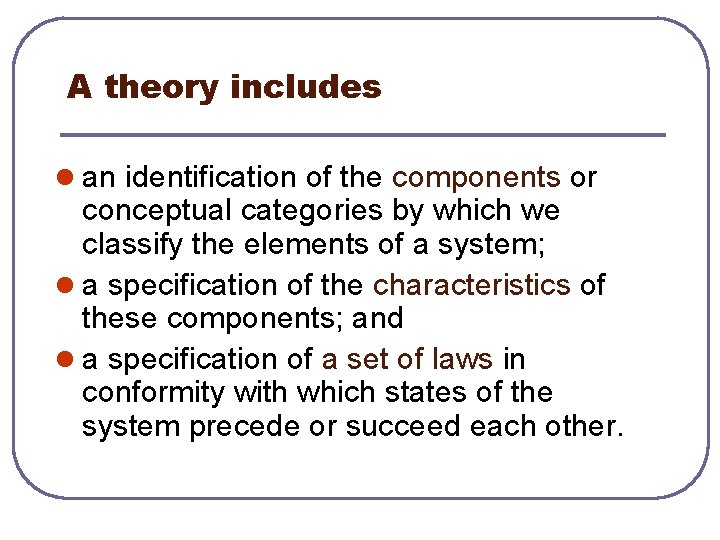
A theory includes l an identification of the components or conceptual categories by which we classify the elements of a system; l a specification of the characteristics of these components; and l a specification of a set of laws in conformity with which states of the system precede or succeed each other.
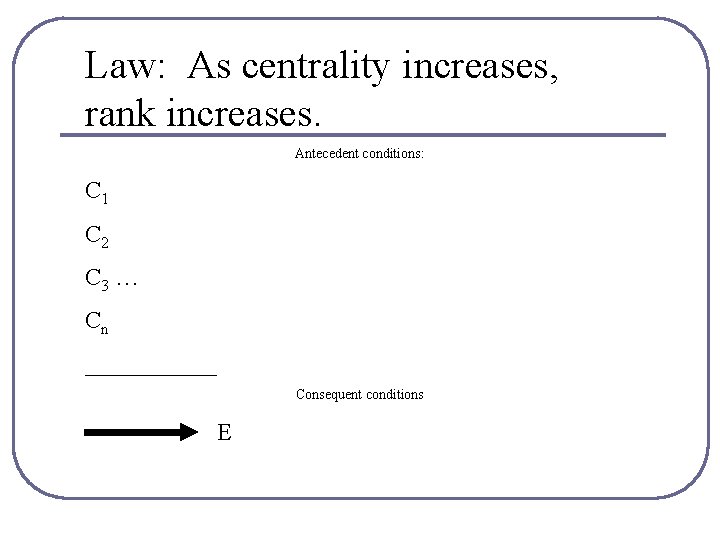
Law: As centrality increases, rank increases. Antecedent conditions: C 1 C 2 C 3 … Cn ______ Consequent conditions E
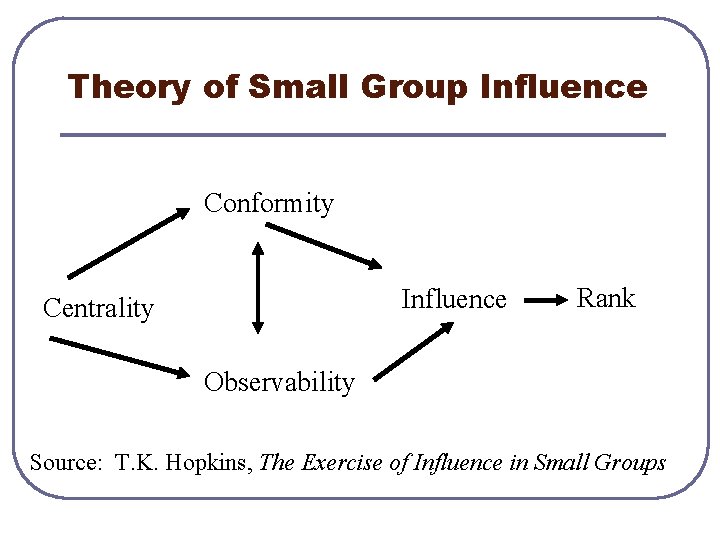
Theory of Small Group Influence Conformity Influence Centrality Rank Observability Source: T. K. Hopkins, The Exercise of Influence in Small Groups
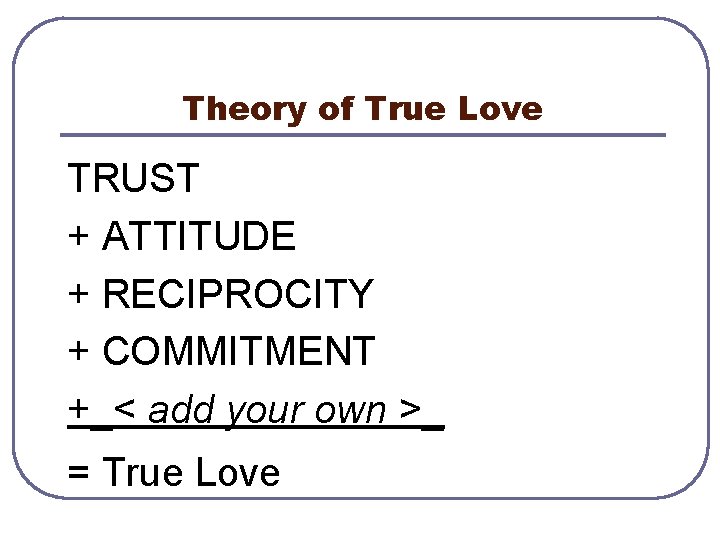
Think of True Love – what factors produce true love, maintain it, or destroy it? Take out a piece of paper & write down four of these main factors
Theory of True Love TRUST + ATTITUDE + RECIPROCITY + COMMITMENT +_< add your own >_ = True Love
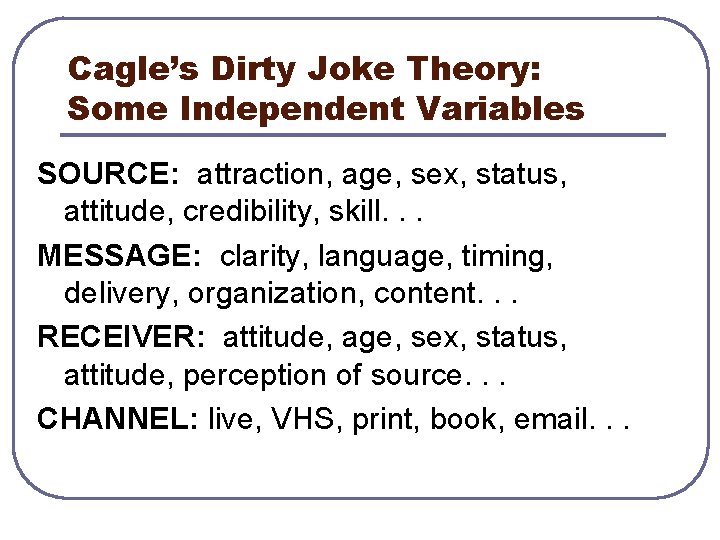
Cagle’s Dirty Joke Theory: Some Independent Variables SOURCE: attraction, age, sex, status, attitude, credibility, skill. . . MESSAGE: clarity, language, timing, delivery, organization, content. . . RECEIVER: attitude, age, sex, status, attitude, perception of source. . . CHANNEL: live, VHS, print, book, email. . .
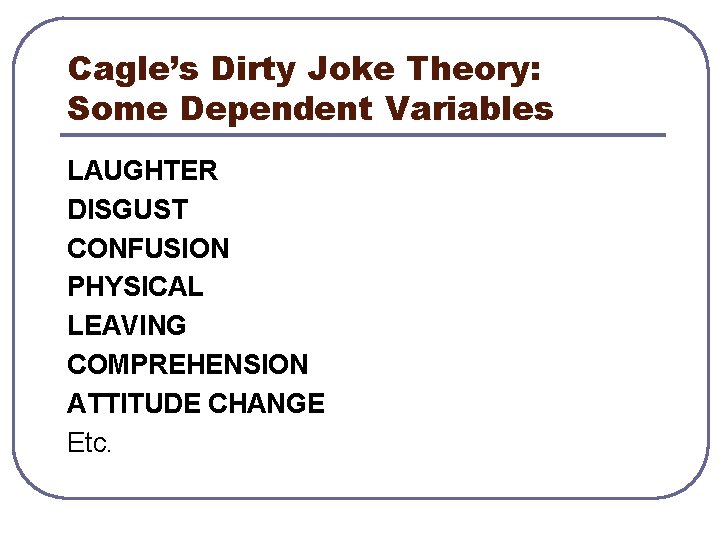
Cagle’s Dirty Joke Theory: Some Dependent Variables LAUGHTER DISGUST CONFUSION PHYSICAL LEAVING COMPREHENSION ATTITUDE CHANGE Etc.
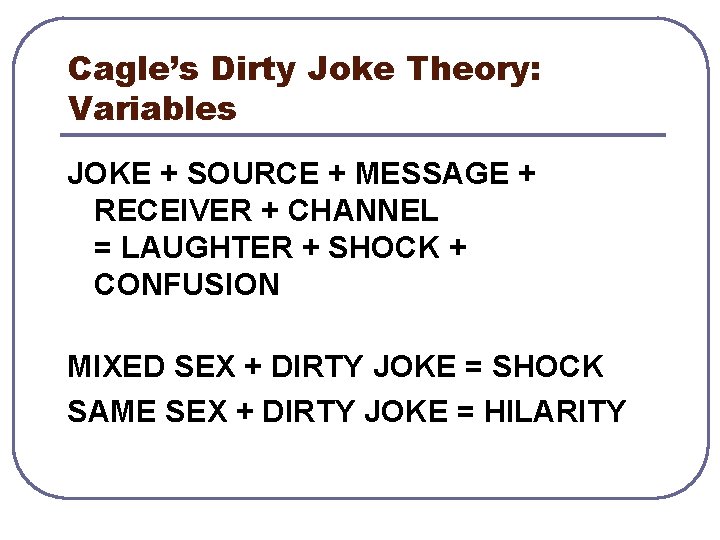
Cagle’s Dirty Joke Theory: Variables JOKE + SOURCE + MESSAGE + RECEIVER + CHANNEL = LAUGHTER + SHOCK + CONFUSION MIXED SEX + DIRTY JOKE = SHOCK SAME SEX + DIRTY JOKE = HILARITY
COMMUNICATION l Communication is a complex, pervasive phenomena. l Virtually every human endeavor involves communication in some way. l Consequently, there a great many communication theories--each, in its own way, appropriate to those aspects of the phenomena germane to its purpose.
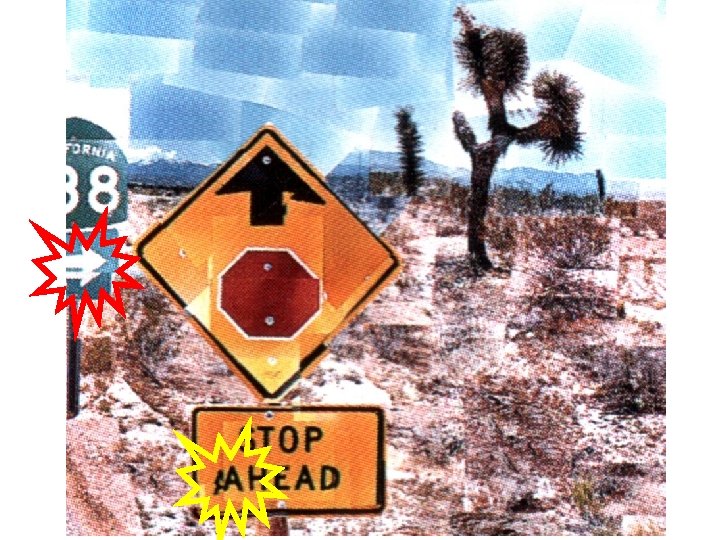
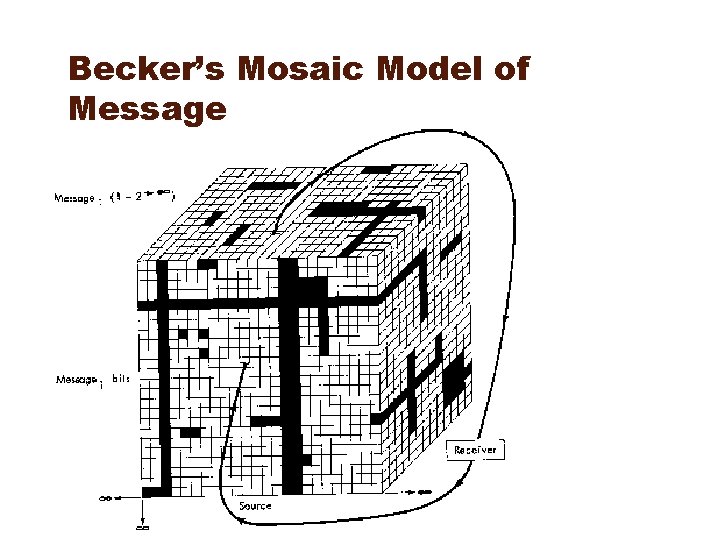
Communication Mosaic: A Metaphor l First, the metaphor of a mosaic offers a theoretical orientation to illumine the interconnectedness among all communication theories. l Second, it provides an overview of some of the more interesting, provocative, and heuristic theories within the major types of communication theories. l Meaning is created from bits and pieces which our mind puts together into a gestalt.
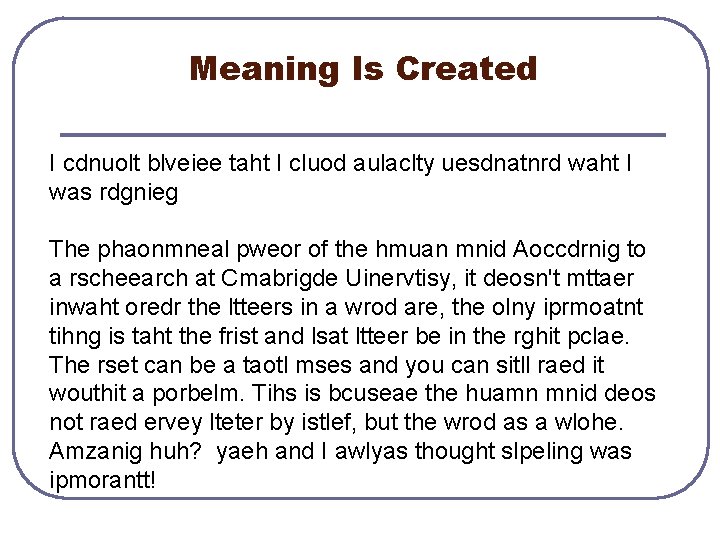
Meaning Is Created I cdnuolt blveiee taht I cluod aulaclty uesdnatnrd waht I was rdgnieg The phaonmneal pweor of the hmuan mnid Aoccdrnig to a rscheearch at Cmabrigde Uinervtisy, it deosn't mttaer inwaht oredr the ltteers in a wrod are, the olny iprmoatnt tihng is taht the frist and lsat ltteer be in the rghit pclae. The rset can be a taotl mses and you can sitll raed it wouthit a porbelm. Tihs is bcuseae the huamn mnid deos not raed ervey lteter by istlef, but the wrod as a wlohe. Amzanig huh? yaeh and I awlyas thought slpeling was ipmorantt!
Becker’s Mosaic Model of Message
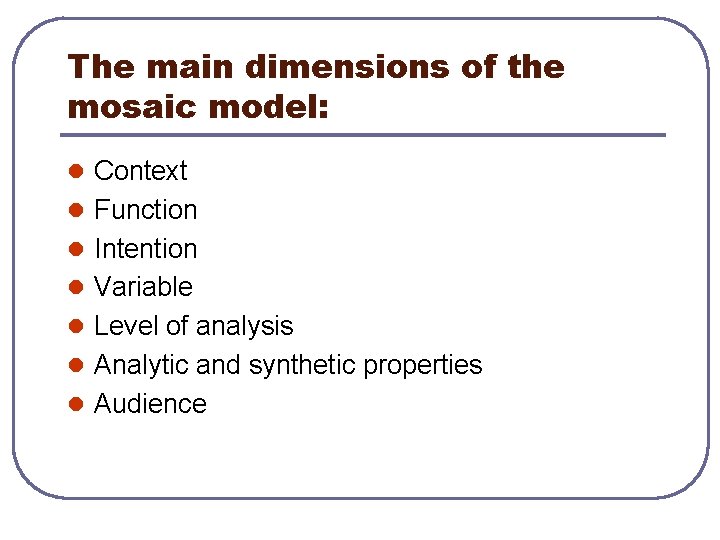
The main dimensions of the mosaic model: l Context l Function l Intention l Variable l Level of analysis l Analytic and synthetic properties l Audience