Chemistry Name Worksheet on Temperature Heat Date 1


- Slides: 7
Chemistry Name Worksheet on Temperature & Heat Date 1. For q = m ● c ● ΔT : identify each variables by name & the units associated with it. q = amount of heat (J) m = mass (grams) c = specific heat (J/g°C) ΔT = change in temperature (°C) 2. Heat is not the same as temperature, yet they are related. Explain how they differ from each other. Temperature is the average kinetic energy of a collection of molecules Heat is the total kinetic energy of a collection of molecules For the following problems, perform calculations using: (q = m ● c ● ΔT) 3. Gold has a specific heat of 0. 129 J/(g°C). How many joules of heat energy are required to raise the temperature of 15 grams of gold from 22 °C to 85°C? q=? m = 15 g c = 0. 129 J/g°C ΔT = 85°C - 22°C = 63°C q = mc ΔT q = (15 g)(0. 129 J/g°C)(63 °C) q = 121. 9 J Endothermic or exothermic? Endothermic slide 1
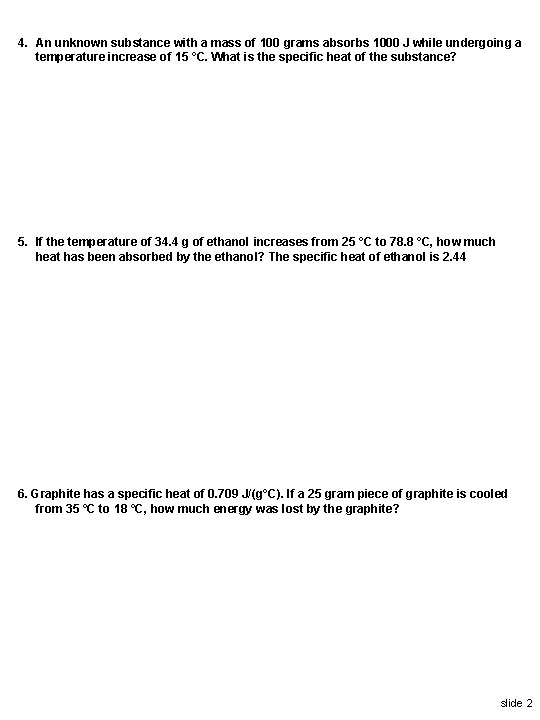
4. An unknown substance with a mass of 100 grams absorbs 1000 J while undergoing a temperature increase of 15 °C. What is the specific heat of the substance? q = 1000 J m = 100 g c=? ΔT = 15°C c = 0. 666667 J/g°C ≈ 0. 7 J/g°C Endothermic or exothermic? Endothermic 5. If the temperature of 34. 4 g of ethanol increases from 25 °C to 78. 8 °C, how much heat has been absorbed by the ethanol? The specific heat of ethanol is 2. 44 J/(g×°C) q=? m = 34. 4 g c = 2. 44 J/g°C ΔT = 78. 8°C - 25°C = 53. 8°C 54 °C q = (34. 4 g)(2. 44 J/g°C)(54 °C) q = 4532. 544 J Endothermic or exothermic? Endothermic 6. Graphite has a specific heat of 0. 709 J/(g°C). If a 25 gram piece of graphite is cooled from 35 °C to 18 °C, how much energy was lost by the graphite? q=? m = 25 g c = 0. 709 J/g°C ΔT = 18°C - 35°C = -17°C q = (25 g)(0. 709 J/g°C)(-17 °C) q = --301. 325 J Endothermic or exothermic? Exothermic slide 2
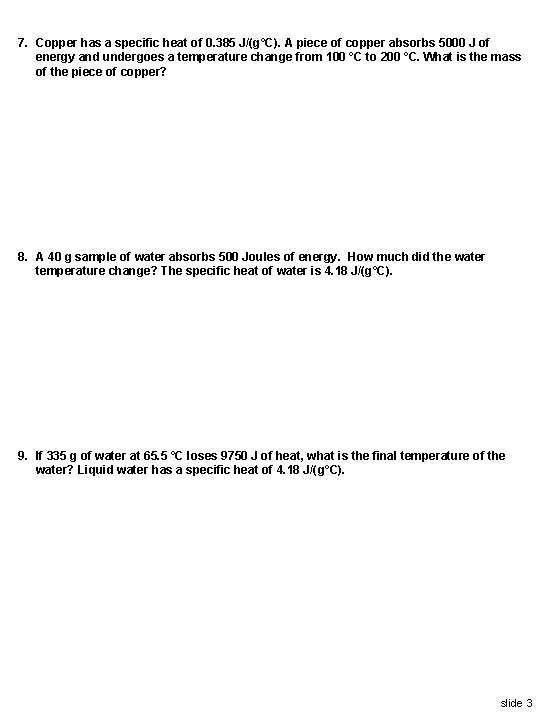
7. Copper has a specific heat of 0. 385 J/(g°C). A piece of copper absorbs 5000 J of energy and undergoes a temperature change from 100 °C to 200 °C. What is the mass of the piece of copper? q = 5000 J m=? c = 0. 385 J/g°C ΔT = 200°C - 100°C = 100°C m= 129. 87 g Endothermic or exothermic? Endothermic 8. A 40 g sample of water absorbs 500 Joules of energy. How much did the water temperature change? The specific heat of water is 4. 18 J/(g°C). q = 500 J m = 40 g c = 4. 18 J/g°C ΔT = ? = 2. 99 °C Endothermic or exothermic? Endothermic 9. If 335 g of water at 65. 5 °C loses 9750 J of heat, what is the final temperature of the water? Liquid water has a specific heat of 4. 18 J/(g°C). q = -9750 J m = 335 g c = 4. 18 J/g°C ΔT = Tfinal – 65. 5 °C Endothermic or exothermic? Exothermic slide 3
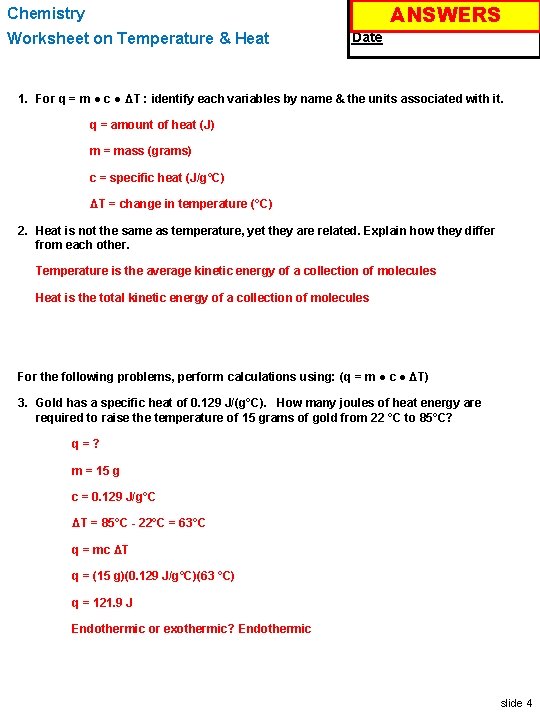
Chemistry Name Worksheet on Temperature & Heat Date ANSWERS 1. For q = m ● c ● ΔT : identify each variables by name & the units associated with it. q = amount of heat (J) m = mass (grams) c = specific heat (J/g°C) ΔT = change in temperature (°C) 2. Heat is not the same as temperature, yet they are related. Explain how they differ from each other. Temperature is the average kinetic energy of a collection of molecules Heat is the total kinetic energy of a collection of molecules For the following problems, perform calculations using: (q = m ● c ● ΔT) 3. Gold has a specific heat of 0. 129 J/(g°C). How many joules of heat energy are required to raise the temperature of 15 grams of gold from 22 °C to 85°C? q=? m = 15 g c = 0. 129 J/g°C ΔT = 85°C - 22°C = 63°C q = mc ΔT q = (15 g)(0. 129 J/g°C)(63 °C) q = 121. 9 J Endothermic or exothermic? Endothermic slide 4
ANSWERS 4. An unknown substance with a mass of 100 grams absorbs 1000 J while undergoing a temperature increase of 15 °C. What is the specific heat of the substance? q = 1000 J m = 100 g c=? ΔT = 15°C c = 0. 666667 J/g°C ≈ 0. 7 J/g°C Endothermic or exothermic? Endothermic 5. If the temperature of 34. 4 g of ethanol increases from 25 °C to 78. 8 °C, how much heat has been absorbed by the ethanol? The specific heat of ethanol is 2. 44 J/(g×°C) q=? m = 34. 4 g c = 2. 44 J/g°C ΔT = 78. 8°C - 25°C = 53. 8°C 54 °C q = (34. 4 g)(2. 44 J/g°C)(54 °C) q = 4532. 544 J Endothermic or exothermic? Endothermic 6. Graphite has a specific heat of 0. 709 J/(g°C). If a 25 gram piece of graphite is cooled from 35 °C to 18 °C, how much energy was lost by the graphite? q=? m = 25 g c = 0. 709 J/g°C ΔT = 18°C - 35°C = -17°C q = (25 g)(0. 709 J/g°C)(-17 °C) q = --301. 325 J Endothermic or exothermic? Exothermic slide 5
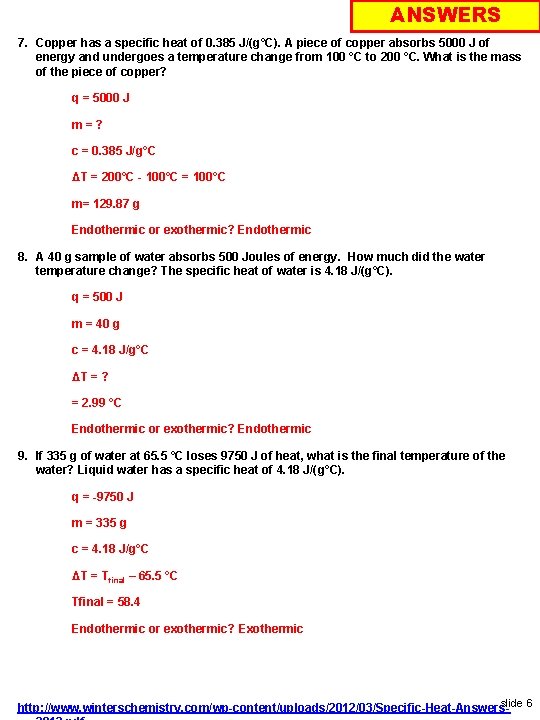
ANSWERS 7. Copper has a specific heat of 0. 385 J/(g°C). A piece of copper absorbs 5000 J of energy and undergoes a temperature change from 100 °C to 200 °C. What is the mass of the piece of copper? q = 5000 J m=? c = 0. 385 J/g°C ΔT = 200°C - 100°C = 100°C m= 129. 87 g Endothermic or exothermic? Endothermic 8. A 40 g sample of water absorbs 500 Joules of energy. How much did the water temperature change? The specific heat of water is 4. 18 J/(g°C). q = 500 J m = 40 g c = 4. 18 J/g°C ΔT = ? = 2. 99 °C Endothermic or exothermic? Endothermic 9. If 335 g of water at 65. 5 °C loses 9750 J of heat, what is the final temperature of the water? Liquid water has a specific heat of 4. 18 J/(g°C). q = -9750 J m = 335 g c = 4. 18 J/g°C ΔT = Tfinal – 65. 5 °C Tfinal = 58. 4 Endothermic or exothermic? Exothermic slide 6 http: //www. winterschemistry. com/wp-content/uploads/2012/03/Specific-Heat-Answers-
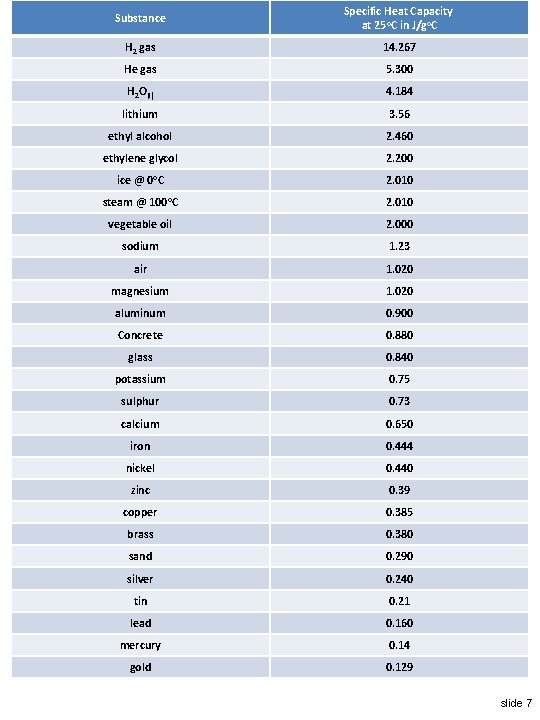
Substance Specific Heat Capacity at 25 o. C in J/go. C H 2 gas 14. 267 He gas 5. 300 H 2 O(l) 4. 184 lithium 3. 56 ethyl alcohol 2. 460 ethylene glycol 2. 200 ice @ 0 o. C 2. 010 steam @ 100 o. C 2. 010 vegetable oil 2. 000 sodium 1. 23 air 1. 020 magnesium 1. 020 aluminum 0. 900 Concrete 0. 880 glass 0. 840 potassium 0. 75 sulphur 0. 73 calcium 0. 650 iron 0. 444 nickel 0. 440 zinc 0. 39 copper 0. 385 brass 0. 380 sand 0. 290 silver 0. 240 tin 0. 21 lead 0. 160 mercury 0. 14 gold 0. 129 slide 7