Chemistry careers in SMEs Reflective writing Samantha Pugh
- Slides: 19
Chemistry careers in SMEs Reflective writing Samantha Pugh University of Leeds
What is reflective writing? • reflection has been described as a form of mental processing which involves considering things in more detail (Jenny Moon, 2010) • ". . . a deliberate process when the candidate takes time, within the course of their work, to focus on their performance and think carefully about [. . . ] particular actions, what happened and what they are learning from the experience, in order to inform what they might do in the future. " (QCA, 2001).
Why bother? • In a job application or at interview, it is not just your experiences that are useful, it is your ability to reflect upon those experiences. • For any experience, you need to be able to evaluate what happened, how you felt about it, and what you learned from that experience. • As scientists, we are not used to doing this – we are much more used to being descriptive and objective.
Emotional intelligence 1 What is it? • An increased awareness of the effect of one’s own actions and behaviours on others. • Linked to empathy. Why is it important? • It is a characteristic that employers are looking for.
Emotional intelligence 2 How does it link to reflective writing? • Being able to write reflectively requires a good level of emotional intelligence. • The ability to write reflectively indicates a good level of emotional intelligence.
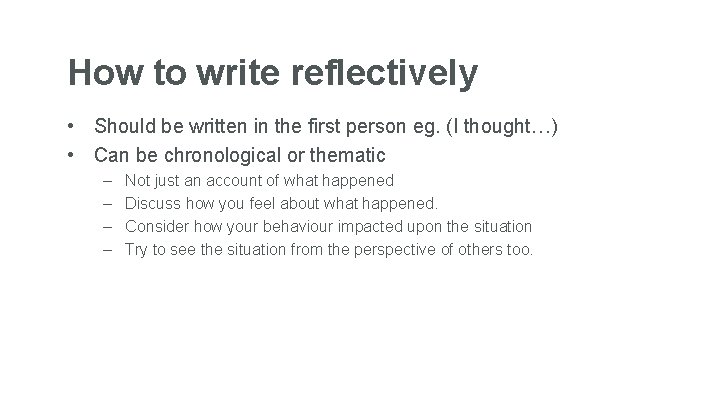
How to write reflectively • Should be written in the first person eg. (I thought…) • Can be chronological or thematic – – Not just an account of what happened Discuss how you feel about what happened. Consider how your behaviour impacted upon the situation Try to see the situation from the perspective of others too.
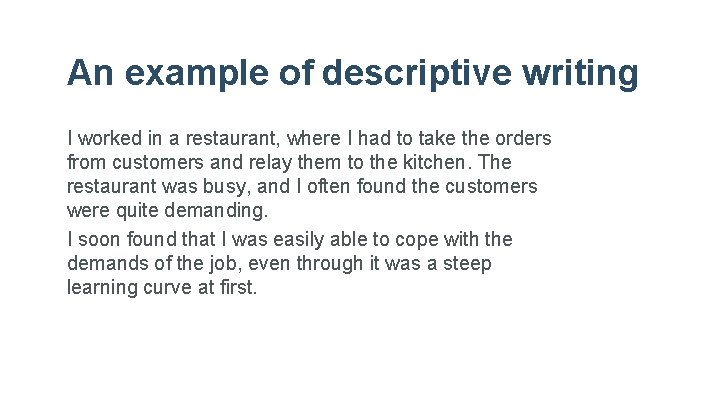
An example of descriptive writing I worked in a restaurant, where I had to take the orders from customers and relay them to the kitchen. The restaurant was busy, and I often found the customers were quite demanding. I soon found that I was easily able to cope with the demands of the job, even through it was a steep learning curve at first.
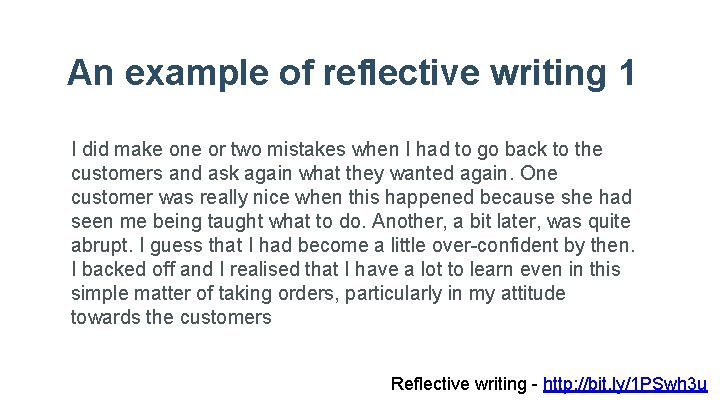
An example of reflective writing 1 I did make one or two mistakes when I had to go back to the customers and ask again what they wanted again. One customer was really nice when this happened because she had seen me being taught what to do. Another, a bit later, was quite abrupt. I guess that I had become a little over-confident by then. I backed off and I realised that I have a lot to learn even in this simple matter of taking orders, particularly in my attitude towards the customers Reflective writing - http: //bit. ly/1 PSwh 3 u
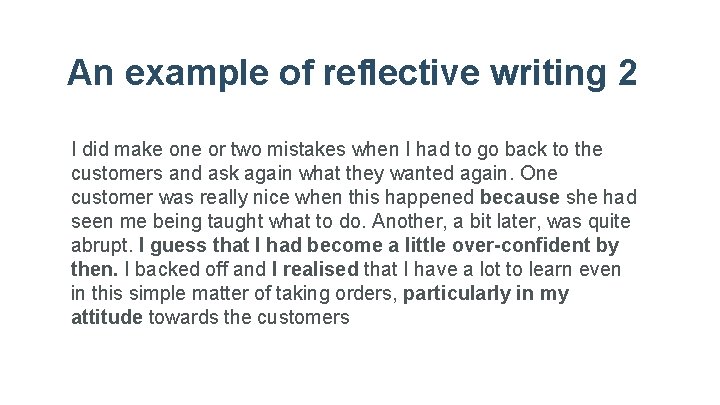
An example of reflective writing 2 I did make one or two mistakes when I had to go back to the customers and ask again what they wanted again. One customer was really nice when this happened because she had seen me being taught what to do. Another, a bit later, was quite abrupt. I guess that I had become a little over-confident by then. I backed off and I realised that I have a lot to learn even in this simple matter of taking orders, particularly in my attitude towards the customers
Further examples 1 This has taught me that I can only take responsibility for myself and that I cannot hold myself accountable for other people’s lack of responsibility to themselves and their team. My major shortcoming was believing that I could motivate people who were unwilling to be motivated.
Further examples 2 The concept that you get out what you put into something has been reasserted as a result of this experience; this is easily demonstrated by the correlation between low attendance and people who claim to have not benefited. Having attended every session I have gained knowledge that not only benefited me in the project but has helped me in a greater sense.
Further examples 3 Whilst I have always recognised the importance of being multidimensional, and not someone just interested in science, it is something that I have been guilty of losing sight of when I am absorbed in the course, being reminded of this has immeasurable value.
Effective reflective writing 1 • The only descriptive element may be a short introductory section that sets the scene. • The writer will have used evidence to back up or provide counterpoints to their analysis and critique • The writer will have examined their responses • The writer will have begun to stand back from the issue under consideration and to critically evaluate both their own and others’ reactions. Courtesy of University of Birmingham
Effective reflective writing 2 • The writer will have critiqued and commented on their own and others’ behaviour, shown their awareness of the influence of prior experience, and considered the influence of alternative perspectives. • The writer will have identified areas for further development and acknowledged the need for additional learning. Courtesy of University of Birmingham
What you gain • • • Make connections between past experiences Clarification of what you are learning during particular activities Reflect on mistakes and successes that you can take forward To become an active and self-aware learner To become a reflective practitioner and continue this throughout your professional life
Considering skills • Use the skills audit to consider your own skills • What are your levels of – Experience – Confidence • How has this course changed your perceptions?
Skills for SMEs • From what you have learned during this course, what do you think are the key skills and attributes for working in an SME? • How do these skills compare to your own skill set?
Finally • Further information and support is available in the handbook • Library books on emotional intelligence may be helpful • Don’t forget to think about this session when you are writing your reflections.
Copyright information This resource “new name”, is a derivative of “RSC reflective writing” by The Royal Society of Chemistry used under CC-BY-NC-SA 4. 0. “new name” is licensed under CC-BY-NC-SA 4. 0 by “name of user”.