Chapter Three 3 1 Secondary Data vs Primary



- Slides: 14
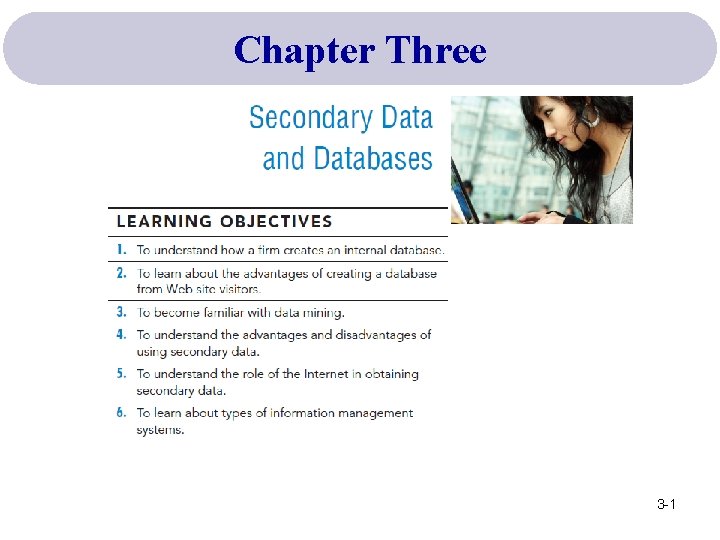
Chapter Three 3 -1
Secondary Data vs. Primary Data Secondary Data: • Data that have been gathered previously. Primary Data: • New data gathered to help solve the problem under investigation. Key Terms & Definitions 3 -2
Advantages of Secondary Data • Can help to clarify or refine the issue or problem • Might provide a solution to a research problem • Might provide primary data research alternatives • Can alert the researcher to other problems • Provides background information enhancing research credibility • Usually less expensive and faster to gather Key Terms & Definitions 3 -3
Disadvantages of Secondary Data • Lack of Availability • Might not be any available data on your topic • Lack of Relevance • Data might be outdated • Inaccuracy • Might be biased--intentionally or unintentionally • Questionable source • Insufficiency • Not enough information exists Key Terms & Definitions 3 -4
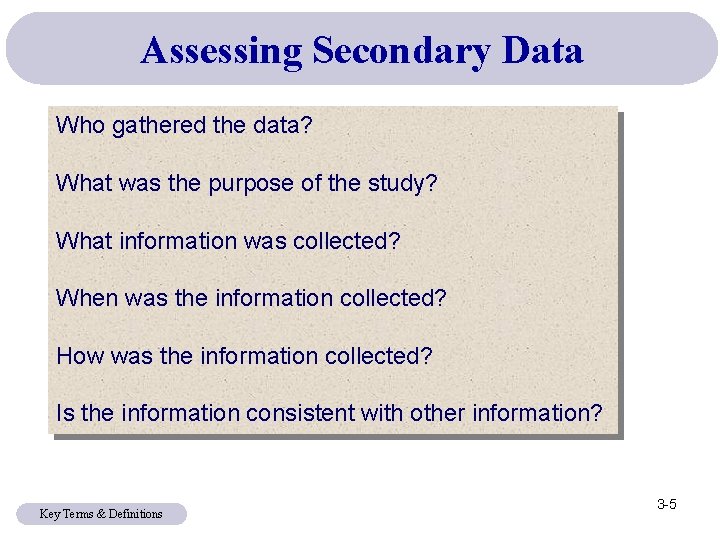
Assessing Secondary Data Who gathered the data? What was the purpose of the study? What information was collected? When was the information collected? How was the information collected? Is the information consistent with other information? Key Terms & Definitions 3 -5
Internal Databases Internal Database: • A collection of related information developed from data within the organization. Database Marketing: • Marketing that relies on the creation of a large computerized file of customers’ and potential customers’ profiles and purchase patterns to create a targeted marketing mix. Key Terms & Definitions 3 -6
Internal Databases Continued Some Key Features: • Creation of large, up-to-date, computerized file • Can include current, past, or potential customers • Might be focused on demographic/purchase behaviors • Development of customer profile results • Should enable one to generate direct marketing mailers /e-mails targeted at specific customers based on their buying behavior • Can be used to collect customer information from your website • Should be organized to enable you to search the database using queries • Should be compatible with database software that will enhance analysis Key Terms & Definitions 3 -7
Internal Databases Continued Neutral Network: • A computer program that mimics the processes of the human brain and thus is capable of learning from examples to find patterns in data. Data Mining: • The use of statistical and other advanced software to discover nonobvious patterns hidden in a database. • Some applications include: • Customer acquisition • Customer retention • Customer abandonment • Market basket analysis Key Terms & Definitions 3 -8
Internal Databases Continued Potential Uses in Marketing: • • Key Terms & Definitions Customer acquisition Customer retention Customer abandonment Market basket analysis 3 -9
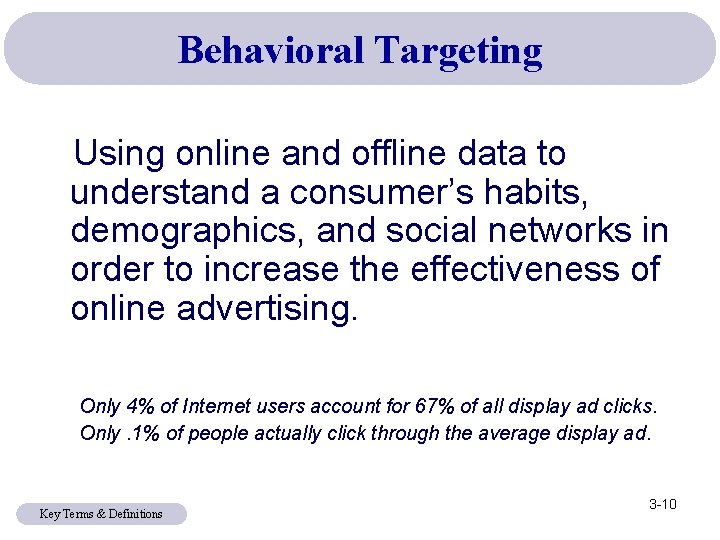
Behavioral Targeting Using online and offline data to understand a consumer’s habits, demographics, and social networks in order to increase the effectiveness of online advertising. Only 4% of Internet users account for 67% of all display ad clicks. Only. 1% of people actually click through the average display ad. Key Terms & Definitions 3 -10
Marketing Research Aggregators A company that acquires, catalogues, reformats, segments, and resells reports already published by large and small marketing research firms. Key Terms & Definitions 3 -11
Battle for Privacy Identity Theft and Government Action Federal Laws: • Gramm-Leach-Bliley Act (Financial Services Act) • Health Insurance Portability and Accountability Act • The Fair Credit Reporting Act (FCRA) • The Children’s Online Privacy Protection Act (COPPA) State Laws: • California’s Notice of Security Breach Law A Possible Problem: Getting paid to give up your privacy--How much money would it take to get you to give up your privacy? Key Terms & Definitions 3 -13
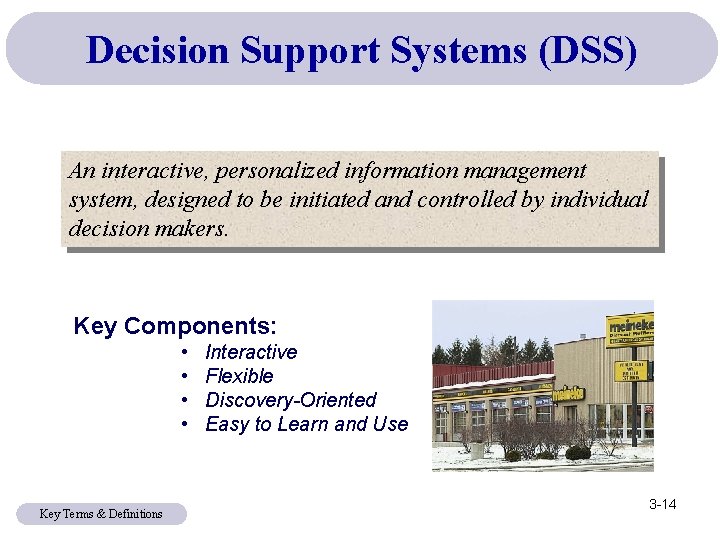
Decision Support Systems (DSS) An interactive, personalized information management system, designed to be initiated and controlled by individual decision makers. Key Components: • • Key Terms & Definitions Interactive Flexible Discovery-Oriented Easy to Learn and Use 3 -14
Key Terms & Definitions • Secondary Data • Primary Data • Advantages of Secondary Data • Disadvantages of Secondary Data • Secondary Data Limitations • Internal Database • Database Marketing • Battle For Privacy • Neural Network • Data Mining • Marketing Research Aggregator • Decision Support System (DSS) • Behavioral Targeting Links and Key Terms & Definitions button are active when in “Slide Show Mode” 3 -15