
Year 9 10 GCSE Preparation Natural Hazards Tectonics

- Slides: 7
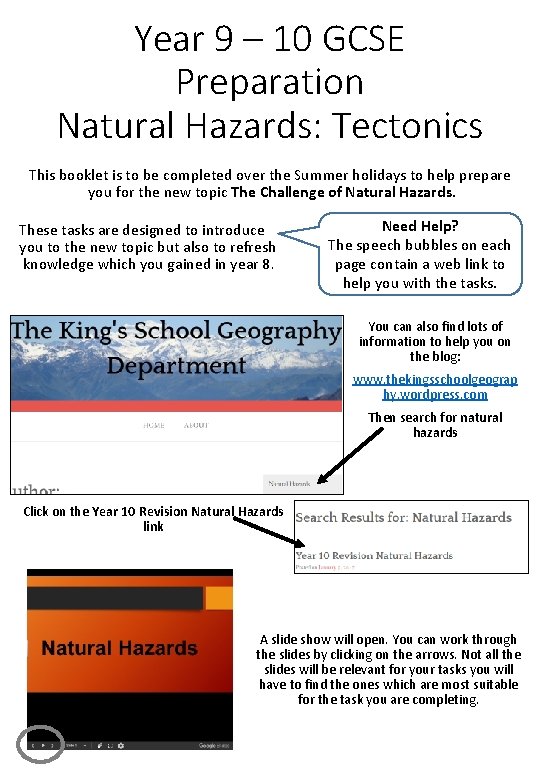
Year 9 – 10 GCSE Preparation Natural Hazards: Tectonics This booklet is to be completed over the Summer holidays to help prepare you for the new topic The Challenge of Natural Hazards. These tasks are designed to introduce you to the new topic but also to refresh knowledge which you gained in year 8. Need Help? The speech bubbles on each page contain a web link to help you with the tasks. You can also find lots of information to help you on the blog: www. thekingsschoolgeograp hy. wordpress. com Then search for natural hazards Click on the Year 10 Revision Natural Hazards link A slide show will open. You can work through the slides by clicking on the arrows. Not all the slides will be relevant for your tasks you will have to find the ones which are most suitable for the task you are completing.
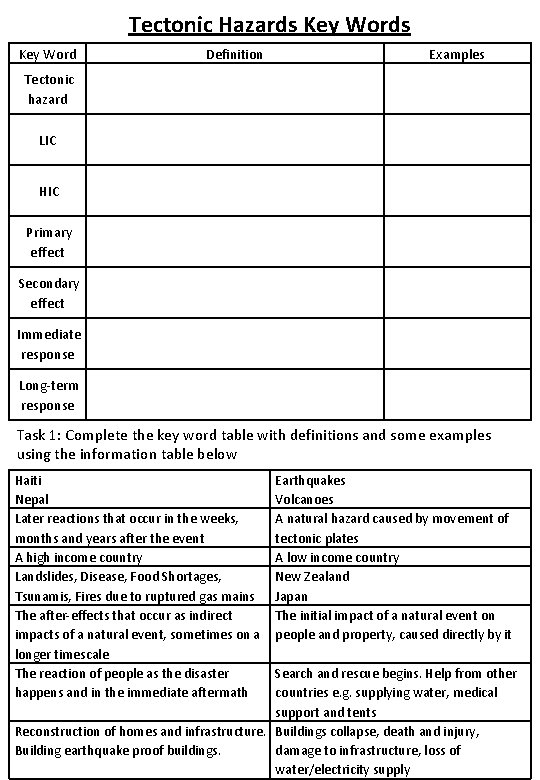
Tectonic Hazards Key Word Definition Tectonic hazard Examples LIC HIC Primary effect Secondary effect Immediate response Long-term response Task 1: Complete the key word table with definitions and some examples using the information table below Haiti Nepal Later reactions that occur in the weeks, months and years after the event A high income country Landslides, Disease, Food Shortages, Tsunamis, Fires due to ruptured gas mains The after-effects that occur as indirect impacts of a natural event, sometimes on a longer timescale The reaction of people as the disaster happens and in the immediate aftermath Earthquakes Volcanoes A natural hazard caused by movement of tectonic plates A low income country New Zealand Japan The initial impact of a natural event on people and property, caused directly by it Search and rescue begins. Help from other countries e. g. supplying water, medical support and tents Reconstruction of homes and infrastructure. Buildings collapse, death and injury, Building earthquake proof buildings. damage to infrastructure, loss of water/electricity supply
Task 2: Describe the distribution of tectonic hazards shown in the map below. _________________________________________________________________ _________________________________________________________________ Remember Trend Evidence Anomaly Why do plates move? Task 3: Use the diagram to help you explain why the plates move. ________________________________________________________________ Need Help? https: //handygeography. wordpress. ________________________________ com/gcse/the-restless-earth-revision ________________________________ -materials/plate-tectonics/ _______________________________
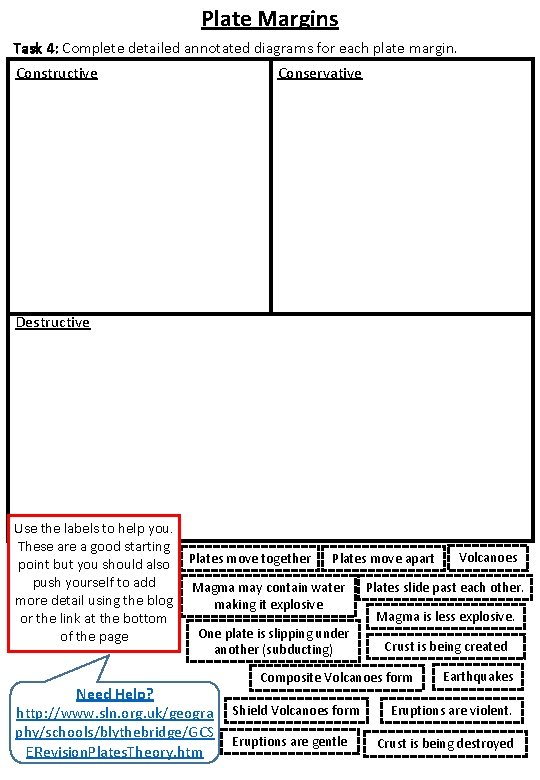
Plate Margins Task 4: Complete detailed annotated diagrams for each plate margin. Constructive Conservative Destructive Use the labels to help you. These are a good starting point but you should also push yourself to add more detail using the blog or the link at the bottom of the page Plates move together Plates move apart Magma may contain water making it explosive One plate is slipping under another (subducting) Need Help? http: //www. sln. org. uk/geogra phy/schools/blythebridge/GCS ERevision. Plates. Theory. htm Plates slide past each other. Magma is less explosive. Crust is being created Composite Volcanoes form Shield Volcanoes form Eruptions are gentle Volcanoes Earthquakes Eruptions are violent. Crust is being destroyed
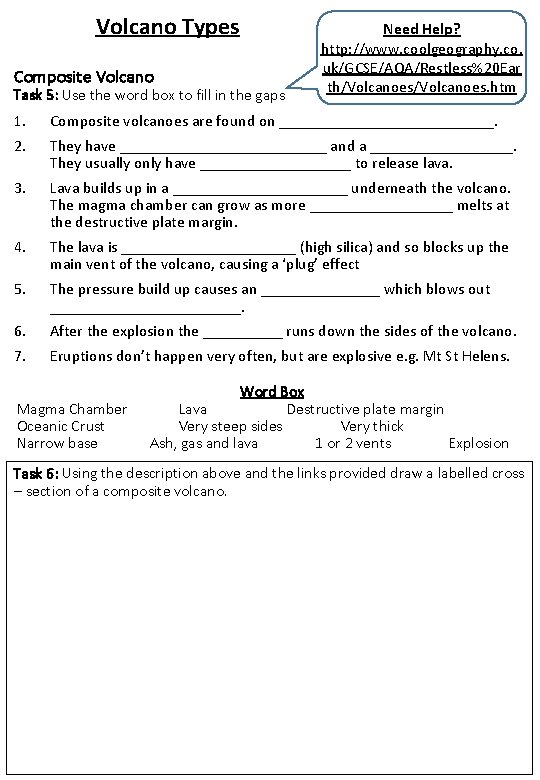
Volcano Types Composite Volcano Task 5: Use the word box to fill in the gaps Need Help? http: //www. coolgeography. co. uk/GCSE/AQA/Restless%20 Ear th/Volcanoes. htm 1. Composite volcanoes are found on ______________. 2. They have _____________ and a _________. They usually only have __________ to release lava. 3. Lava builds up in a ___________ underneath the volcano. The magma chamber can grow as more _________ melts at the destructive plate margin. 4. The lava is ___________ (high silica) and so blocks up the main vent of the volcano, causing a ‘plug’ effect 5. The pressure build up causes an ________ which blows out ____________. 6. After the explosion the _____ runs down the sides of the volcano. 7. Eruptions don’t happen very often, but are explosive e. g. Mt St Helens. Magma Chamber Oceanic Crust Narrow base Word Box Lava Destructive plate margin Very steep sides Very thick Ash, gas and lava 1 or 2 vents Explosion Task 6: Using the description above and the links provided draw a labelled cross – section of a composite volcano.
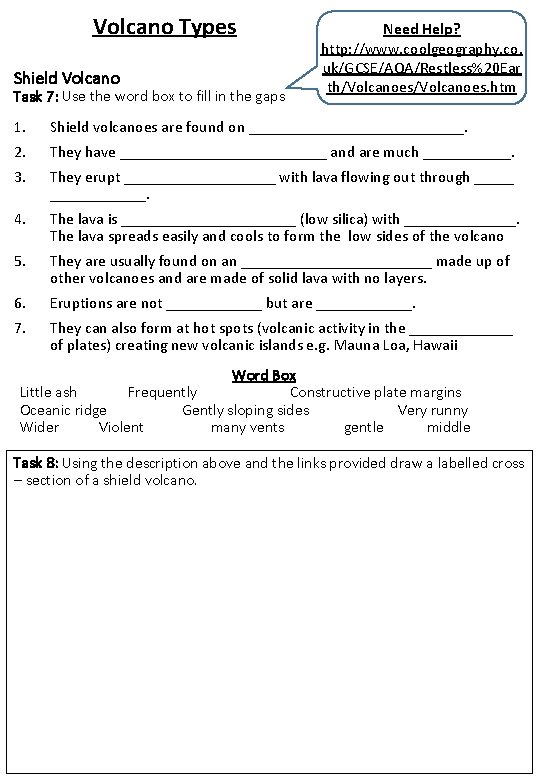
Volcano Types Shield Volcano Task 7: Use the word box to fill in the gaps Need Help? http: //www. coolgeography. co. uk/GCSE/AQA/Restless%20 Ear th/Volcanoes. htm 1. Shield volcanoes are found on ______________. 2. They have _____________ and are much ______. 3. They erupt __________ with lava flowing out through ____________. 4. The lava is ___________ (low silica) with _______. The lava spreads easily and cools to form the low sides of the volcano 5. They are usually found on an ____________ made up of other volcanoes and are made of solid lava with no layers. 6. Eruptions are not ______ but are ______. 7. They can also form at hot spots (volcanic activity in the _______ of plates) creating new volcanic islands e. g. Mauna Loa, Hawaii Word Box Little ash Frequently Constructive plate margins Oceanic ridge Gently sloping sides Very runny Wider Violent many vents gentle middle Task 8: Using the description above and the links provided draw a labelled cross – section of a shield volcano.
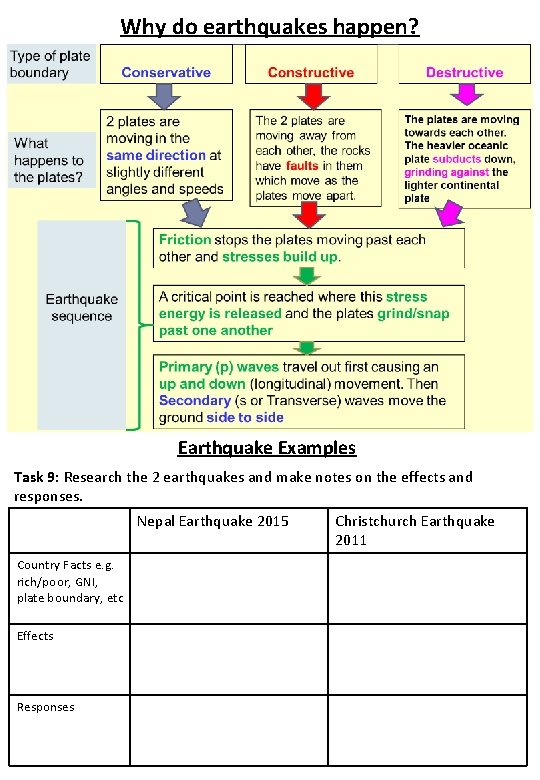
Why do earthquakes happen? Earthquake Examples Task 9: Research the 2 earthquakes and make notes on the effects and responses. Nepal Earthquake 2015 Country Facts e. g. rich/poor, GNI, plate boundary, etc Effects Responses Christchurch Earthquake 2011