Chapter Eleven Pricing Strategies Copyright 2009 Pearson Education
- Slides: 18
Chapter Eleven Pricing Strategies Copyright © 2009 Pearson Education, Inc. Publishing as Prentice Hall Chapter 11 - slide
Pricing Strategies Topic Outline • • New-Product Pricing Strategies Product Mix Pricing Strategies Price Adjustment Strategies Price Changes Copyright © 2010 Pearson Education, Inc. Publishing as Prentice Hall Chapter 11 - slide 2
New-Product Pricing Strategies • Market-skimming pricing • Marketpenetration pricing Copyright © 2010 Pearson Education, Inc. Publishing as Prentice Hall Chapter 11 - slide 3
New-Product Pricing Strategies Market-skimming pricing is a strategy with high initial prices to “skim” revenue layers from the market • Product quality and image must support the price • Buyers must want the product at the price • Costs of producing the product in small volume should not cancel the advantage of higher prices • Competitors should not be able to enter the market easily Copyright © 2010 Pearson Education, Inc. Publishing as Prentice Hall Chapter 11 - slide 4
New-Product Pricing Strategies Market-penetration pricing sets a low initial price in order to penetrate the market quickly and deeply to attract a large number of buyers quickly to gain market share • Price sensitive market • Inverse relationship of production and distribution cost to sales growth • Low prices must keep competition out of the market Copyright © 2010 Pearson Education, Inc. Publishing as Prentice Hall Chapter 11 - slide 5
Product Mix Pricing Strategies Product line pricing takes into account the cost differences between products in the line, customer evaluation of their features, and competitors’ prices Optional-product pricing takes into account optional or accessory products along with the main product Copyright © 2010 Pearson Education, Inc. Publishing as Prentice Hall Chapter 11 - slide 6
Product Mix Pricing Strategies Captive-product pricing involves products that must be used along with the main product Two-part pricing involves breaking the price into: – Fixed fee – Variable usage fee Copyright © 2010 Pearson Education, Inc. Publishing as Prentice Hall Chapter 11 - slide 7
Price Mix Pricing Strategies By-product pricing refers to products with little or no value produced as a result of the main product. Producers will seek little or no profit other than the cost to cover storage and delivery. Copyright © 2010 Pearson Education, Inc. Publishing as Prentice Hall Chapter 11 - slide 8
Price Mix Pricing Strategies Product bundle pricing combines several products at a reduced price Copyright © 2010 Pearson Education, Inc. Publishing as Prentice Hall Chapter 11 - slide 9
Price-Adjustment Strategies Pricing Strategies Discount and allowance pricing reduces prices to reward customer responses such as paying early or promoting the product • Discounts • Allowances Copyright © 2010 Pearson Education, Inc. Publishing as Prentice Hall Chapter 11 - slide 10
Price-Adjustment Strategies Pricing Strategies Segmented pricing is used when a company sells a product at two or more prices even though the difference is not based on cost Copyright © 2010 Pearson Education, Inc. Publishing as Prentice Hall Chapter 11 - slide 11
Price-Adjustment Strategies Pricing Strategies Segmented Pricing To be effective: • Market must be segmentable • Segments must show different degrees of demand • Watching the market cannot exceed the extra revenue obtained from the price difference • Must be legal Copyright © 2010 Pearson Education, Inc. Publishing as Prentice Hall Chapter 11 - slide 12
Price-Adjustment Strategies Pricing Strategies Psychological pricing occurs when sellers consider the psychology of prices and not simply the economics Reference prices are prices that buyers carry in their minds and refer to when looking at a given product – Noting current prices – Remembering past prices – Assessing the buying situations Copyright © 2010 Pearson Education, Inc. Publishing as Prentice Hall Chapter 11 - slide 13
Price-Adjustment Strategies Pricing Strategies Promotional pricing is when prices are temporarily priced below list price or cost to increase demand • Loss leaders • Special event pricing • Cash rebates • Low-interest financing • Longer warrantees • Free maintenance Copyright © 2010 Pearson Education, Inc. Publishing as Prentice Hall Chapter 11 - slide 14
Price-Adjustment Strategies Pricing Strategies Risks of promotional pricing • Used too frequently, and copies by competitors can create “deal-prone” customers who will wait for promotions and avoid buying at regular price • Creates price wars Copyright © 2010 Pearson Education, Inc. Publishing as Prentice Hall Chapter 11 - slide 15
Price Changes Initiating Pricing Changes Price cuts occur due to: • Excess capacity • Increased market share Price increase from: • Cost inflation • Increased demand • Lack of supply Copyright © 2010 Pearson Education, Inc. Publishing as Prentice Hall Chapter 11 - slide 16
Price Changes Responding to Price Changes Questions – Why did the competitor change the price? – Is the price cut permanent or temporary? – What is the effect on market share and profits? – Will competitors respond? Copyright © 2010 Pearson Education, Inc. Publishing as Prentice Hall Chapter 11 - slide 17
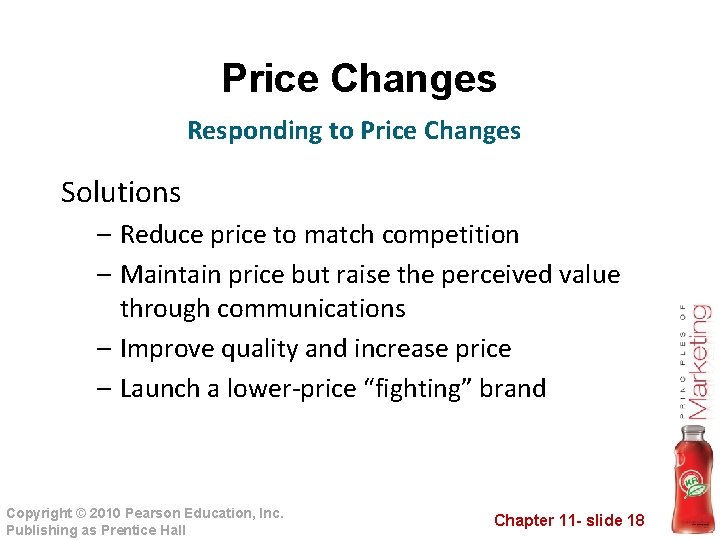
Price Changes Responding to Price Changes Solutions – Reduce price to match competition – Maintain price but raise the perceived value through communications – Improve quality and increase price – Launch a lower-price “fighting” brand Copyright © 2010 Pearson Education, Inc. Publishing as Prentice Hall Chapter 11 - slide 18