Chapter 8 Reporting and Interpreting Property Plant and


- Slides: 38
Chapter 8 – Reporting and Interpreting Property, Plant, and Equipment; Intangibles; and Natural Resources Click on links Exercise 8 -1 Preparing a Classified Balance Sheet Exercise 8 -1 Exercise 8 -3 Computing and Recording Cost and Depreciation of Assets (Straight. Line Depreciation) Exercise 8 -3 Exercise 8 -5 Recording Depreciation and Repairs (Straight-Line Depreciation) Exercise 8 -5 Exercise 8 -6 Determining Financial Statement Effects of Depreciation and Repairs (Straight-Line Depreciation) Exercise 8 -6 Exercise 8 -12 Inferring Asset Impairment and Recording Disposal of an Asset Exercise 8 -12 Exercise 8 -13 Recording the Disposal of an Asset at Three Different Sale Prices Exercise 8 -13 Exercise 8 -14 Recording the Disposal of an Asset at Three Different Sale Prices Exercise 8 -14 Exercise 8 -17 Computing and Reporting the Acquisition and Amortization of Three Different Intangible Assets Exercise 8 -17 Exercise 8 -19 Recording Leasehold Improvements and Related Amortization Exercise 8 -19 Exercise 8 -21 Recording a Change in Estimate Exercise 8 -21 Copyright © 2015 Mc. Graw-Hill Education. All rights reserved. No reproduction or distribution without the prior written consent of Mc. Graw-Hill Education.
Exercise 8 -1
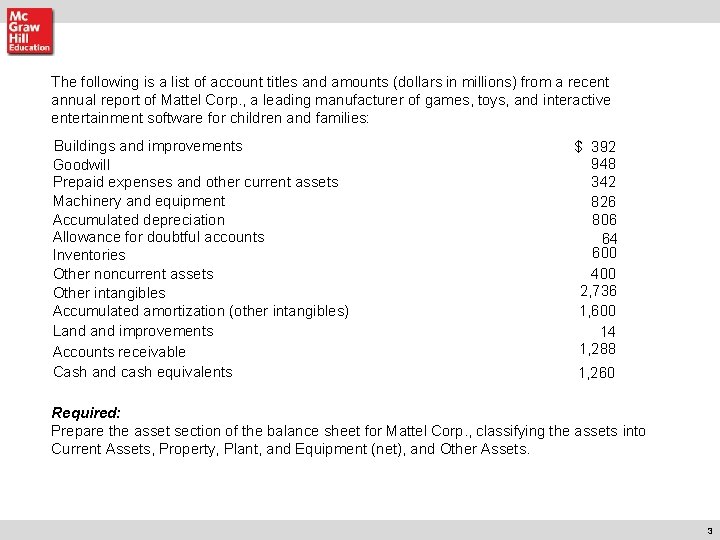
The following is a list of account titles and amounts (dollars in millions) from a recent annual report of Mattel Corp. , a leading manufacturer of games, toys, and interactive entertainment software for children and families: Buildings and improvements Goodwill Prepaid expenses and other current assets Machinery and equipment Accumulated depreciation Allowance for doubtful accounts Inventories Other noncurrent assets Other intangibles Accumulated amortization (other intangibles) Land improvements Accounts receivable Cash and cash equivalents $ 392 948 342 826 806 64 600 400 2, 736 1, 600 14 1, 288 1, 260 Required: Prepare the asset section of the balance sheet for Mattel Corp. , classifying the assets into Current Assets, Property, Plant, and Equipment (net), and Other Assets. 3
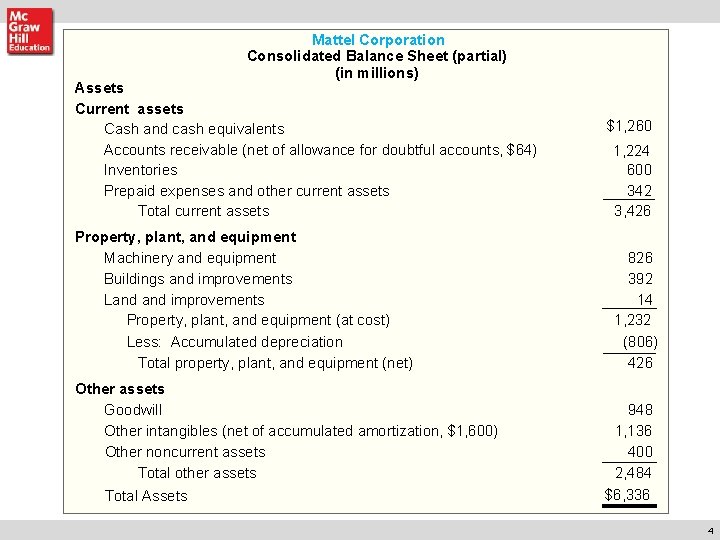
Mattel Corporation Consolidated Balance Sheet (partial) (in millions) Assets Current assets Cash and cash equivalents Accounts receivable (net of allowance for doubtful accounts, $64) Inventories Prepaid expenses and other current assets Total current assets Property, plant, and equipment Machinery and equipment Buildings and improvements Land improvements Property, plant, and equipment (at cost) Less: Accumulated depreciation Total property, plant, and equipment (net) Other assets Goodwill Other intangibles (net of accumulated amortization, $1, 600) Other noncurrent assets Total other assets Total Assets $1, 260 1, 224 600 342 3, 426 826 392 14 1, 232 (806) 426 948 1, 136 400 2, 484 $6, 336 4
Exercise 8 -3
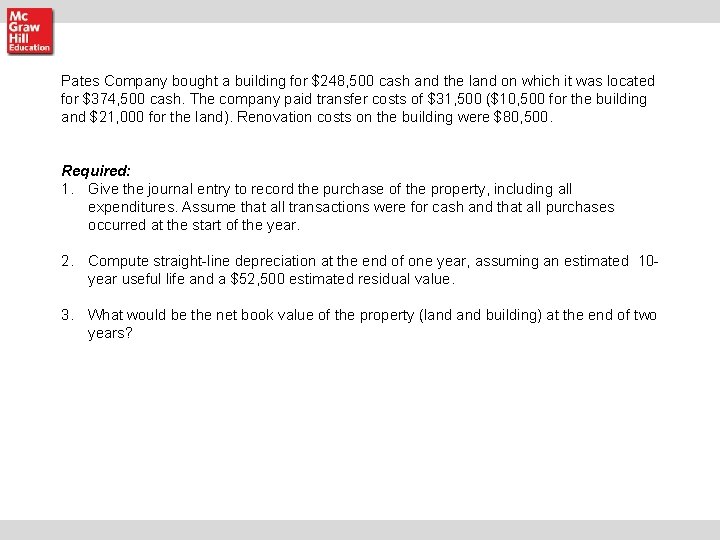
Pates Company bought a building for $248, 500 cash and the land on which it was located for $374, 500 cash. The company paid transfer costs of $31, 500 ($10, 500 for the building and $21, 000 for the land). Renovation costs on the building were $80, 500. Required: 1. Give the journal entry to record the purchase of the property, including all expenditures. Assume that all transactions were for cash and that all purchases occurred at the start of the year. 2. Compute straight-line depreciation at the end of one year, assuming an estimated 10 year useful life and a $52, 500 estimated residual value. 3. What would be the net book value of the property (land building) at the end of two years?
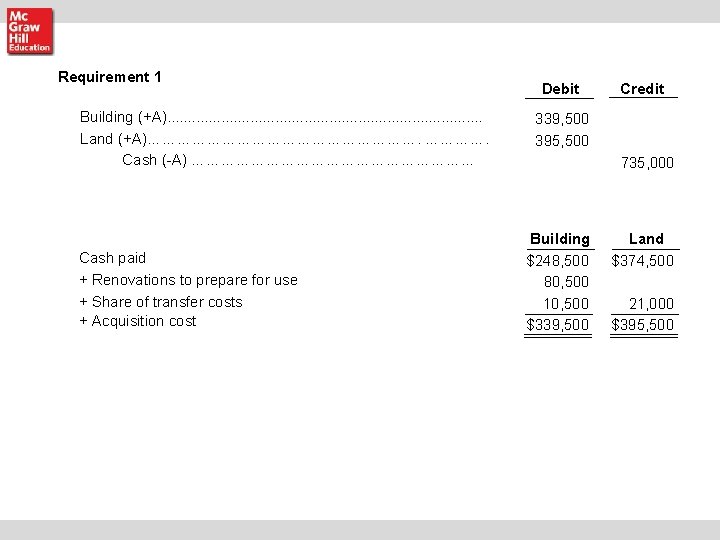
Requirement 1 Building (+A). . . . . Land (+A)………………………. Cash (-A) ………………………… Cash paid + Renovations to prepare for use + Share of transfer costs + Acquisition cost Debit Credit 339, 500 395, 500 735, 000 Building $248, 500 80, 500 10, 500 $339, 500 Land $374, 500 21, 000 $395, 500
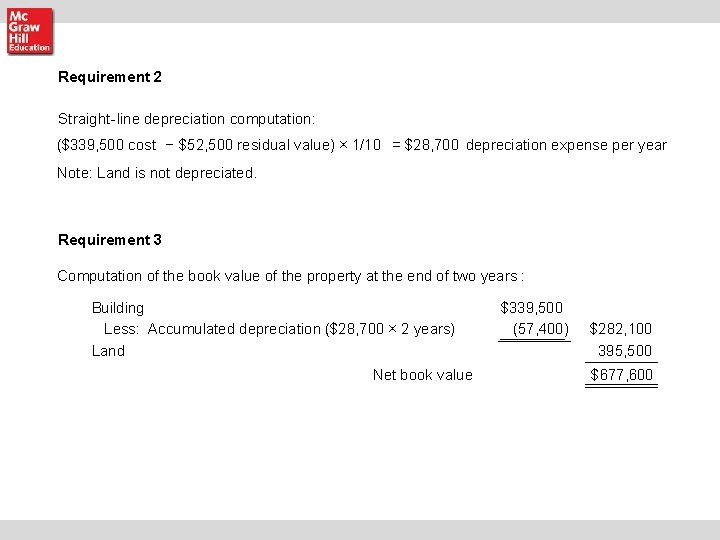
Requirement 2 Straight-line depreciation computation: ($339, 500 cost − $52, 500 residual value) × 1/10 = $28, 700 depreciation expense per year Note: Land is not depreciated. Requirement 3 Computation of the book value of the property at the end of two years : Building Less: Accumulated depreciation ($28, 700 × 2 years) Land Net book value $339, 500 (57, 400) $282, 100 395, 500 $677, 600
Exercise 8 -5
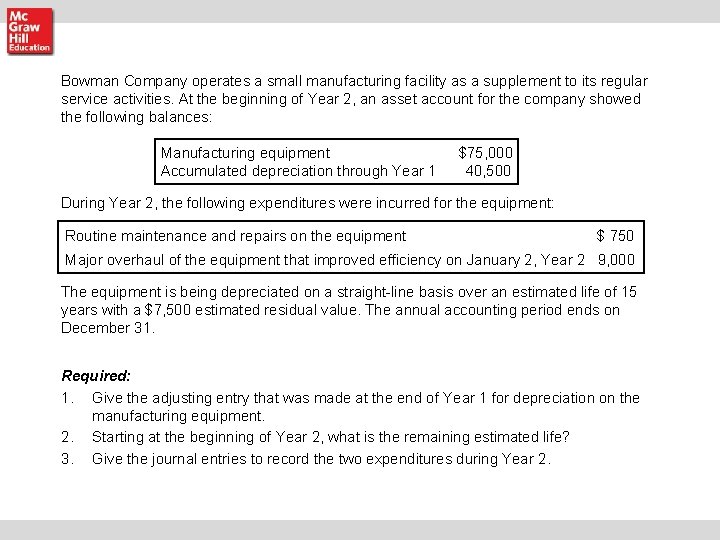
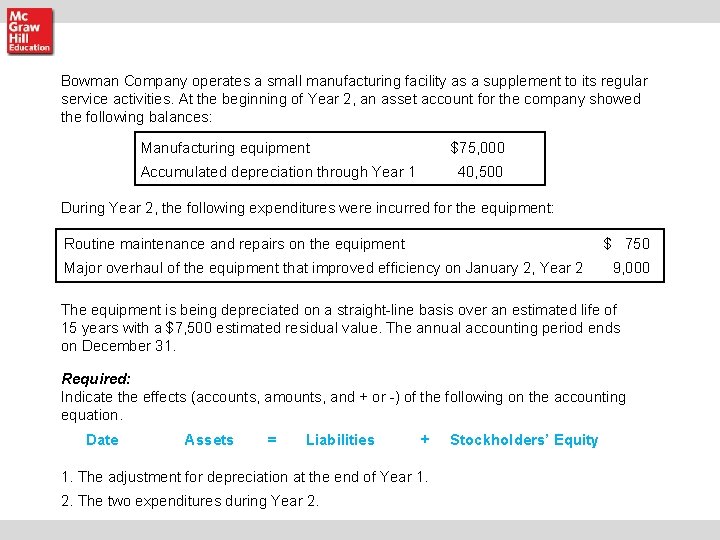
Bowman Company operates a small manufacturing facility as a supplement to its regular service activities. At the beginning of Year 2, an asset account for the company showed the following balances: Manufacturing equipment Accumulated depreciation through Year 1 $75, 000 40, 500 During Year 2, the following expenditures were incurred for the equipment: Routine maintenance and repairs on the equipment $ 750 Major overhaul of the equipment that improved efficiency on January 2, Year 2 9, 000 The equipment is being depreciated on a straight-line basis over an estimated life of 15 years with a $7, 500 estimated residual value. The annual accounting period ends on December 31. Required: 1. Give the adjusting entry that was made at the end of Year 1 for depreciation on the manufacturing equipment. 2. Starting at the beginning of Year 2, what is the remaining estimated life? 3. Give the journal entries to record the two expenditures during Year 2.
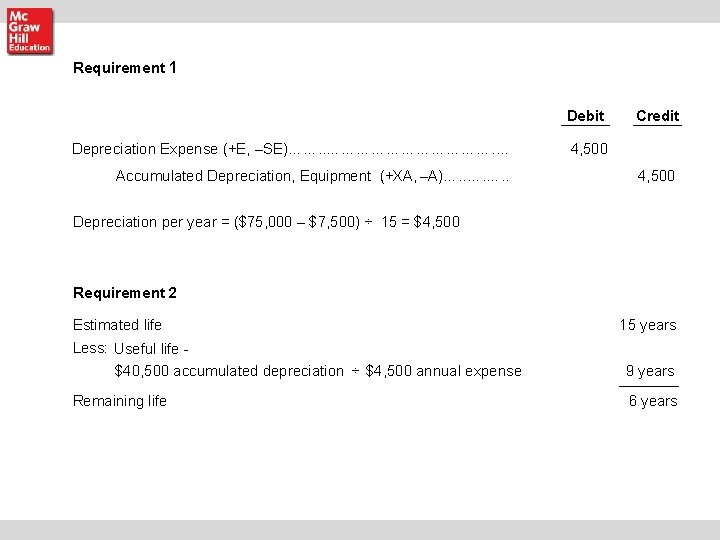
Requirement 1 Debit Depreciation Expense (+E, –SE)……. . ………………. . Accumulated Depreciation, Equipment (+XA, –A)…. . …. …. . Credit 4, 500 Depreciation per year = ($75, 000 – $7, 500) ÷ 15 = $4, 500 Requirement 2 Estimated life 15 years Less: Useful life $40, 500 accumulated depreciation ÷ $4, 500 annual expense 9 years Remaining life 6 years
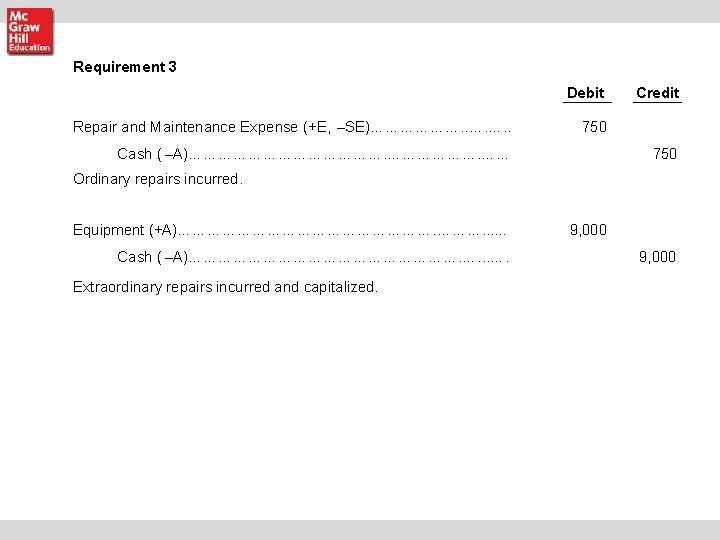
Requirement 3 Debit Repair and Maintenance Expense (+E, –SE)………………. . …. …. . Credit 750 Cash ( –A)…………………. …… 750 Ordinary repairs incurred. Equipment (+A)………………………. . . … Cash ( –A)………………………. …. Extraordinary repairs incurred and capitalized. 9, 000
Exercise 8 -6
Bowman Company operates a small manufacturing facility as a supplement to its regular service activities. At the beginning of Year 2, an asset account for the company showed the following balances: Manufacturing equipment $75, 000 Accumulated depreciation through Year 1 40, 500 During Year 2, the following expenditures were incurred for the equipment: Routine maintenance and repairs on the equipment $ 750 Major overhaul of the equipment that improved efficiency on January 2, Year 2 9, 000 The equipment is being depreciated on a straight-line basis over an estimated life of 15 years with a $7, 500 estimated residual value. The annual accounting period ends on December 31. Required: Indicate the effects (accounts, amounts, and + or -) of the following on the accounting equation. Date Assets = Liabilities + 1. The adjustment for depreciation at the end of Year 1. 2. The two expenditures during Year 2. Stockholders’ Equity
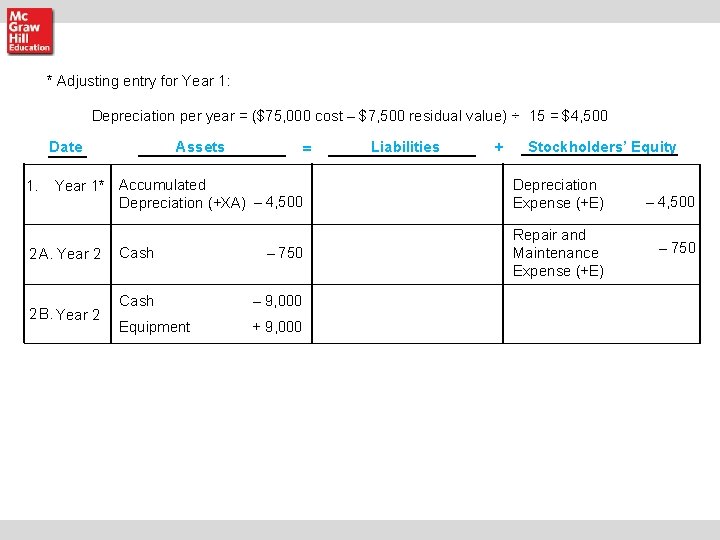
* Adjusting entry for Year 1: Depreciation per year = ($75, 000 cost – $7, 500 residual value) ÷ 15 = $4, 500 Date 1. Assets = Year 1* Accumulated Depreciation (+XA) – 4, 500 2 A. Year 2 2 B. Year 2 Cash – 750 Cash – 9, 000 Equipment + 9, 000 Liabilities + Stockholders’ Equity Depreciation Expense (+E) Repair and Maintenance Expense (+E) – 4, 500 – 750
Exercise 8 -12
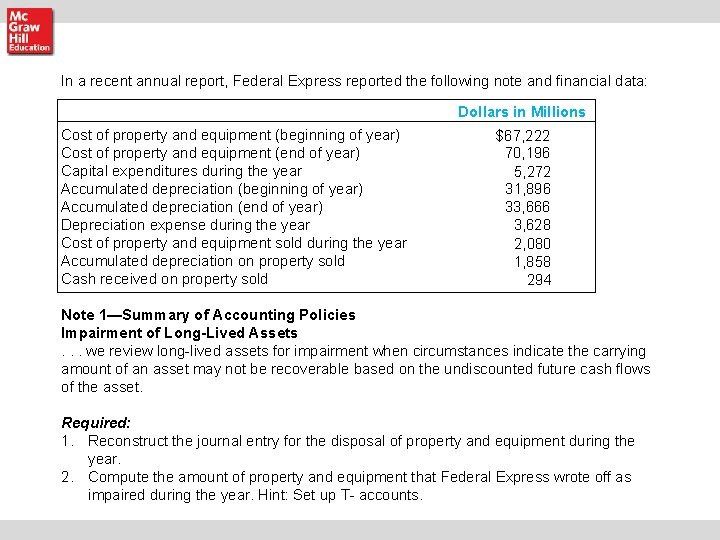
In a recent annual report, Federal Express reported the following note and financial data: . . . Cost of property and equipment (beginning of year) Cost of property and equipment (end of year) Capital expenditures during the year Accumulated depreciation (beginning of year) Accumulated depreciation (end of year) Depreciation expense during the year Cost of property and equipment sold during the year Accumulated depreciation on property sold Cash received on property sold Dollars in Millions $67, 222 70, 196 5, 272 31, 896 33, 666 3, 628 2, 080 1, 858 294 Note 1—Summary of Accounting Policies Impairment of Long-Lived Assets. . . we review long-lived assets for impairment when circumstances indicate the carrying amount of an asset may not be recoverable based on the undiscounted future cash flows of the asset. Required: 1. Reconstruct the journal entry for the disposal of property and equipment during the year. 2. Compute the amount of property and equipment that Federal Express wrote off as impaired during the year. Hint: Set up T- accounts.
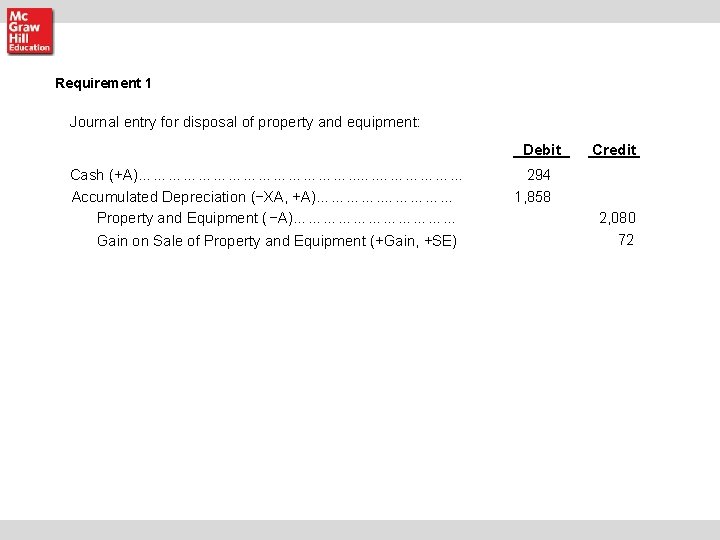
Requirement 1 Journal entry for disposal of property and equipment: Debit Cash (+A)…………………. . …. ……………… Accumulated Depreciation (−XA, +A)…………… Property and Equipment (−A)……………… Gain on Sale of Property and Equipment (+Gain, +SE) Credit 294 1, 858 2, 080 72
Requirement 2 Property, Plant, and Equipment Beg. Bal 67, 222 Capital 5, 272 expenditures End. Bal. 2, 080 Property sold 218 Write-offs 70, 196 Accumulated Depreciation Property sold 1, 858 31, 896 Beg. Bal. 3, 628 Depreciation expense 33, 666 End. Bal. Amount of property and equipment written off as impaired during the year: Beginning balance + Capital expenditures during year − Cost of property sold during year − Impairment loss during year Ending balance Impairment loss = $218 $67, 222 5, 272 (2, 080) (? ) $70, 196
Exercise 8 -13
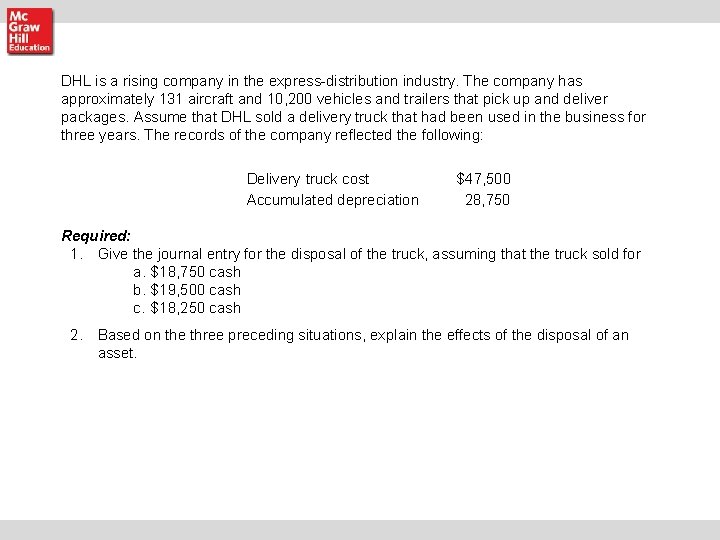
DHL is a rising company in the express-distribution industry. The company has approximately 131 aircraft and 10, 200 vehicles and trailers that pick up and deliver packages. Assume that DHL sold a delivery truck that had been used in the business for three years. The records of the company reflected the following: Delivery truck cost Accumulated depreciation $47, 500 28, 750 Required: 1. Give the journal entry for the disposal of the truck, assuming that the truck sold for a. $18, 750 cash b. $19, 500 cash c. $18, 250 cash 2. Based on the three preceding situations, explain the effects of the disposal of an asset.
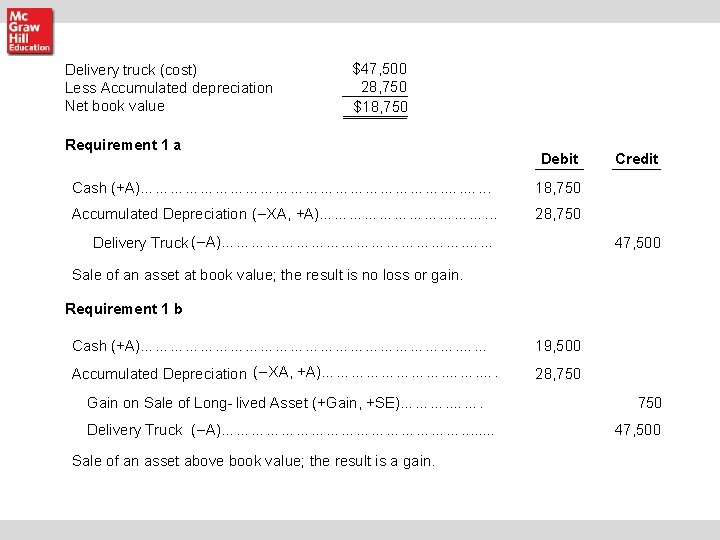
Delivery truck (cost) Less Accumulated depreciation Net book value $47, 500 28, 750 $18, 750 Requirement 1 a Debit Cash (+A)…………………………. …. …. . . 18, 750 Accumulated Depreciation (−XA, +A)………………. . . 28, 750 Delivery Truck (−A)……………………. …… Credit 47, 500 Sale of an asset at book value; the result is no loss or gain. Requirement 1 b Cash (+A)……………………………. …… 19, 500 Accumulated Depreciation (−XA, +A)…………. ……. …. 28, 750 Gain on Sale of Long- lived Asset (+Gain, +SE)………. Delivery Truck (−A)……………………. . . . Sale of an asset above book value; the result is a gain. 750 47, 500
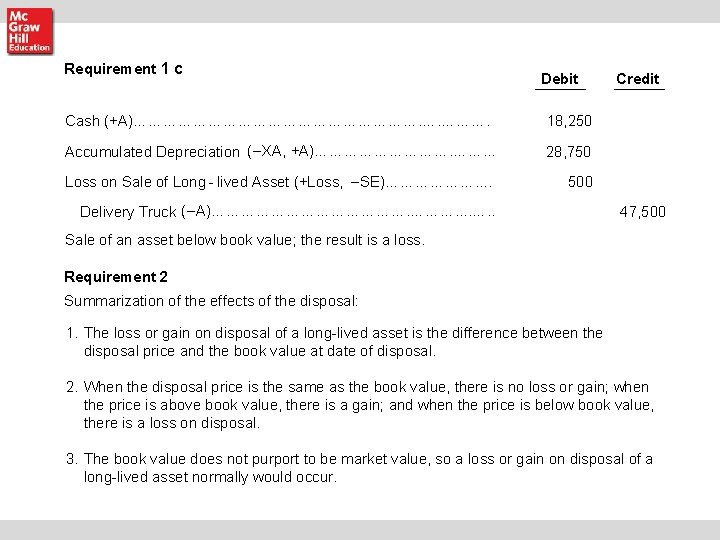
Requirement 1 c Debit Cash (+A)…………………………. …. ………. 18, 250 Accumulated Depreciation (−XA, +A)……………. ……… 28, 750 Loss on Sale of Long - lived Asset (+Loss, −SE)………………. . Credit 500 Delivery Truck (−A)…………………. . …. . 47, 500 Sale of an asset below book value; the result is a loss. Requirement 2 Summarization of the effects of the disposal: 1. The loss or gain on disposal of a long-lived asset is the difference between the disposal price and the book value at date of disposal. 2. When the disposal price is the same as the book value, there is no loss or gain; when the price is above book value, there is a gain; and when the price is below book value, there is a loss on disposal. 3. The book value does not purport to be market value, so a loss or gain on disposal of a long-lived asset normally would occur.
Exercise 8 -14
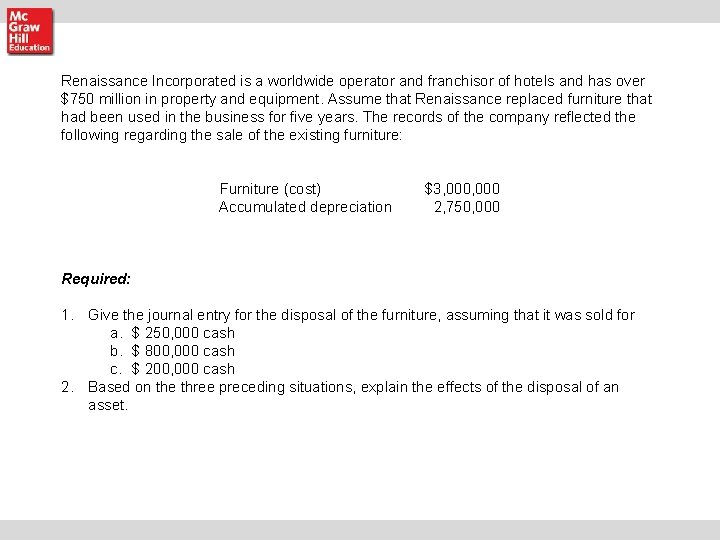
Renaissance Incorporated is a worldwide operator and franchisor of hotels and has over $750 million in property and equipment. Assume that Renaissance replaced furniture that had been used in the business for five years. The records of the company reflected the following regarding the sale of the existing furniture: Furniture (cost) Accumulated depreciation $3, 000 2, 750, 000 Required: 1. Give the journal entry for the disposal of the furniture, assuming that it was sold for a. $ 250, 000 cash b. $ 800, 000 cash c. $ 200, 000 cash 2. Based on the three preceding situations, explain the effects of the disposal of an asset.
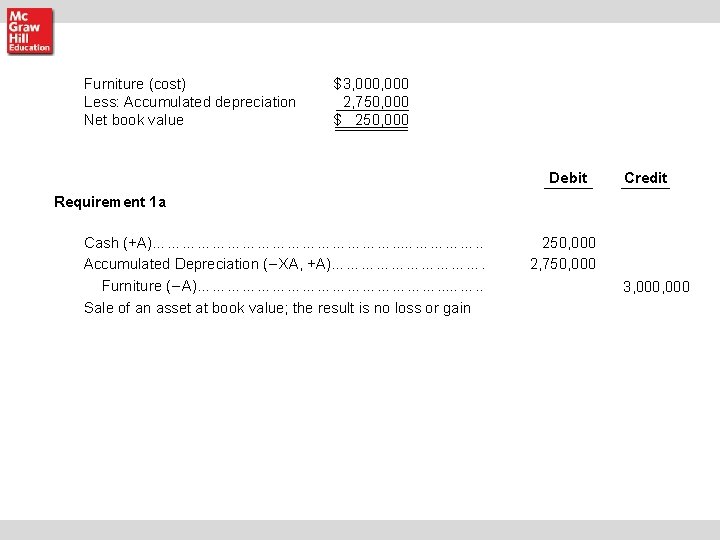
Furniture (cost) Less: Accumulated depreciation Net book value $3, 000 2, 750, 000 $ 250, 000 Debit Credit Requirement 1 a Cash (+A)……………………. . Accumulated Depreciation (−XA, +A)……………. Furniture (−A)……………………. . Sale of an asset at book value; the result is no loss or gain 250, 000 2, 750, 000 3, 000
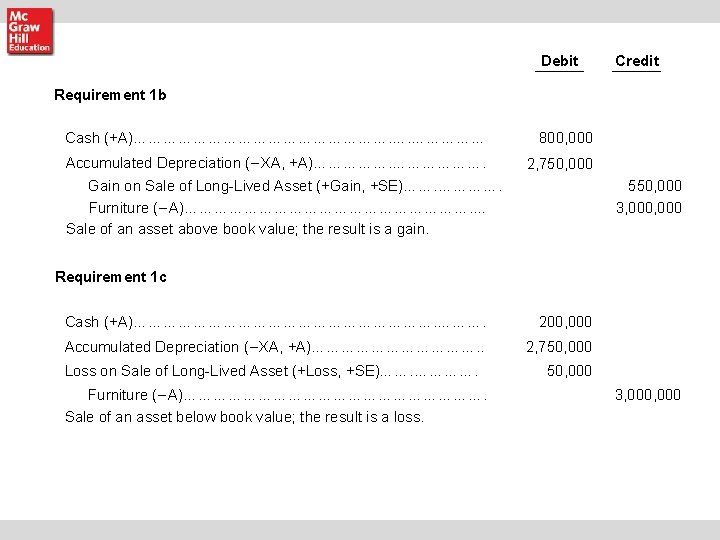
Debit Credit Requirement 1 b Cash (+A)………………………. …. …………… 800, 000 Accumulated Depreciation (−XA, +A)………………. 2, 750, 000 Gain on Sale of Long-Lived Asset (+Gain, +SE)……. …………. Furniture (−A)…………………………. . Sale of an asset above book value; the result is a gain. 550, 000 3, 000 Requirement 1 c Cash (+A)…………………………. 200, 000 Accumulated Depreciation (−XA, +A)………………. . 2, 750, 000 Loss on Sale of Long-Lived Asset (+Loss, +SE)……. …………. Furniture (−A)…………………………. Sale of an asset below book value; the result is a loss. 50, 000 3, 000
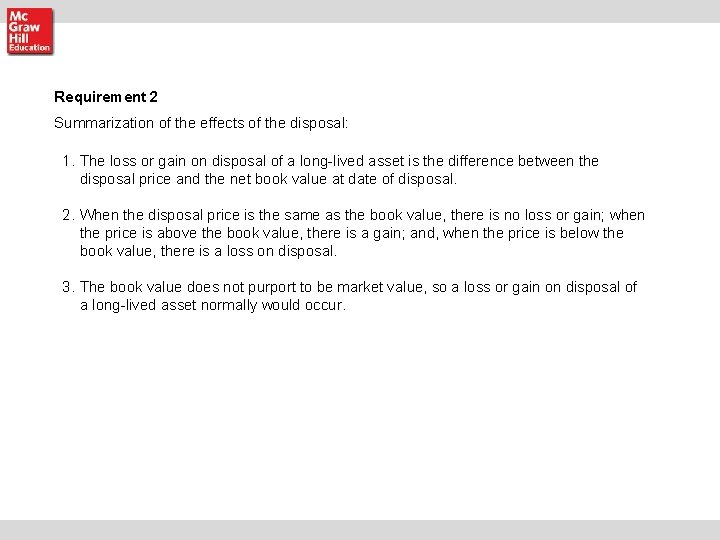
Requirement 2 Summarization of the effects of the disposal: 1. The loss or gain on disposal of a long-lived asset is the difference between the disposal price and the net book value at date of disposal. 2. When the disposal price is the same as the book value, there is no loss or gain; when the price is above the book value, there is a gain; and, when the price is below the book value, there is a loss on disposal. 3. The book value does not purport to be market value, so a loss or gain on disposal of a long-lived asset normally would occur.
Exercise 8 -17
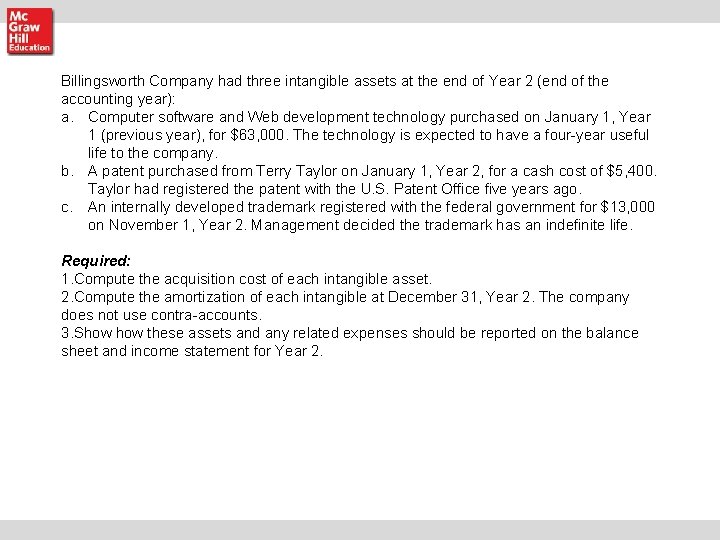
Billingsworth Company had three intangible assets at the end of Year 2 (end of the accounting year): a. Computer software and Web development technology purchased on January 1, Year 1 (previous year), for $63, 000. The technology is expected to have a four-year useful life to the company. b. A patent purchased from Terry Taylor on January 1, Year 2, for a cash cost of $5, 400. Taylor had registered the patent with the U. S. Patent Office five years ago. c. An internally developed trademark registered with the federal government for $13, 000 on November 1, Year 2. Management decided the trademark has an indefinite life. Required: 1. Compute the acquisition cost of each intangible asset. 2. Compute the amortization of each intangible at December 31, Year 2. The company does not use contra-accounts. 3. Show these assets and any related expenses should be reported on the balance sheet and income statement for Year 2.
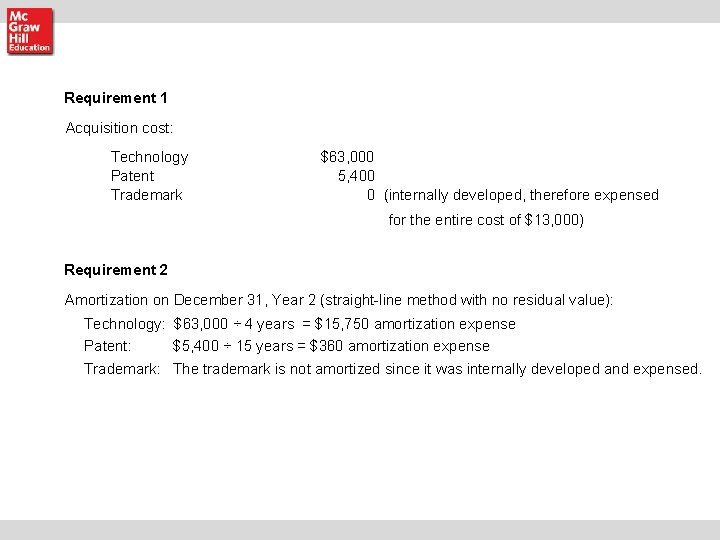
Requirement 1 Acquisition cost: Technology Patent Trademark $63, 000 5, 400 0 (internally developed, therefore expensed for the entire cost of $13, 000) Requirement 2 Amortization on December 31, Year 2 (straight-line method with no residual value): Technology: $63, 000 ÷ 4 years = $15, 750 amortization expense Patent: $5, 400 ÷ 15 years = $360 amortization expense Trademark: The trademark is not amortized since it was internally developed and expensed.
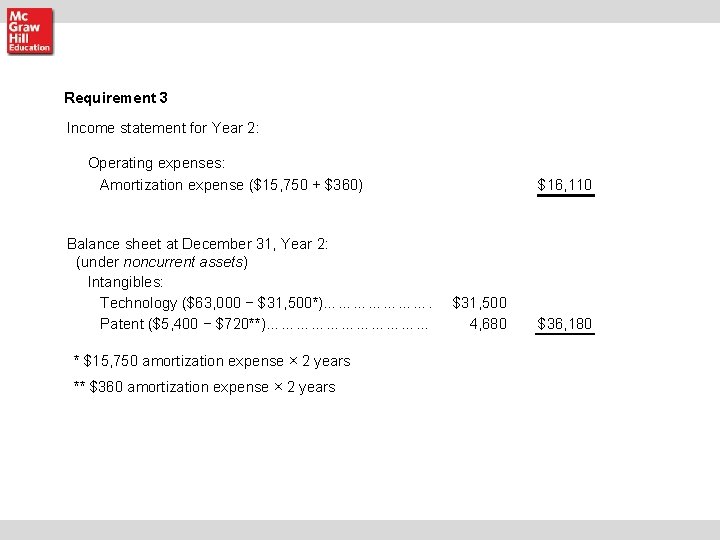
Requirement 3 Income statement for Year 2: Operating expenses: Amortization expense ($15, 750 + $360) Balance sheet at December 31, Year 2: (under noncurrent assets) Intangibles: Technology ($63, 000 − $31, 500*)…………………. Patent ($5, 400 − $720**)……………… * $15, 750 amortization expense × 2 years ** $360 amortization expense × 2 years $16, 110 $31, 500 4, 680 $36, 180
Exercise 8 -19
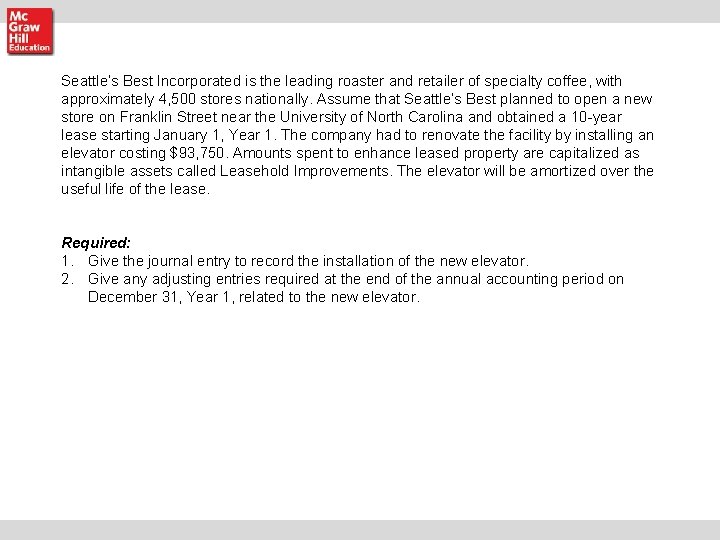
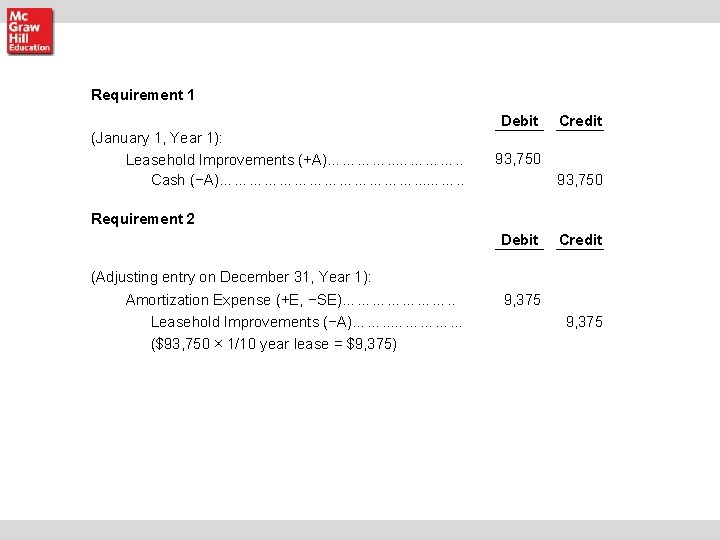
Seattle’s Best Incorporated is the leading roaster and retailer of specialty coffee, with approximately 4, 500 stores nationally. Assume that Seattle’s Best planned to open a new store on Franklin Street near the University of North Carolina and obtained a 10 -year lease starting January 1, Year 1. The company had to renovate the facility by installing an elevator costing $93, 750. Amounts spent to enhance leased property are capitalized as intangible assets called Leasehold Improvements. The elevator will be amortized over the useful life of the lease. Required: 1. Give the journal entry to record the installation of the new elevator. 2. Give any adjusting entries required at the end of the annual accounting period on December 31, Year 1, related to the new elevator.
Requirement 1 (January 1, Year 1): Leasehold Improvements (+A)…………. . Cash (−A)…………………. . Debit Credit 93, 750 Requirement 2 Debit Credit (Adjusting entry on December 31, Year 1): Amortization Expense (+E, −SE)…………………. . Leasehold Improvements (−A)……. . …………… ($93, 750 × 1/10 year lease = $9, 375) 9, 375
Exercise 8 -21
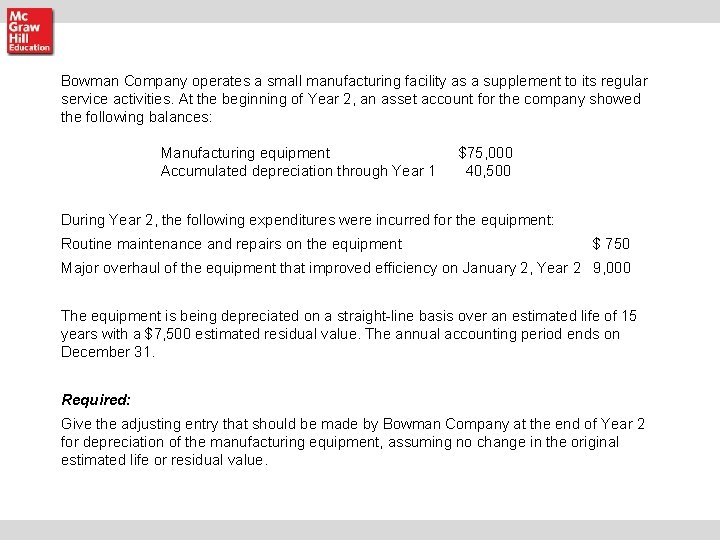
Bowman Company operates a small manufacturing facility as a supplement to its regular service activities. At the beginning of Year 2, an asset account for the company showed the following balances: Manufacturing equipment Accumulated depreciation through Year 1 $75, 000 40, 500 During Year 2, the following expenditures were incurred for the equipment: Routine maintenance and repairs on the equipment $ 750 Major overhaul of the equipment that improved efficiency on January 2, Year 2 9, 000 The equipment is being depreciated on a straight-line basis over an estimated life of 15 years with a $7, 500 estimated residual value. The annual accounting period ends on December 31. Required: Give the adjusting entry that should be made by Bowman Company at the end of Year 2 for depreciation of the manufacturing equipment, assuming no change in the original estimated life or residual value.
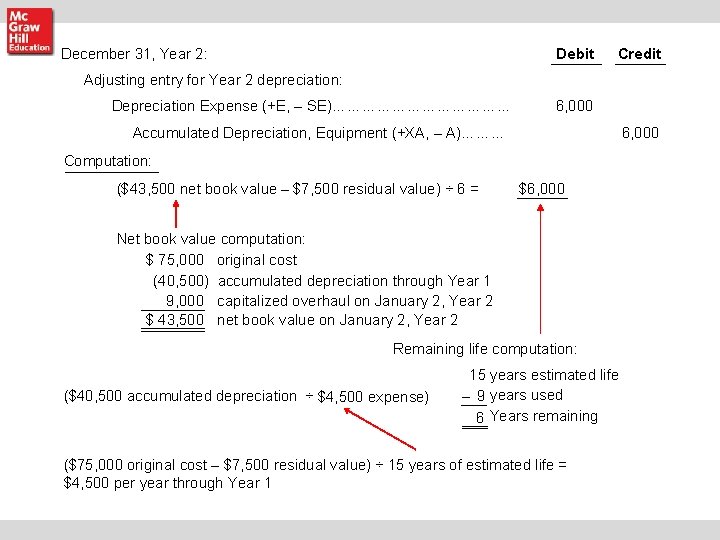
December 31, Year 2: Debit Credit Adjusting entry for Year 2 depreciation: Depreciation Expense (+E, – SE)……………… 6, 000 Accumulated Depreciation, Equipment (+XA, – A)……… Computation: ($43, 500 net book value – $7, 500 residual value) ÷ 6 = $6, 000 Net book value computation: $ 75, 000 original cost (40, 500) accumulated depreciation through Year 1 9, 000 capitalized overhaul on January 2, Year 2 $ 43, 500 net book value on January 2, Year 2 Remaining life computation: ($40, 500 accumulated depreciation ÷ $4, 500 expense) 15 years estimated life – 9 years used 6 Years remaining ($75, 000 original cost – $7, 500 residual value) ÷ 15 years of estimated life = $4, 500 per year through Year 1