Chapter 7 Auditing Internal Control over Financial Reporting
- Slides: 36
Chapter 7 Auditing Internal Control over Financial Reporting © Mc. Graw-Hill Education 2014
Management Responsibilities under Section 404 of the Sarbanes-Oxley Act requires managements of publicly traded companies to issue a report that accepts responsibility for establishing and maintaining ‘adequate’ internal control over financial reporting (ICFR) and assert whether ICFR is effective as of the end of the fiscal year. © Mc. Graw-Hill Education 2014
Management Responsibilities under Section 404 Management must comply with the following requirements in order for the external auditor to complete an audit of ICFR. 1. Accepts responsibility for the effectiveness of the entity’s ICFR. 2. Evaluate the effectiveness of the entity’s ICFR using suitable control criteria. 3. Support the evaluation with sufficient evidence, including documentation. 4. Present a written assessment of the effectiveness of the entity’s ICFR ‘as of’ the end of the entity’s most recent fiscal year. © Mc. Graw-Hill Education 2014
Auditor Responsibilities under Section 404 and AS 5 The entity’s independent auditor must audit and report on the effectiveness of ICFR. The auditor is required to conduct an integrated audit of the entity’s ICFR and its financial statements. © Mc. Graw-Hill Education 2014
ICFR Defined ICFR is defined as a process designed to provide reasonable assurance regarding the reliability of financial reporting and the preparation of financial statements in accordance with GAAP. Controls include procedures that: 1. Pertain to the maintenance of records that accurately and fairly reflect the transactions and dispositions of the assets of the company. 2. Provide reasonable assurance that transactions are properly authorized and recorded in accordance with GAAP. 3. Provide reasonable assurance regarding prevention or timely detection of unauthorized acquisition, use, or disposition of the company’s assets. © Mc. Graw-Hill Education 2014
Internal Control Deficiencies Defined A control deficiency exists when the design or operation of a control does not allow management or employees, in the normal course of performing their assigned functions, to prevent or detect misstatements on a timely basis. A significant deficiency is a deficiency, or a combination of deficiencies, in internal control over financial reporting that is less severe than a material weakness, yet important enough to merit attention by those responsible for oversight of the company's financial reporting. © Mc. Graw-Hill Education 2014
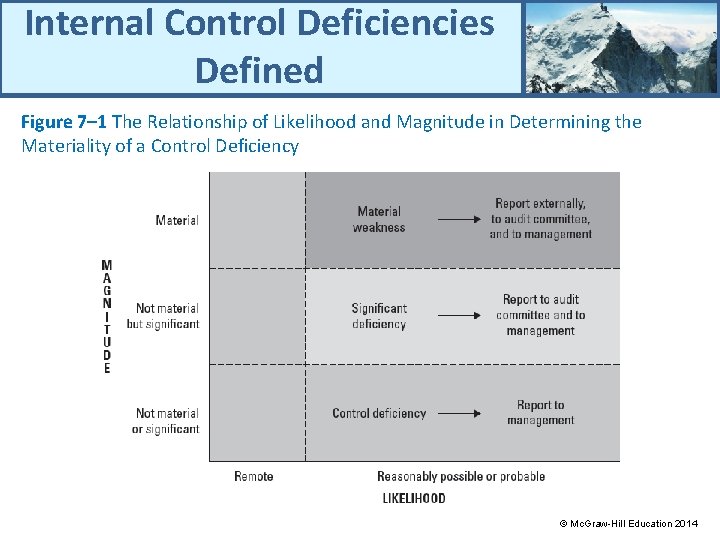
Internal Control Deficiencies Defined A control deficiency may be serious enough that it is to be considered not only a significant deficiency but also a material weakness in the system of internal control. A material weakness is a deficiency, or a combination of deficiencies, in ICFR, such that there is a reasonable possibility that a material misstatement of the annual or interim financial statements will not be prevented or detected on a timely basis. As illustrated on the next slide, the auditor must consider two dimensions of the control deficiency: likelihood (reasonably possible); and magnitude (material, significant, or insignificant). © Mc. Graw-Hill Education 2014
Internal Control Deficiencies Defined Figure 7– 1 The Relationship of Likelihood and Magnitude in Determining the Materiality of a Control Deficiency © Mc. Graw-Hill Education 2014
Management’s Assessment Process Management must follow a top-down, risk-based approach: 1. Identify financial reporting risks and controls. 2. Consider which locations to include in the evaluation. 3. Evaluate evidence about the operating effectiveness of ICFR. © Mc. Graw-Hill Education 2014
Framework Used by Management to Conduct Its Assessment Most entities use the framework developed by COSO. This framework identifies three primary objectives of internal control: (1) reliable financial reporting; (2) efficiency and effectiveness of operations; and (3) compliance with laws and regulations. © Mc. Graw-Hill Education 2014
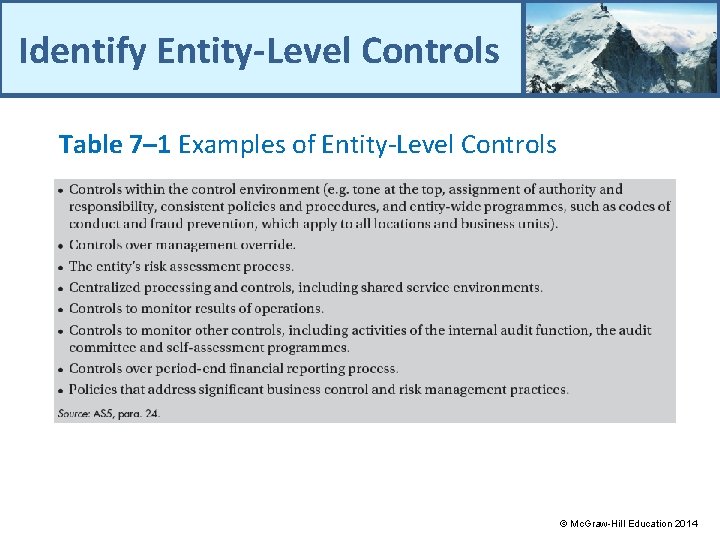
Identify Entity-Level Controls Table 7– 1 Examples of Entity-Level Controls © Mc. Graw-Hill Education 2014
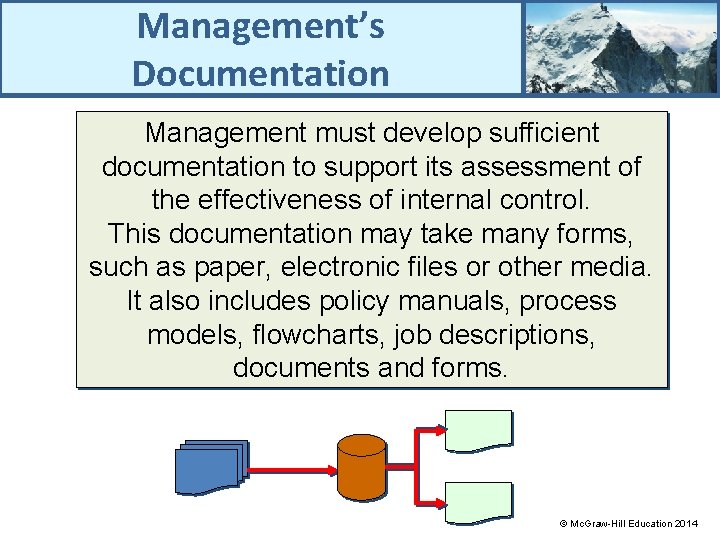
Management’s Documentation Management must develop sufficient documentation to support its assessment of the effectiveness of internal control. This documentation may take many forms, such as paper, electronic files or other media. It also includes policy manuals, process models, flowcharts, job descriptions, documents and forms. © Mc. Graw-Hill Education 2014
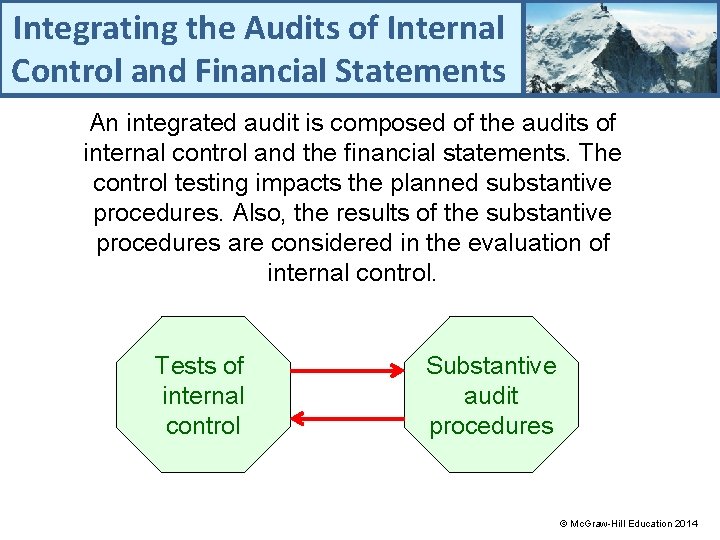
Integrating the Audits of Internal Control and Financial Statements An integrated audit is composed of the audits of internal control and the financial statements. The control testing impacts the planned substantive procedures. Also, the results of the substantive procedures are considered in the evaluation of internal control. Tests of internal control Substantive audit procedures © Mc. Graw-Hill Education 2014
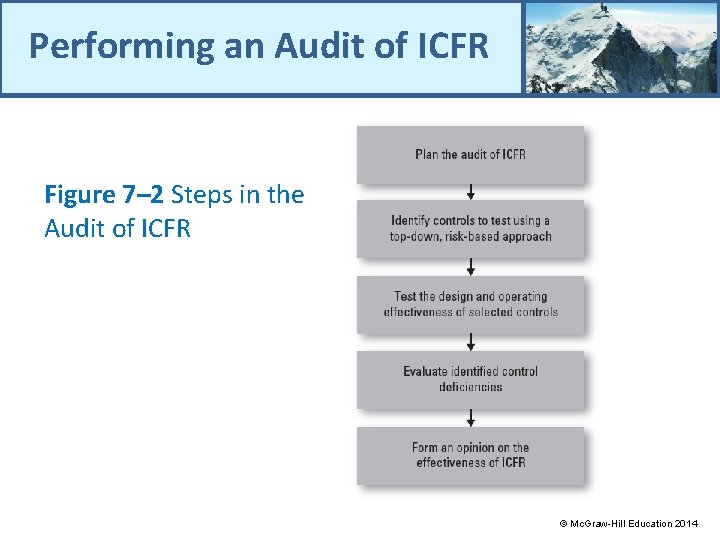
Performing an Audit of ICFR Figure 7– 2 Steps in the Audit of ICFR © Mc. Graw-Hill Education 2014
Planning the Audit of ICFR • The planning process is similar to the process used for the audit of financial statements. • Consider the following: - Role of risk assessment and the risk of fraud. - Scaling the audit. - Using the work of others. © Mc. Graw-Hill Education 2014
Special Consideration: Using the Work of Others A major consideration for the external auditor is how much work is to be performed by others. In determining the extent to which the auditor may use the work of others, the auditor should: (1) evaluate the nature of the controls subjected to the work of others, (2) evaluate the competence and objectivity of the individuals who performed the work, and (3) test some of the work performed by others to evaluate the quality and effectiveness of their work. As the risk associated with the control being tested increases, the external auditor should do more of the work. © Mc. Graw-Hill Education 2014
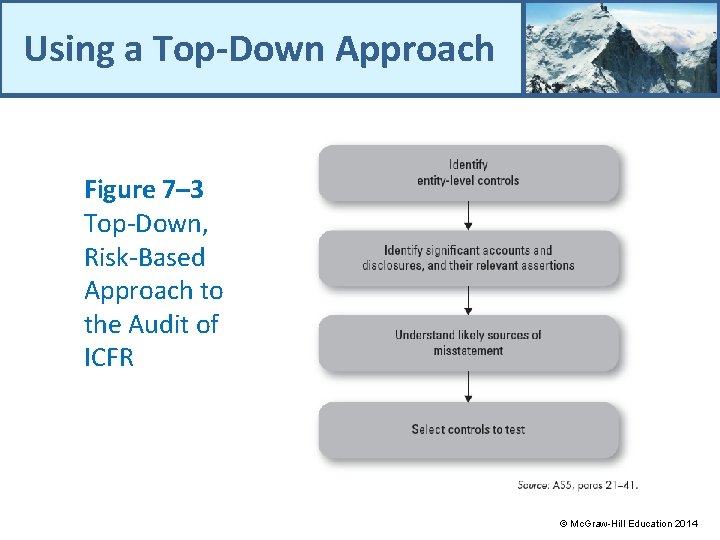
Using a Top-Down Approach Figure 7– 3 Top-Down, Risk-Based Approach to the Audit of ICFR © Mc. Graw-Hill Education 2014
Identifying Significant Accounts • Size and composition of the account. • Susceptibility to misstatement due to errors or fraud. • Volume of activity, complexity, and homogeneity of the individual transactions processed through the account or reflected in the disclosure. • Nature of the account or disclosure. • Accounting and reporting complexities associated with the account or disclosure. © Mc. Graw-Hill Education 2014
Identifying Significant Accounts • Exposure to losses in the account. • Possibility of significant contingent liabilities arising from the activities reflected in the account or disclosure. • Existence of related-party transactions in the account. • Changes from the prior period in account or disclosure characteristics. © Mc. Graw-Hill Education 2014
Sources of Misstatement • Understand the flow of transactions related to the relevant assertions. • Identify the points within the entity’s processes at which a misstatement could arise that would be material. • Identify the controls that management has implemented to address these potential misstatements. • Identify the controls that management has implemented over the prevention or timely detection of unauthorized acquisition, use, or disposition of the company’s assets that could result in a material misstatement of the financial statements. © Mc. Graw-Hill Education 2014
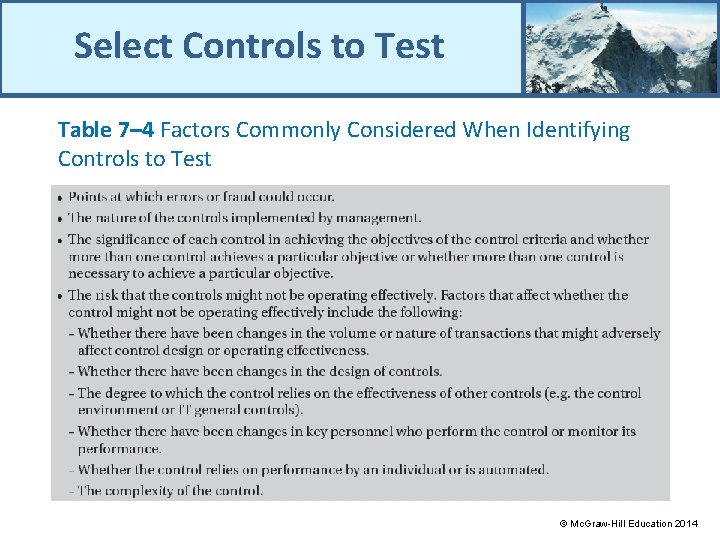
Select Controls to Test Table 7– 4 Factors Commonly Considered When Identifying Controls to Test © Mc. Graw-Hill Education 2014
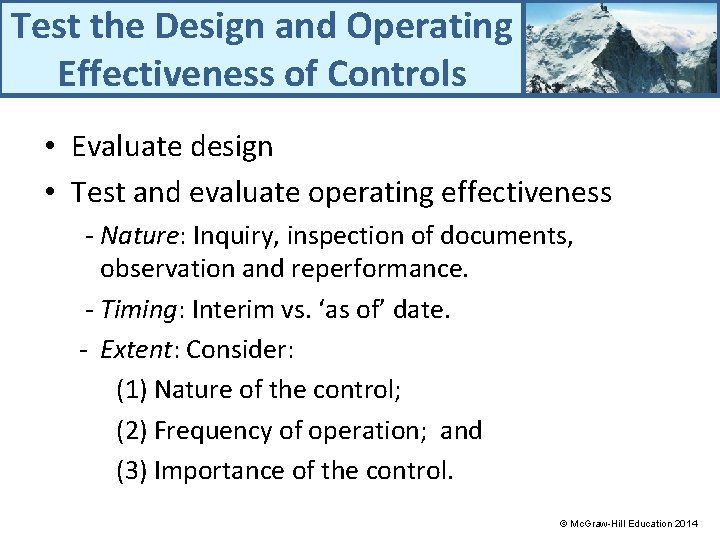
Test the Design and Operating Effectiveness of Controls • Evaluate design • Test and evaluate operating effectiveness - Nature: Inquiry, inspection of documents, observation and reperformance. - Timing: Interim vs. ‘as of’ date. - Extent: Consider: (1) Nature of the control; (2) Frequency of operation; and (3) Importance of the control. © Mc. Graw-Hill Education 2014
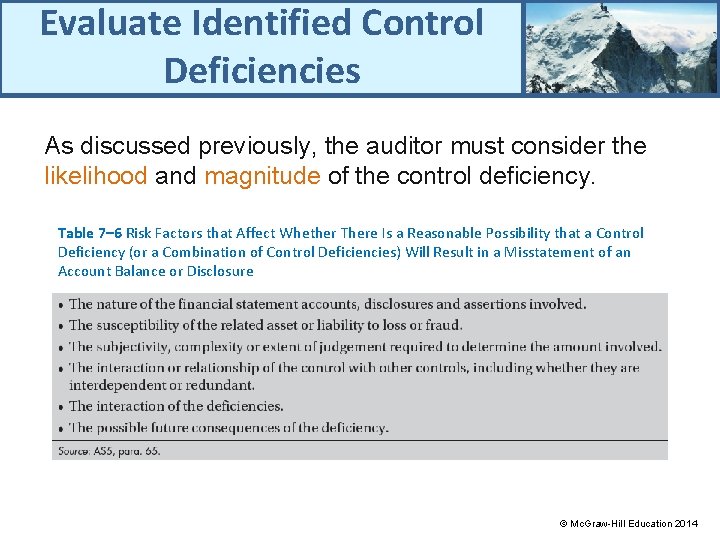
Evaluate Identified Control Deficiencies As discussed previously, the auditor must consider the likelihood and magnitude of the control deficiency. Table 7– 6 Risk Factors that Affect Whether There Is a Reasonable Possibility that a Control Deficiency (or a Combination of Control Deficiencies) Will Result in a Misstatement of an Account Balance or Disclosure © Mc. Graw-Hill Education 2014
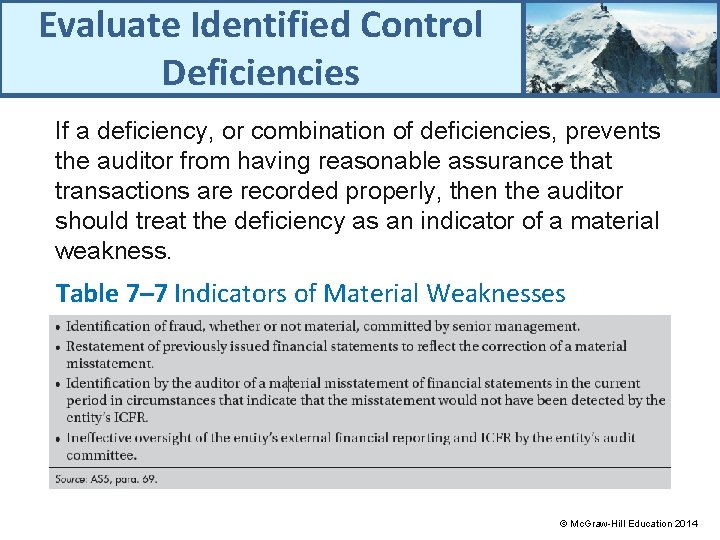
Evaluate Identified Control Deficiencies If a deficiency, or combination of deficiencies, prevents the auditor from having reasonable assurance that transactions are recorded properly, then the auditor should treat the deficiency as an indicator of a material weakness. Table 7– 7 Indicators of Material Weaknesses © Mc. Graw-Hill Education 2014
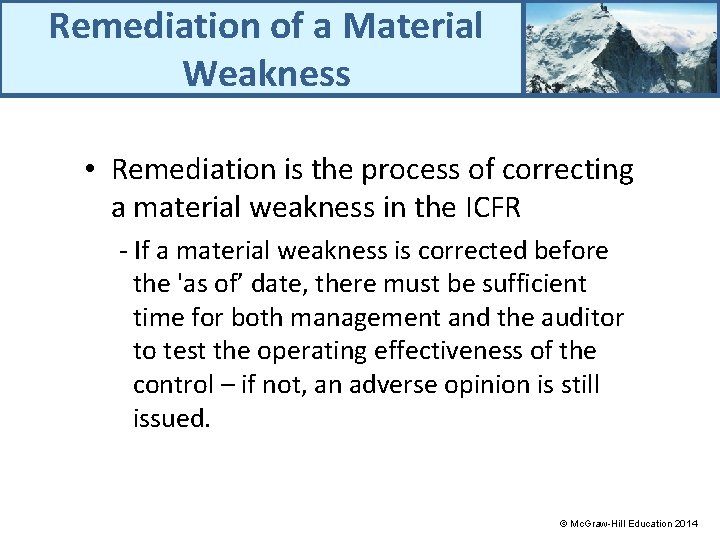
Remediation of a Material Weakness • Remediation is the process of correcting a material weakness in the ICFR - If a material weakness is corrected before the 'as of’ date, there must be sufficient time for both management and the auditor to test the operating effectiveness of the control – if not, an adverse opinion is still issued. © Mc. Graw-Hill Education 2014
Written Representations In addition to the management representations obtained as part of a financial statement audit, the auditor also obtains written representations from management related to the audit of ICFR. Failure to obtain written representations from management, including management’s refusal to furnish them, constitutes a limitation on the scope of the audit sufficient to preclude an unqualified opinion. © Mc. Graw-Hill Education 2014
Auditor Documentation Requirements The auditor must properly document the processes, procedures, judgements, and results relating to the audit of internal control. When an entity has effective ICFR, the auditor should be able to perform sufficient testing of controls to assess control risk for all relevant assertions at a low level. © Mc. Graw-Hill Education 2014
Auditor Documentation Requirements The auditor’s documentation of the process, procedures, judgements and results relating to the audit of ICFR should include: 1. Auditor’s understanding and evaluation of the design of ICFR; 2. The process used to determine the points at which material misstatements could occur; 3. The extent to which the auditor relied upon the work of others; and 4. The evaluation of any deficiencies discovered or other findings which could result in a report modification. © Mc. Graw-Hill Education 2014
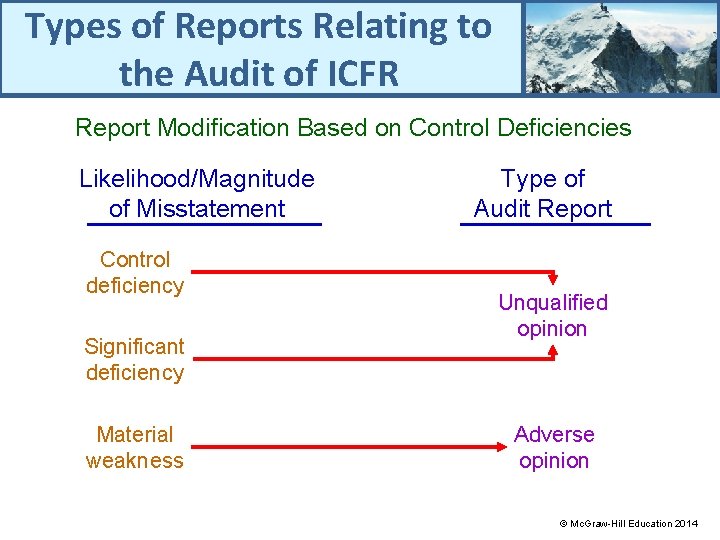
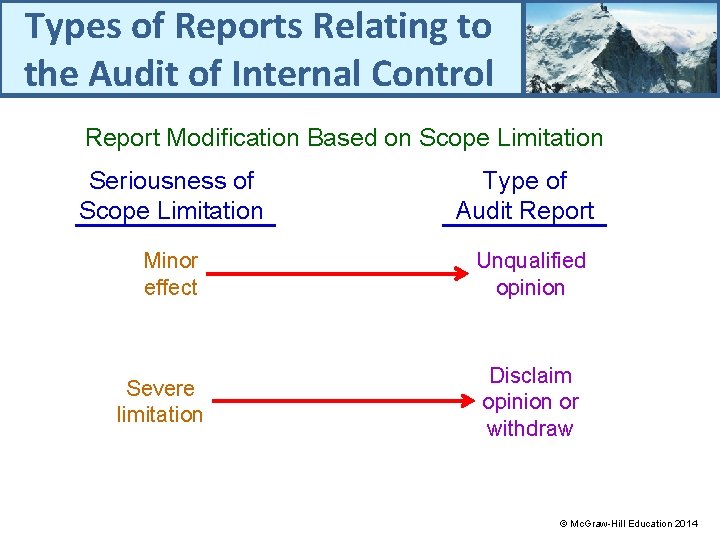
Types of Reports Relating to the Audit of ICFR An unqualified opinion signifies that the entity’s internal control is designed and operating effectively (no material weaknesses). A serious (more than minor) scope limitation requires the auditor to disclaim an opinion. An adverse opinion is required if a material weakness is identified. © Mc. Graw-Hill Education 2014
Types of Reports Relating to the Audit of ICFR Report Modification Based on Control Deficiencies Likelihood/Magnitude of Misstatement Control deficiency Significant deficiency Material weakness Type of Audit Report Unqualified opinion Adverse opinion © Mc. Graw-Hill Education 2014
Types of Reports Relating to the Audit of Internal Control Report Modification Based on Scope Limitation Seriousness of Scope Limitation Type of Audit Report Minor effect Unqualified opinion Severe limitation Disclaim opinion or withdraw © Mc. Graw-Hill Education 2014
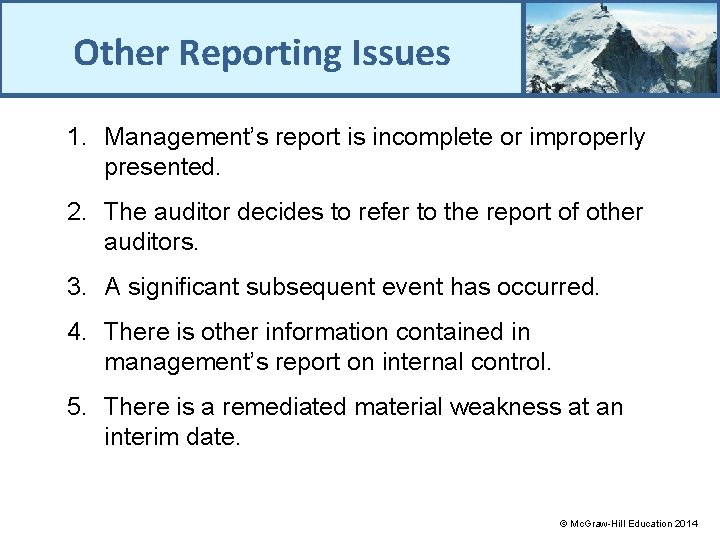
Other Reporting Issues 1. Management’s report is incomplete or improperly presented. 2. The auditor decides to refer to the report of other auditors. 3. A significant subsequent event has occurred. 4. There is other information contained in management’s report on internal control. 5. There is a remediated material weakness at an interim date. © Mc. Graw-Hill Education 2014
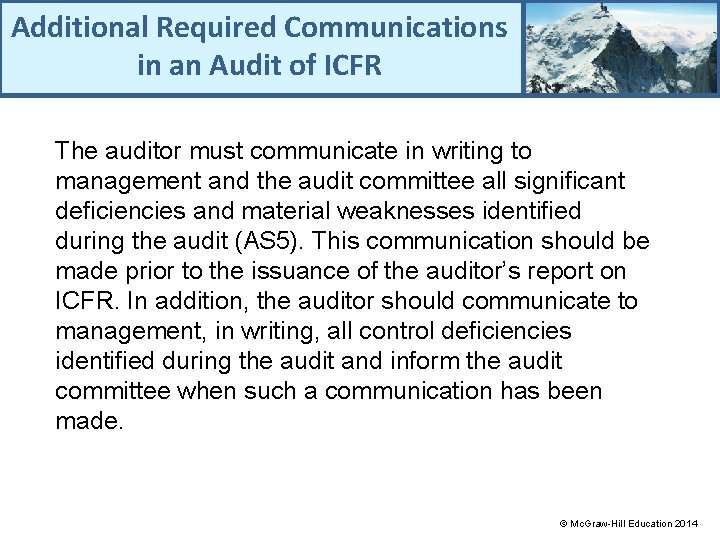
Additional Required Communications in an Audit of ICFR The auditor must communicate in writing to management and the audit committee all significant deficiencies and material weaknesses identified during the audit (AS 5). This communication should be made prior to the issuance of the auditor’s report on ICFR. In addition, the auditor should communicate to management, in writing, all control deficiencies identified during the audit and inform the audit committee when such a communication has been made. © Mc. Graw-Hill Education 2014
Use of Service Organizations Many companies use a service organization to process transactions. If the service organization's services make up part of a company’s information system, then they are considered part of the information and communication component of the company’s internal control over financial report. Thus, both management and the auditor must consider the activities of the service organization. © Mc. Graw-Hill Education 2014
Use of Service Organizations Management and the auditor should perform the following procedures with respect to the activities performed by the service organization: (1) obtain an understanding of the nature and significance of the services provided by the service organization and their effect of the user entity’s internal control relevant to the audit, sufficient to identify and assess the risks of material misstatement; and (2) design and perform audit procedures responsive to those risks. © Mc. Graw-Hill Education 2014
Safeguarding of Assets Safeguarding of assets is defined as policies and procedures that ‘provide reasonable assurance regarding prevention or timely detection of unauthorized acquisition, use or disposition of the company’s assets that could have a material effect on the financial statements. ’ © Mc. Graw-Hill Education 2014