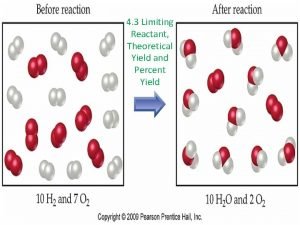
Chapter 7 7 3 Reaction Yields Percentage Yield




- Slides: 11
Chapter 7: 7. 3 Reaction Yields Percentage Yield 1
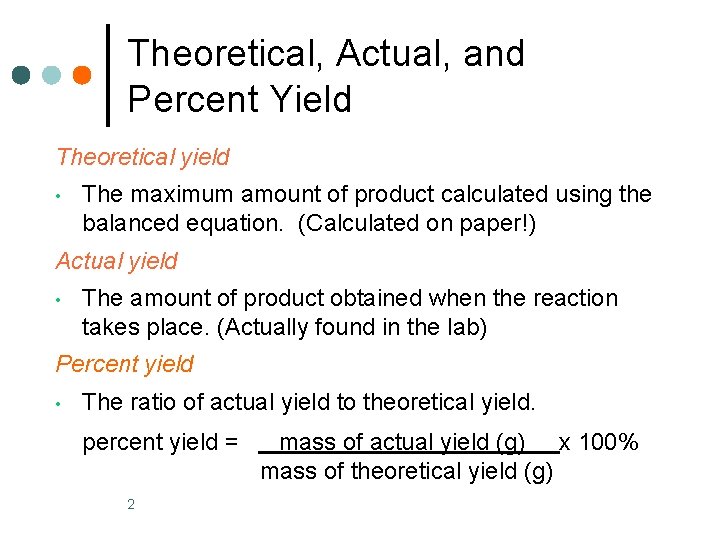
Theoretical, Actual, and Percent Yield Theoretical yield • The maximum amount of product calculated using the balanced equation. (Calculated on paper!) Actual yield • The amount of product obtained when the reaction takes place. (Actually found in the lab) Percent yield • The ratio of actual yield to theoretical yield. percent yield = 2 mass of actual yield (g) x 100% mass of theoretical yield (g)
Calculating Percent Yield To calculate the percent yield, the actual yield and theoretical yield are needed. You prepared cookie dough to make 5 dozen cookies. The phone rings and you answer. While talking, a sheet of 12 cookies burn and you have to throw them out. The rest of the cookies are okay. What is the percent yield of edible cookies? Theoretical yield 60 cookies possible Actual yield 48 cookies to eat Percent yield 48 cookies x 100 = 80% yield 60 cookies 3
4
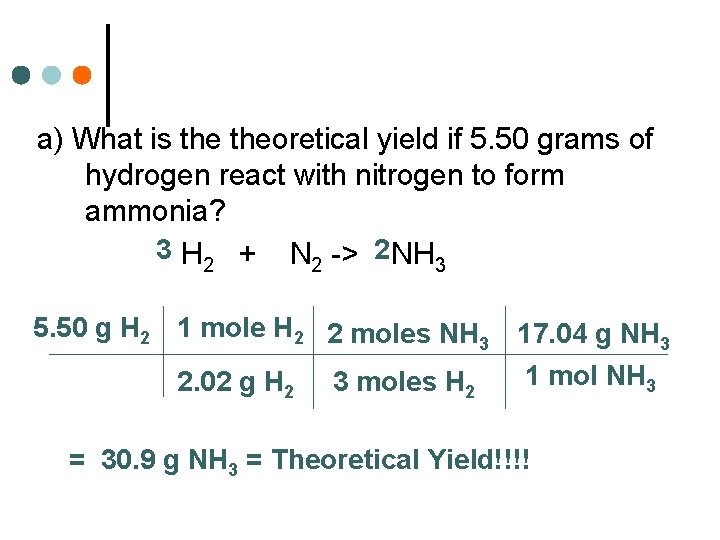
a) What is theoretical yield if 5. 50 grams of hydrogen react with nitrogen to form ammonia? 3 H 2 + N 2 -> 2 NH 3 5. 50 g H 2 1 mole H 2 2 moles NH 3 17. 04 g NH 3 1 mol NH 3 2. 02 g H 2 3 moles H 2 = 30. 9 g NH 3 = Theoretical Yield!!!!
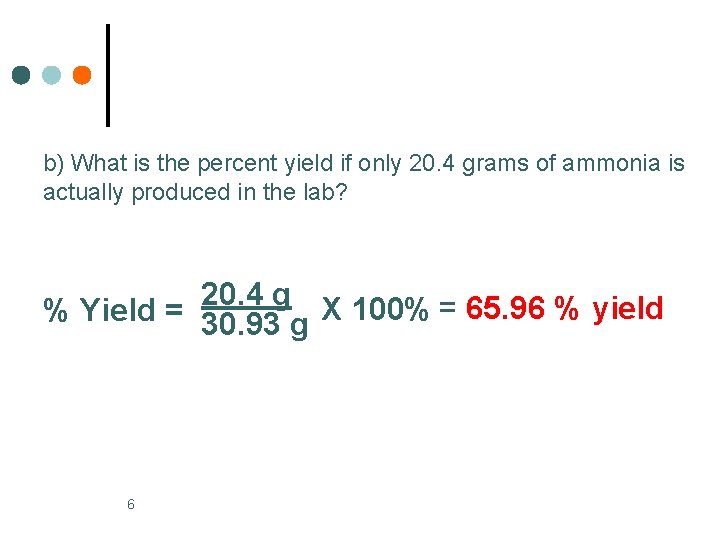
b) What is the percent yield if only 20. 4 grams of ammonia is actually produced in the lab? 20. 4 g X 100% = 65. 96 % yield % Yield = 30. 93 g 6
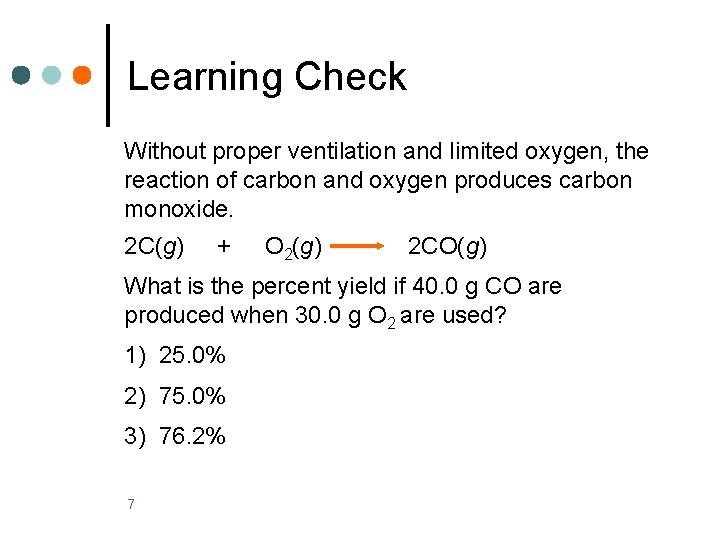
Learning Check Without proper ventilation and limited oxygen, the reaction of carbon and oxygen produces carbon monoxide. 2 C(g) + O 2(g) 2 CO(g) What is the percent yield if 40. 0 g CO are produced when 30. 0 g O 2 are used? 1) 25. 0% 2) 75. 0% 3) 76. 2% 7
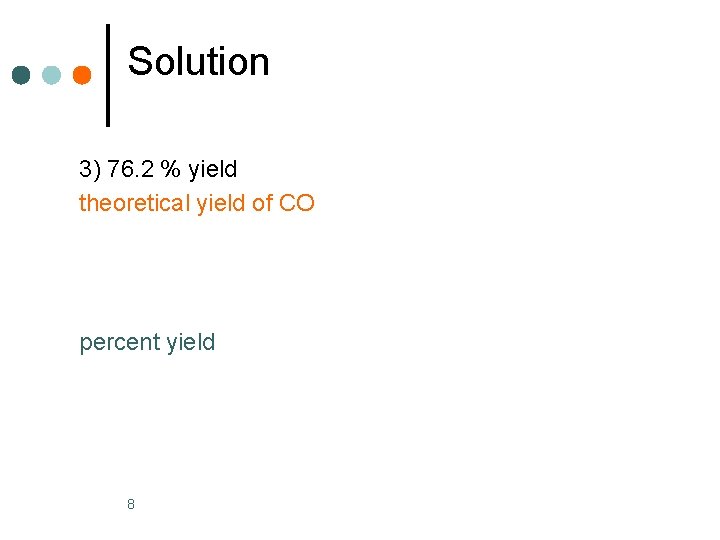
Solution 3) 76. 2 % yield theoretical yield of CO percent yield 8
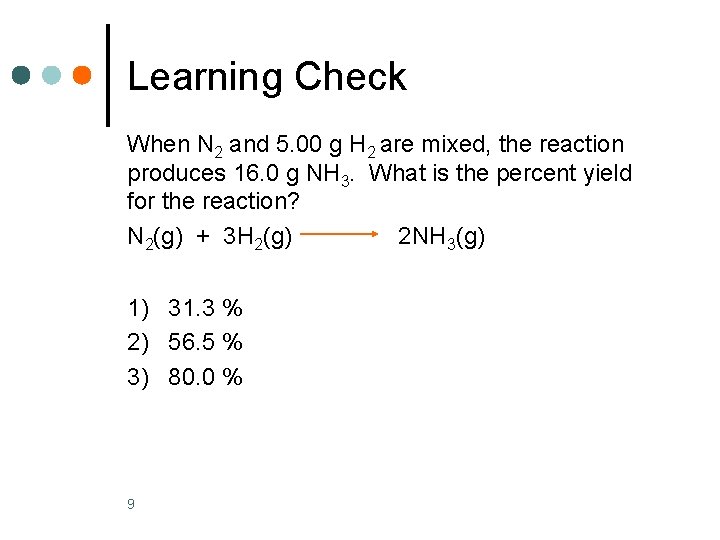
Learning Check When N 2 and 5. 00 g H 2 are mixed, the reaction produces 16. 0 g NH 3. What is the percent yield for the reaction? N 2(g) + 3 H 2(g) 2 NH 3(g) 1) 31. 3 % 2) 56. 5 % 3) 80. 0 % 9
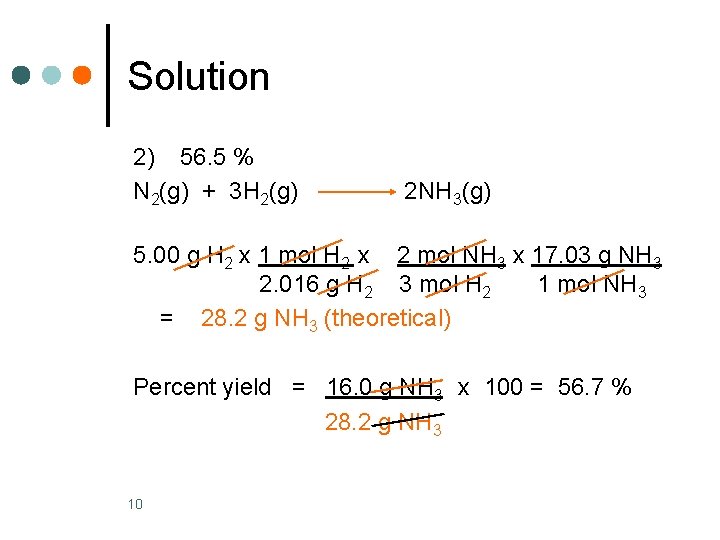
Solution 2) 56. 5 % N 2(g) + 3 H 2(g) 2 NH 3(g) 5. 00 g H 2 x 1 mol H 2 x 2 mol NH 3 x 17. 03 g NH 3 2. 016 g H 2 3 mol H 2 1 mol NH 3 = 28. 2 g NH 3 (theoretical) Percent yield = 16. 0 g NH 3 x 100 = 56. 7 % 28. 2 g NH 3 10
Reasons for low % Yield Reactions do not always work perfectly. Experimental error (spills, contamination) often means that the amount of product made in the lab does not match the ideal amount that could have been made. WHY? 1. Experimental design- Can you fix the method? 2. Experimental errors/human error(loss when transferring, or filtering) 3. Impurities in the reactants (most laboratory chemicals are only 80 -90% pure) 11 4. Side reactions