Chapter 4 The Internal Assessment Strategic Management Concepts

- Slides: 34
Chapter 4 The Internal Assessment Strategic Management: Concepts & Cases 13 th Edition Fred David Copyright © 2011 Pearson Education, Inc. Publishing as Prentice Hall 1
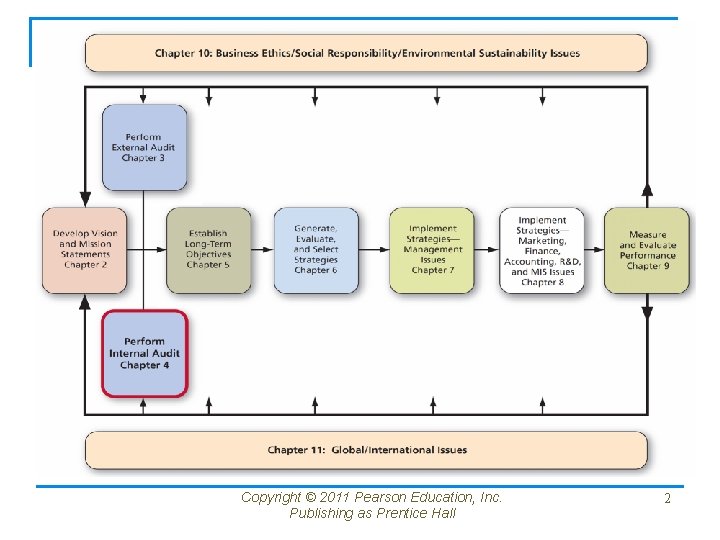
Copyright © 2011 Pearson Education, Inc. Publishing as Prentice Hall 2
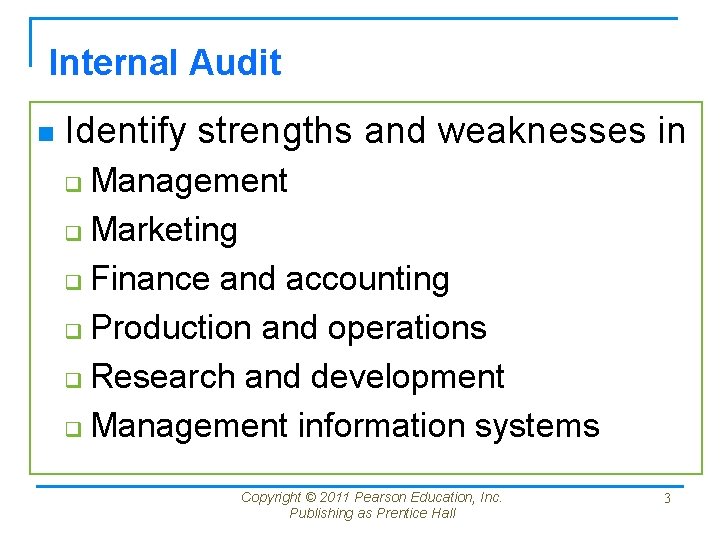
Internal Audit n Identify strengths and weaknesses in Management q Marketing q Finance and accounting q Production and operations q Research and development q Management information systems q Copyright © 2011 Pearson Education, Inc. Publishing as Prentice Hall 3
Nature of an Internal Audit Basis for Objectives & Strategies Internal strengths/weaknesses n External opportunities/threats n Clear statement of mission n Copyright © 2011 Pearson Education, Inc. Publishing as Prentice Hall 4
Key Internal Forces Distinctive Competencies: n. Firm’s strengths that cannot be easily matched or imitated by competitors Copyright © 2011 Pearson Education, Inc. Publishing as Prentice Hall 5
Key Internal Forces Distinctive Competencies: n. Building competitive advantage involves taking advantage of distinctive competencies Copyright © 2011 Pearson Education, Inc. Publishing as Prentice Hall 6
Internal Audit Process Parallels process of external audit n. Information gathered from: q Management q Marketing q Finance/accounting q Production/operations q Research & development q Management information systems Copyright © 2011 Pearson Education, Inc. Publishing as Prentice Hall 7
Internal Audit n. Managers and employees from all areas provide information n. A team of managers then selects 10 to 15 key organizational strengths and weaknesses to focus on Copyright © 2011 Pearson Education, Inc. Publishing as Prentice Hall 8
Internal Audit Financial Ratio Analysis Exemplifies complexity of relationships among functional areas of the business Copyright © 2011 Pearson Education, Inc. Publishing as Prentice Hall 9
Integrating Strategy & Culture Organizational Culture Pattern of behavior developed by an organization as it learns to cope with its problem of external adaptation and internal integration. . . is considered valid and taught to new members as the correct way to perceive, think, and feel Copyright © 2011 Pearson Education, Inc. Publishing as Prentice Hall 10
Integrating Strategy & Culture Organizational Culture n Resistant to change n May represent: q Strength q Weakness Copyright © 2011 Pearson Education, Inc. Publishing as Prentice Hall 11
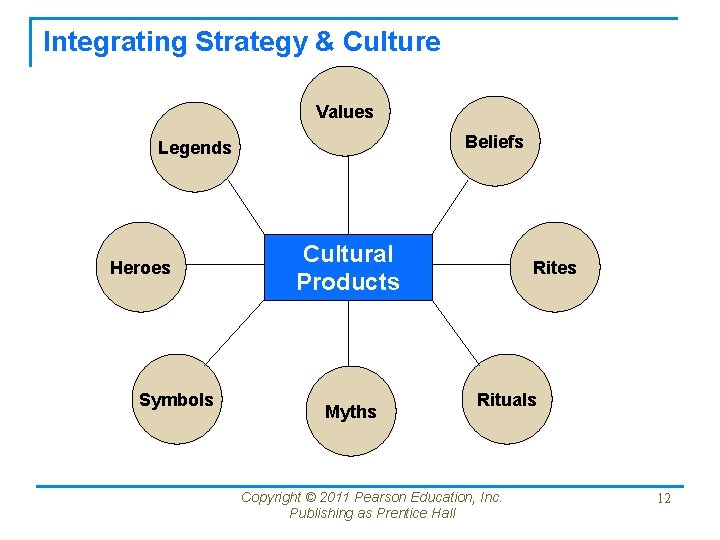
Integrating Strategy & Culture Values Beliefs Legends Heroes Symbols Cultural Products Myths Rites Rituals Copyright © 2011 Pearson Education, Inc. Publishing as Prentice Hall 12
Integrating Strategy & Culture Organizational Culture Can Inhibit Strategic Management n Miss external changes due to strongly held beliefs n Natural tendency to “hold the course” even during times of strategic change Copyright © 2011 Pearson Education, Inc. Publishing as Prentice Hall 13
Marketing Functions 1. Customer analysis 2. Selling products/services 3. Product & service planning 4. Pricing 5. Distribution 6. Marketing research 7. Opportunity analysis Copyright © 2011 Pearson Education, Inc. Publishing as Prentice Hall 14
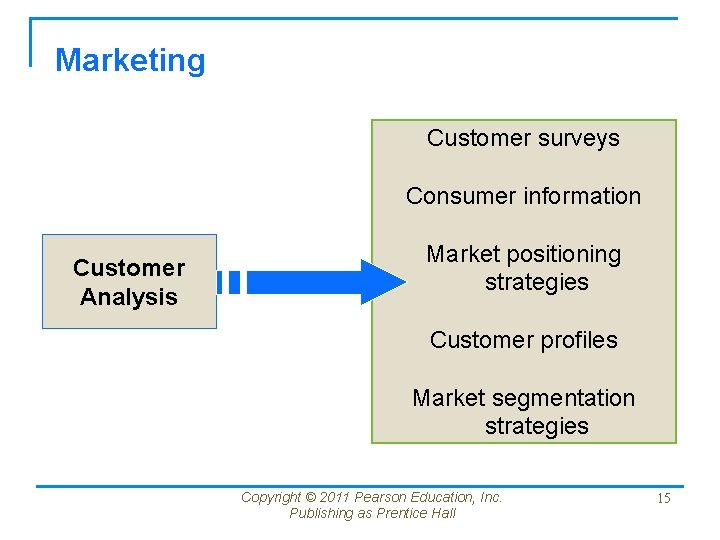
Marketing Customer surveys Consumer information Customer Analysis Market positioning strategies Customer profiles Market segmentation strategies Copyright © 2011 Pearson Education, Inc. Publishing as Prentice Hall 15
Finance/Accounting 1. Investment decision (Capital budgeting) 2. Financing decision 3. Dividend decision Copyright © 2011 Pearson Education, Inc. Publishing as Prentice Hall 16
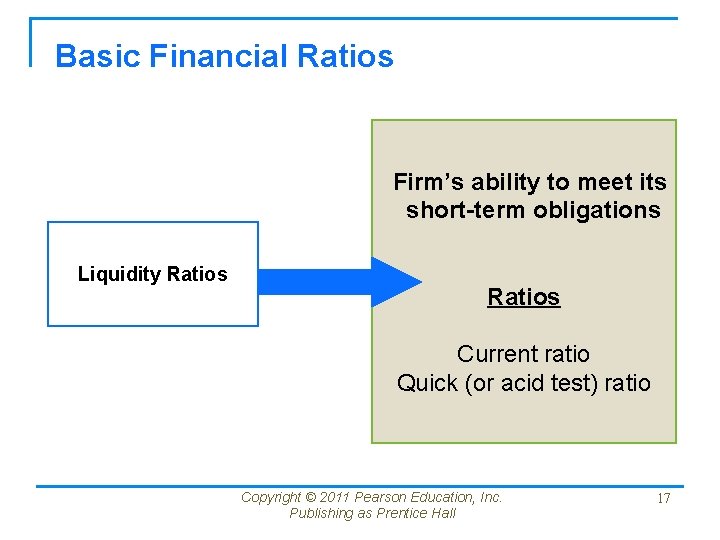
Basic Financial Ratios Firm’s ability to meet its short-term obligations Liquidity Ratios Current ratio Quick (or acid test) ratio Copyright © 2011 Pearson Education, Inc. Publishing as Prentice Hall 17
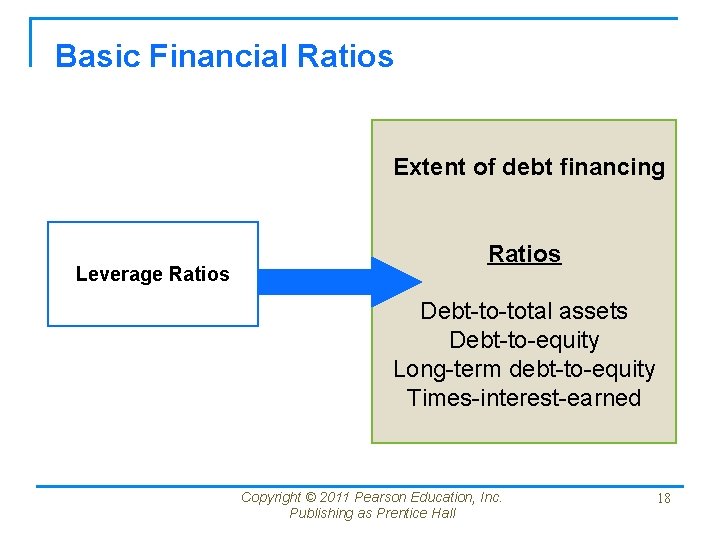
Basic Financial Ratios Extent of debt financing Leverage Ratios Debt-to-total assets Debt-to-equity Long-term debt-to-equity Times-interest-earned Copyright © 2011 Pearson Education, Inc. Publishing as Prentice Hall 18
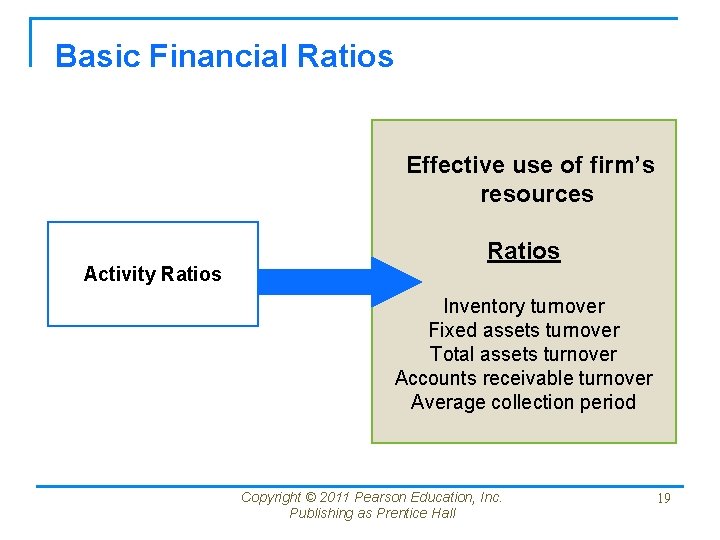
Basic Financial Ratios Effective use of firm’s resources Activity Ratios Inventory turnover Fixed assets turnover Total assets turnover Accounts receivable turnover Average collection period Copyright © 2011 Pearson Education, Inc. Publishing as Prentice Hall 19
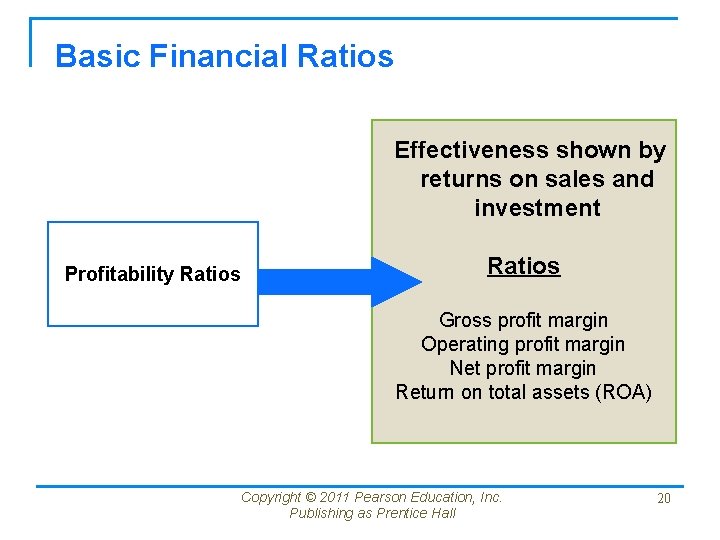
Basic Financial Ratios Effectiveness shown by returns on sales and investment Profitability Ratios Gross profit margin Operating profit margin Net profit margin Return on total assets (ROA) Copyright © 2011 Pearson Education, Inc. Publishing as Prentice Hall 20
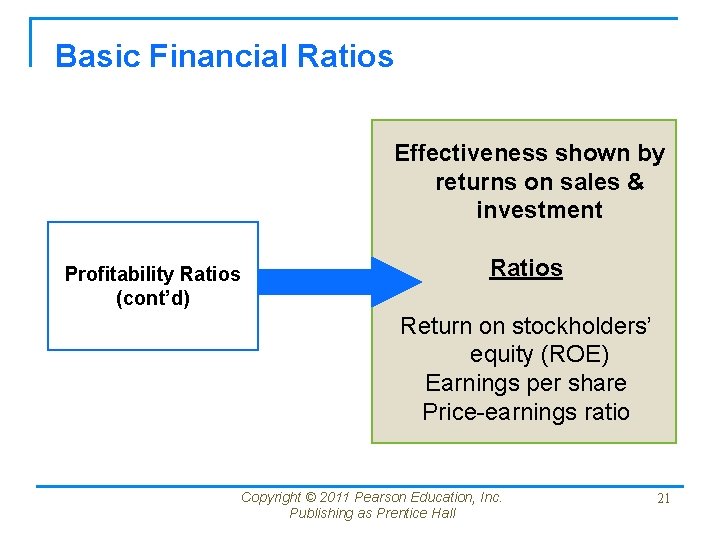
Basic Financial Ratios Effectiveness shown by returns on sales & investment Profitability Ratios (cont’d) Ratios Return on stockholders’ equity (ROE) Earnings per share Price-earnings ratio Copyright © 2011 Pearson Education, Inc. Publishing as Prentice Hall 21
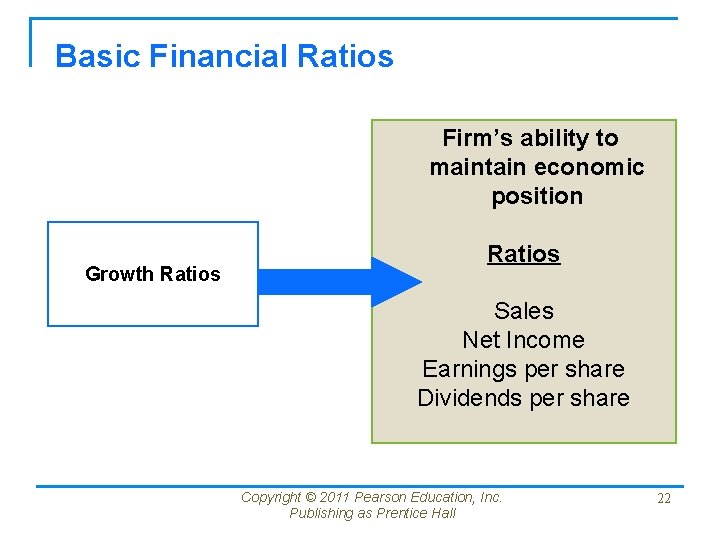
Basic Financial Ratios Firm’s ability to maintain economic position Growth Ratios Sales Net Income Earnings per share Dividends per share Copyright © 2011 Pearson Education, Inc. Publishing as Prentice Hall 22
Finance/Accounting Audit 1. 2. 3. 4. 5. Where is the firm financially strong/weak as indicated by financial ratio analysis? Can the firm raise needed short-term capital? Can the firm raise needed long-term capital through debt and/or equity? Does the firm have sufficient working capital? Are capital budgeting procedures effective? Copyright © 2011 Pearson Education, Inc. Publishing as Prentice Hall 23
Finance/Accounting Audit 6. 7. 8. 9. Are dividend payout policies reasonable? Does the firm have good relations with its investors and stockholders? Are the firm’s financial managers experienced and well trained? Is the firm’s debt situation excellent? Copyright © 2011 Pearson Education, Inc. Publishing as Prentice Hall 24
Production/Operations Functions n Process n Capacity n Inventory n Workforce n Quality Copyright © 2011 Pearson Education, Inc. Publishing as Prentice Hall 25
Production/Operations Audit • Are suppliers of materials, parts, etc. reliable and reasonable? • Are facilities, equipment, machinery, and offices in good condition? • Are inventory-control policies and procedures effective? Copyright © 2011 Pearson Education, Inc. Publishing as Prentice Hall 26
Production/Operations Audit • Are quality-control policies & procedures effective? • Are facilities, resources, and markets strategically located? • Does the firm have technological competencies? Copyright © 2011 Pearson Education, Inc. Publishing as Prentice Hall 27
Research & Development Functions n Development of new products before competitors n Improving product quality n Improving manufacturing processes to reduce costs n These functions can be done internally or externally Copyright © 2011 Pearson Education, Inc. Publishing as Prentice Hall 28
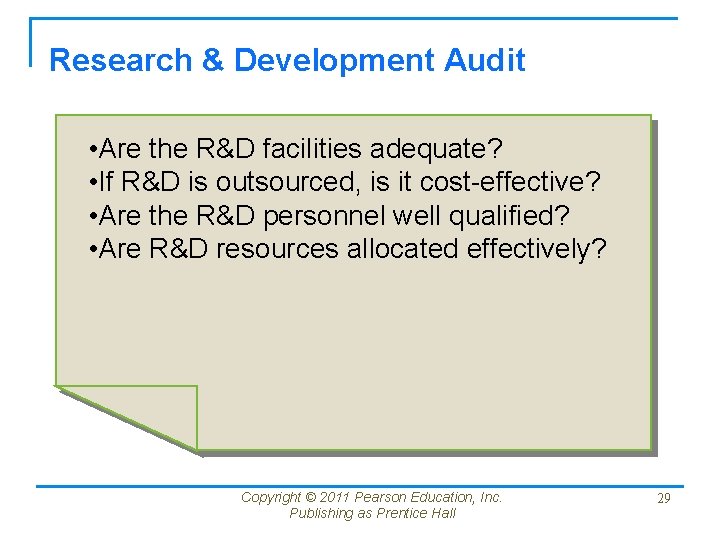
Research & Development Audit • Are the R&D facilities adequate? • If R&D is outsourced, is it cost-effective? • Are the R&D personnel well qualified? • Are R&D resources allocated effectively? Copyright © 2011 Pearson Education, Inc. Publishing as Prentice Hall 29
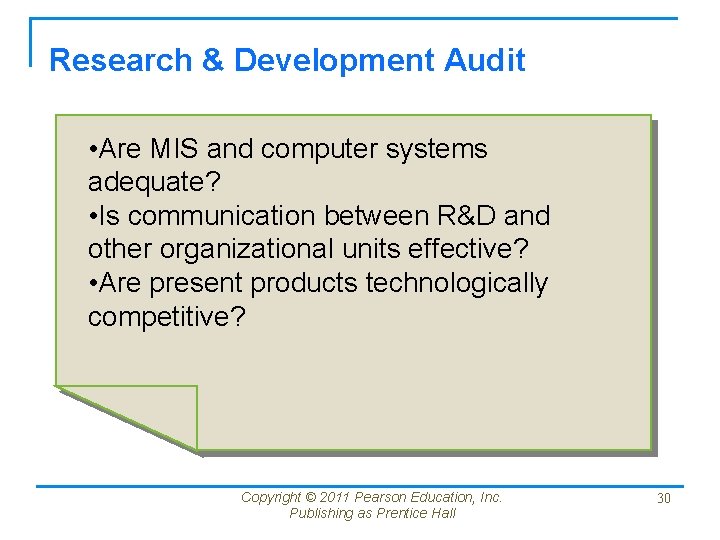
Research & Development Audit • Are MIS and computer systems adequate? • Is communication between R&D and other organizational units effective? • Are present products technologically competitive? Copyright © 2011 Pearson Education, Inc. Publishing as Prentice Hall 30
Management Information Systems Purpose n Improve performance of an enterprise by improving the quality of managerial decisions Copyright © 2011 Pearson Education, Inc. Publishing as Prentice Hall 31
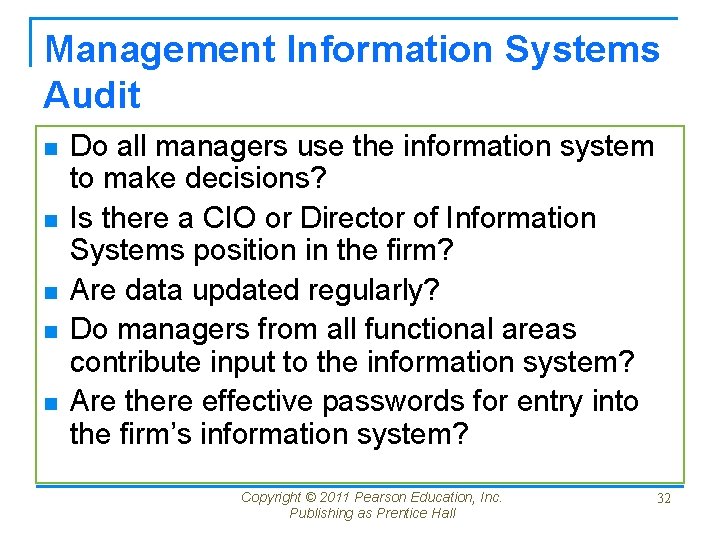
Management Information Systems Audit n n n Do all managers use the information system to make decisions? Is there a CIO or Director of Information Systems position in the firm? Are data updated regularly? Do managers from all functional areas contribute input to the information system? Are there effective passwords for entry into the firm’s information system? Copyright © 2011 Pearson Education, Inc. Publishing as Prentice Hall 32
Management Information Systems Audit n n n Are strategists of the firm familiar with the information systems of rival firms? Is the information system user-friendly? Do all users understand the competitive advantages that information can provide? Are computer training workshops provided for users? Is the firm’s system being improved? Copyright © 2011 Pearson Education, Inc. Publishing as Prentice Hall 33
Internal Factor Evaluation (IFE) Matrix 1. List key internal factors 2. Assign a weight ranging from 0. 0 to 1. 0 3. Assign a 1 to 4 rating to each factor 4. Multiply the weight times the rating 5. Sum the weighted scores Copyright © 2011 Pearson Education, Inc. Publishing as Prentice Hall 34