
Chapter 3 The External Assessment Strategic Management Concepts
- Slides: 41
Chapter 3 The External Assessment Strategic Management: Concepts and Cases. 9 th edition Fred R. David Power. Point Slides by Anthony F. Chelte Western New England College Fred R. David Prentice Hall Ch. 3 -1
Chapter Outline • • The Nature of an External Audit The Industrial Organization View Economic Forces Social, Cultural, Demographic, and Environmental Forces Fred R. David Prentice Hall Ch. 3 -2
Chapter Outline • Political, Governmental, and Legal Forces • Technological Forces • Competitive Forces Fred R. David Prentice Hall Ch. 3 -3
The External Assessment Prediction is very difficult, especially about the future. -- Neils Bohr Fred R. David Prentice Hall Ch. 3 -4
External Strategic Management Audit Also called: – Environmental scanning – Industry analysis Fred R. David Prentice Hall Ch. 3 -5
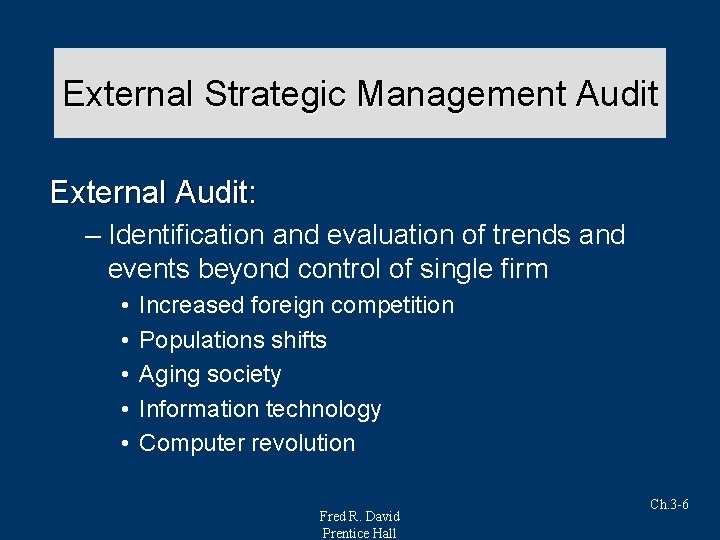
External Strategic Management Audit External Audit: – Identification and evaluation of trends and events beyond control of single firm • • • Increased foreign competition Populations shifts Aging society Information technology Computer revolution Fred R. David Prentice Hall Ch. 3 -6
The Industrial Organization (I/O) View • The Industrial Organization (I/O) approach to competitive advantage advocates that external (industry) factors are more important than internal factors in a firm achieving competitive advantage. Fred R. David Prentice Hall Ch. 3 -7
Nature of External Audit Purpose: – Development of Finite List: • Opportunities • Threats to be avoided Fred R. David Prentice Hall Ch. 3 -8
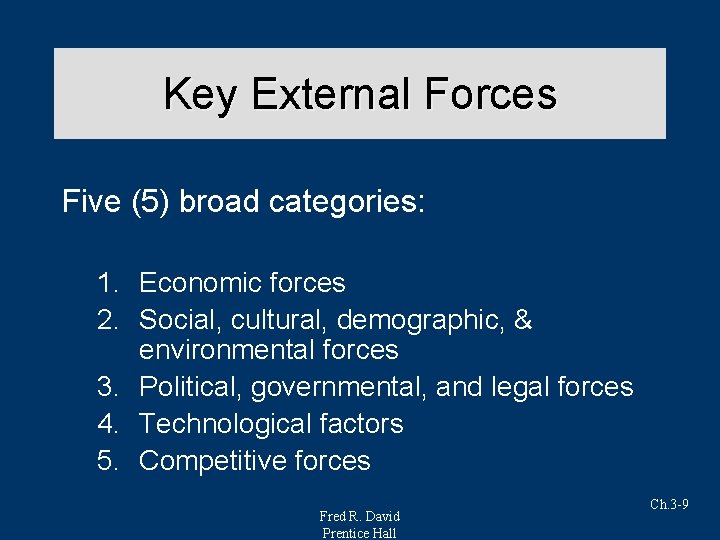
Key External Forces Five (5) broad categories: 1. Economic forces 2. Social, cultural, demographic, & environmental forces 3. Political, governmental, and legal forces 4. Technological factors 5. Competitive forces Fred R. David Prentice Hall Ch. 3 -9
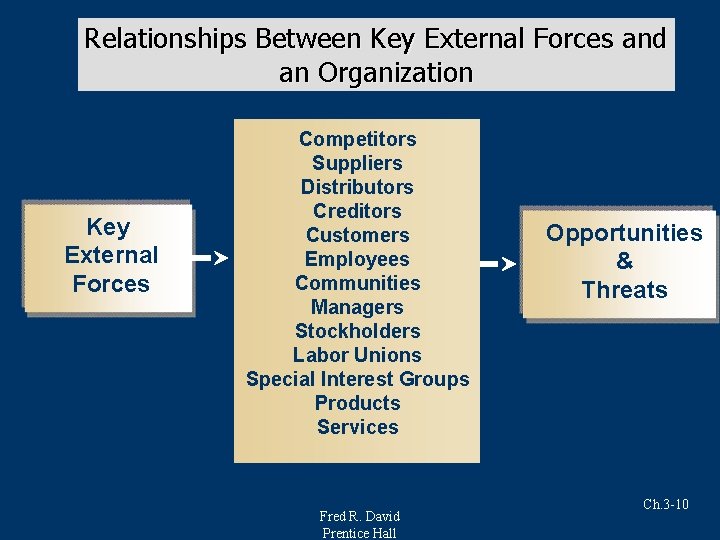
Relationships Between Key External Forces and an Organization Key External Forces Competitors Suppliers Distributors Creditors Customers Employees Communities Managers Stockholders Labor Unions Special Interest Groups Products Services Fred R. David Prentice Hall Opportunities & Threats Ch. 3 -10
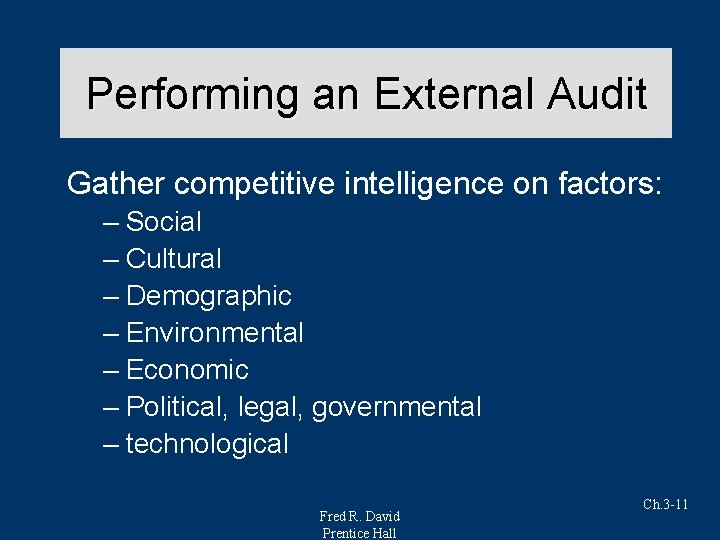
Performing an External Audit Gather competitive intelligence on factors: – Social – Cultural – Demographic – Environmental – Economic – Political, legal, governmental – technological Fred R. David Prentice Hall Ch. 3 -11
Performing an External Audit Key factors: – Vary over time – Vary by industry Fred R. David Prentice Hall Ch. 3 -12
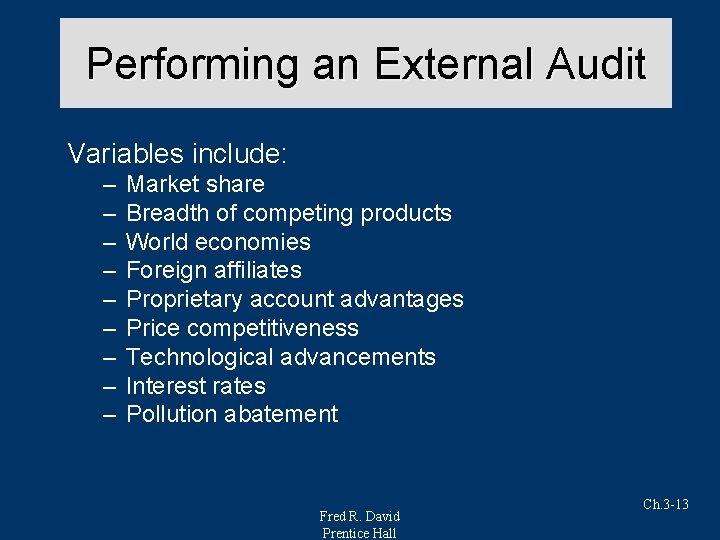
Performing an External Audit Variables include: – – – – – Market share Breadth of competing products World economies Foreign affiliates Proprietary account advantages Price competitiveness Technological advancements Interest rates Pollution abatement Fred R. David Prentice Hall Ch. 3 -13
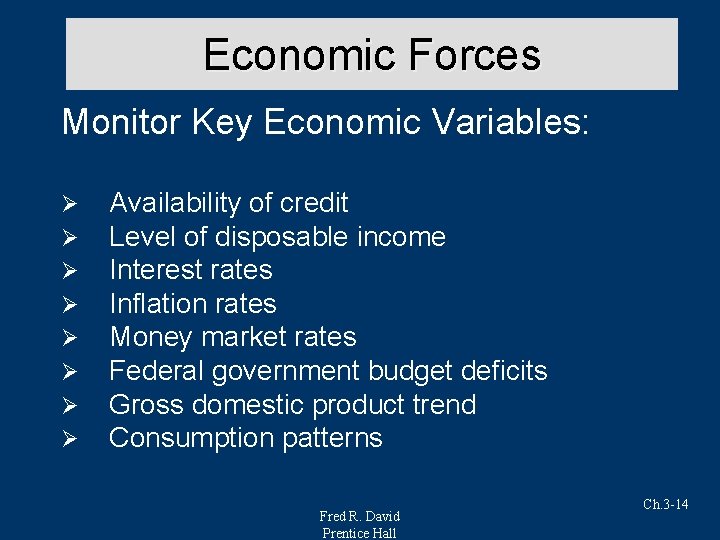
Economic Forces Monitor Key Economic Variables: Ø Ø Ø Ø Availability of credit Level of disposable income Interest rates Inflation rates Money market rates Federal government budget deficits Gross domestic product trend Consumption patterns Fred R. David Prentice Hall Ch. 3 -14
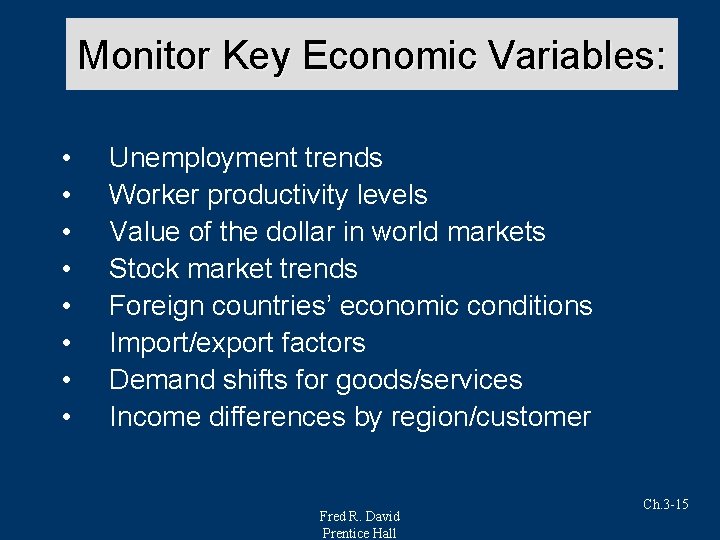
Monitor Key Economic Variables: • • • Unemployment trends Worker productivity levels Value of the dollar in world markets Stock market trends Foreign countries’ economic conditions Import/export factors Demand shifts for goods/services Income differences by region/customer Fred R. David Prentice Hall Ch. 3 -15
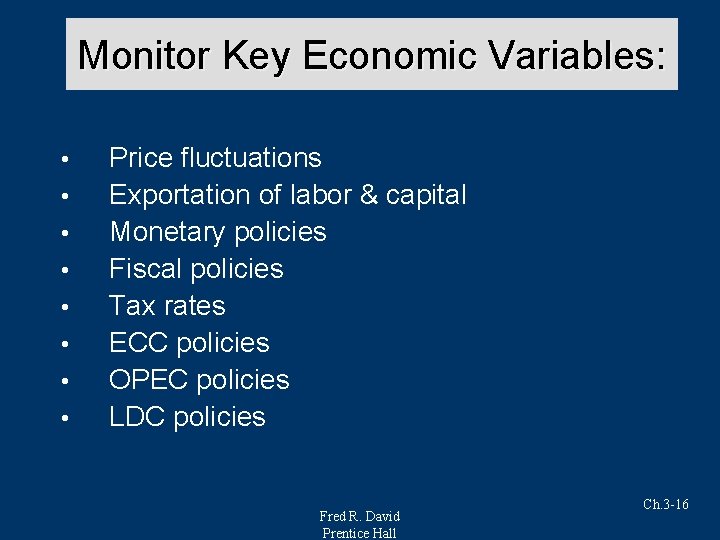
Monitor Key Economic Variables: • • Price fluctuations Exportation of labor & capital Monetary policies Fiscal policies Tax rates ECC policies OPEC policies LDC policies Fred R. David Prentice Hall Ch. 3 -16
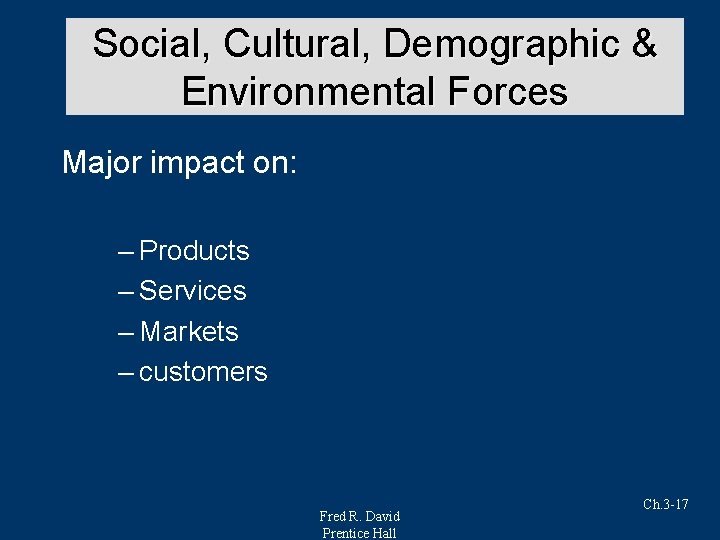
Social, Cultural, Demographic & Environmental Forces Major impact on: – Products – Services – Markets – customers Fred R. David Prentice Hall Ch. 3 -17
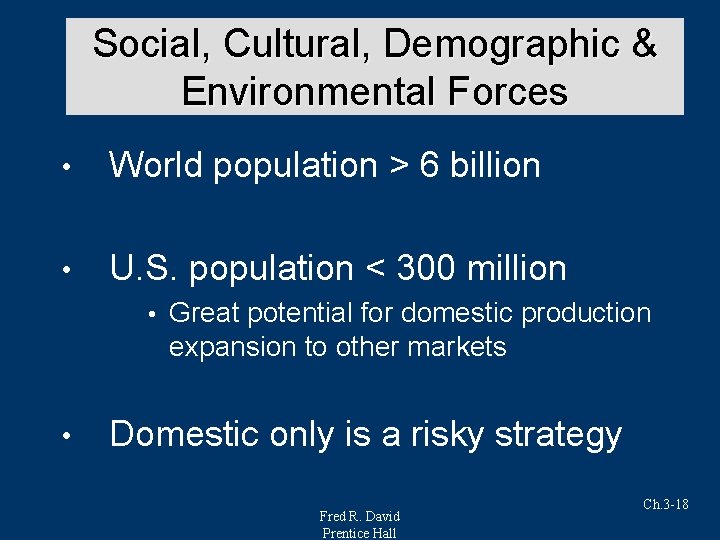
Social, Cultural, Demographic & Environmental Forces • World population > 6 billion • U. S. population < 300 million • • Great potential for domestic production expansion to other markets Domestic only is a risky strategy Fred R. David Prentice Hall Ch. 3 -18
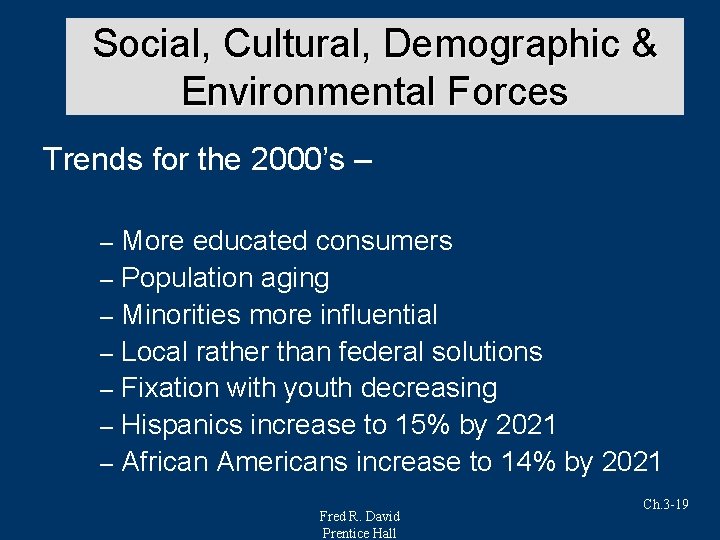
Social, Cultural, Demographic & Environmental Forces Trends for the 2000’s – More educated consumers – Population aging – Minorities more influential – Local rather than federal solutions – Fixation with youth decreasing – Hispanics increase to 15% by 2021 – African Americans increase to 14% by 2021 – Fred R. David Prentice Hall Ch. 3 -19
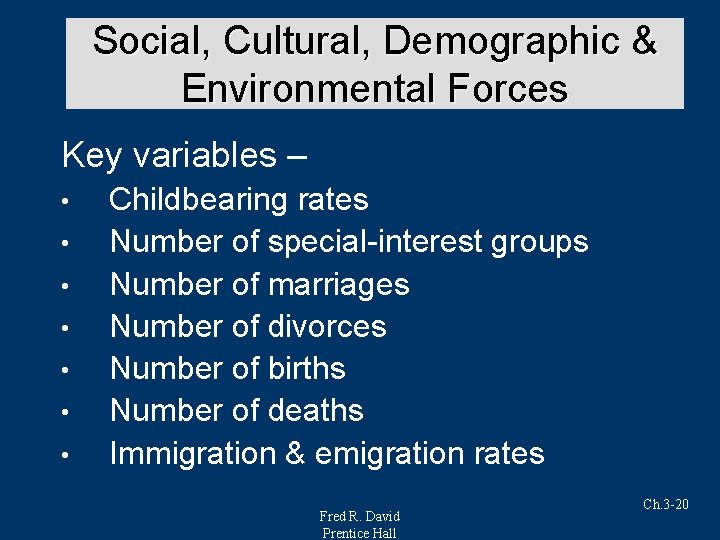
Social, Cultural, Demographic & Environmental Forces Key variables – • • Childbearing rates Number of special-interest groups Number of marriages Number of divorces Number of births Number of deaths Immigration & emigration rates Fred R. David Prentice Hall Ch. 3 -20
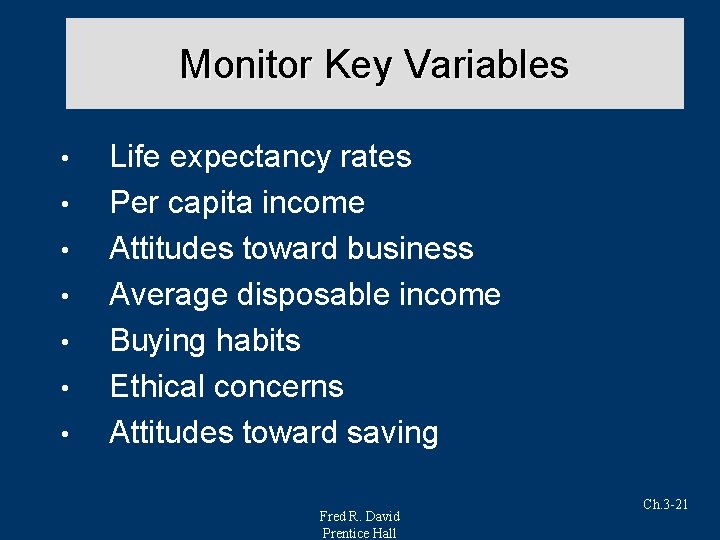
Monitor Key Variables • • Life expectancy rates Per capita income Attitudes toward business Average disposable income Buying habits Ethical concerns Attitudes toward saving Fred R. David Prentice Hall Ch. 3 -21
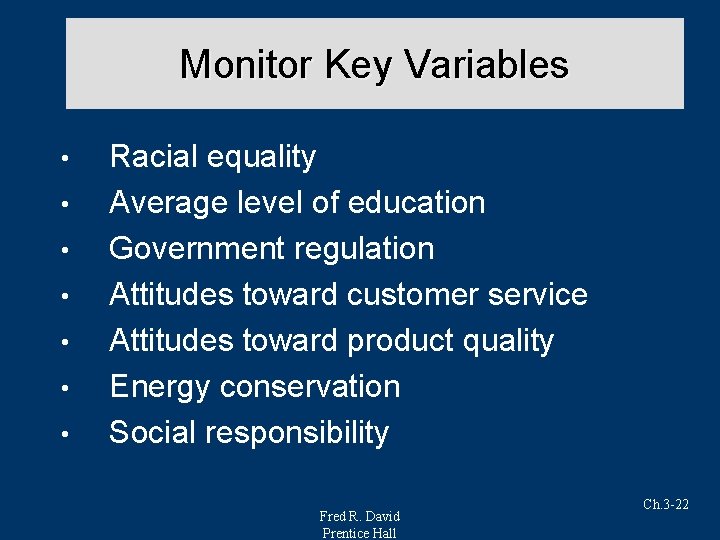
Monitor Key Variables • • Racial equality Average level of education Government regulation Attitudes toward customer service Attitudes toward product quality Energy conservation Social responsibility Fred R. David Prentice Hall Ch. 3 -22
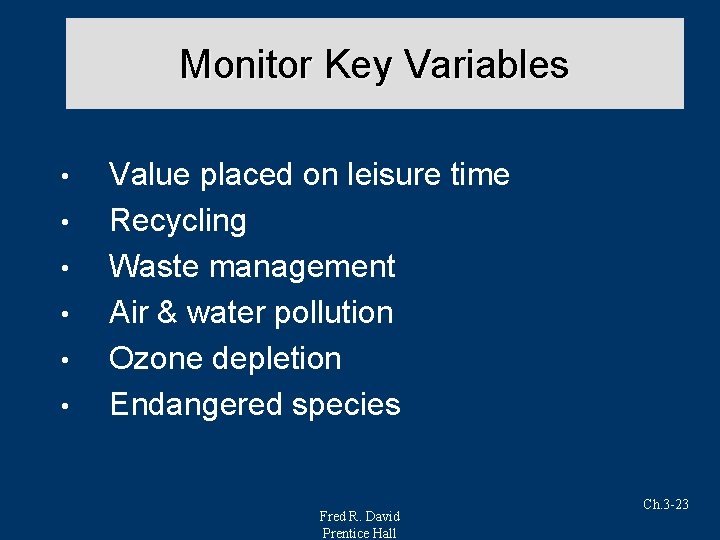
Monitor Key Variables • • • Value placed on leisure time Recycling Waste management Air & water pollution Ozone depletion Endangered species Fred R. David Prentice Hall Ch. 3 -23
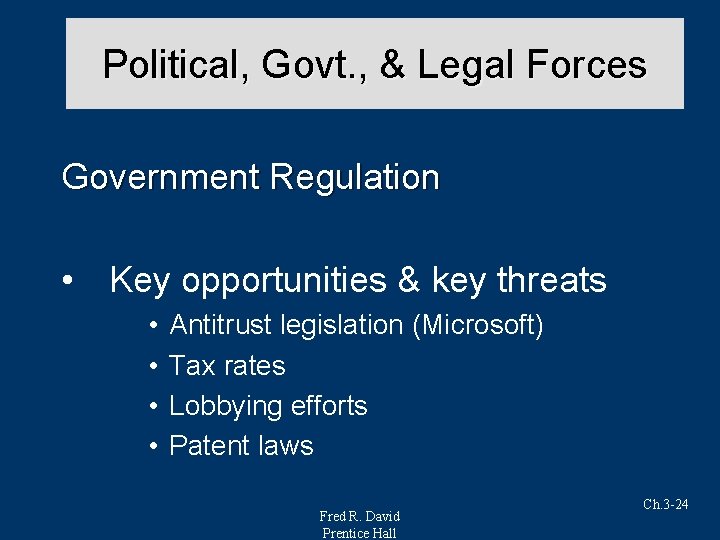
Political, Govt. , & Legal Forces Government Regulation • Key opportunities & key threats • • Antitrust legislation (Microsoft) Tax rates Lobbying efforts Patent laws Fred R. David Prentice Hall Ch. 3 -24
Political, Govt. , & Legal Forces Increasing Global Interdependence • Impact of political variables – Formulation of Strategies – Implementation of Strategies Fred R. David Prentice Hall Ch. 3 -25
Political, Govt. , & Legal Forces Increasing Global Interdependence • Strategists in a global economy Forecast political climates • Legalistic skills • Diverse world cultures • Fred R. David Prentice Hall Ch. 3 -26
Political, Govt. , & Legal Forces Globalization of Industry • Worldwide trend toward similar consumption patterns • Global buyers & sellers • E-commerce • Instant transmission of money & information across continents Fred R. David Prentice Hall Ch. 3 -27
Political, Govt. , & Legal Forces Key Political, govt. , & legal variables: • • Government regulation/deregulation Tax law changes Special tariffs Political Action Committees (PACs) Voter participation rates Number of patents Changes in patent laws Fred R. David Prentice Hall Ch. 3 -28
Technological Forces Internet changes the nature of opportunities and threats - • • • Alters life cycle of products Increases speed of distribution Creates new products and services Eases limitations of geographic markets Alters economies of scale Changes entry barriers Fred R. David Prentice Hall Ch. 3 -29
Technological Forces Capitalizing on Information Technology (IT) • Chief Information Officer (CIO) • Chief Technology Officer (CTO) Fred R. David Prentice Hall Ch. 3 -30
Technological Forces Technology-based issues – Underlie nearly every strategic decision Fred R. David Prentice Hall Ch. 3 -31
Strategy and Future Forecast • Linear regression is based on the assumption that the future will be just like the past. Fred R. David Prentice Hall Ch. 3 -32
Competitive Forces Collection and evaluation of information on competitors is essential for successful strategy formulation Fred R. David Prentice Hall Ch. 3 -33
Competitive Forces Competition in virtually all industries can be described as intense. Fred R. David Prentice Hall Ch. 3 -34
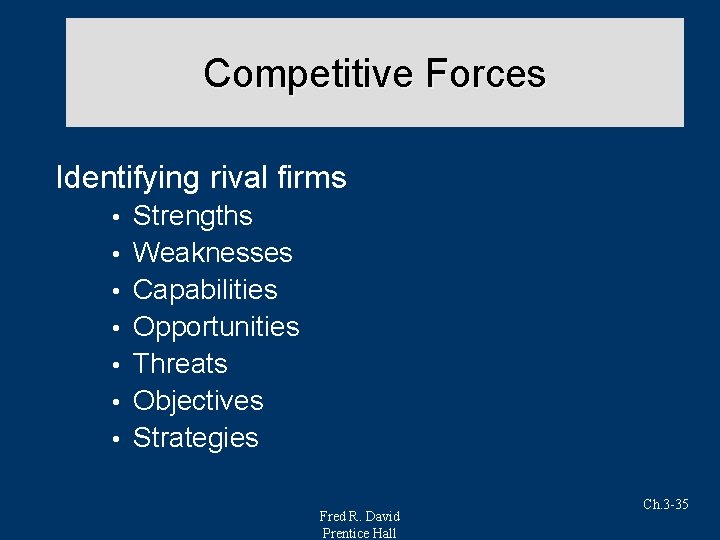
Competitive Forces Identifying rival firms • • Strengths Weaknesses Capabilities Opportunities Threats Objectives Strategies Fred R. David Prentice Hall Ch. 3 -35
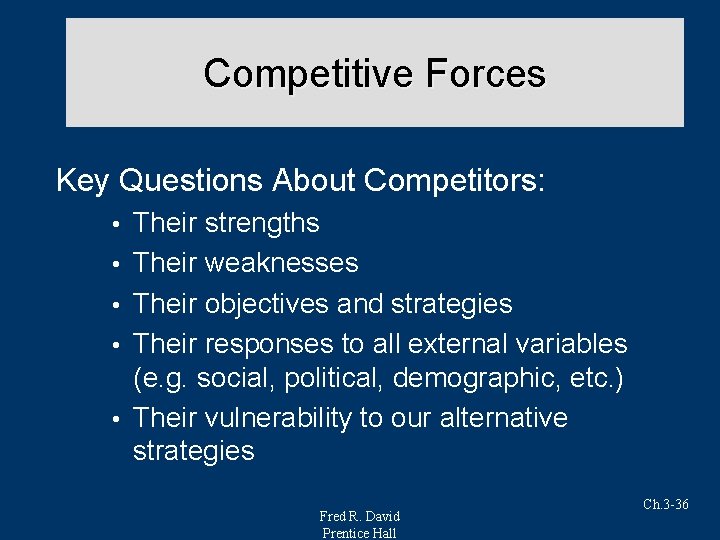
Competitive Forces Key Questions About Competitors: • • • Their strengths Their weaknesses Their objectives and strategies Their responses to all external variables (e. g. social, political, demographic, etc. ) Their vulnerability to our alternative strategies Fred R. David Prentice Hall Ch. 3 -36
Competitive Forces Key Questions About Competitors: Our vulnerability to successful strategic counterattack • Our product and service positioning relative to competitors • Entry and exit of firms in the industry • Key factors for our current position in industry • Fred R. David Prentice Hall Ch. 3 -37
Competitive Forces Key Questions About Competitors: Sales and profit rankings of competitors over time • Nature of supplier and distributor relationships • The threat of substitute products or services • Fred R. David Prentice Hall Ch. 3 -38
Competitive Forces Sources of Corporate Information: • • Moody’s Manuals Standard Corporation Descriptions Value Line Investment Surveys Dun’s Business Rankings Standard & Poor’s Industry Surveys Industry Week Forbes, Fortune, Business Week Fred R. David Prentice Hall Ch. 3 -39
Competitive Forces Competitive Intelligence Programs: • Systematic and ethical process for gathering and analyzing information about the competition’s activities and general business trends to further a business’ own goals. Fred R. David Prentice Hall Ch. 3 -40
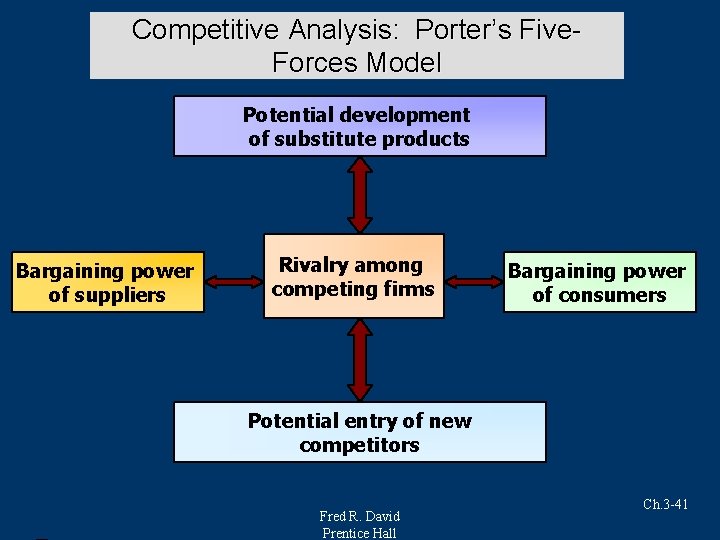
Competitive Analysis: Porter’s Five. Forces Model Potential development of substitute products Bargaining power of suppliers Rivalry among competing firms Bargaining power of consumers Potential entry of new competitors Fred R. David Prentice Hall Ch. 3 -41