Chapter 34 Comfort and Pain Management Copyright 2011

- Slides: 39
Chapter 34 Comfort and Pain Management Copyright © 2011 Wolters Kluwer Health | Lippincott Williams & Wilkins
Categories of Pain • Duration – Acute – Chronic • Location or source • Mode of transmission • Etiology Copyright © 2015 Wolters Kluwer • All Rights Reserved
Sources of Pain • Nociceptive • Cutaneous • Somatic • Visceral • Neuropathic Copyright © 2015 Wolters Kluwer • All Rights Reserved
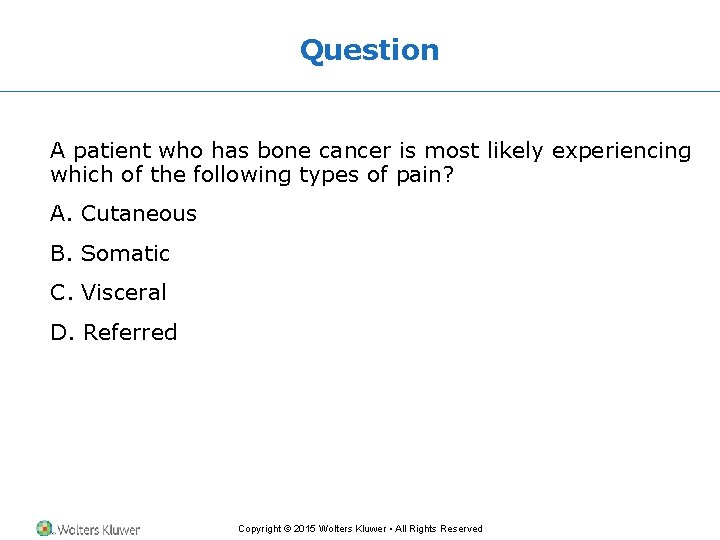
Question A patient who has bone cancer is most likely experiencing which of the following types of pain? A. Cutaneous B. Somatic C. Visceral D. Referred Copyright © 2015 Wolters Kluwer • All Rights Reserved
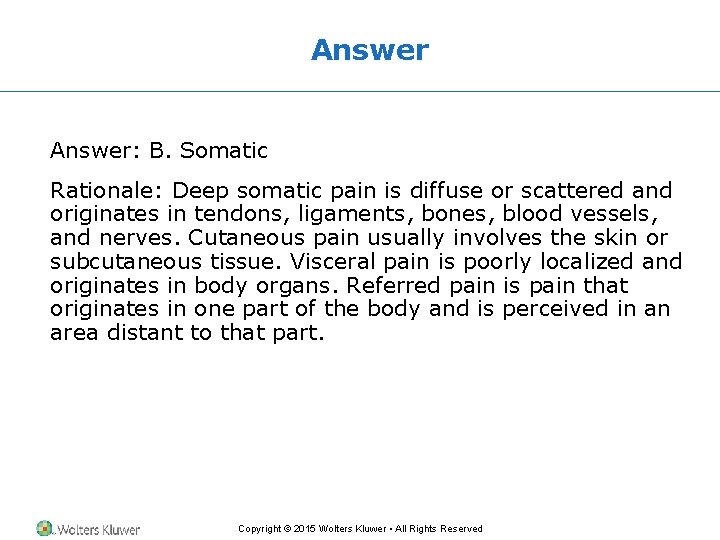
Answer: B. Somatic Rationale: Deep somatic pain is diffuse or scattered and originates in tendons, ligaments, bones, blood vessels, and nerves. Cutaneous pain usually involves the skin or subcutaneous tissue. Visceral pain is poorly localized and originates in body organs. Referred pain is pain that originates in one part of the body and is perceived in an area distant to that part. Copyright © 2015 Wolters Kluwer • All Rights Reserved
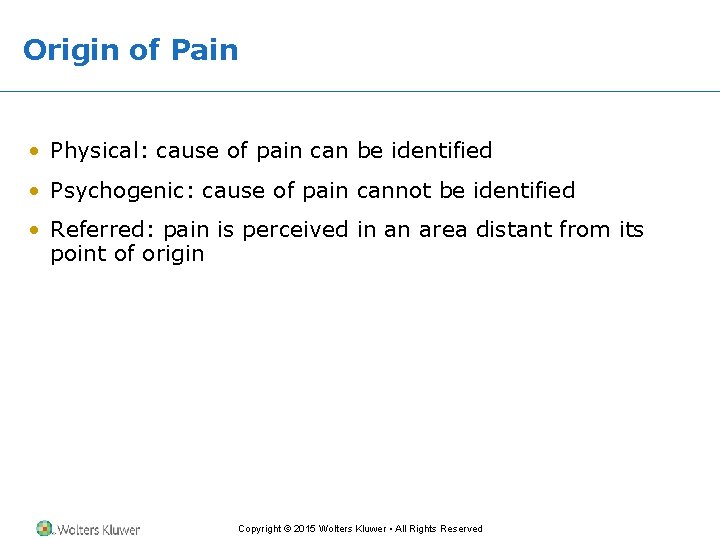
Origin of Pain • Physical: cause of pain can be identified • Psychogenic: cause of pain cannot be identified • Referred: pain is perceived in an area distant from its point of origin Copyright © 2015 Wolters Kluwer • All Rights Reserved
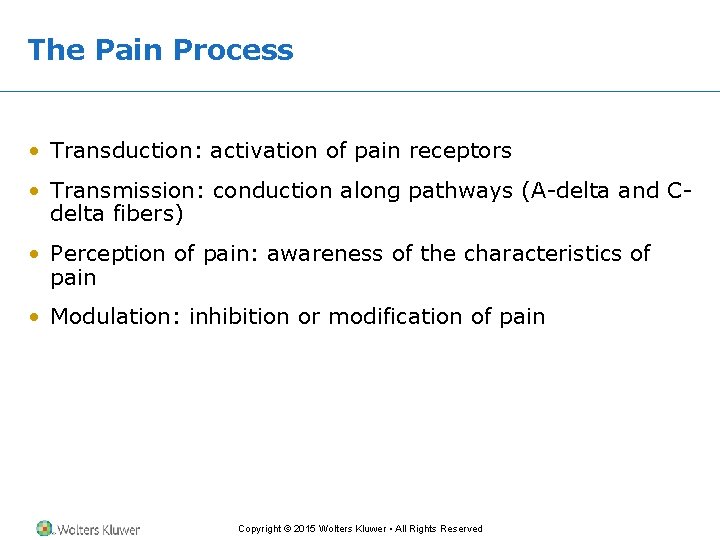
The Pain Process • Transduction: activation of pain receptors • Transmission: conduction along pathways (A-delta and Cdelta fibers) • Perception of pain: awareness of the characteristics of pain • Modulation: inhibition or modification of pain Copyright © 2015 Wolters Kluwer • All Rights Reserved
Stimulator of Nociceptors or Pain Receptors • Bradykinin: a powerful vasodilator that increases capillary permeability and constricts smooth muscle • Prostaglandins: important hormone-like substances that send additional pain stimuli to the CNS • Substance P: sensitizes receptors on nerves to feel pain and also increases the rate of firing of nerves Copyright © 2015 Wolters Kluwer • All Rights Reserved
Gate Control Theory of Pain • Describes the transmission of painful stimuli and recognizes a relationship between pain and emotions • Small- and large-diameter nerve fibers conduct and inhibit pain stimuli toward the brain. • Gating mechanism determines the impulses that reach the brain. Copyright © 2015 Wolters Kluwer • All Rights Reserved
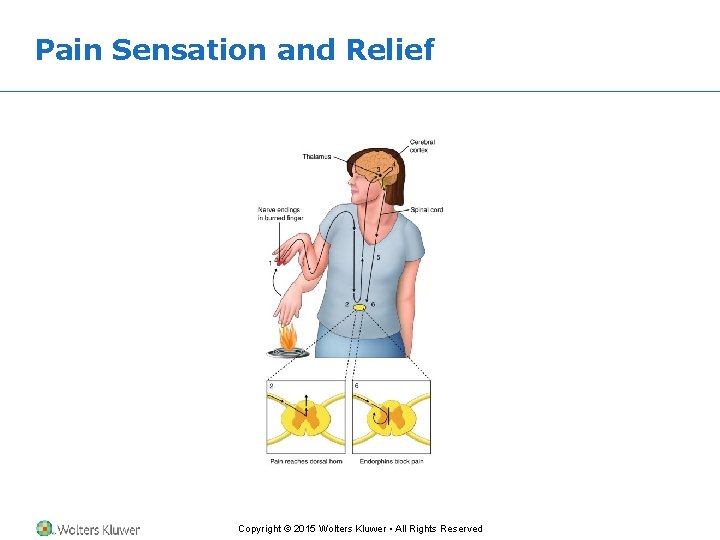
Perception of Pain • Pain threshold • Adaptation • Modulation of pain – Neuromodulators – Endorphins, dynorphins, enkephalins Copyright © 2015 Wolters Kluwer • All Rights Reserved
Question Which modulator of pain is thought to reduce pain sensation by inhibiting the release of substance P from the terminals of afferent neurons? A. Endorphins B. Dynorphins C. Enkephalins D. Nociceptors Copyright © 2015 Wolters Kluwer • All Rights Reserved
Answer: C. Enkephalins Rationale: Enkephalins are thought to reduce pain by inhibiting the release of substance P from the terminals of afferent neurons. Endorphins and dynorphins are released when certain measures are used to relieve pain. Nociceptors are the peripheral nerve fibers that transmit pain. Copyright © 2015 Wolters Kluwer • All Rights Reserved
Pain Sensation and Relief Copyright © 2015 Wolters Kluwer • All Rights Reserved
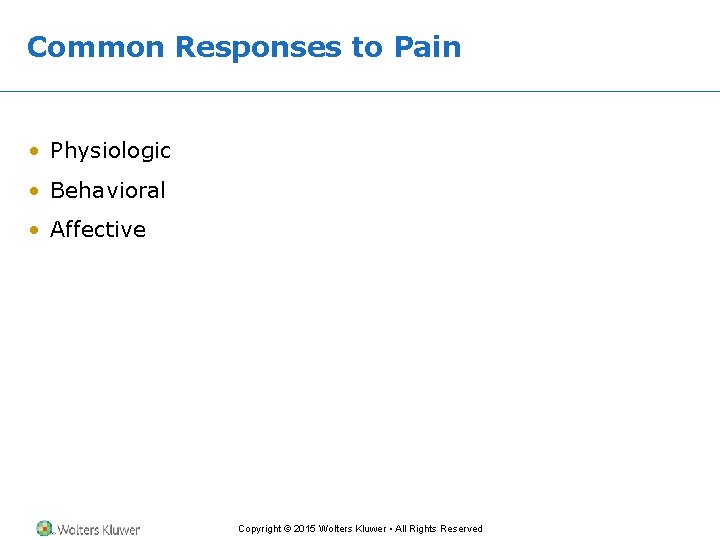
Common Responses to Pain • Physiologic • Behavioral • Affective Copyright © 2015 Wolters Kluwer • All Rights Reserved
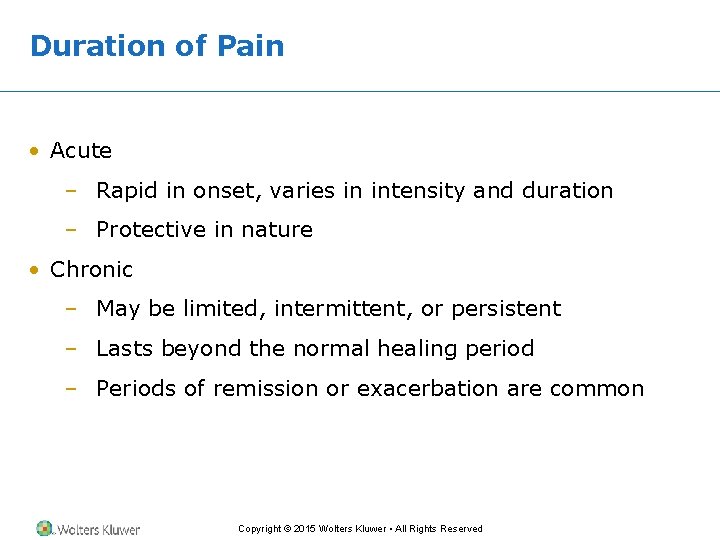
Duration of Pain • Acute – Rapid in onset, varies in intensity and duration – Protective in nature • Chronic – May be limited, intermittent, or persistent – Lasts beyond the normal healing period – Periods of remission or exacerbation are common Copyright © 2015 Wolters Kluwer • All Rights Reserved
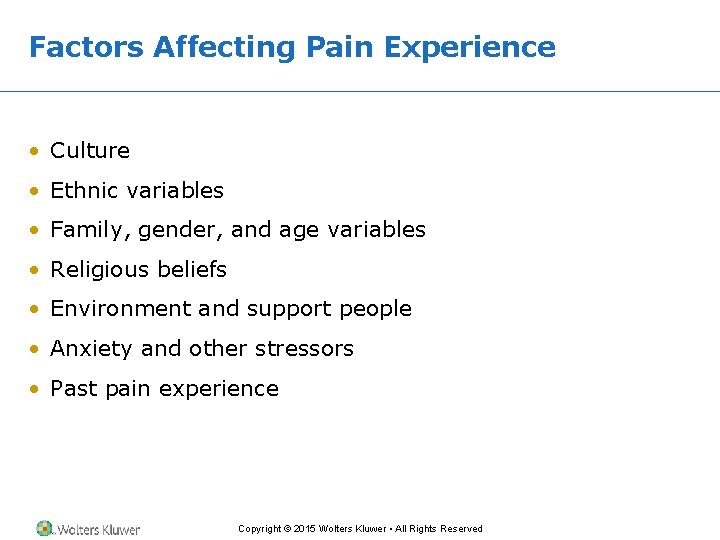
Factors Affecting Pain Experience • Culture • Ethnic variables • Family, gender, and age variables • Religious beliefs • Environment and support people • Anxiety and other stressors • Past pain experience Copyright © 2015 Wolters Kluwer • All Rights Reserved
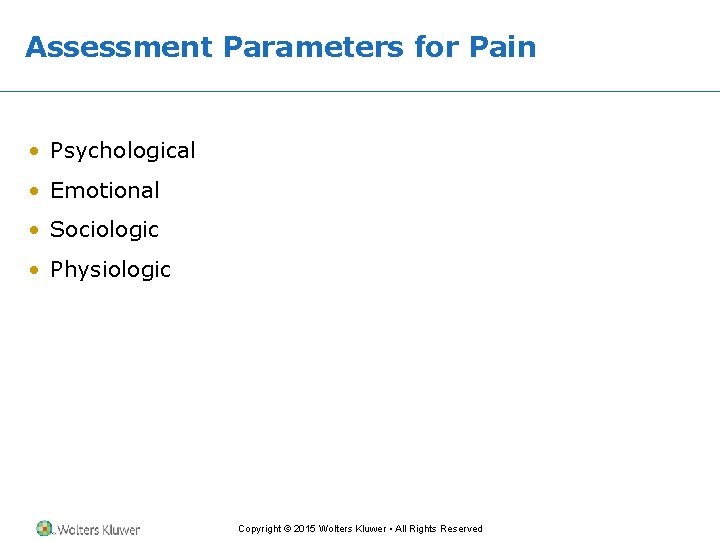
Assessment Parameters for Pain • Psychological • Emotional • Sociologic • Physiologic Copyright © 2015 Wolters Kluwer • All Rights Reserved
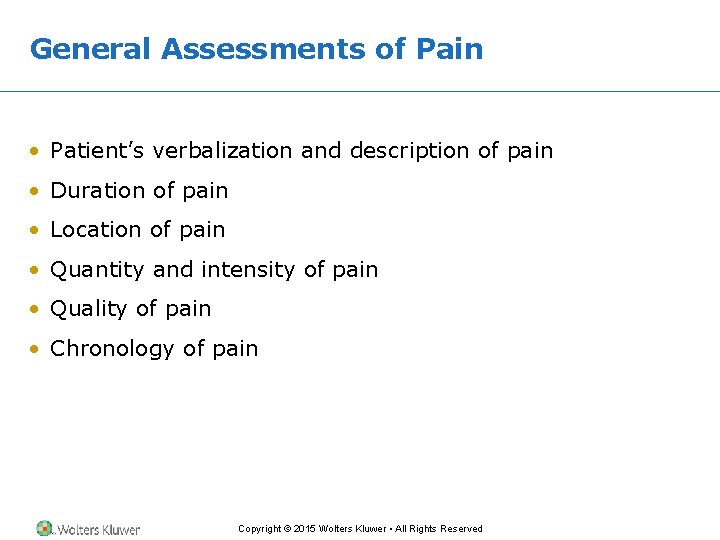
General Assessments of Pain • Patient’s verbalization and description of pain • Duration of pain • Location of pain • Quantity and intensity of pain • Quality of pain • Chronology of pain Copyright © 2015 Wolters Kluwer • All Rights Reserved
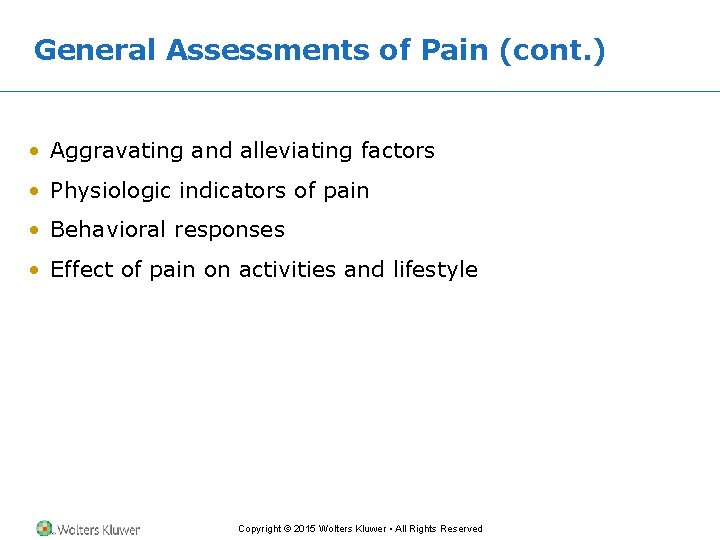
General Assessments of Pain (cont. ) • Aggravating and alleviating factors • Physiologic indicators of pain • Behavioral responses • Effect of pain on activities and lifestyle Copyright © 2015 Wolters Kluwer • All Rights Reserved
Question Tell whether the following statement is true or false. The best judge of the existence and severity of a patient’s pain is the physician or nurse caring for the patient. A. True B. False Copyright © 2015 Wolters Kluwer • All Rights Reserved
Answer: B. False Rationale: The best judge of the existence and severity of a patient’s pain is the patient. Copyright © 2015 Wolters Kluwer • All Rights Reserved
Basic Methods of Assessing Pain (Pasero and Mc. Caffery (20 ll) • Patient self-report • Report of family member, other person close to the patient or caregiver familiar with the person • Nonverbal behaviors: restlessness, grimacing, crying, clenching fists, protecting the painful area • Physiologic measures: increased blood pressure and pulse Copyright © 2015 Wolters Kluwer • All Rights Reserved
Pain Assessment Tools • Wong-Baker FACES • Beyer Oucher pain scale • CRIES pain scale • FLACC scale • COMFORT scale Copyright © 2015 Wolters Kluwer • All Rights Reserved
Question Which following pain assessment tool is recommended for use with neonates ages 0 to 6 months? A. Oucher pain scale B. Wong-Baker FACES C. FLACC pain scale D. CRIES pain scale Copyright © 2015 Wolters Kluwer • All Rights Reserved
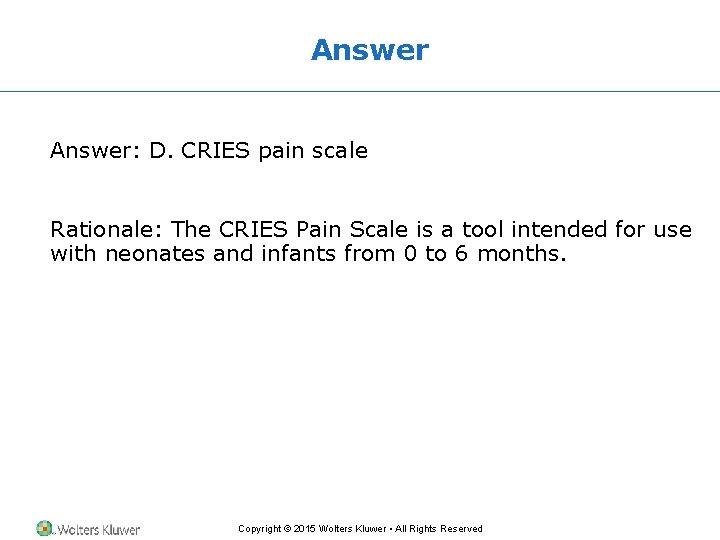
Answer: D. CRIES pain scale Rationale: The CRIES Pain Scale is a tool intended for use with neonates and infants from 0 to 6 months. Copyright © 2015 Wolters Kluwer • All Rights Reserved
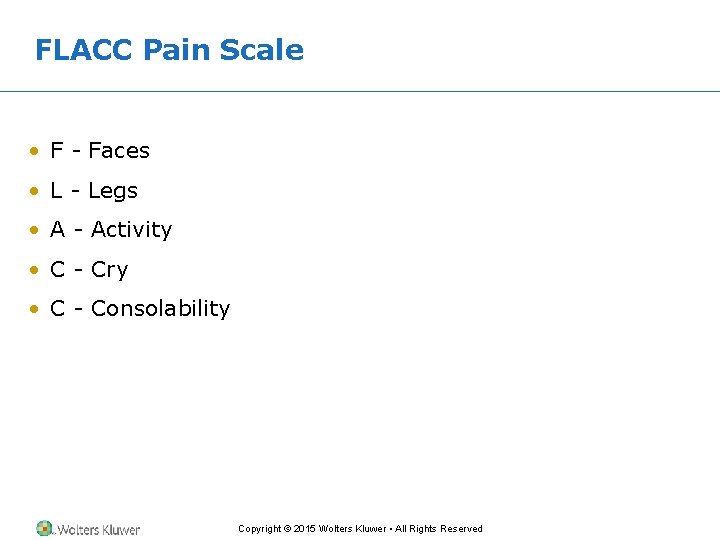
FLACC Pain Scale • F - Faces • L - Legs • A - Activity • C - Cry • C - Consolability Copyright © 2015 Wolters Kluwer • All Rights Reserved
Diagnosing Pain • Type of pain • Etiologic factors • Behavioral, physiologic, affective response • Other factors affecting pain process Copyright © 2015 Wolters Kluwer • All Rights Reserved
Nursing Interventions for Pain • Establishing trusting nurse–patient relationship • Manipulating factors affecting pain experience • Initiating nonpharmacologic pain relief measures • Managing pharmacologic interventions • Reviewing additional pain control measures, including complementary and alternative relief measures • Considering ethical and legal responsibility to relieve pain • Teaching patient about pain Copyright © 2015 Wolters Kluwer • All Rights Reserved
Manipulating Pain Experience Factors • Remove or alter cause of pain. • Alter factors affecting pain tolerance. • Initiate nonpharmacologic relief measures. Copyright © 2015 Wolters Kluwer • All Rights Reserved
Nonpharmacologic Pain Relief Measures • Distraction • Humor • Music • Imagery • Relaxation • Cutaneous stimulation • Acupuncture Copyright © 2015 Wolters Kluwer • All Rights Reserved
Nonpharmacologic Pain Relief Measures (cont. ) • Hypnosis • Biofeedback • Therapeutic touch • Animal-facilitated therapy Copyright © 2015 Wolters Kluwer • All Rights Reserved
Pharmacologic Pain Relief Measures • Analgesic administration • Nonopioid analgesics • Opioids or narcotic analgesics • Adjuvant drugs Copyright © 2015 Wolters Kluwer • All Rights Reserved
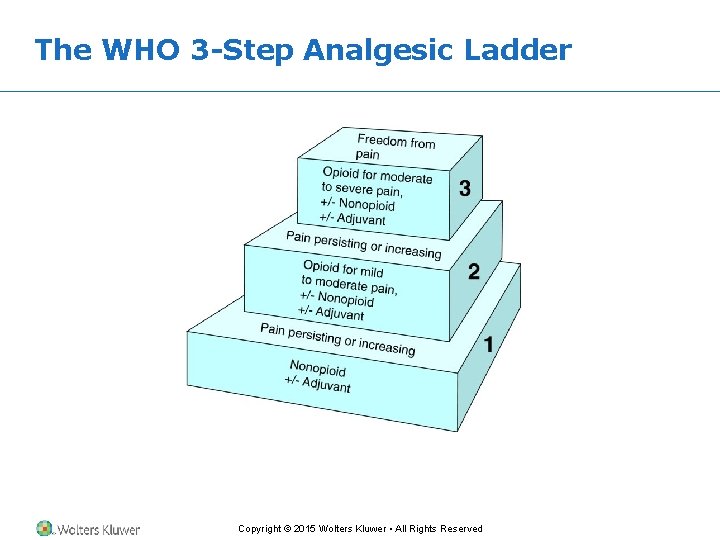
The WHO 3 -Step Analgesic Ladder Copyright © 2015 Wolters Kluwer • All Rights Reserved
Question A sedated patient is frequently drowsy and drifts off during his conversation with the nurse. What number on the sedation scale best describes this patient? A. 1 B. 2 C. 3 D. 4 Copyright © 2015 Wolters Kluwer • All Rights Reserved
Answer: D. 3 Rationale: 3 denotes that the patient is frequently drowsy and hard to awake. 1 means the patient is awake and alert. 2 denotes the patient is occasionally drowsy, but easy to arouse. At 4, the patient is somnolent, with minimal or no response to stimuli. Copyright © 2015 Wolters Kluwer • All Rights Reserved
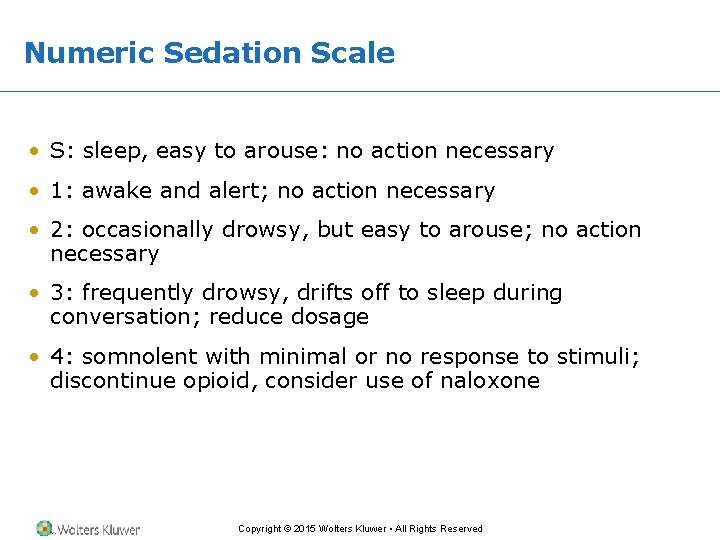
Numeric Sedation Scale • S: sleep, easy to arouse: no action necessary • 1: awake and alert; no action necessary • 2: occasionally drowsy, but easy to arouse; no action necessary • 3: frequently drowsy, drifts off to sleep during conversation; reduce dosage • 4: somnolent with minimal or no response to stimuli; discontinue opioid, consider use of naloxone Copyright © 2015 Wolters Kluwer • All Rights Reserved
Pain Management Regimens for Cancer or Chronic Pain • Give medications orally if possible. • Administer medications ATC rather than PRN. • Adjust the dose to achieve maximum benefit with minimum side effects. • Allow patients as much control as possible over the regimen. Copyright © 2015 Wolters Kluwer • All Rights Reserved
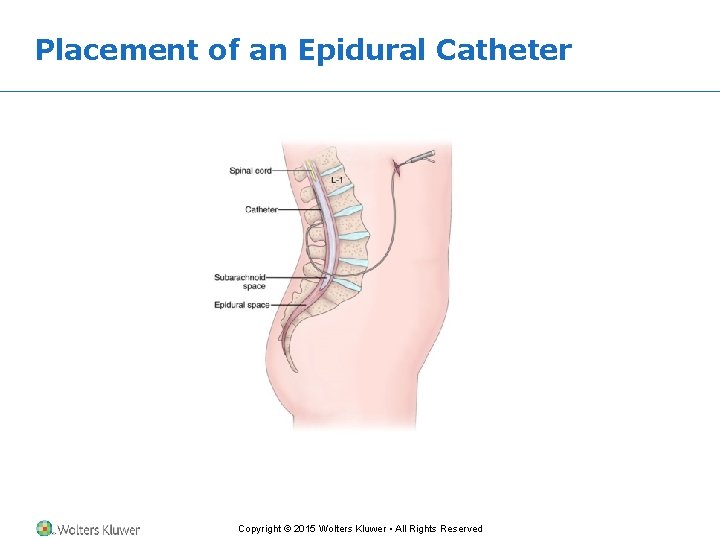
Additional Methods for Administering Analgesics • Patient-controlled analgesia • Epidural analgesia • Local anesthesia Copyright © 2015 Wolters Kluwer • All Rights Reserved
Placement of an Epidural Catheter Copyright © 2015 Wolters Kluwer • All Rights Reserved