
MaternalChild Nursing Care Optimizing Outcomes for Mothers Children










- Slides: 100
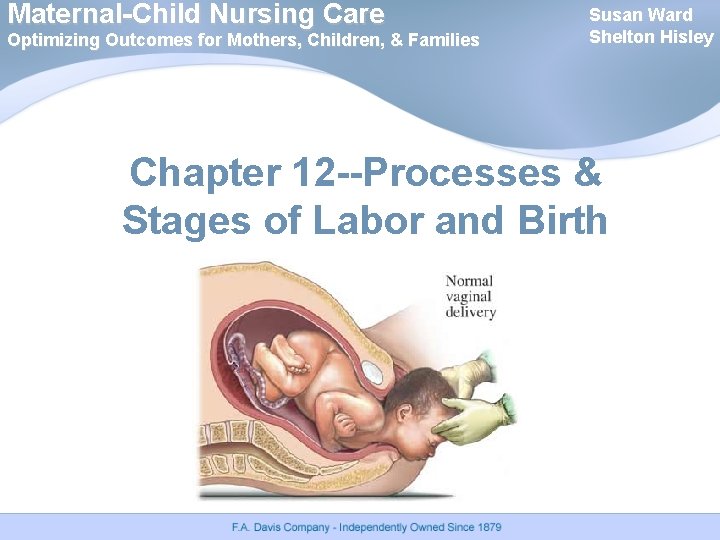
Maternal-Child Nursing Care Optimizing Outcomes for Mothers, Children, & Families Susan Ward Shelton Hisley Chapter 12 --Processes & Stages of Labor and Birth
Critical Factors In Labor § The Four P’s: passage, passenger, powers & psyche § Passage: § adequate pelvis? § cephalopelvic disproportion (CPD) § Suspect if presenting part does not engage in pelvis (0 station)
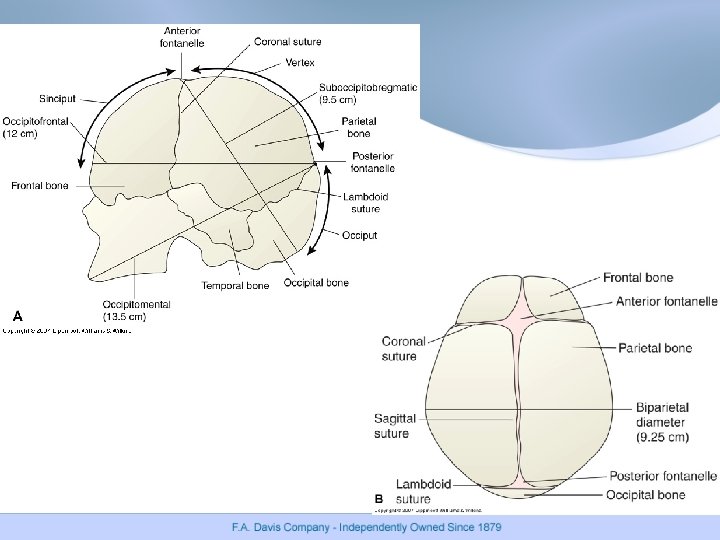
Passenger § The fetus: head is largest diameter § Fetal head: 4 bones with 3 membranous interspaces (sutures) that allow bones to move & overlap to diminish size of skull § Molding: head becomes narrower, longer, sutures can overlap--normal--resolves 1 -2 days after birth § Fontanelles: at junctures of skull bones
Passenger § Fetus and fetal membranes § Molding of head § Fetal lie § Longitudinal § Transverse § Oblique
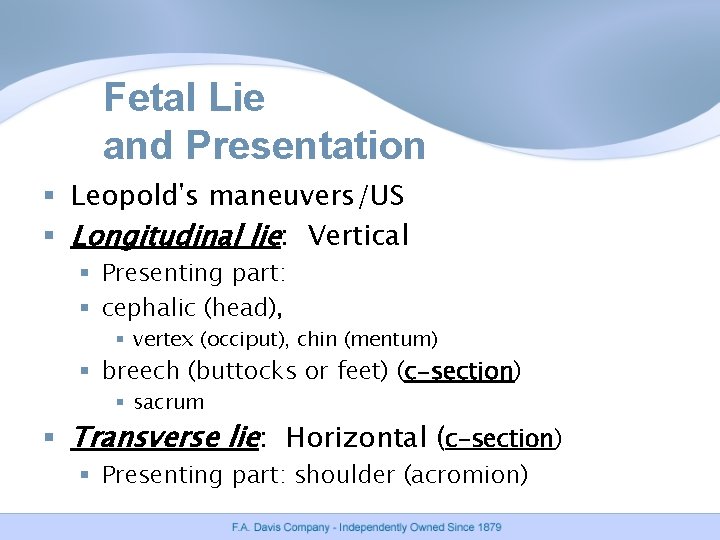
Fetal Lie and Presentation § Leopold's maneuvers/US § Longitudinal lie: Vertical § Presenting part: § cephalic (head), § vertex (occiput), chin (mentum) § breech (buttocks or feet) (c-section) § sacrum § Transverse lie: Horizontal (c-section) § Presenting part: shoulder (acromion)
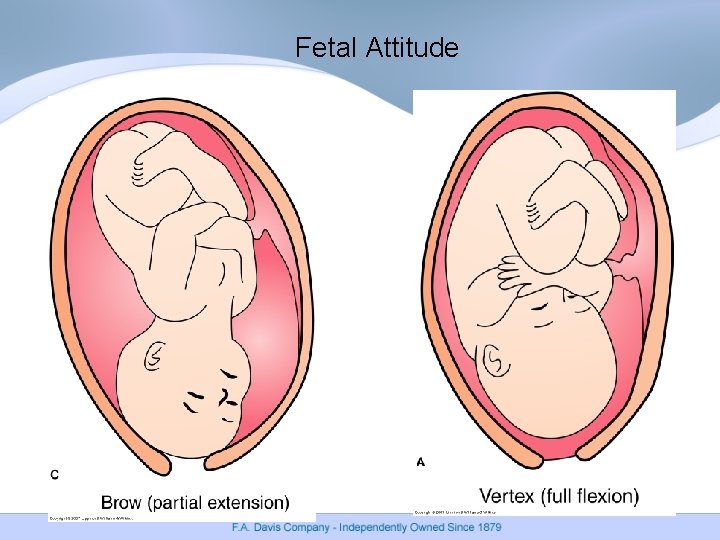
Passenger (cont. ) § Fetal attitude—flexion § Fetal presentation § Cephalic § Vertex § Military § Brow § Face
Fetal Attitude
Advantages of Cephalic Presentations § Head usually largest part of infant § Molding § Optimal shape—smooth and round
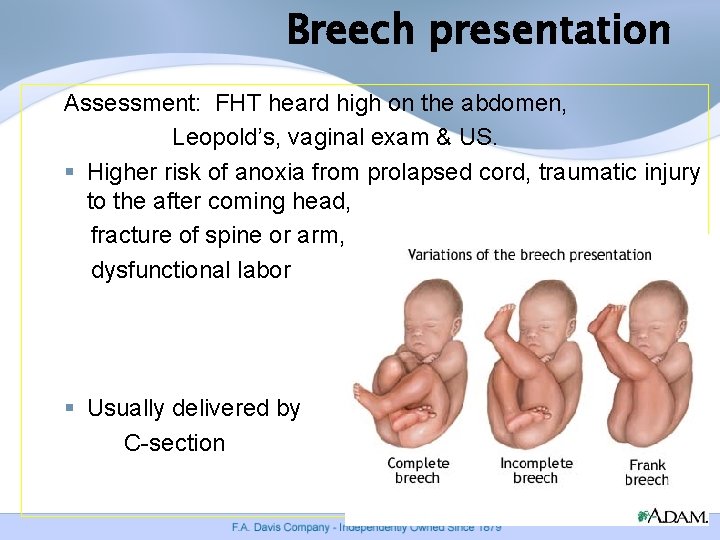
Breech presentation Assessment: FHT heard high on the abdomen, Leopold’s, vaginal exam & US. § Higher risk of anoxia from prolapsed cord, traumatic injury to the after coming head, fracture of spine or arm, dysfunctional labor § Usually delivered by C-section
Disadvantages of Breech Presentation § Risk of cord prolapse § Presenting part less effective in cervical dilation § Risk of cord compression § Risk of prolonged labor
Shoulder Presentation § Occurs when fetus in transverse lie § Cannot be delivered vaginally unless rotation occurs
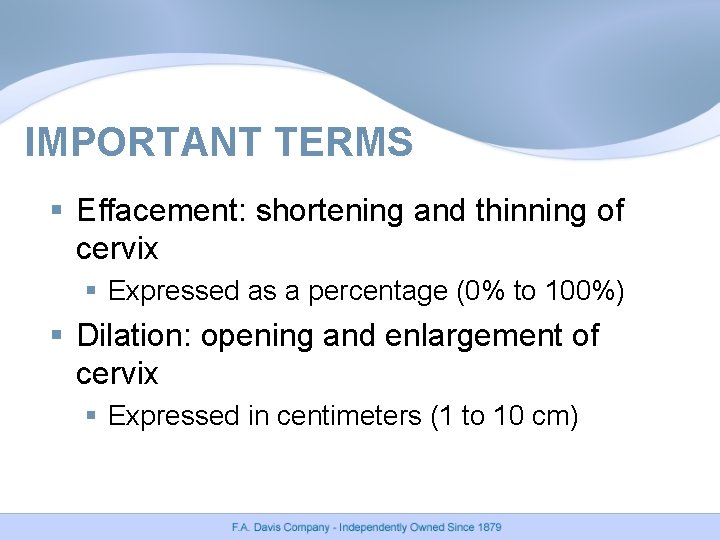
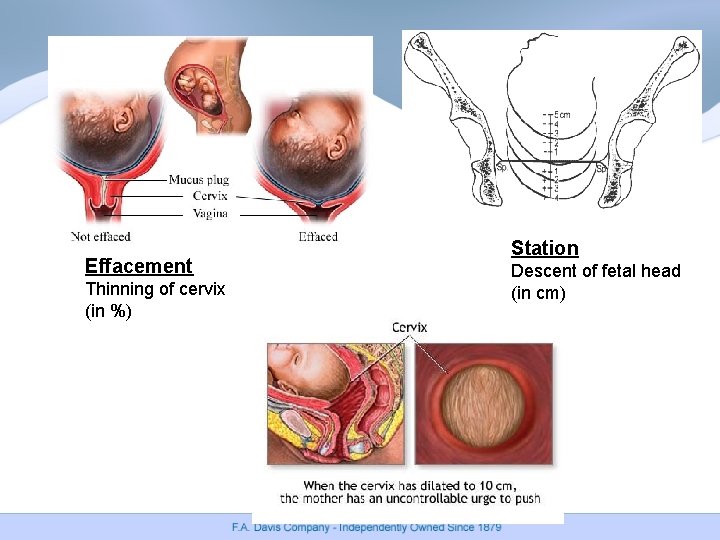
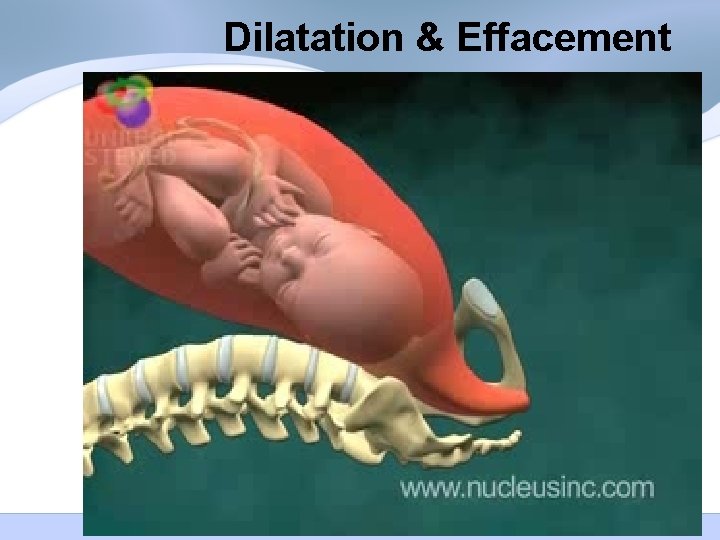
IMPORTANT TERMS § Effacement: shortening and thinning of cervix § Expressed as a percentage (0% to 100%) § Dilation: opening and enlargement of cervix § Expressed in centimeters (1 to 10 cm)
Effacement Thinning of cervix (in %) Station Descent of fetal head (in cm)
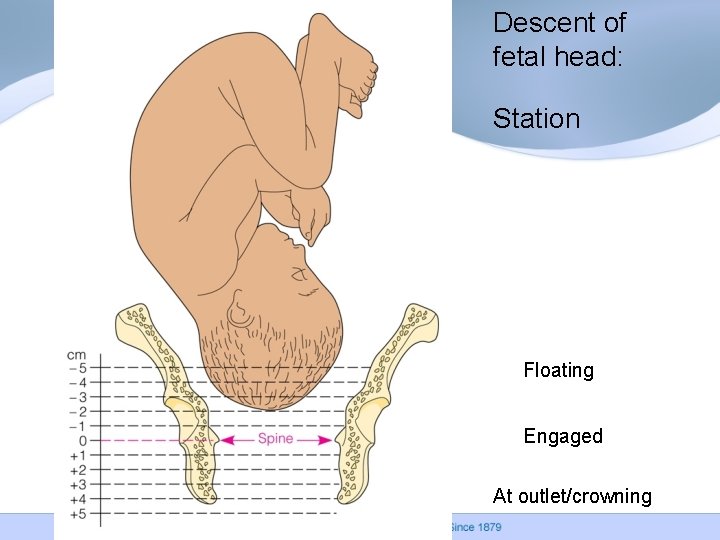
Descent of fetal head: Station Floating Engaged At outlet/crowning
Passageway + Passenger Relationship § Engagement § Station § § Ischial spines— 0 station Above ischial spines—(–) minus station Below ischial spines—(+) plus station +4 cm means that. . .
Powers § Uterine contractions—primary force § Maternal pushing efforts—secondary force § Characteristics of uterine contractions § Increment § Acme § Decrement
Powers Maternal Pushing Efforts § “Bearing down” sensation § Urge to push § No urge to push
Assessment of Uterine Contractions § Characteristics § Frequency § Duration § Intensity § Palpation § Electronic fetal monitoring
Onset of labor § Usually begins between 38 & 42 weeks § Mechanism is unknown § Upper uterus contracts downward pushing presenting part on cervix causing effacement and dilatation § Premonitory signs of labor: § Lightening, Braxton-Hicks contractions (false labor), § cervical changes (ripening), § bloody show (mucous plug), § rupture of membranes (ROM), § sudden burst of energy
False vs True Labor: Contractions False Labor True Labor: § Benign and irregular contractions § Begin irregularly but become regular and predictable § Felt first in lower back and sweep around to the abdomen in a wave § Continue no matter what the women’s level of activity § Increase in duration, frequency, and intensity § Felt first abdominally and remain confined to the abdomen and groin § Often disappear with ambulation and sleep. § Do not increase in duration, frequency or intensity
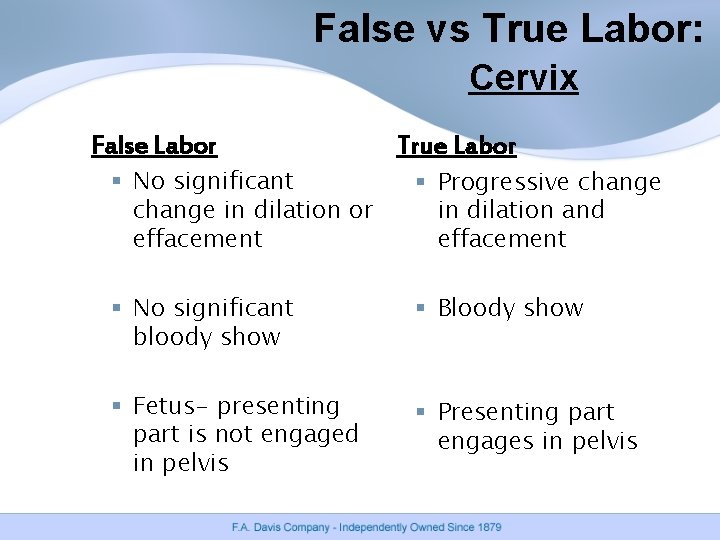
False vs True Labor: Cervix False Labor True Labor § No significant change in dilation or effacement § Progressive change in dilation and effacement § No significant bloody show § Bloody show § Fetus- presenting part is not engaged in pelvis § Presenting part engages in pelvis
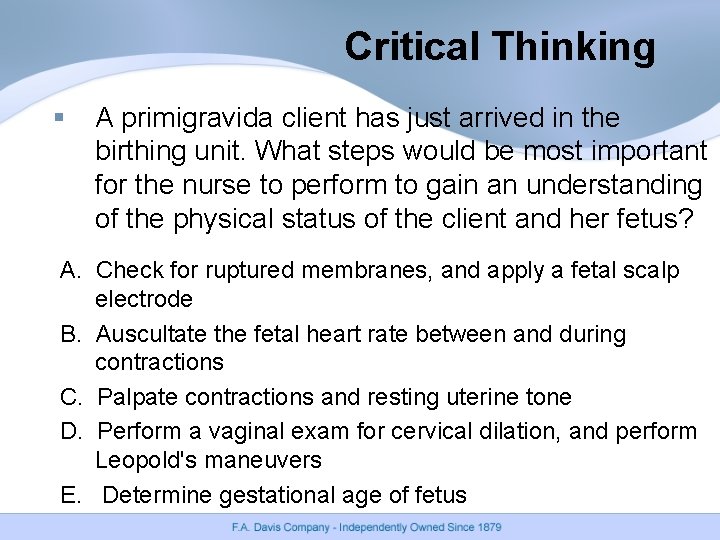
Critical Thinking § A primigravida client has just arrived in the birthing unit. What steps would be most important for the nurse to perform to gain an understanding of the physical status of the client and her fetus? A. Check for ruptured membranes, and apply a fetal scalp electrode B. Auscultate the fetal heart rate between and during contractions C. Palpate contractions and resting uterine tone D. Perform a vaginal exam for cervical dilation, and perform Leopold's maneuvers E. Determine gestational age of fetus
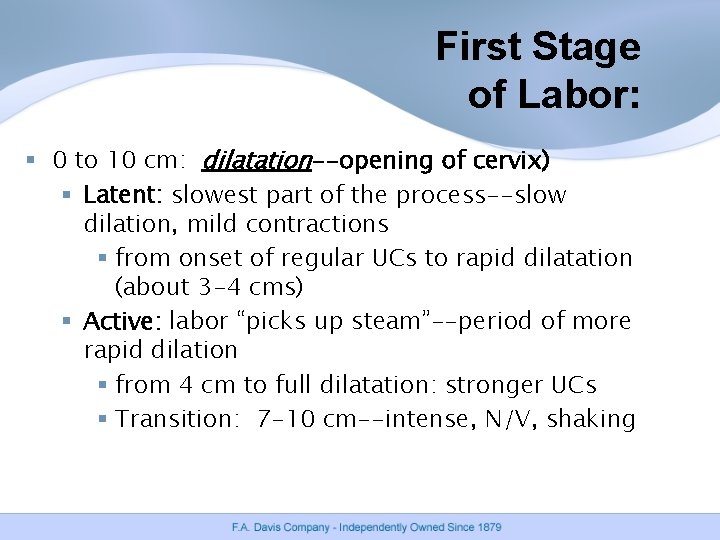
First Stage of Labor: § 0 to 10 cm: dilatation--opening of cervix) § Latent: slowest part of the process--slow dilation, mild contractions § from onset of regular UCs to rapid dilatation (about 3 -4 cms) § Active: labor “picks up steam”--period of more rapid dilation § from 4 cm to full dilatation: stronger UCs § Transition: 7 -10 cm--intense, N/V, shaking
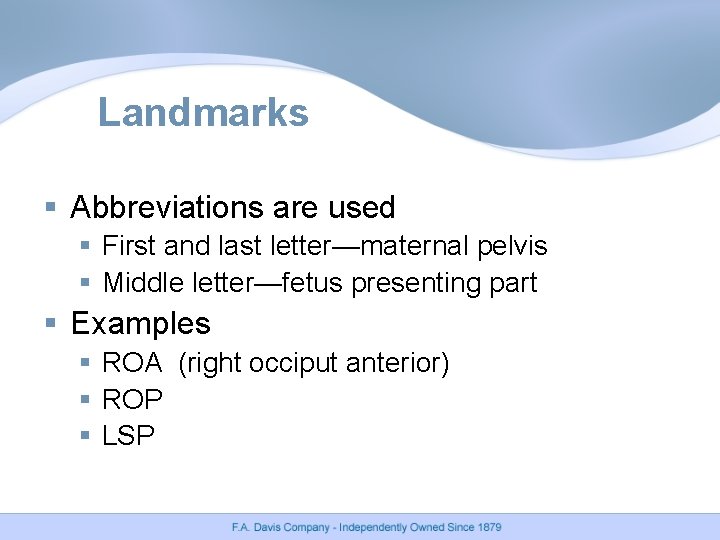
Landmarks § Abbreviations are used § First and last letter—maternal pelvis § Middle letter—fetus presenting part § Examples § ROA (right occiput anterior) § ROP § LSP
Psychosocial Influences § Other critical factors § Readiness, educational preparedness, etc. § Cultural views of childbirth § Role transition facilitated by positive childbirth experience § Negative experience interferes with bonding and maternal role attainment
Childbirth Settings and Labor Support
Admission Procedures § Establish positive relationship § Collect admission data § Initial admission assessments § § Focused Psychosocial assessment Cultural assessment Laboratory tests
Nursing Care § § § Ongoing assessment Facilitate a positive birth experience Manage discomfort Advocate for patient’s needs Provide anticipatory guidance
Care of Laboring Patient Early Labor üCouple excited, talkative, pain is manageable § Initial physical assessment & history § Admission--rapport § Fetal & UC monitoring § Vaginal exams, q 2 hours § Vital signs § Temperature q 4 hours-intact or q 2 hours ROM § Educate regarding labor § Encourage comfort, position changes, bladder emptying § Assess pain, pain tolerance, preferred type of labor/delivery § Reassure regarding what is normal, reduce anxiety
Care of Laboring Patient Active Labor üCouple quieter, discouraged, pain increasing § Transition (7 -10 cm): Yikes! “out of control”, shaking, nausea/vomiting, sweating, pain is intense § Prepare for delivery § Second stage (Pushing): § Educate/instruct regarding pushing § Assess urge to push and fetal descent § Encourage/motivate patient, assess fatigue § Monitor fetal/maternal response to pushing bulge, crowning § Signs of imminent birth: perineal bulging
Labor Support § § § Presence Promote comfort Environment Personal hygiene Elimination Supportive relaxation techniques
Critical Thinking A client is admitted to the labor unit with contractions 2 to 3 minutes apart and lasting 60 to 90 seconds. The client is apprehensive and vomiting. This nurse understands this information to indicate that the client is most likely in what phase of labor? § § § A) Active B) Transition C) Latent D) Second
Fetal Assessment § Position § Fetal heart sounds § Baseline FHR § Presence of § Variability § Accelerations § Decelerations
Interpretation of FHR Tracings § Consider contraction frequency and intensity, stage of labor, and earlier FHR pattern § Reassuring § Non-reassuring
Nursing Care § FHR decelerations § Early: no action § Variable and late § Lateral position changes § Oxygen per face mask § Palpation for hyperstimulation § Discontinue oxytocin § Increase IVF rate
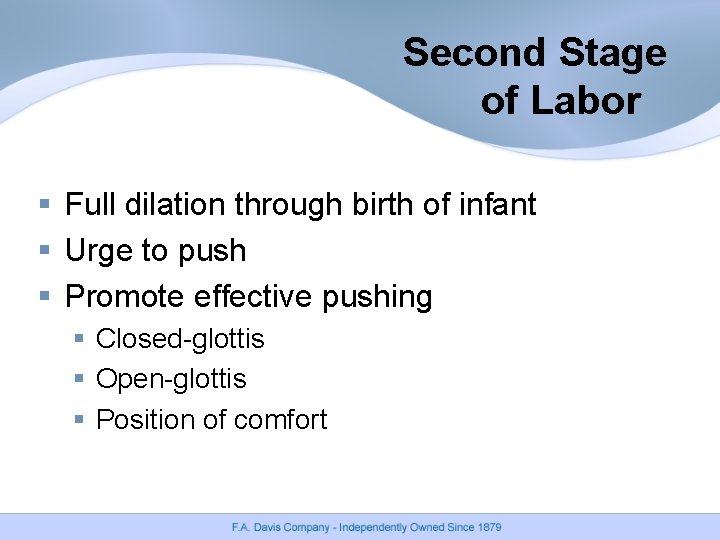
Second Stage of Labor § Full dilation through birth of infant § Urge to push § Promote effective pushing § Closed-glottis § Open-glottis § Position of comfort
Preparation for Birth § § Bulging of the perineum and rectum Flattening and thinning of the perineum Increased bloody show Labia begin to separate
Dilatation & Effacement
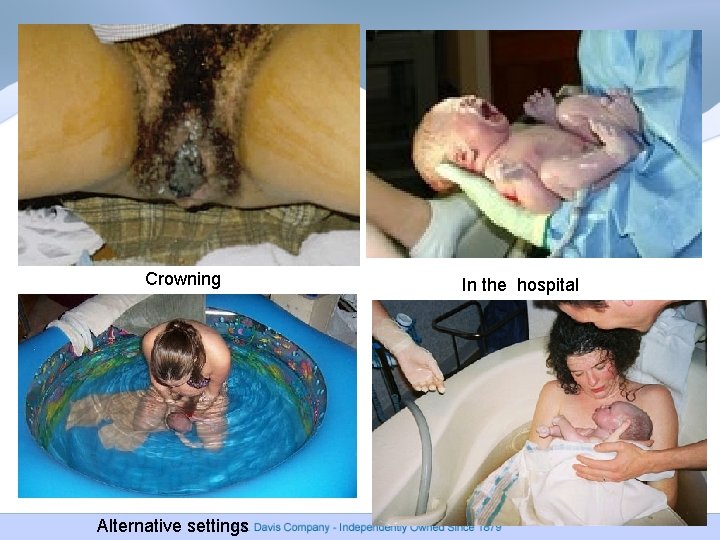
Imminent Birth § Crowning § Burning sensation § Intense pressure in rectum
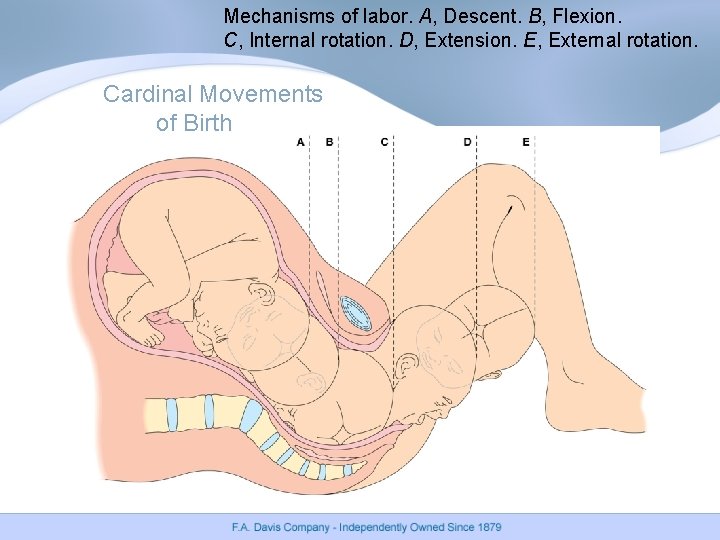
Mechanisms of labor. A, Descent. B, Flexion. C, Internal rotation. D, Extension. E, External rotation. Cardinal Movements of Birth
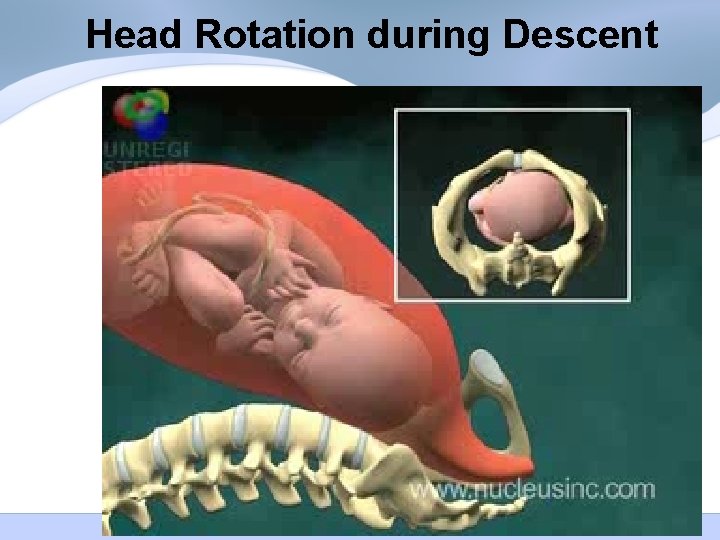
Head Rotation during Descent
Crowning Alternative settings In the hospital
Nursing Diagnoses for Intrapartal Patient § § § Pain Knowledge deficit Anxiety Fatigue Risk for infection Impaired fetal gas exchange
Third Stage § Birth of baby to complete delivery of placenta § Smaller, spherical uterus § Elevation of uterus in abdomen § Lengthening and protrusion of cord § Gush of blood from vagina
Fourth Stage § Delivery of placenta through 1 to 2 hours after birth § Monitor position and firmness of uterus § “Boggy, ” soft uterus § Report immediately § Initiate fundal massage § Assess lochia § Vital signs and urine output § Shivering—offer blankets
Fourth Stage —Risk Signs § § Hypotension Tachycardia Excessive bleeding Noncontracting uterus
Maternal-Child Nursing Care Optimizing Outcomes for Mothers, Children, & Families Susan Ward Shelton Hisley Chapter 13 Promoting Patient Comfort During Labor and Birth
Pain During Labor and Birth § Shaped by past experiences § Assessing pain § Physiological, psychological indicators § Patient responses § May be intensified by fear, anxiety, fatigue
Maternal-Child Nursing Care Optimizing Outcomes for Mothers, Children, & Families Physical Causes of Pain Labor and Birth Susan Ward Shelton Hisley
Pain Neurology § § Uterine ischemia Visceral pain—dull and aching Referred pain Somatic pain—sharp, burning, prickling
Pain Perception and Expression § Highly personal and subjective § Affected by gender, culture, ethnicity, and past experiences § Physiological/affective expression § Increased catecholamines § Increased blood pressure and heart rate § Altered respiratory pattern
Factors Affecting Maternal Pain Response § Physical § Physiological § Psychological § Anxiety, fear, previous experience § Support systems, childbirth preparation § Environmental
Nonpharmacological Pain Relief Measures § § § Maternal position and movement Breathing techniques Music Relaxation techniques Other attention-focusing strategies § Guided imagery
Massage and Touch § § Effleurage Counterpressure Therapeutic touch Healing touch
Other Therapies for Comfort § Hydrotherapy, hypnotherapy, aromatherapy § Application of heat and cold § Biofeedback, TENS, intradermal water block § Acupressure/acupuncture
Pharmacological Pain Relief Measures § Timing § Nonpharmacological and pharmacological measures promote positive experience § Informed consent
Pharmacological Measures § Sedatives and antiemetics § Systemic opiods & analgesics
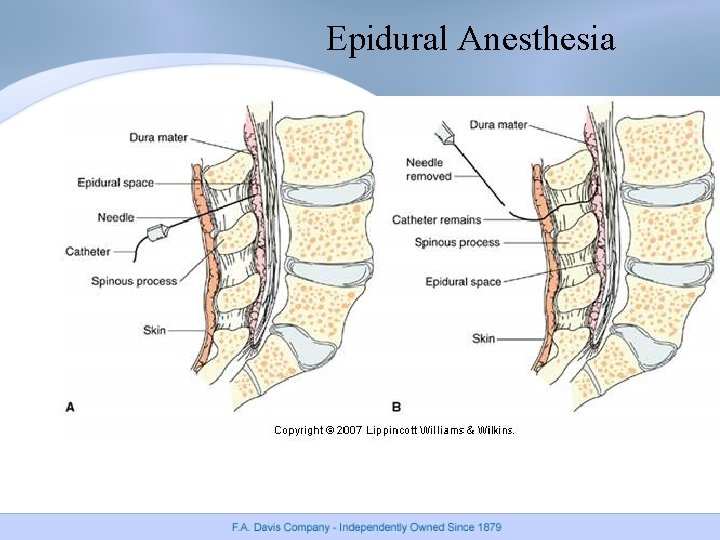
Nerve Block Analgesia, Anesthesia § Regional anesthesia- Epidural § Local perineal infiltration anesthesia § Pudendal nerve block § Spinal anesthesia block § Complications: maternal hypotension, decreased placental perfusion, ineffective breathing pattern
Systemic Analgesia § Pre-medication Assessment: § Pain level, VS, allergies, drug dependence (withdrawal), vaginal exam/progress in labor, UC pattern, fetal heart rate tracing § Post-medication Assessment: § VS, esp. RR, LOC, dizziness (bedpan), sedation, FHR § Reversal agent: Naloxone (Narcan) § Competes with narcotic for opiate receptors. Used in both mom and baby. (avoid with narcotic dependence)
Regional Anesthesia Definition: Injection of local anesthesia to block specific nerve pathways • Epidural/spinal anesthesia • Systemic toxicity: cardiovascular collapse • Side effects: Hypotension (preload with IV fluids), fetal distress on FHR tracing, spinal HA • Contraindications: coagulation disorders, low platelet count (< 100), allergy, neurologic disease, aspirin or heparin use § Nursing care: Preload IV fluids (LR), monitor BP, HR, anesthesia level, FHR, foley catheter, maternal positioning
Maternal Hypotension § Prevention § Preload IV fluids § Requires constant nursing attendance § Monitor vital signs
Epidural Anesthesia
Postdural Puncture (Spinal) Headache § § Leakage of cerebrospinal fluid Intensified in upright position Auditory and visual problems Autologous epidural blood patch § Discharge instructions
Disadvantages of Epidural § § § Limited mobility Common side effects Accidental injection into blood vessel Sympathetic blockage Urinary retention, bladder distention
General Anesthesia § § Major risks –used ONLY in emergencies Pre-operative preparation Anesthetic gases and medications Recovery room nursing care
Nursing Care Related to Comfort Measures § Assessment § Ongoing and collaborative § Diagnoses § Anxiety § Ineffective coping § Acute pain
Nursing Care § Expected outcomes § Plan of care § Individualized § Modified as needed § Collaborative approach
Maternal-Child Nursing Care Optimizing Outcomes for Mothers, Children, & Families Chapter 14 Caring for the Woman Experiencing Complications During Labor and Birth Susan Ward Shelton Hisley
Dystocia § Long, difficult, or abnormal labor § May arise from § Powers § Passenger § Passageway
Dysfunctional Labor Pattern: Hypertonic § § Strong, painful, ineffective contractions Contributing factor—maternal anxiety Occiput-posterior malposition of fetus Management § Rest, hydration, sedation § Facilitate rotation of the fetal head
Dysfunctional Labor Pattern: Hypotonic § Contractions decrease in frequency and intensity § Maternal and fetal factors that produce excessive uterine stretching § Management § Walking, position changes § Augmentation of labor
Precipitate Labor and Birth § Rapid labor & birth § Nursing considerations § § Careful examination for dilation and effacement Reassure woman and support person Breathing to avoid pushing and prevent tearing Careful examination of maternal soft tissue and placenta
Pelvic Structure Alterations § Pelvic dystocia § Soft tissue dystocia § Trial of labor § To assess safety of vaginal birth
Obstetric Interventions Amniotomy § Artificial rupture of membranes § Augment or induce labor § Nursing § Careful monitoring of vital signs, cervical effacement/dilation, station, FHR, contractions § Document regarding amniotic fluid
Obstetric Interventions Amnioinfusion § Risks: infection, overdistention of uterus, increased uterine tone § Nursing § Careful monitoring of infusion, intensity and frequency of contractions, and maternal vital signs § Educate § Pharmacological induction of labor § Nonpharmacological stimulants of labor
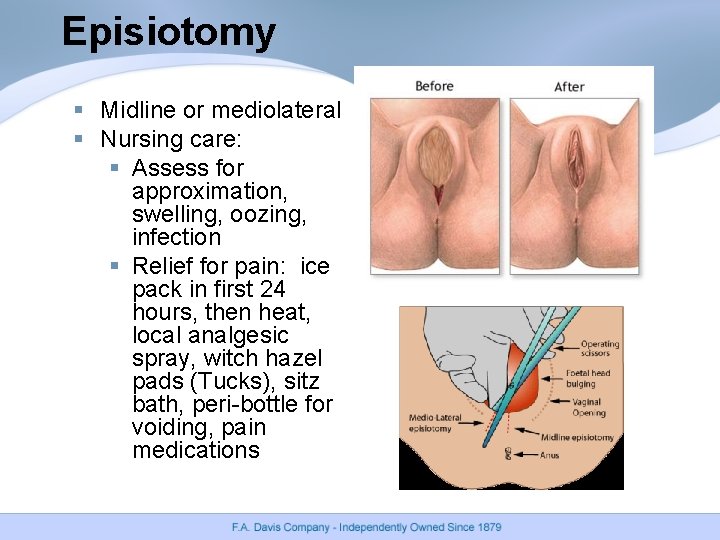
Episiotomy § Midline or mediolateral § Nursing care: § Assess for approximation, swelling, oozing, infection § Relief for pain: ice pack in first 24 hours, then heat, local analgesic spray, witch hazel pads (Tucks), sitz bath, peri-bottle for voiding, pain medications
Induction of Labor § § § Indications for induction Bishop score Cervical ripening agents Mechanical methods Oxytocin Augmentation of labor
Induction—Nursing Considerations § § § Informed consent Careful monitoring of labor Discuss pain relief measures Position changes Keep patient and support person informed of progress
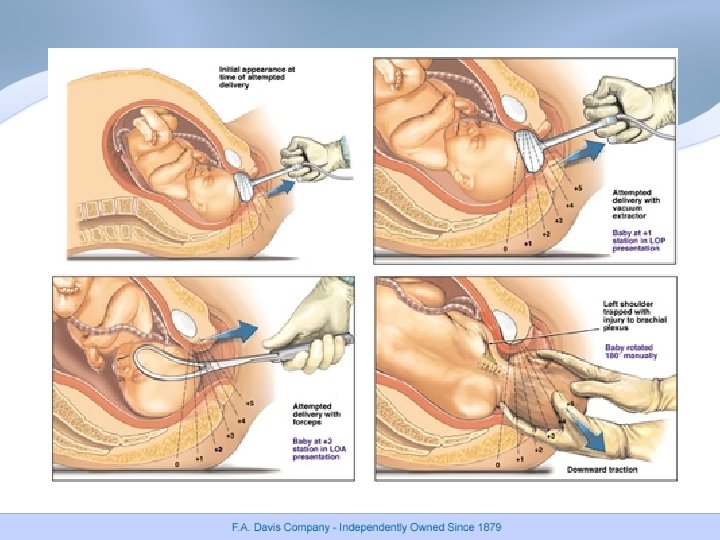
Instrumentation Assistance of Birth § Forceps § Indications: unable to push, arrested descent, need a quick delivery, breech § Associated with: maternal/fetal birth trauma, rectal sphincter tear, urinary stress incontinence § Vacuum extraction § Advantages: fewer lacerations, less anesthesia needed, § Disadvantages: marked caput, cephalhematomas, scalp laceration/bruising
Maternal Complications Hypertensive Disorders § Preeclampsia-eclampsia, HELLP syndrome § Nursing § § Careful assessments Monitor lab values Administer platelets as appropriate Ongoing education
Maternal Complications Diabetes § Fetal lung maturity § Intrapartum management -Maternal hydration, -Insulin, and -Blood glucose levels § Labor: normal progression of labor § Upright or side-lying position § Encourage breastfeeding
Preterm Labor and Birth § Careful maternal monitoring § FHR monitoring *** § Identify and report symptoms suggestive of fetal hypoxia § Assess psychological status
Labor and Birth Complications Fetal § Fetal malpresentation § Version: external or internal § § Shoulder dystocia Cephalopelvic disproportion Multiple gestation Non-reassuring FHR patterns
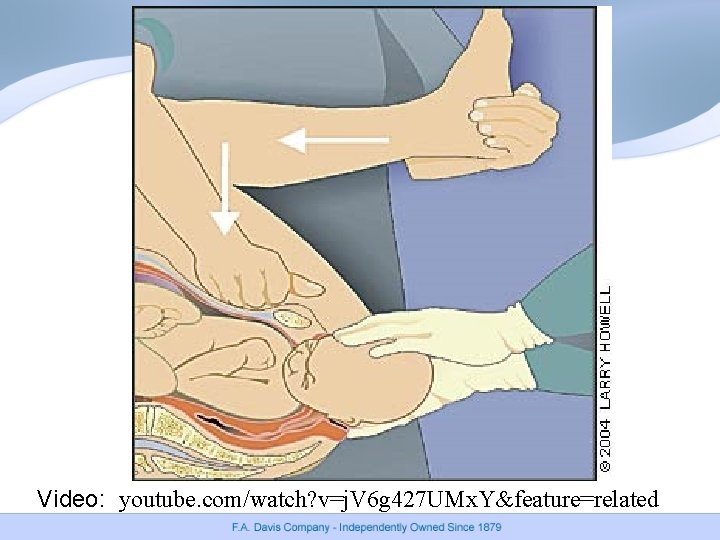
Macrosomia/Shoulder Dystocia § Wt. > 4500 gms (9 -10 lbs) § Associated with: § DM, Gestational DM, Multiparity, Postdates, obesity § Risks: § Shoulder dystocia, difficulty delivering the shoulders after head is delivered (obstetrical emergency) § Maternal: vaginal/cervical tears, pp hemorrhage, rupture § Fetal: compressed cord, fractured clavical, asphyxia & neurologic damage, brachial plexus injury (Erb’s. Palsy) § S/S: Turtle sign § Nursing interventions: Mc. Roberts maneuvers, suprapubic pressure. PP: assess for uterine atony/hemorrhage; trauma, cerebral or neurologic damage to baby
Video: youtube. com/watch? v=j. V 6 g 427 UMx. Y&feature=related
Mc. Roberts Maneuvers Video
Amniotic Fluid Complications § § Oligohydramnios Hydramnios Meconium Nuchal cord
Other Complications § Uterine rupture § Obstetric emergency § Uterine inversion § Umbilical cord prolapse
Maternal-Child Nursing Care Optimizing Outcomes for Mothers, Children, & Families Susan Ward Shelton Hisley Collaboration in Perinatal Emergencies
Perinatal Fetal Loss § What to say § What NOT to say § Nursing considerations < 20 weeks > 20 weeks name & hold the baby funeral/memorial service Resolve support group
Cesarean Birth § Indications § Health of mother or fetus is jeopardized § § Ethical considerations Surgical procedures Surgical and postoperative care Vaginal birth after cesarean
Cesarean Birth Indications for: Maternal Factors § § § § § Active genital herpes AIDS/HIV + Cephalopelvic disproportion Severe preeclampsia, diabetes Obstructive tumor Ruptured uterus Previous c-section Failed induction/fx to progress in labor Elective? Placenta Factors § Placenta previa § Placental abruption § Umbilical cord prolapse Fetal Factors § § § Breech, transverse lie Macrosomia Extreme low birth wt Fetal distress Fetal anomalies Multiple gestation
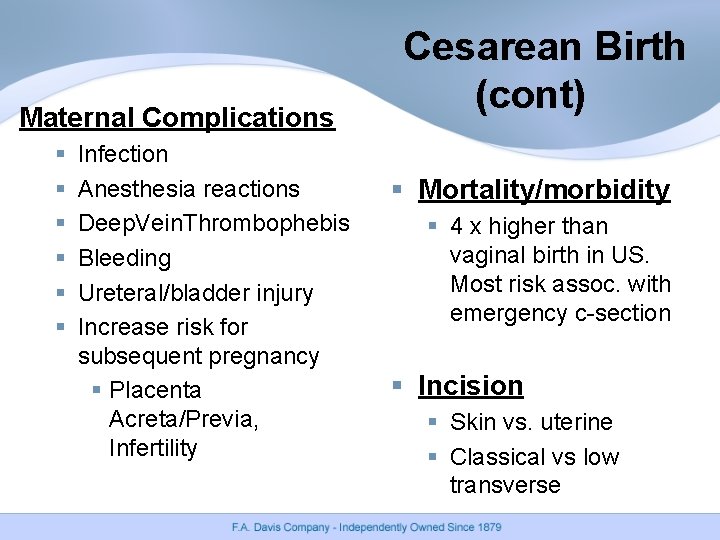
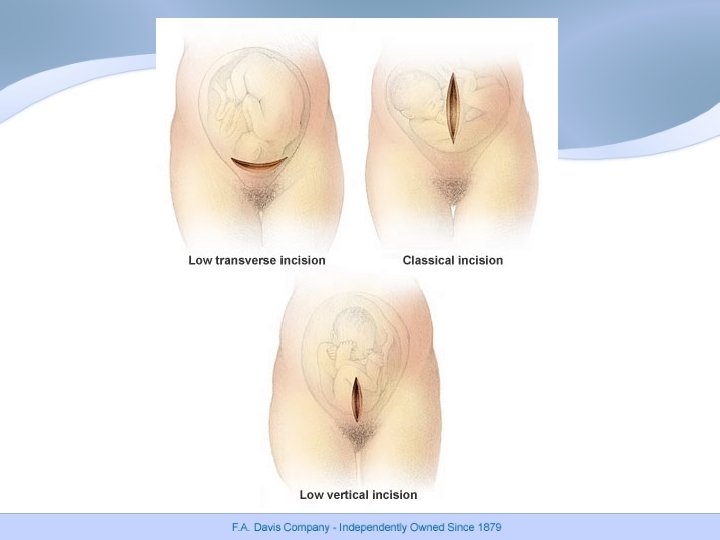
Maternal Complications § § § Infection Anesthesia reactions Deep. Vein. Thrombophebis Bleeding Ureteral/bladder injury Increase risk for subsequent pregnancy § Placenta Acreta/Previa, Infertility Cesarean Birth (cont) § Mortality/morbidity § 4 x higher than vaginal birth in US. Most risk assoc. with emergency c-section § Incision § Skin vs. uterine § Classical vs low transverse
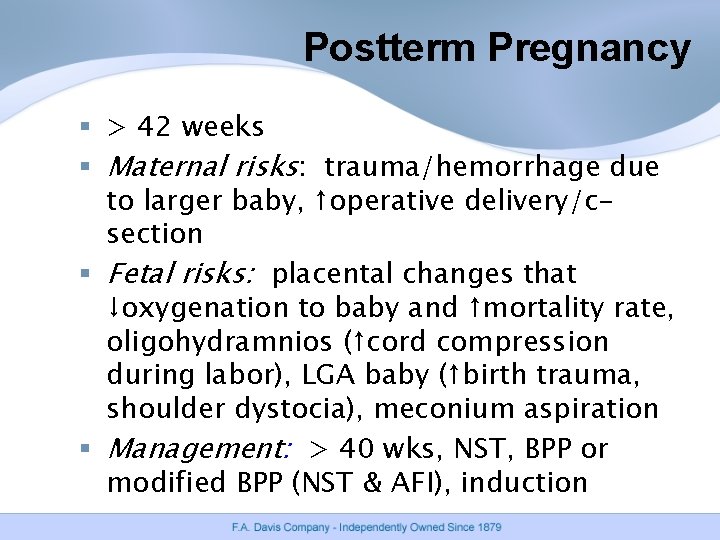
Postterm Pregnancy § > 42 weeks § Maternal risks: trauma/hemorrhage due to larger baby, ↑operative delivery/csection § Fetal risks: placental changes that ↓oxygenation to baby and ↑mortality rate, oligohydramnios (↑cord compression during labor), LGA baby (↑birth trauma, shoulder dystocia), meconium aspiration § Management: > 40 wks, NST, BPP or modified BPP (NST & AFI), induction
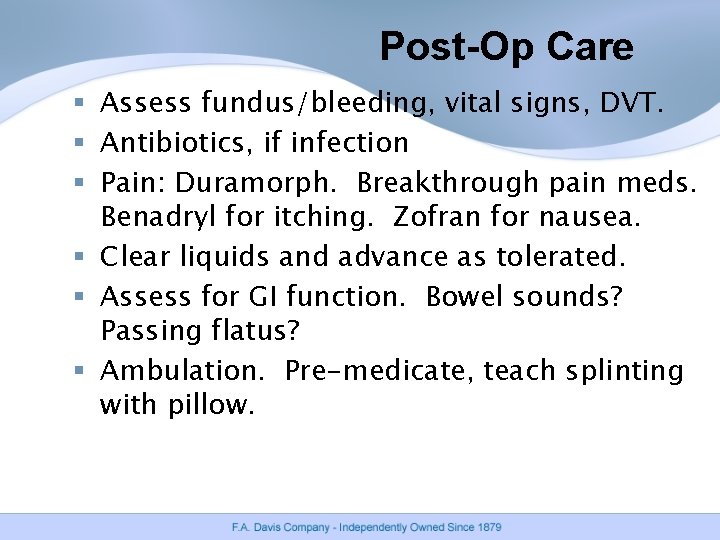
Post-Op Care § Assess fundus/bleeding, vital signs, DVT. § Antibiotics, if infection § Pain: Duramorph. Breakthrough pain meds. Benadryl for itching. Zofran for nausea. § Clear liquids and advance as tolerated. § Assess for GI function. Bowel sounds? Passing flatus? § Ambulation. Pre-medicate, teach splinting with pillow.
Critical Thinking § A laboring multipara is having intense uterine contractions with incomplete uterine relaxation between contractions. Vaginal examinations reveal rapid cervical dilation and fetal descent. What should the nurse do first? A) Notify the physician of these findings. B) Place the woman in knee-chest position. C) Turn off the lights to make it easier for the woman to relax. D) Assemble supplies to prepare for birth.
Case Study: Linda Mandella is in labor with her third baby at the birth center. She wishes to experience a natural, unmedicated birth. Linda is groaning and crying. A cervical examination performed 2 hours ago revealed that she was 6 cm dilated, and 100% effaced. Linda’s family is present, and this is the first time that they have been able to attend and support her during the labor and birthing process. The family members are shouting and blaming the nurse for causing Linda to suffer. They demand that the nurse give Linda painkillers to ease her suffering and pain. Critical Thinking Questions § 1. What are the priority nursing diagnoses at this time? § 2. What are the expected outcomes associated with these diagnoses? § 3. Describe the teaching/learning needs related to the scenario that correspond to the priority nursing diagnoses. § 4. List nursing interventions with rationales that correspond to the priority nursing diagnoses.