Chapter 3 Your Purchasing Power Page 76 Ch
- Slides: 19
Chapter 3 Your Purchasing Power Page 76
Ch. 3 OBJECTIVES • Explain inflation and how it is measured • Understand types of inflation and how they affect consumers • Describe methods of setting prices in a market economy • Explain consumer’s buying strategies and how they affect demand prices Slide 2
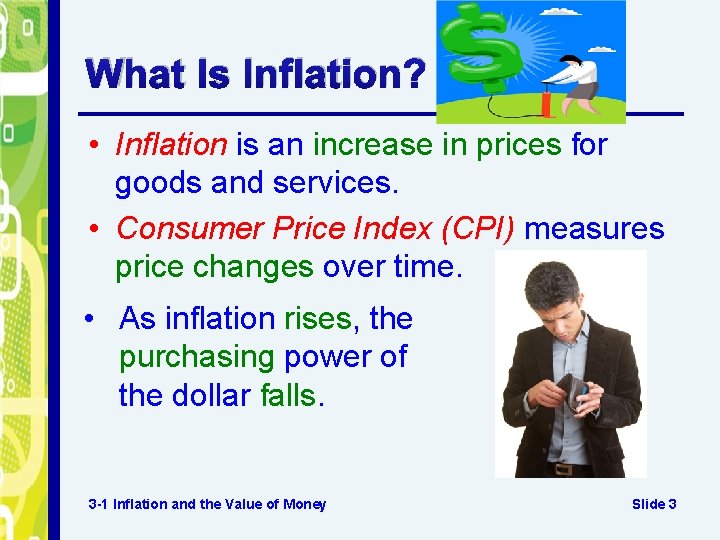
What Is Inflation? • Inflation is an increase in prices for goods and services. • Consumer Price Index (CPI) measures price changes over time. • As inflation rises, the purchasing power of the dollar falls. 3 -1 Inflation and the Value of Money Slide 3
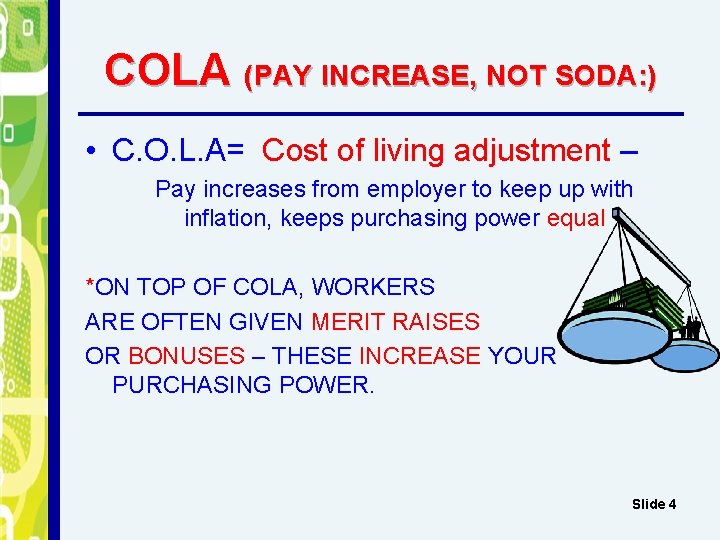
COLA (PAY INCREASE, NOT SODA: ) • C. O. L. A= Cost of living adjustment – Pay increases from employer to keep up with inflation, keeps purchasing power equal *ON TOP OF COLA, WORKERS ARE OFTEN GIVEN MERIT RAISES OR BONUSES – THESE INCREASE YOUR PURCHASING POWER. Slide 4
What Are the Types of Inflation? SEE page 79 • Disinflation occurs when the rate of rising prices slows down. Ex. swimsuits in winter • Reflation occurs when high prices are followed by lower prices and then high prices again. Ex. gasoline prices • Hyperinflation is rapidly rising prices that are out of control. Ex: Not so much in US, but 50%-300% in other countries, especially following war • Deflation is a decrease in prices. Ex. computers, phones, dvd players 3 -1 Inflation and the Value of Money Slide 5
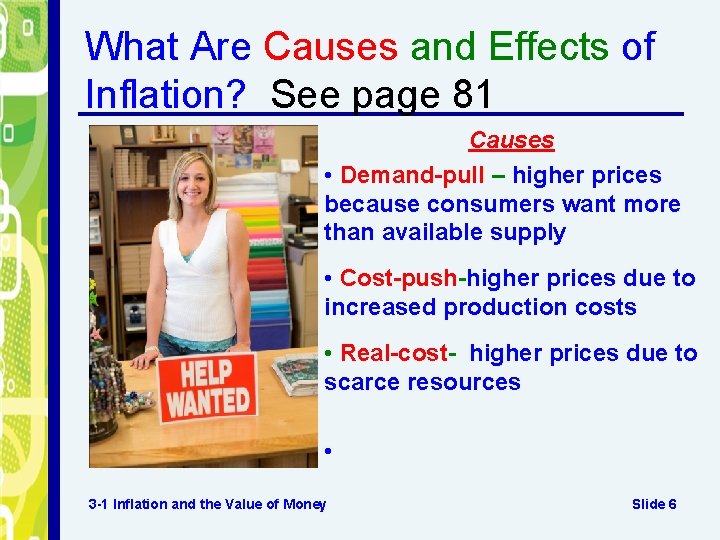
What Are Causes and Effects of Inflation? See page 81 Causes • Demand-pull – higher prices because consumers want more than available supply • Cost-push-higher prices due to increased production costs • Real-cost- higher prices due to scarce resources • 3 -1 Inflation and the Value of Money Slide 6
What Are Causes and Effects of Inflation? Effects • Higher employment rates – Mild inflation of 2 -3% is said to be good for the economy • Less spending – loss of purchase power if pay raises do not keep up with inflation • Less saving – must use more of your disposable income to buy needed goods • Time value of money: a dollar you receive in the future will be worth less than you receive today SEE PAGE 83 - CPI 20 year history in U. S. Slide 7
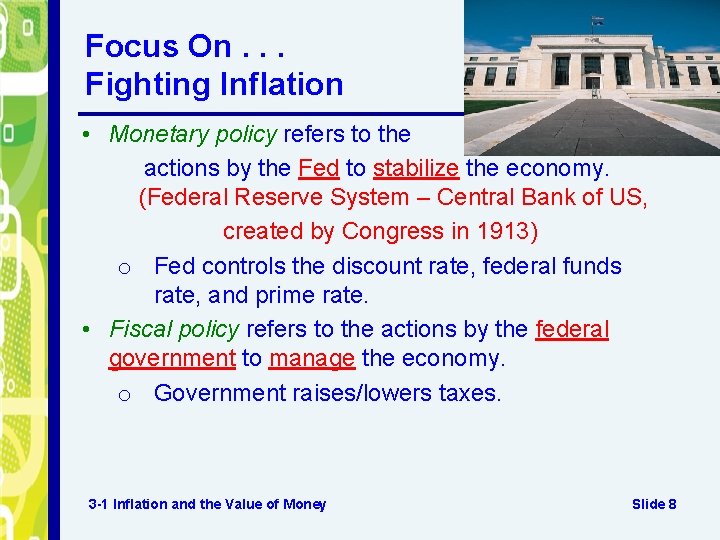
Focus On. . . Fighting Inflation • Monetary policy refers to the actions by the Fed to stabilize the economy. (Federal Reserve System – Central Bank of US, created by Congress in 1913) o Fed controls the discount rate, federal funds rate, and prime rate. • Fiscal policy refers to the actions by the federal government to manage the economy. o Government raises/lowers taxes. 3 -1 Inflation and the Value of Money Slide 8
How Are Prices Set in a Market Economy? • • Cost-recovery pricing is used to recover R&D costs. Cost-plus pricing is calculated using production costs plus a markup (a. k. a. profit margin or gross profit). See p. 87 Value-based pricing is based on what consumers are willing to pay. Market-based pricing is set to be competitive with similar products. 3 -2 Prices and Consumer Choices Slide 9
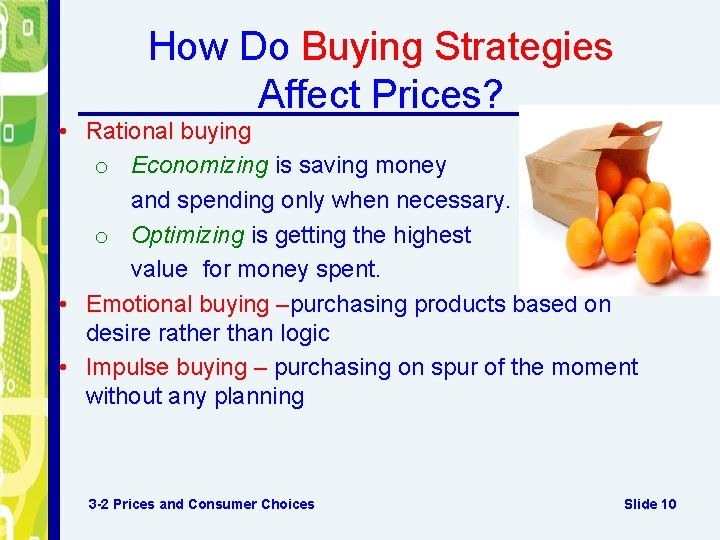
How Do Buying Strategies Affect Prices? • Rational buying o Economizing is saving money and spending only when necessary. o Optimizing is getting the highest value for money spent. • Emotional buying –purchasing products based on desire rather than logic • Impulse buying – purchasing on spur of the moment without any planning 3 -2 Prices and Consumer Choices Slide 10
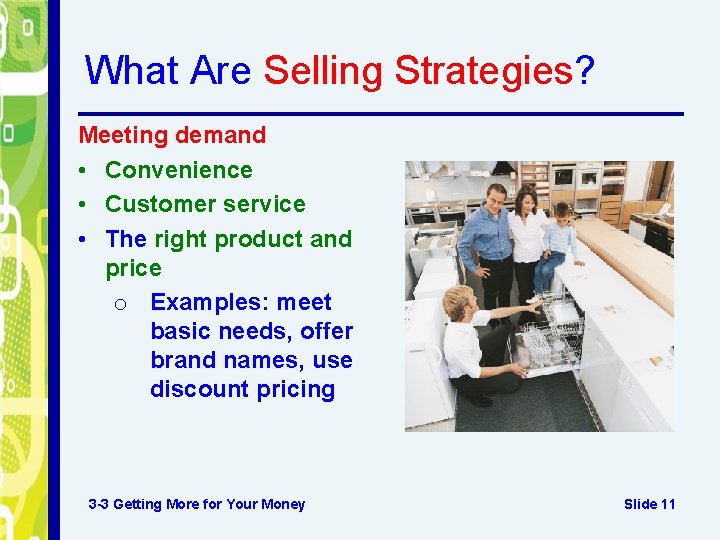
What Are Selling Strategies? Meeting demand • Convenience • Customer service • The right product and price o Examples: meet basic needs, offer brand names, use discount pricing 3 -3 Getting More for Your Money Slide 11
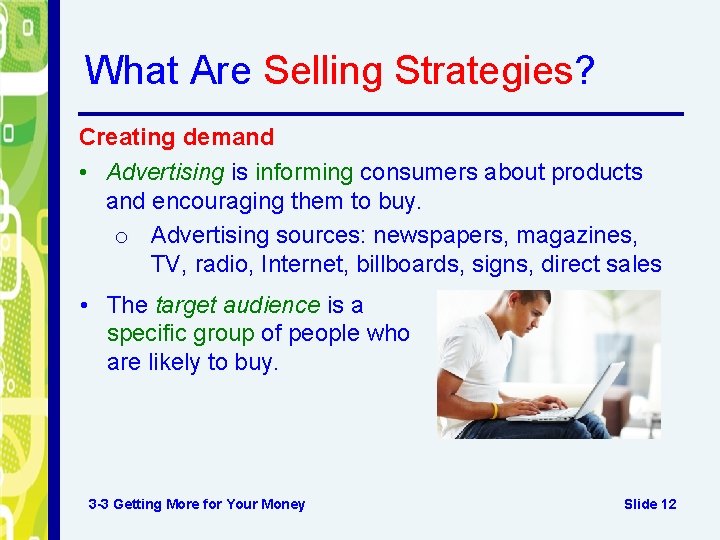
What Are Selling Strategies? Creating demand • Advertising is informing consumers about products and encouraging them to buy. o Advertising sources: newspapers, magazines, TV, radio, Internet, billboards, signs, direct sales • The target audience is a specific group of people who are likely to buy. 3 -3 Getting More for Your Money Slide 12
What Are Consumer Buying Strategies? • • • Prepare a shopping list. Do not let a salesperson influence you. Stick to your list and avoid impulse buying. Shop when you are most alert. Comparison shop among several sellers. Keep receipts, warranties, and packaging. 3 -3 Getting More for Your Money Slide 13
What Are Consumer Rights? Many laws protect consumers. • Consumer Bill of Rights • Airline Passenger Rights • Consumer Technology Bill of Rights • Patients’ Bill of Rights • Consumer Protection Laws o Examples: Food, Drug, and Cosmetic Act; Hazardous Substances Act; Cigarette Labeling and Advertising Act; Nutrition Labeling and Education Act; FERPA; HIPAA 3 -4 Consumer Rights and Responsibilities Slide 14
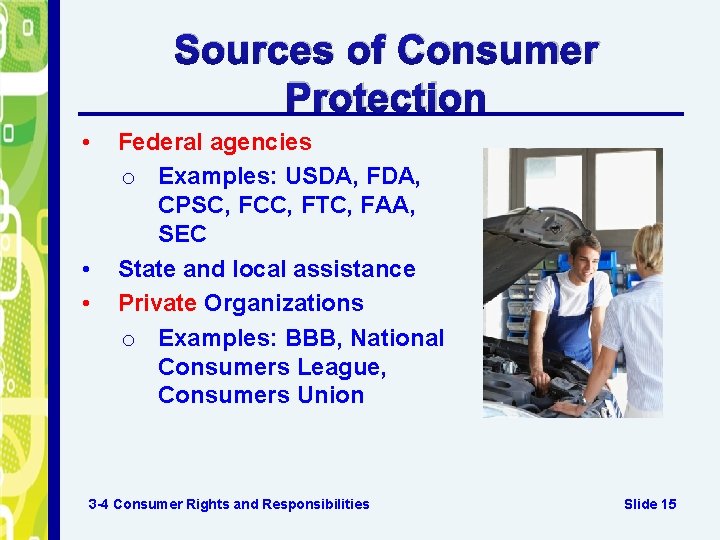
Sources of Consumer Protection • • • Federal agencies o Examples: USDA, FDA, CPSC, FCC, FTC, FAA, SEC State and local assistance Private Organizations o Examples: BBB, National Consumers League, Consumers Union 3 -4 Consumer Rights and Responsibilities Slide 15
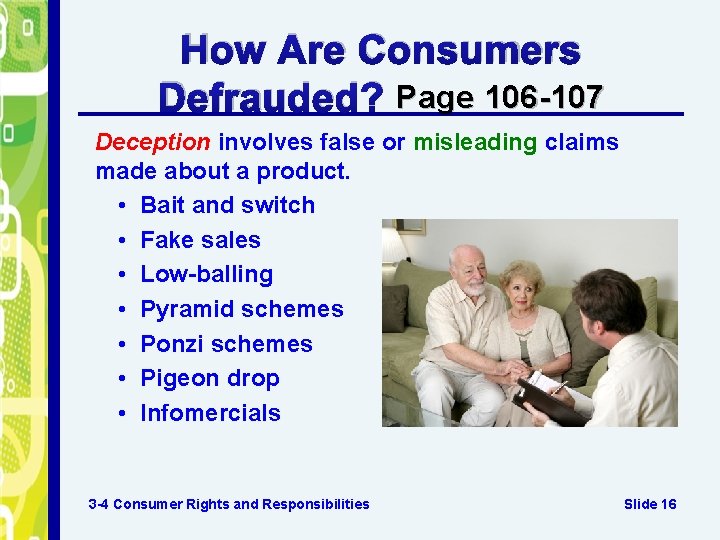
How Are Consumers Defrauded? Page 106 -107 Deception involves false or misleading claims made about a product. • Bait and switch • Fake sales • Low-balling • Pyramid schemes • Ponzi schemes • Pigeon drop • Infomercials 3 -4 Consumer Rights and Responsibilities Slide 16
How Can Consumers Protect Themselves from Fraud? • • • Shop smart Be aware of prices Understand sale terminology Compute unit prices Read labels Check packages carefully 3 -4 Consumer Rights and Responsibilities • • Read contracts Keep receipts and warranties Compute total cost Research businesses Slide 17
Success Skills Time Management • • • Be aware of how you are using your time. Identify peak performance times. Use a daily or weekly planner. Keep a to-do list. Prioritize your activities. Break large projects into smaller parts. • Do not rush important decisions. 3 -2 Prices and Consumer Choices Slide 18
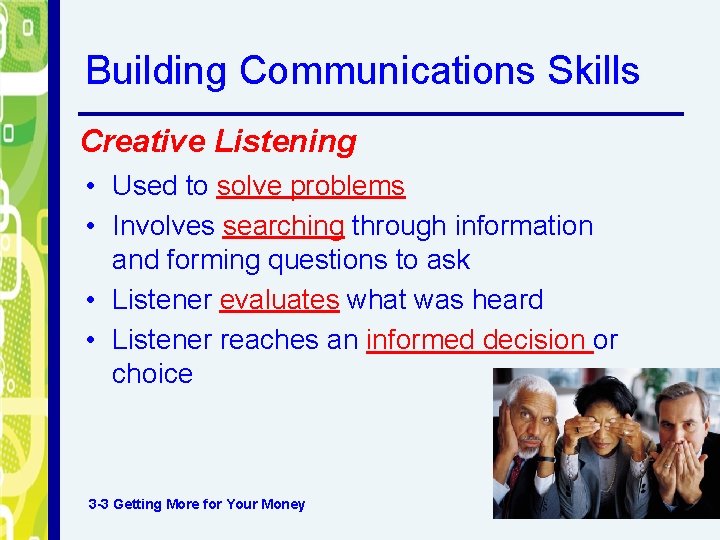
Building Communications Skills Creative Listening • Used to solve problems • Involves searching through information and forming questions to ask • Listener evaluates what was heard • Listener reaches an informed decision or choice 3 -3 Getting More for Your Money Slide 19