Chapter 3 Growth of Functions Lee HsiuHui Ack



- Slides: 25
Chapter 3 Growth of Functions Lee, Hsiu-Hui Ack: This presentation is based on the lecture slides from Hsu, Lih -Hsing, as well as various materials from the web. 20070928 chap 03 Hsiu-Hui Lee
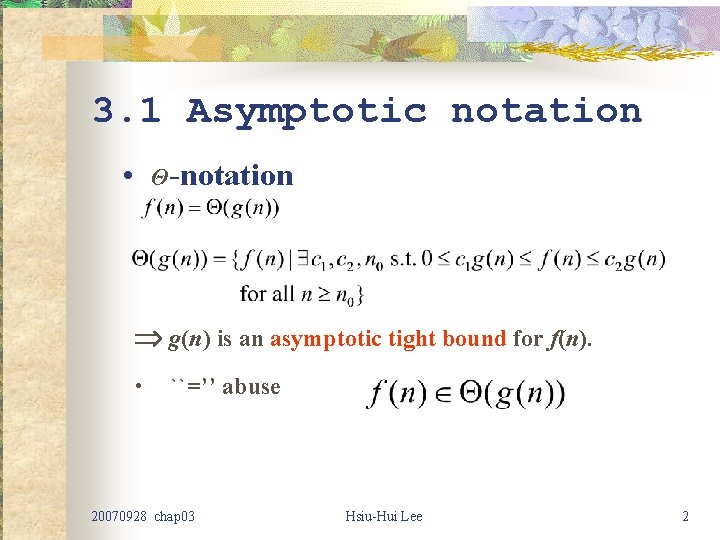
3. 1 Asymptotic notation • Θ-notation g(n) is an asymptotic tight bound for f(n). • ``=’’ abuse 20070928 chap 03 Hsiu-Hui Lee 2
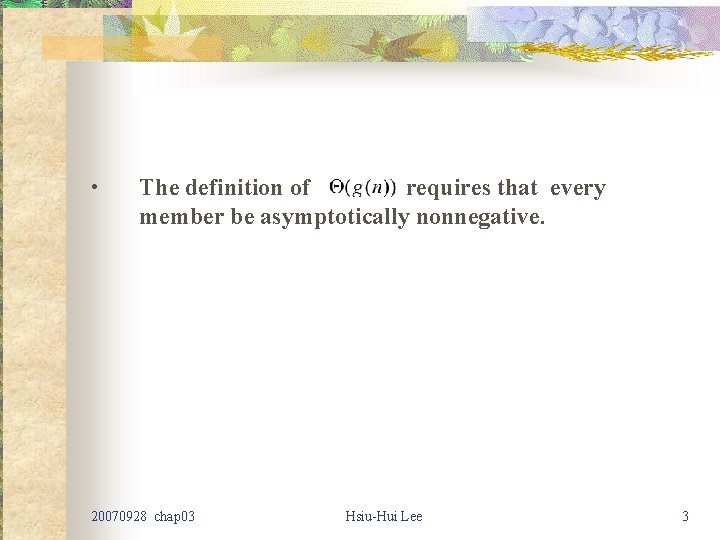
• The definition of requires that every member be asymptotically nonnegative. 20070928 chap 03 Hsiu-Hui Lee 3
EXAMPLE: 20070928 chap 03 Hsiu-Hui Lee 4
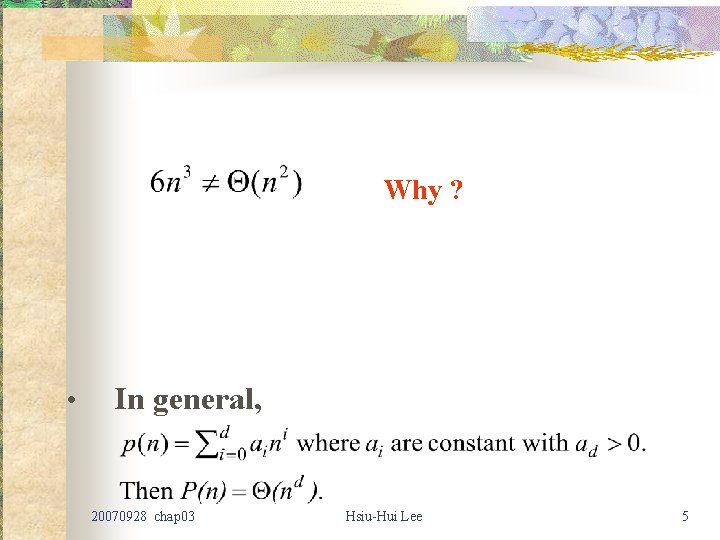
Why ? • In general, 20070928 chap 03 Hsiu-Hui Lee 5
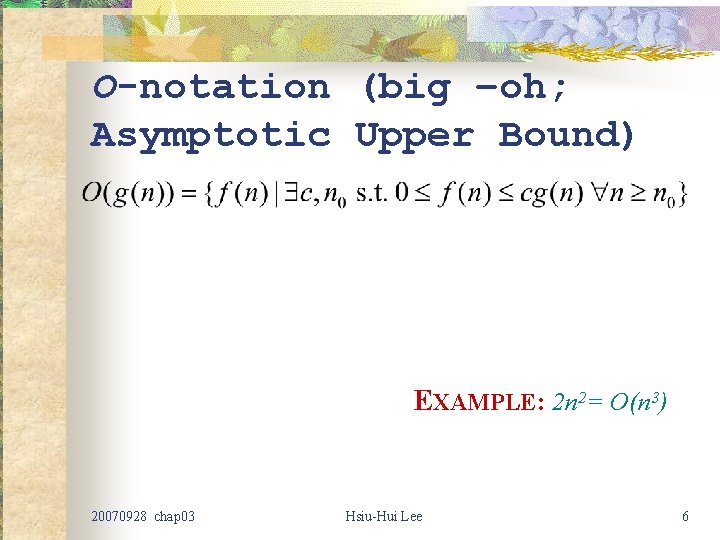
O-notation (big –oh; Asymptotic Upper Bound) EXAMPLE: 2 n 2= O(n 3) 20070928 chap 03 Hsiu-Hui Lee 6
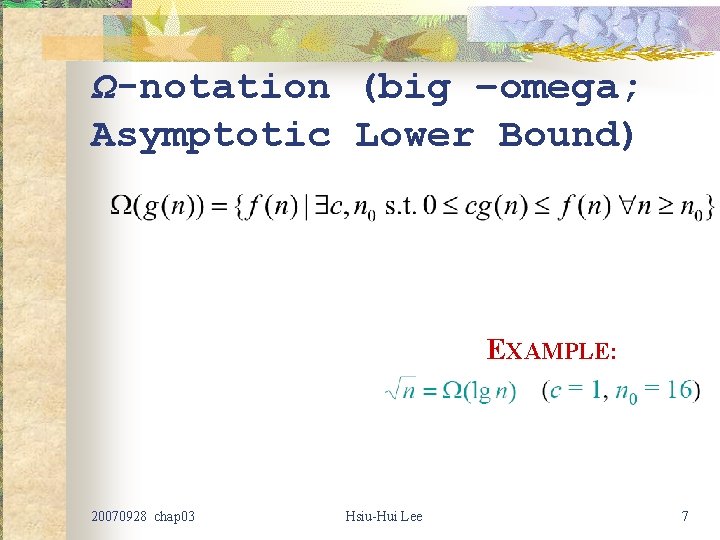
Ω-notation (big –omega; Asymptotic Lower Bound) EXAMPLE: 20070928 chap 03 Hsiu-Hui Lee 7
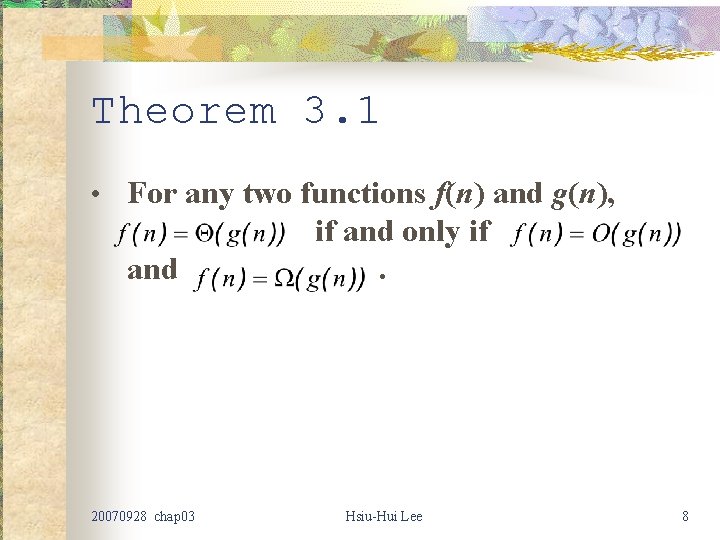
Theorem 3. 1 • For any two functions f(n) and g(n), and 20070928 chap 03 if and only if. Hsiu-Hui Lee 8
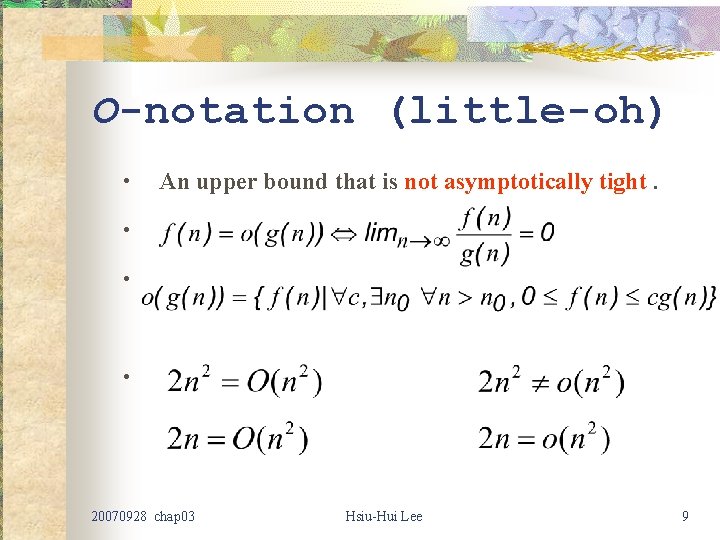
O-notation (little-oh) • An upper bound that is not asymptotically tight. • • • 20070928 chap 03 Hsiu-Hui Lee 9
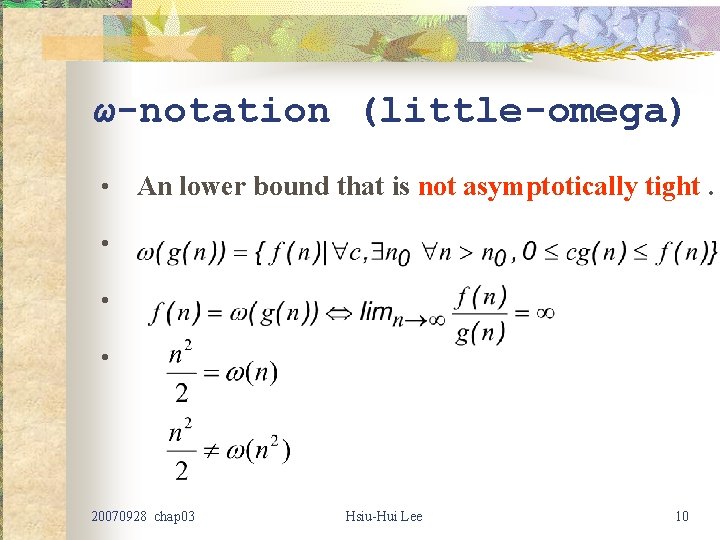
ω-notation (little-omega) • An lower bound that is not asymptotically tight. • • • 20070928 chap 03 Hsiu-Hui Lee 10
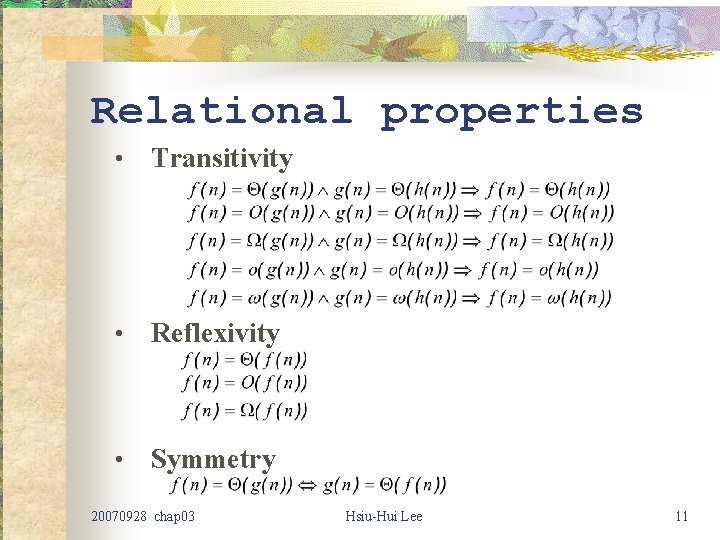
Relational properties • Transitivity • Reflexivity • Symmetry 20070928 chap 03 Hsiu-Hui Lee 11
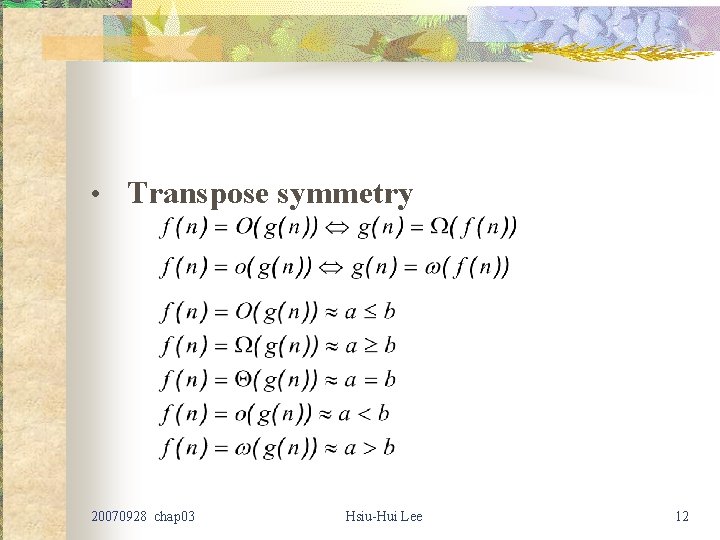
• Transpose symmetry 20070928 chap 03 Hsiu-Hui Lee 12
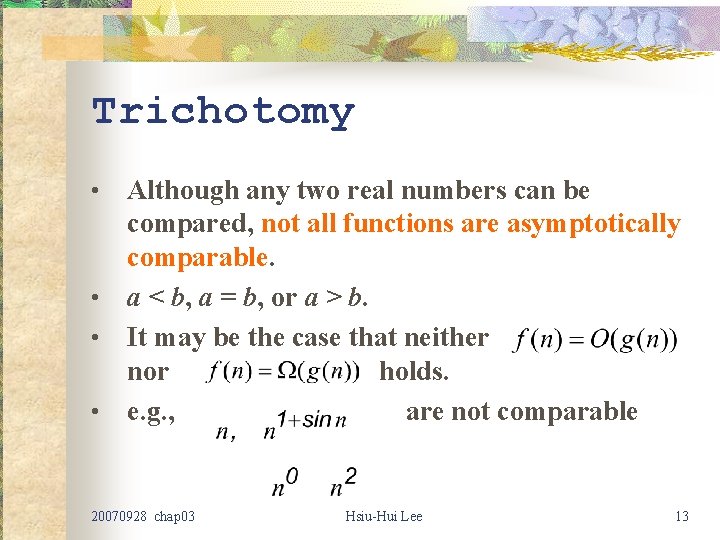
Trichotomy Although any two real numbers can be compared, not all functions are asymptotically comparable. • a < b, a = b, or a > b. • It may be the case that neither nor holds. • e. g. , are not comparable • 20070928 chap 03 Hsiu-Hui Lee 13
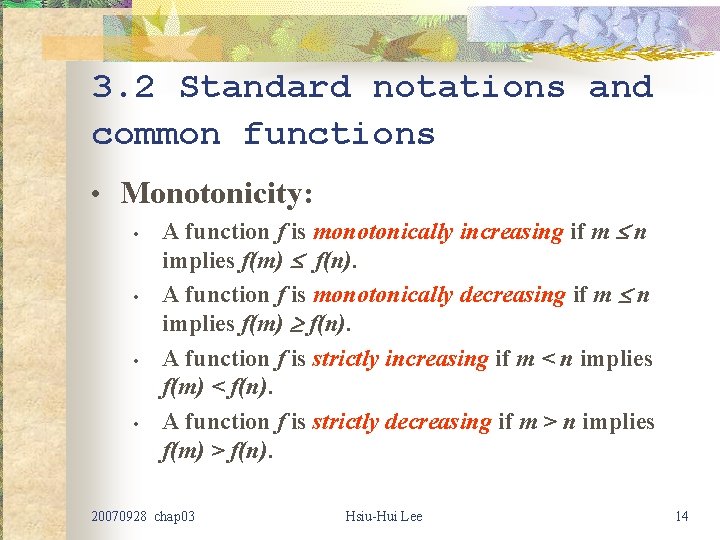
3. 2 Standard notations and common functions • Monotonicity: • • A function f is monotonically increasing if m n implies f(m) f(n). A function f is monotonically decreasing if m n implies f(m) f(n). A function f is strictly increasing if m < n implies f(m) < f(n). A function f is strictly decreasing if m > n implies f(m) > f(n). 20070928 chap 03 Hsiu-Hui Lee 14
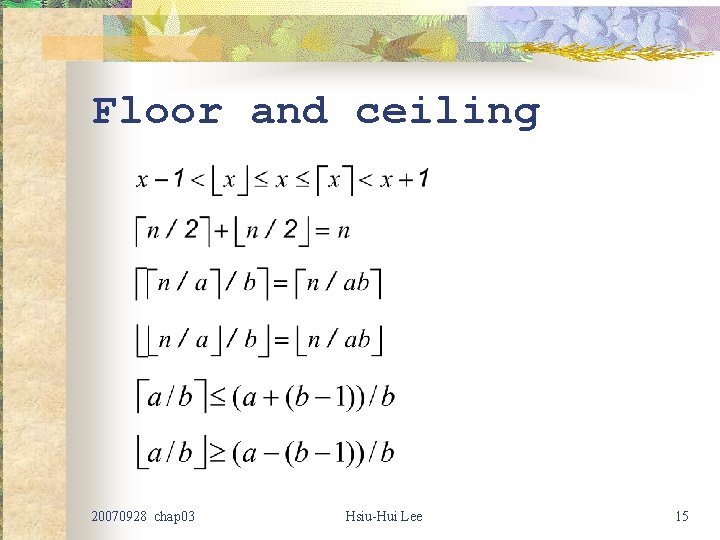
Floor and ceiling 20070928 chap 03 Hsiu-Hui Lee 15
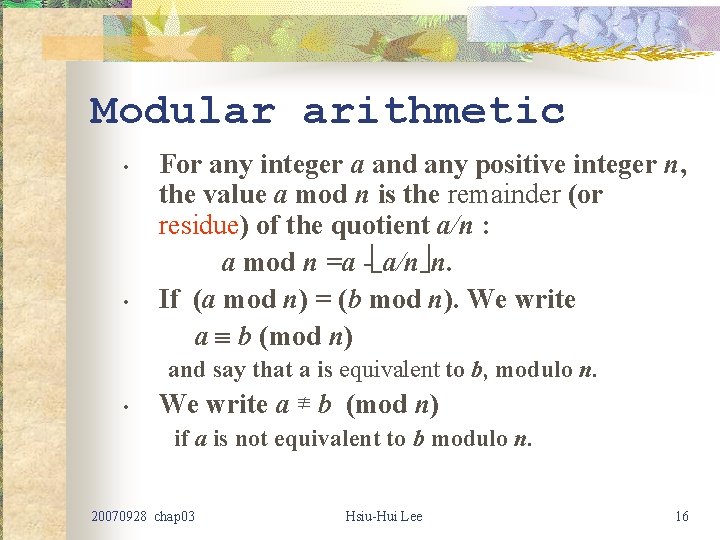
Modular arithmetic • • For any integer a and any positive integer n, the value a mod n is the remainder (or residue) of the quotient a/n : a mod n =a - a/n n. If (a mod n) = (b mod n). We write a b (mod n) and say that a is equivalent to b, modulo n. • We write a ≢ b (mod n) if a is not equivalent to b modulo n. 20070928 chap 03 Hsiu-Hui Lee 16
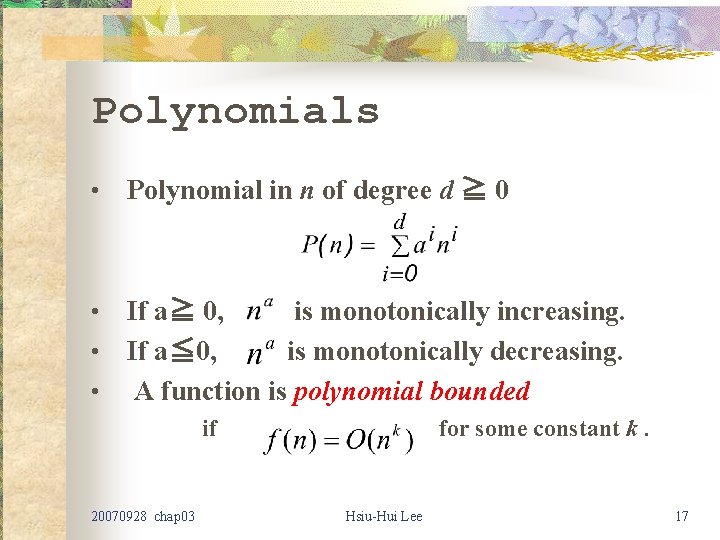
Polynomials • Polynomial in n of degree d ≧ 0 If a≧ 0, is monotonically increasing. • If a≦ 0, is monotonically decreasing. • A function is polynomial bounded • if 20070928 chap 03 for some constant k. Hsiu-Hui Lee 17
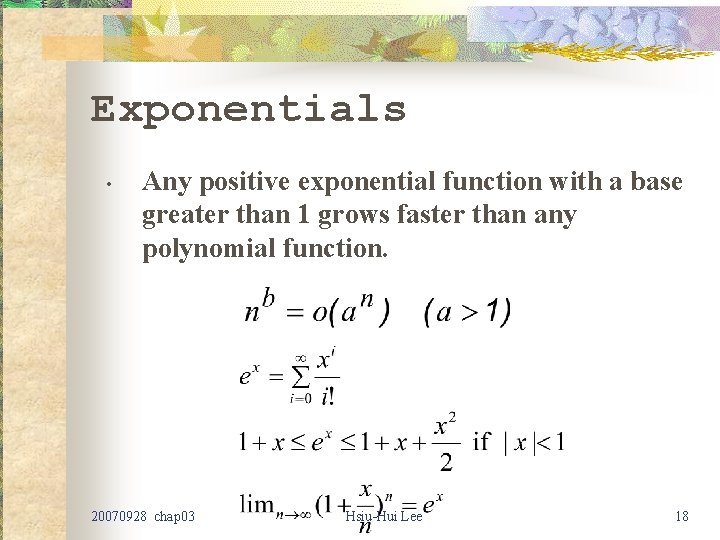
Exponentials • Any positive exponential function with a base greater than 1 grows faster than any polynomial function. 20070928 chap 03 Hsiu-Hui Lee 18
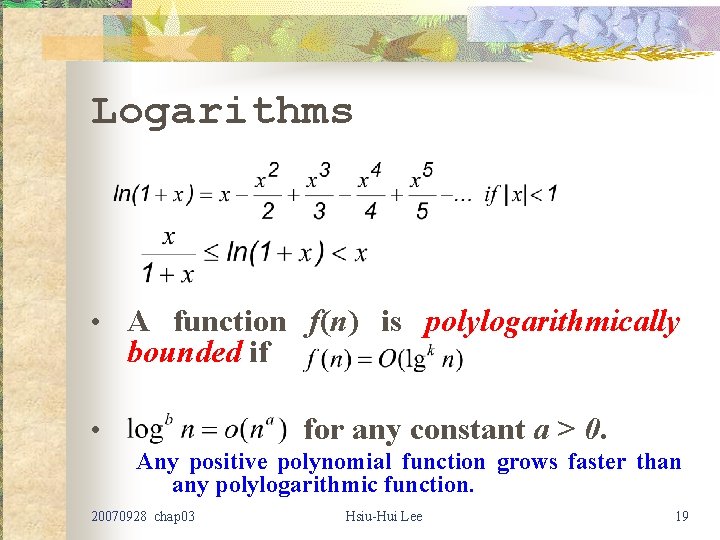
Logarithms • A function f(n) is polylogarithmically bounded if for any constant a > 0. • Any positive polynomial function grows faster than any polylogarithmic function. 20070928 chap 03 Hsiu-Hui Lee 19
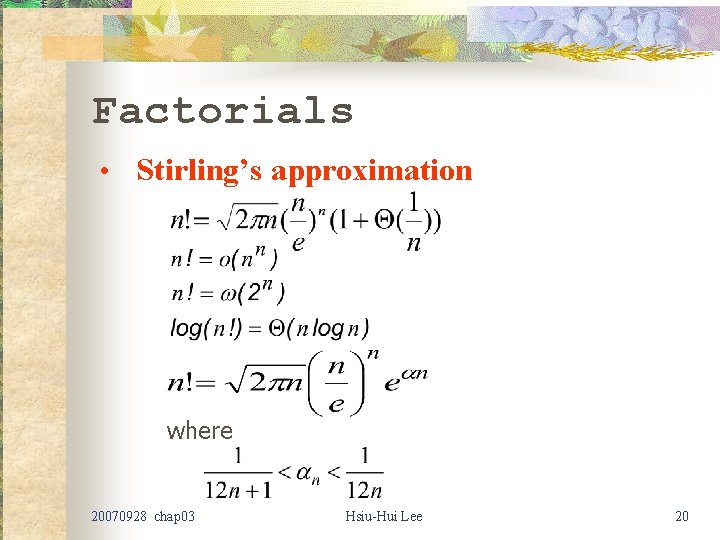
Factorials • Stirling’s approximation where 20070928 chap 03 Hsiu-Hui Lee 20
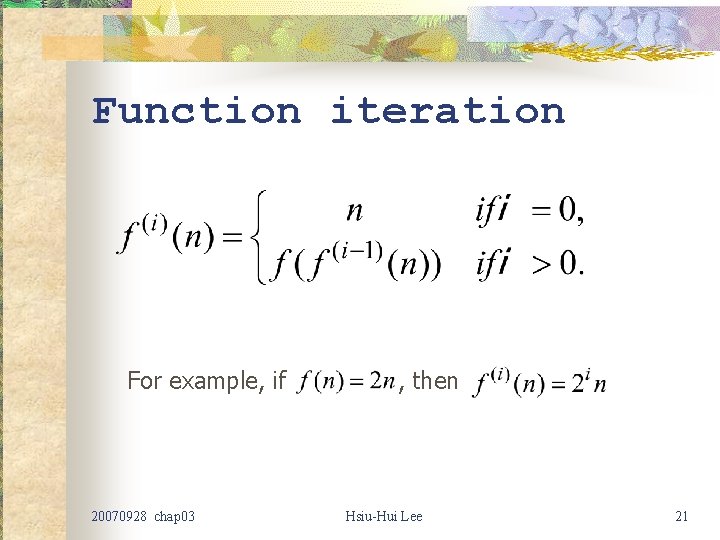
Function iteration For example, if , then 20070928 chap 03 Hsiu-Hui Lee 21
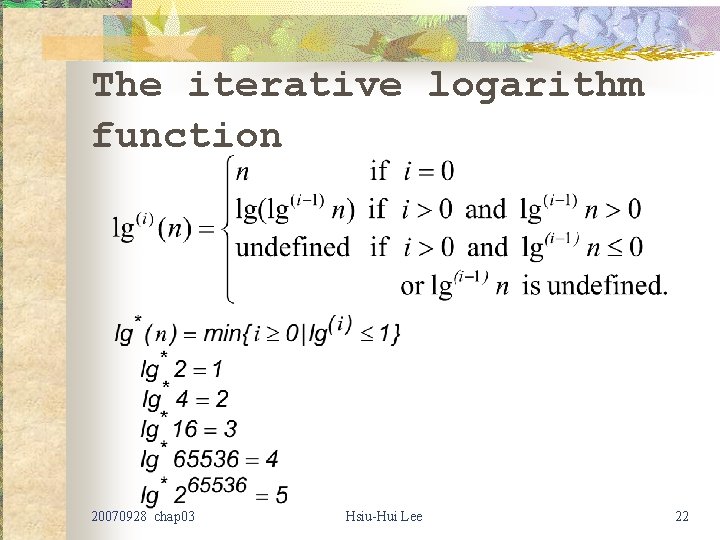
The iterative logarithm function 20070928 chap 03 Hsiu-Hui Lee 22
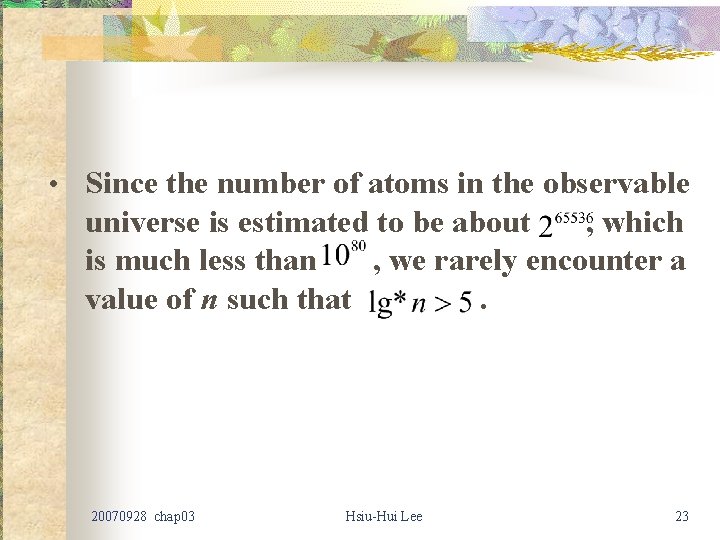
• Since the number of atoms in the observable universe is estimated to be about , which is much less than , we rarely encounter a value of n such that. 20070928 chap 03 Hsiu-Hui Lee 23
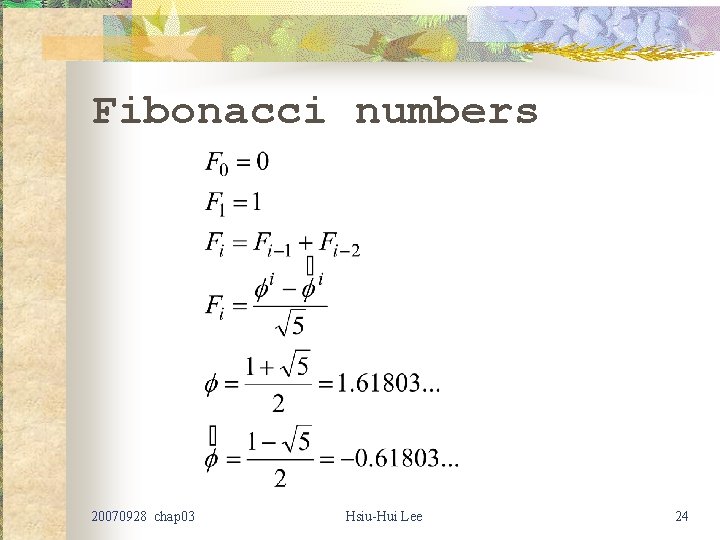
Fibonacci numbers 20070928 chap 03 Hsiu-Hui Lee 24
Homework-1 • Problem 3 -1, 3 -2 • Due: 10/5/20070928 chap 03 Hsiu-Hui Lee 25