Chapter 2 History and Trends in PsychiatricMental Health





- Slides: 22
Chapter 2 History and Trends in Psychiatric–Mental Health Nursing Copyright © 2012 Wolters Kluwer Health | Lippincott Williams & Wilkins
The twenty years in this era (1915 -1935) brought an awakening of interest in raising standards of care in psychiatric work, a growing realization of the role of nurses and the nursing profession in the needed improvements, and gradual inclusion in basic nursing curricula of the dominant psychiatric concepts available at this time. PEPLAU, 1956 Copyright © 2012 Wolters Kluwer Health | Lippincott Williams & Wilkins
Learning Objectives After studying this chapter, you should be able to • Distinguish between mental health and mental illness • Identify factors that influence the development of mental health • Evaluate the levels of communication that affect an individual's personal growth and maturity • Define how ego defense mechanisms affect mental health maintenance • Identify examples of defense mechanisms, including the purpose that each serves Copyright © 2012 Wolters Kluwer Health | Lippincott Williams & Wilkins
Learning Objectives (cont. ) • Analyze the role of a significant other or support person in maintaining mental health • Articulate examples of harmful effects of stigma • Define psychiatric–mental health nursing • Differentiate Peplau’s five phases in the emergence of psychiatric nursing from 1773 through 1936 • Interpret the educational objectives of psychiatric nursing during the early 20 th century as described by the National League for Nursing (NLN) • Articulate the purpose of the Psychiatric–Mental Health Nursing Scope and Standards of Practice • Summarize the current state of psychiatric–mental health nursing Copyright © 2012 Wolters Kluwer Health | Lippincott Williams & Wilkins
Concept of Mental Health Mental health is a positive state in which one is responsible, displays self-awareness, is self-directive, is reasonably worry free, and can cope with usual daily tensions. Cultural beliefs influence how mental health and mental illness are determined. Copyright © 2012 Wolters Kluwer Health | Lippincott Williams & Wilkins
Factors Influencing Mental Health • Genetic characteristics • Nurturing during childhood • Life circumstances Copyright © 2012 Wolters Kluwer Health | Lippincott Williams & Wilkins
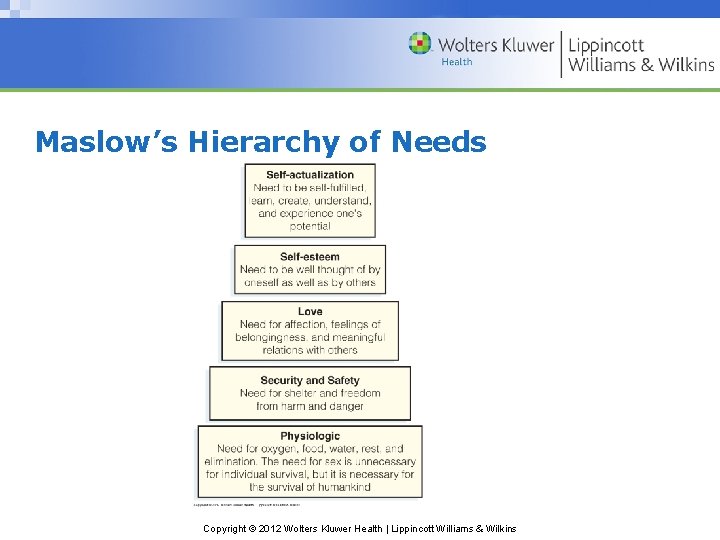
Characteristics of Mental Health Abraham Maslow (1970), an eminent psychologist and writer, identified a “hierarchy of needs” to describe an individual’s motivation to experience selfactualization, or mental health. An individual may progress or experience reverse progression through five levels leading to selfactualization. Copyright © 2012 Wolters Kluwer Health | Lippincott Williams & Wilkins
Maslow’s Hierarchy of Needs Copyright © 2012 Wolters Kluwer Health | Lippincott Williams & Wilkins
Self-Actualization People who achieve self-actualization are able to • Have positive self-concepts and relate well to people and their environment • Form close relationships with others • Make decisions pertaining to reality rather than fantasy • Be optimistic and appreciate and enjoy life • Be independent or autonomous in thought and action, relying on personal standards of behavior and values • Be creative, using a variety of approaches as they perform tasks or solve problems Copyright © 2012 Wolters Kluwer Health | Lippincott Williams & Wilkins
Factors Affecting Mental Health Maintenance • Interpersonal communication • Ego defense mechanisms • Significant others or support people Copyright © 2012 Wolters Kluwer Health | Lippincott Williams & Wilkins
Personal Strategies for Mental Health Maintenance • Stress management programs are one way to combat the increasing demands on individuals both professionally and personally. Copyright © 2012 Wolters Kluwer Health | Lippincott Williams & Wilkins
Concept of Mental Illness Mental illness is an illness or syndrome • With psychologic or behavioral manifestations • With impairment in functioning due to a social, psychologic, genetic, physical/chemical, or biologic disturbance • That is not limited to relations between the person and the society • That is characterized by symptoms and/or impairment in functioning (American Psychiatric Association, 1994) Copyright © 2012 Wolters Kluwer Health | Lippincott Williams & Wilkins
Stigma and Perceptions About Mental Illness Abnormal behavior is different or odd and is easily recognized. Abnormal behavior can be predicted and evaluated. Internal forces are responsible for abnormal behavior. People who exhibit abnormal behavior are dangerous and violent. Maladaptive behavior is always inherited. Mental illness is incurable. Mayo. Clinic. com, 2008; Altrocchi (1980) Copyright © 2012 Wolters Kluwer Health | Lippincott Williams & Wilkins
Historical Development of Psychiatric– Mental Health Nursing (PMHN) • Middle Ages to 1773 • 1773 to 1956 • Other developments since the 1950 s Copyright © 2012 Wolters Kluwer Health | Lippincott Williams & Wilkins
Psychiatric–Mental Health Nursing: Scope and Standards of Practice Standards of practice are authoritative statements used by the nursing profession to describe the responsibilities for which nurses are accountable. • They provide direction for professional nursing practice. • They provide a framework for the evaluation of practice. • They define the nursing profession’s accountability to the public. • They define the client outcomes for which nurses are responsible. Copyright © 2012 Wolters Kluwer Health | Lippincott Williams & Wilkins
Psychiatric–Mental Health Nursing Today • As recently as 2004, a national survey found that 82% of nurses thought that there was still a nursing shortage. More than 1 million new nurses will be needed by the year 2010. The Bureau of Labor Statistics predicts that more than 1 million new nurses will be needed by the year 2010. Copyright © 2012 Wolters Kluwer Health | Lippincott Williams & Wilkins
Education • Licensed practical or vocational nursing programs • Associate degree nursing programs • Baccalaureate degree nursing programs • Master’s degree nursing programs • Continuing education Copyright © 2012 Wolters Kluwer Health | Lippincott Williams & Wilkins
Continuing Education • The Board of Nursing of each state has established continuing education guidelines. • Certification is available for various levels of psychiatric nursing: – Generalist – Clinical specialist – Nurse practitioner Copyright © 2012 Wolters Kluwer Health | Lippincott Williams & Wilkins
Career Opportunities Examples include the following: • Nurse liaison in the general hospital • Therapist in private practice • Consultant, educator • Expert witness in legal issues • Employee assistance counselor • Mental health provider in long-term care facilities • Mobile psychiatric triage unit Copyright © 2012 Wolters Kluwer Health | Lippincott Williams & Wilkins
Expanded Role of the Psychiatric–Mental Health Nurse • Managed care nursing • Parish nursing • Privileging process • Telehealth • Forensic nursing Perhaps the greatest challenge to nursing lies in the future, as we identify and develop clinical provider performance measures that are relevant to the care we provide and the people we serve. Copyright © 2012 Wolters Kluwer Health | Lippincott Williams & Wilkins
Key Terms • Burnout • Parish nursing • Compassion fatigue • Privileging process • Ego defense mechanisms • Forensic nursing • Psychiatric nursing • Self-actualization • Genetics • Significant others • Genomics • Standards of professional performance • Hospitalist • Managed care nursing • Mental disorder • Stigma • Telehealth • Mental health • Mental illness • Nursing informatics Copyright © 2012 Wolters Kluwer Health | Lippincott Williams & Wilkins
Reflection The twenty years in this era (1915 -1935) brought an awakening of interest in raising standards of care in psychiatric work, a growing realization of the role of nurses and the nursing profession in the needed improvements, and gradual inclusion in basic nursing curricula of the dominant psychiatric concepts available at this time. • Explain the impact of these trends on the delivery of care to clients during the 21 st century. ? Peplau, 1956 Copyright © 2012 Wolters Kluwer Health | Lippincott Williams & Wilkins