Chapter 18 2 Le Chteliers principle if a

- Slides: 8
Chapter 18. 2 Le Châtelier’s principle – if a system at equilibrium is subjected to a stress, the equilibrium is shifted in the direction that tends to relieve the stress - stresses are changes in concentration, pressure, and temperature
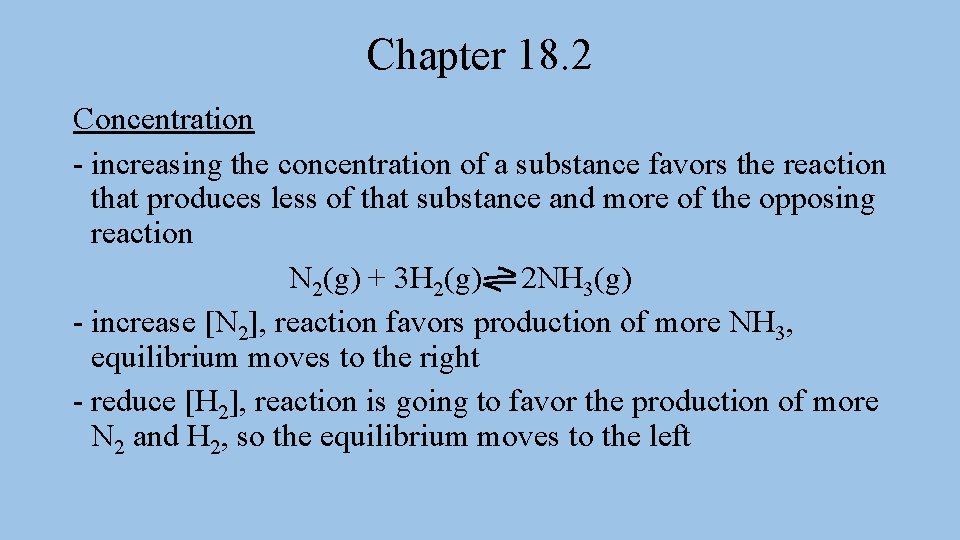
Chapter 18. 2 Concentration - increasing the concentration of a substance favors the reaction that produces less of that substance and more of the opposing reaction N 2(g) + 3 H 2(g) 2 NH 3(g) - increase [N 2], reaction favors production of more NH 3, equilibrium moves to the right - reduce [H 2], reaction is going to favor the production of more N 2 and H 2, so the equilibrium moves to the left
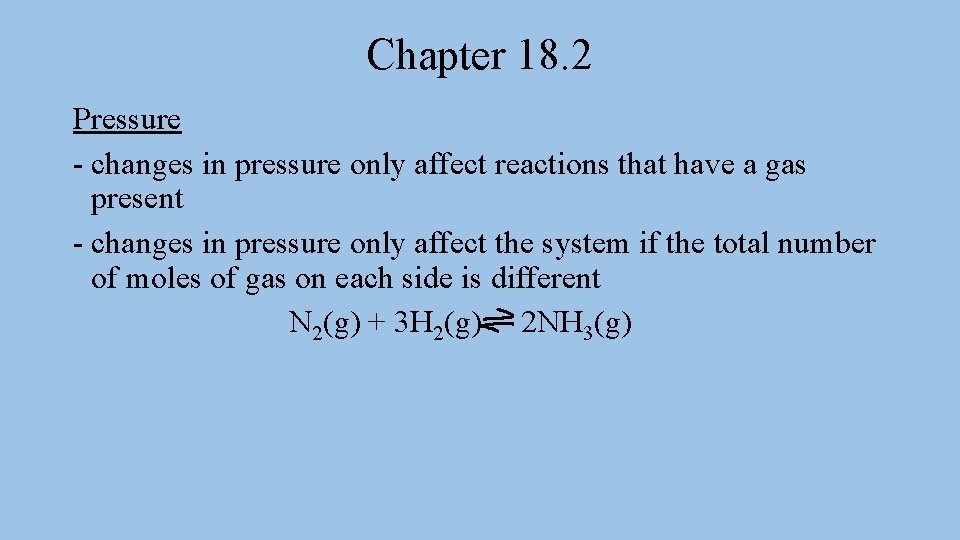
Chapter 18. 2 Pressure - changes in pressure only affect reactions that have a gas present - changes in pressure only affect the system if the total number of moles of gas on each side is different N 2(g) + 3 H 2(g) 2 NH 3(g)
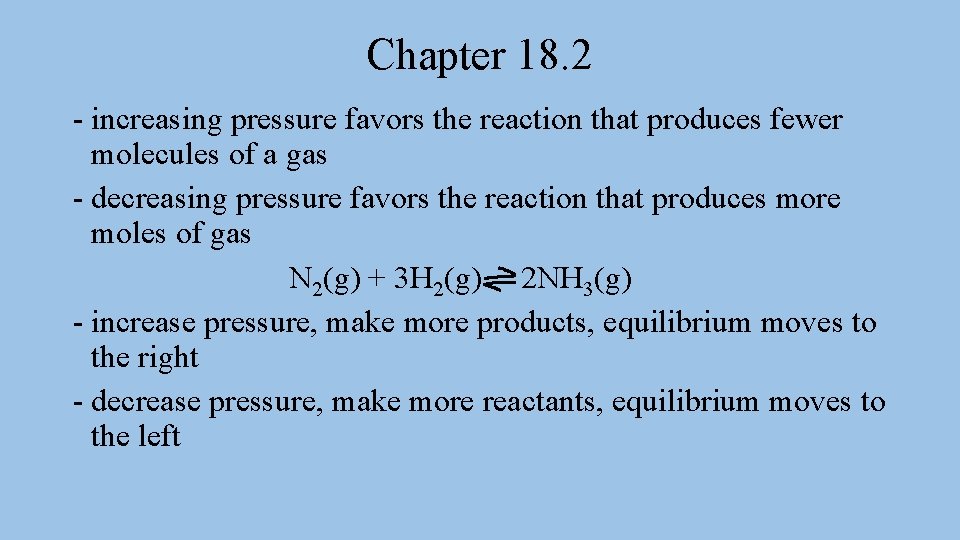
Chapter 18. 2 - increasing pressure favors the reaction that produces fewer molecules of a gas - decreasing pressure favors the reaction that produces more moles of gas N 2(g) + 3 H 2(g) 2 NH 3(g) - increase pressure, make more products, equilibrium moves to the right - decrease pressure, make more reactants, equilibrium moves to the left
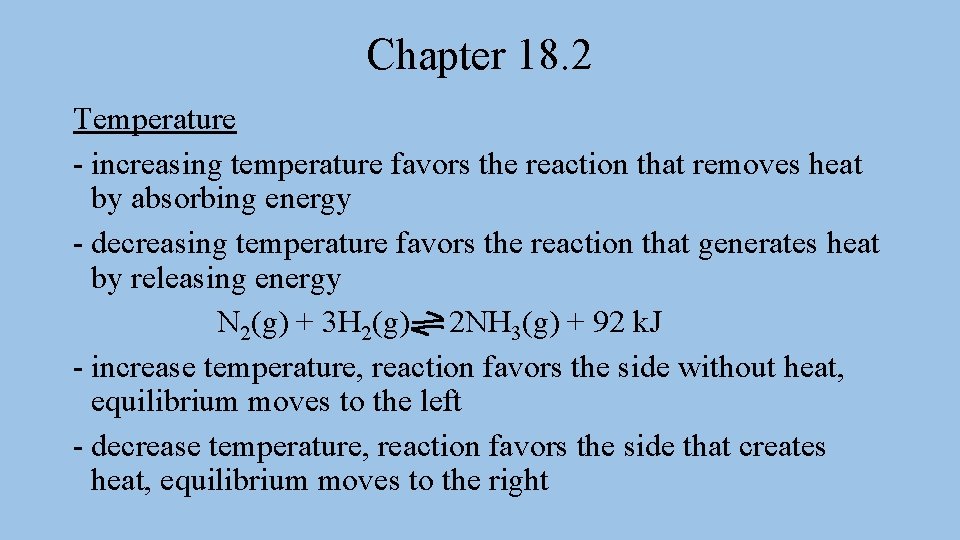
Chapter 18. 2 Temperature - increasing temperature favors the reaction that removes heat by absorbing energy - decreasing temperature favors the reaction that generates heat by releasing energy N 2(g) + 3 H 2(g) 2 NH 3(g) + 92 k. J - increase temperature, reaction favors the side without heat, equilibrium moves to the left - decrease temperature, reaction favors the side that creates heat, equilibrium moves to the right
Chapter 18. 2 - some reactions involving ions go to completion when the ions are removed from solution 3 ways to remove ions 1. produce a gas 2. form a precipitate 3. form a product that is only slightly ionized ex. neutralization reactions
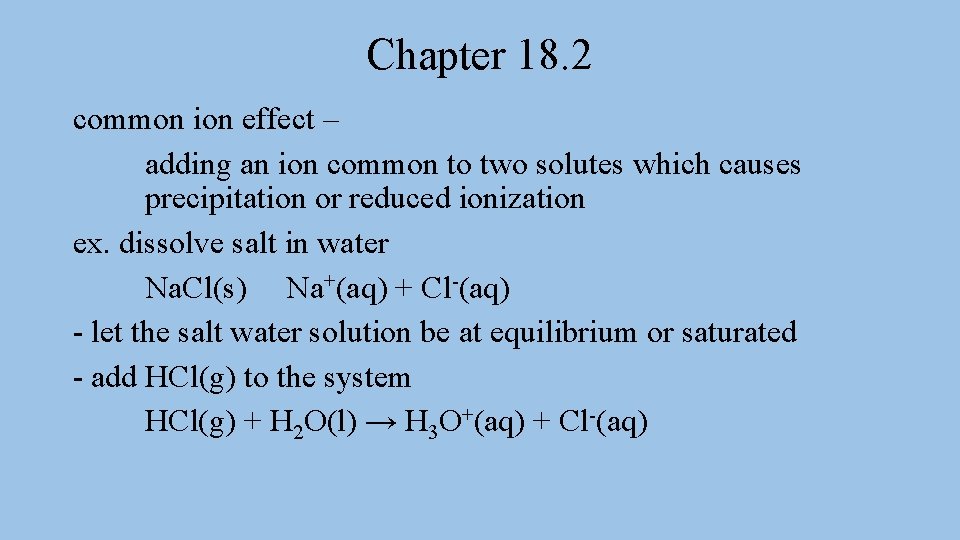
Chapter 18. 2 common ion effect – adding an ion common to two solutes which causes precipitation or reduced ionization ex. dissolve salt in water Na. Cl(s) Na+(aq) + Cl-(aq) - let the salt water solution be at equilibrium or saturated - add HCl(g) to the system HCl(g) + H 2 O(l) → H 3 O+(aq) + Cl-(aq)
Chapter 18. 2 - adding the HCl increases the concentration of Cl. K = [Na+][Cl-] - to keep K constant, the concentration of Na+ must be reduced - this causes Na. Cl to precipitate out of the solution - increase [Cl-], decrease [Na+], K stays constant