Chapter 17 Notes Part 1 Natural Selection and

- Slides: 61
Chapter 17 Notes Part 1 Natural Selection and Adaptions
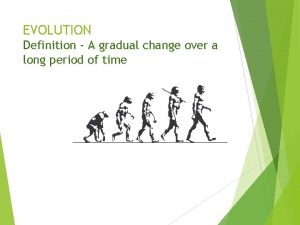
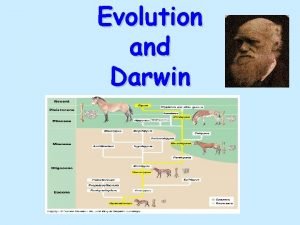
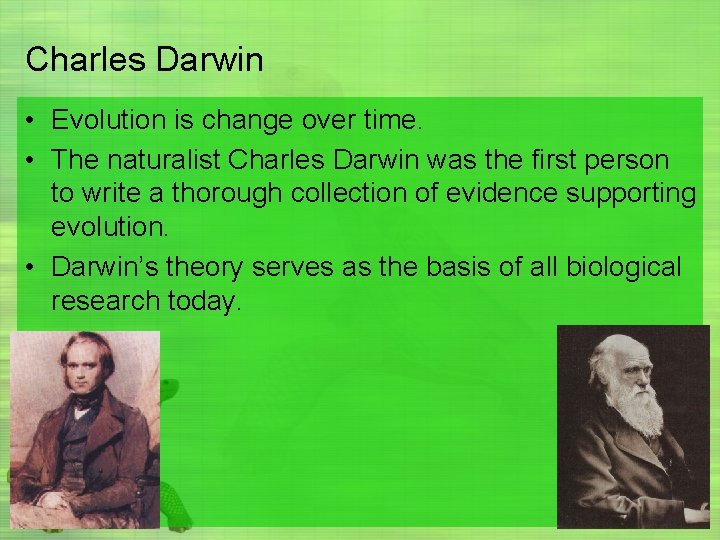
Charles Darwin • Evolution is change over time. • The naturalist Charles Darwin was the first person to write a thorough collection of evidence supporting evolution. • Darwin’s theory serves as the basis of all biological research today.
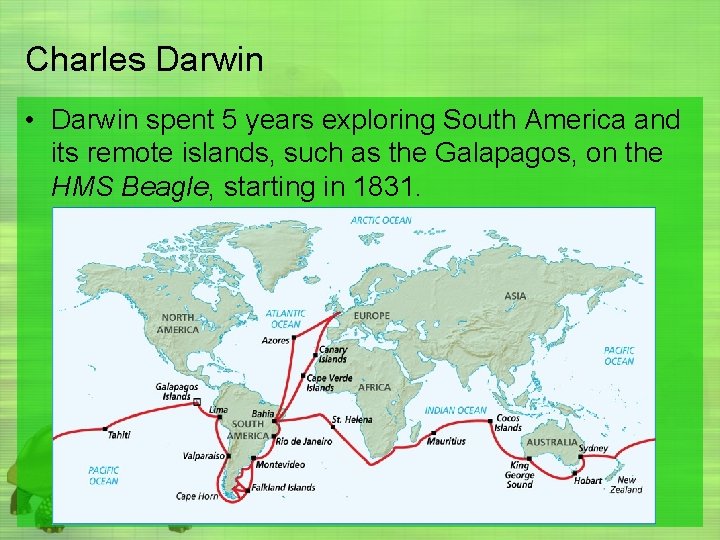
Charles Darwin • Darwin spent 5 years exploring South America and its remote islands, such as the Galapagos, on the HMS Beagle, starting in 1831.
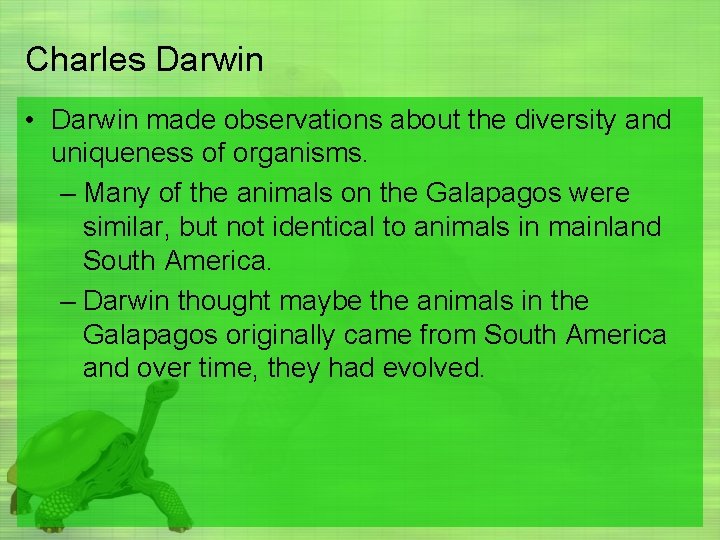
Charles Darwin • Darwin made observations about the diversity and uniqueness of organisms. – Many of the animals on the Galapagos were similar, but not identical to animals in mainland South America. – Darwin thought maybe the animals in the Galapagos originally came from South America and over time, they had evolved.
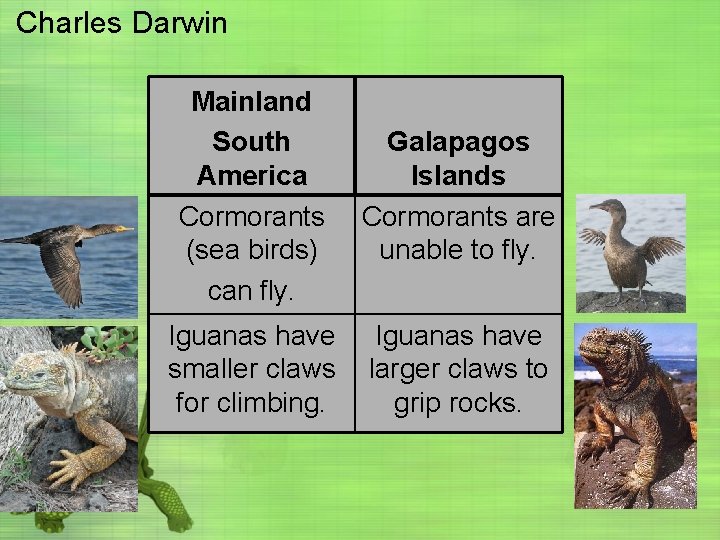
Charles Darwin Mainland South America Cormorants (sea birds) can fly. Galapagos Islands Cormorants are unable to fly. Iguanas have smaller claws for climbing. Iguanas have larger claws to grip rocks.
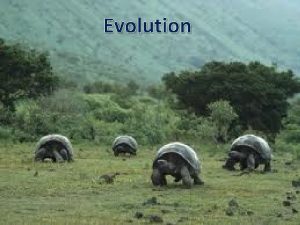
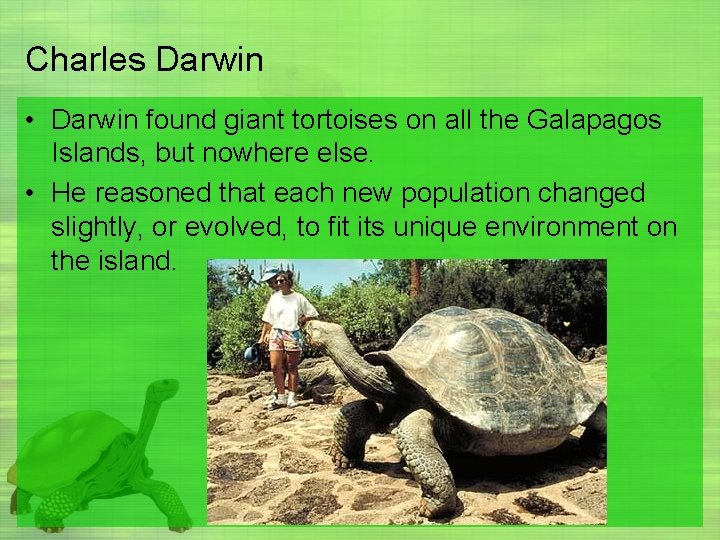
Charles Darwin • Darwin found giant tortoises on all the Galapagos Islands, but nowhere else. • He reasoned that each new population changed slightly, or evolved, to fit its unique environment on the island.
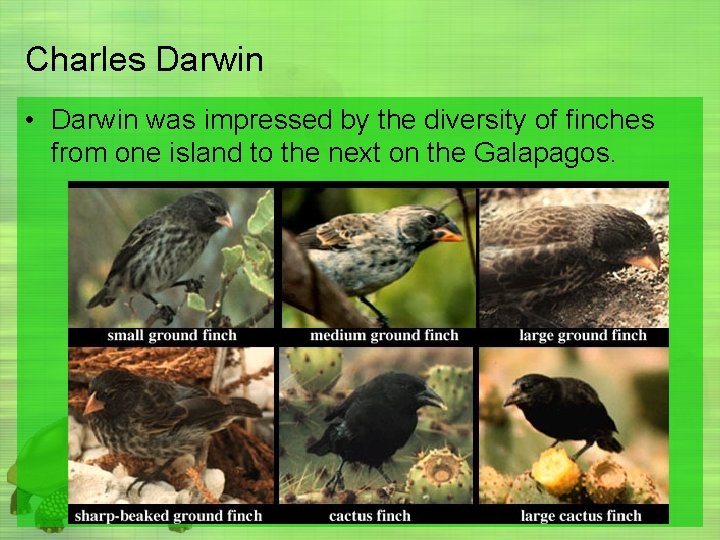
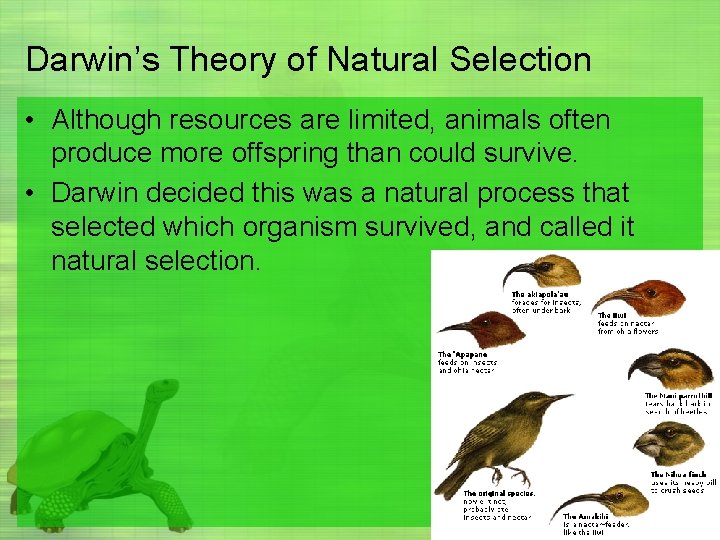
Charles Darwin • Darwin was impressed by the diversity of finches from one island to the next on the Galapagos.
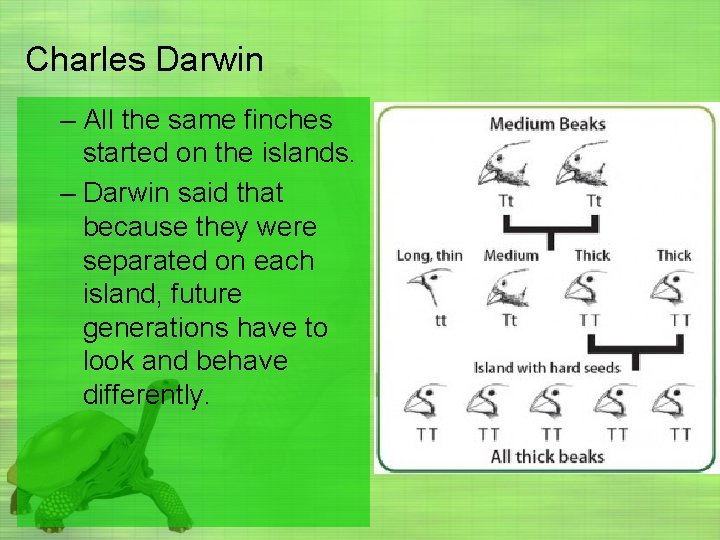
Charles Darwin – All the same finches started on the islands. – Darwin said that because they were separated on each island, future generations have to look and behave differently.
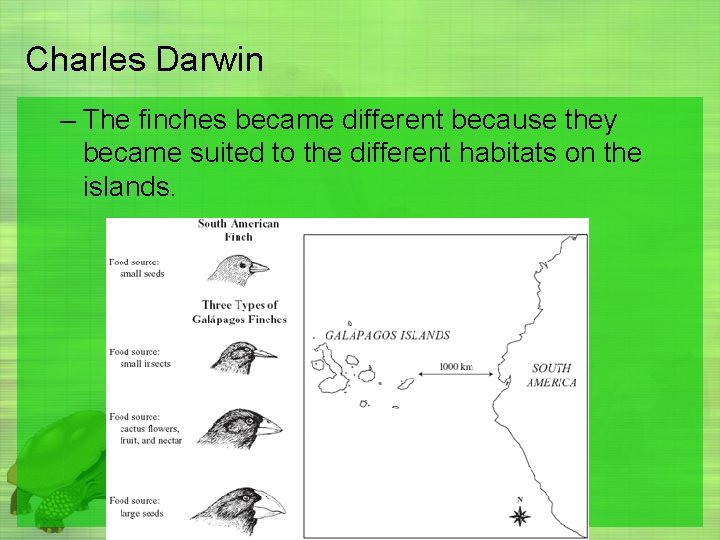
Charles Darwin – The finches became different because they became suited to the different habitats on the islands.
Charles Darwin
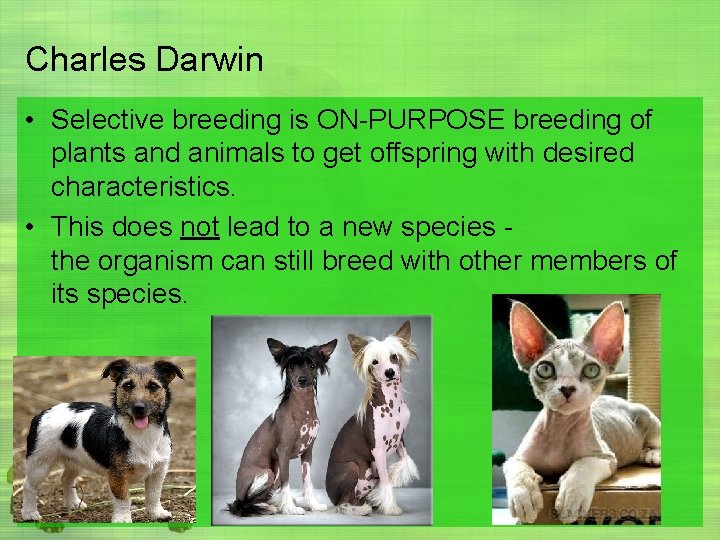
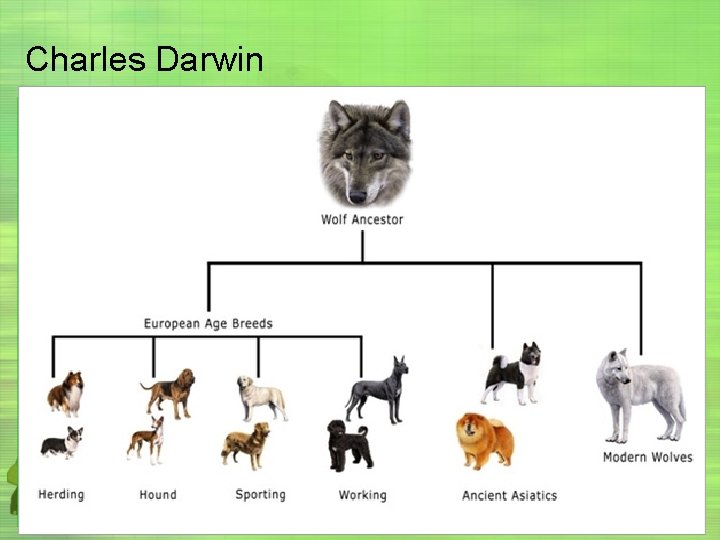
Charles Darwin • Selective breeding is ON-PURPOSE breeding of plants and animals to get offspring with desired characteristics. • This does not lead to a new species the organism can still breed with other members of its species.
Charles Darwin
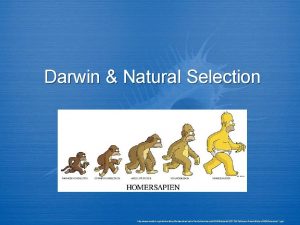
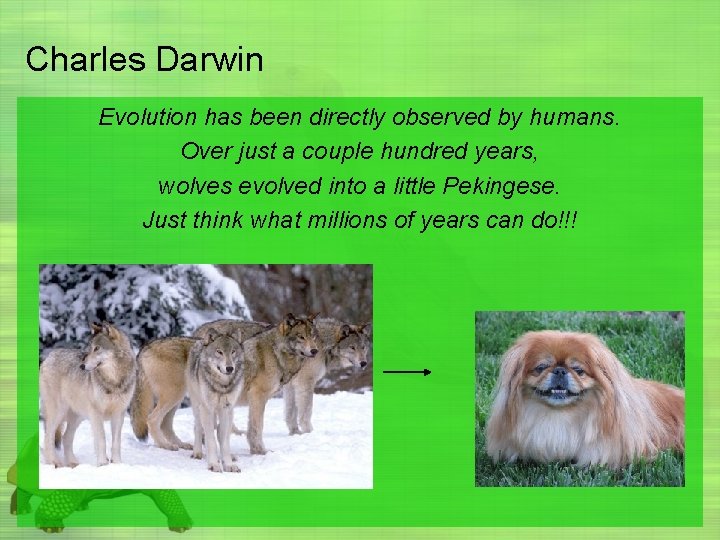
Charles Darwin Evolution has been directly observed by humans. Over just a couple hundred years, wolves evolved into a little Pekingese. Just think what millions of years can do!!!
Darwin’s Theory of Natural Selection • Evolutionary Biologists are like detectives. • They come on the scene AFTER the fact, but can figure out what happened because of clues left behind.
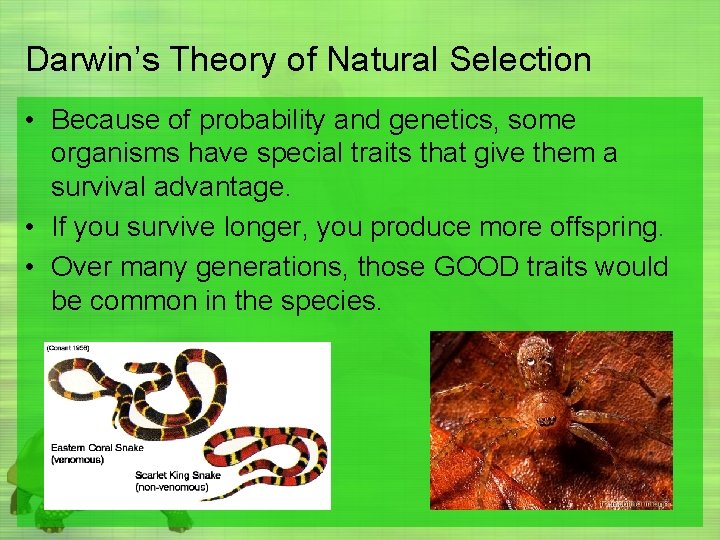
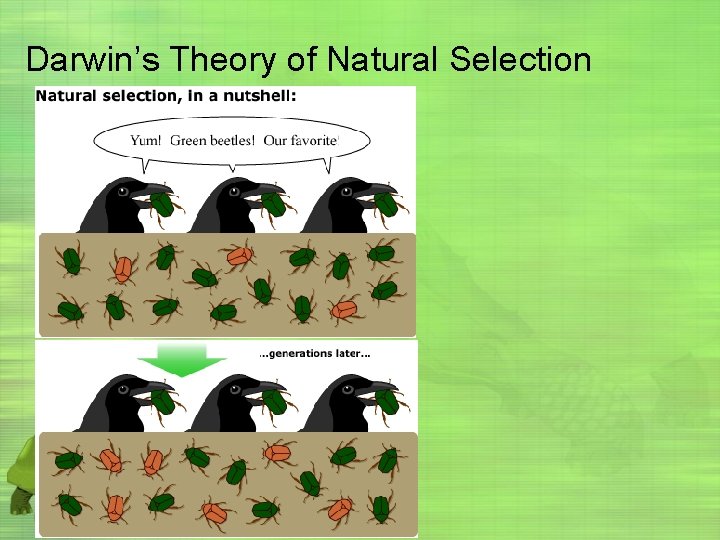
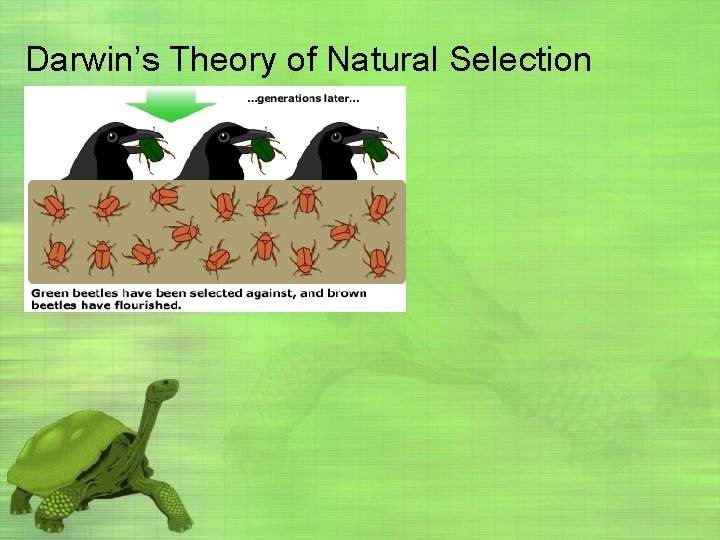
Darwin’s Theory of Natural Selection • Because of probability and genetics, some organisms have special traits that give them a survival advantage. • If you survive longer, you produce more offspring. • Over many generations, those GOOD traits would be common in the species.
Darwin’s Theory of Natural Selection
Darwin’s Theory of Natural Selection
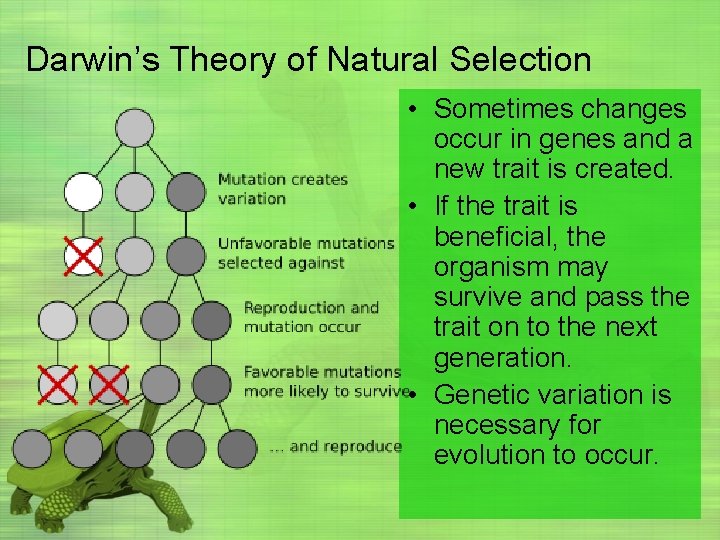
Darwin’s Theory of Natural Selection • Sometimes changes occur in genes and a new trait is created. • If the trait is beneficial, the organism may survive and pass the trait on to the next generation. • Genetic variation is necessary for evolution to occur.
Darwin’s Theory of Natural Selection
Darwin’s Theory of Natural Selection • Although resources are limited, animals often produce more offspring than could survive. • Darwin decided this was a natural process that selected which organism survived, and called it natural selection.
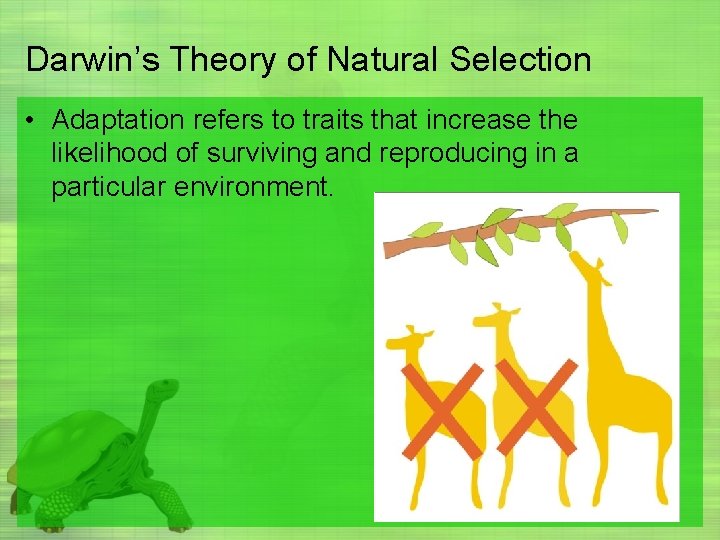
Darwin’s Theory of Natural Selection • Adaptation refers to traits that increase the likelihood of surviving and reproducing in a particular environment.
Darwin’s Theory of Natural Selection • Four steps or requirements of Darwin’s theory of evolution by natural selection: – Step 1: Overproduction – Step 2: Variation – Step 3: Inherited variation – Step 4: Natural selection
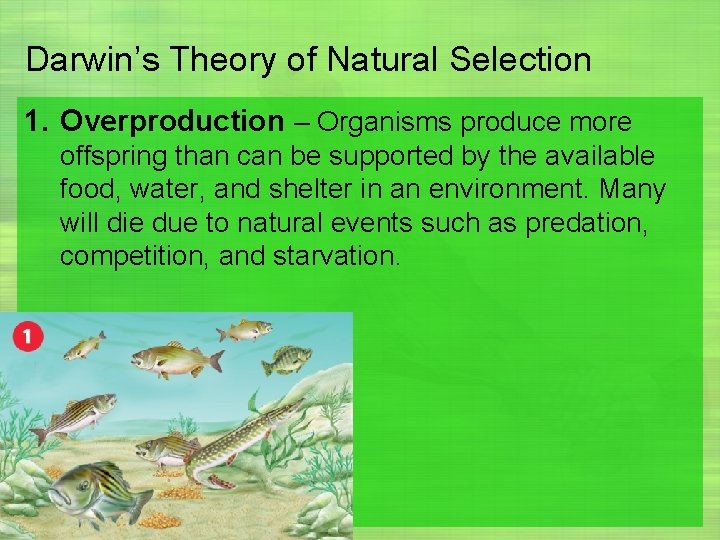
Darwin’s Theory of Natural Selection 1. Overproduction – Organisms produce more offspring than can be supported by the available food, water, and shelter in an environment. Many will die due to natural events such as predation, competition, and starvation.
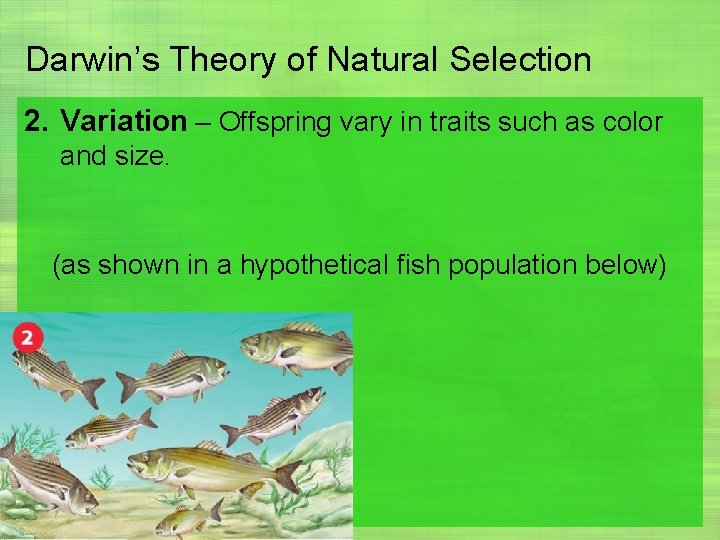
Darwin’s Theory of Natural Selection 2. Variation – Offspring vary in traits such as color and size. (as shown in a hypothetical fish population below)
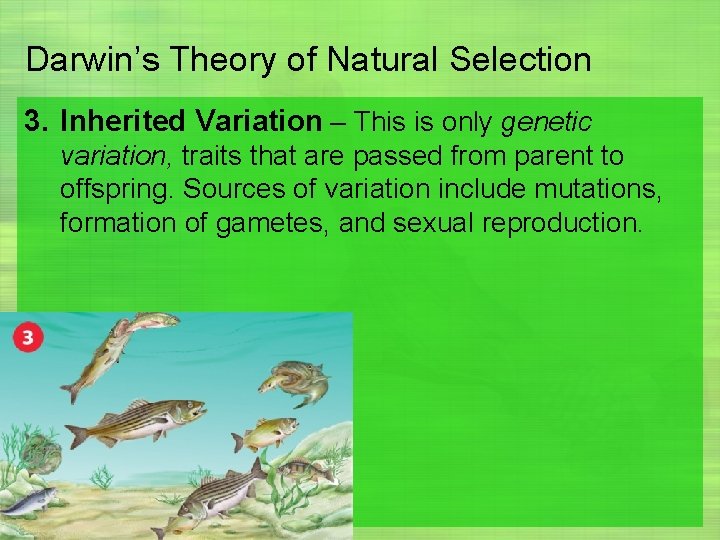
Darwin’s Theory of Natural Selection 3. Inherited Variation – This is only genetic variation, traits that are passed from parent to offspring. Sources of variation include mutations, formation of gametes, and sexual reproduction.
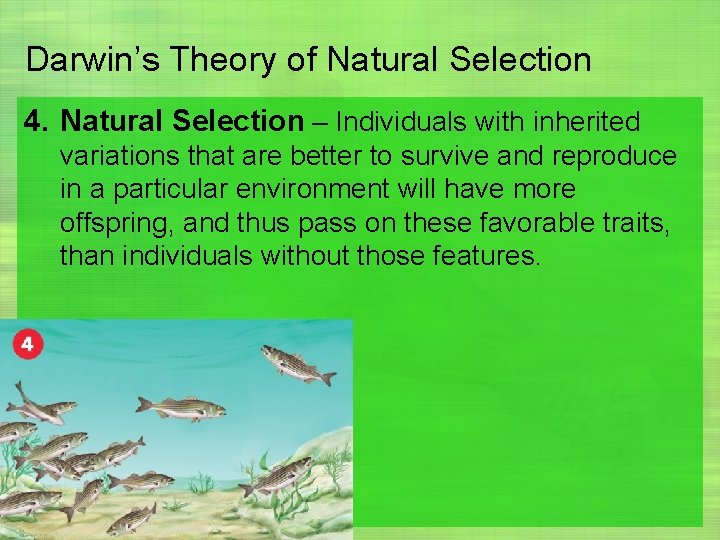
Darwin’s Theory of Natural Selection 4. Natural Selection – Individuals with inherited variations that are better to survive and reproduce in a particular environment will have more offspring, and thus pass on these favorable traits, than individuals without those features.
Darwin’s Theory of Natural Selection
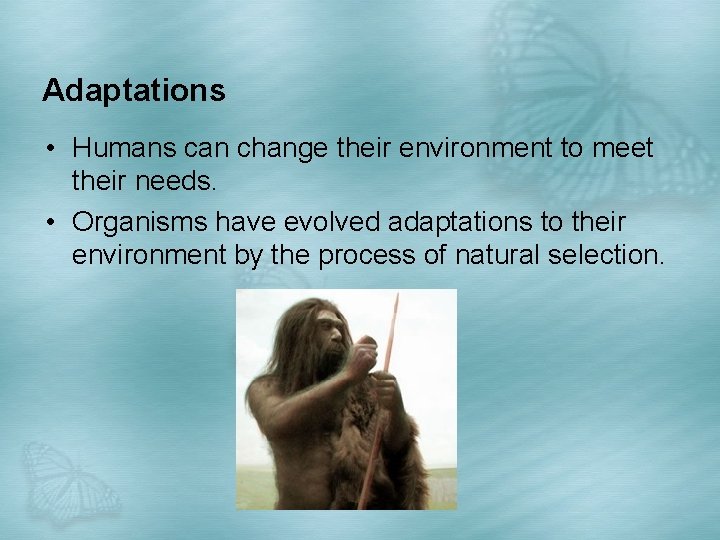
Adaptations • Humans can change their environment to meet their needs. • Organisms have evolved adaptations to their environment by the process of natural selection.
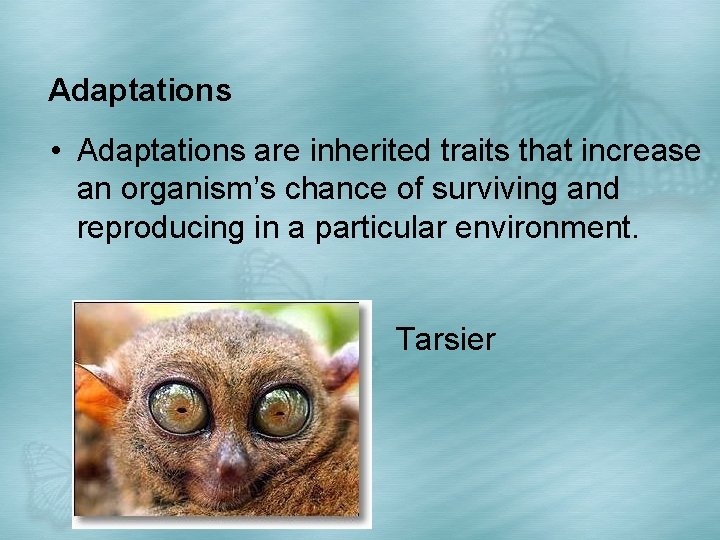
Adaptations • Adaptations are inherited traits that increase an organism’s chance of surviving and reproducing in a particular environment. Tarsier
Adaptations • Not all traits are adaptations. • Sometimes undesirable traits can be passed down because they are genetically linked with other beneficial traits.
Adaptations
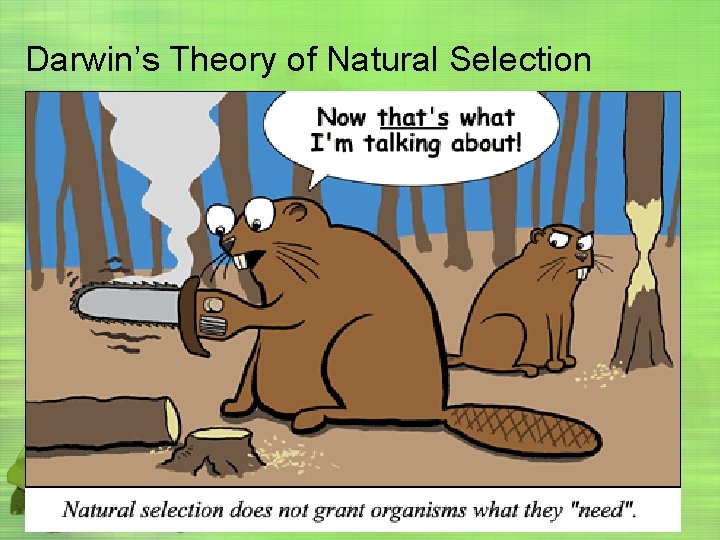
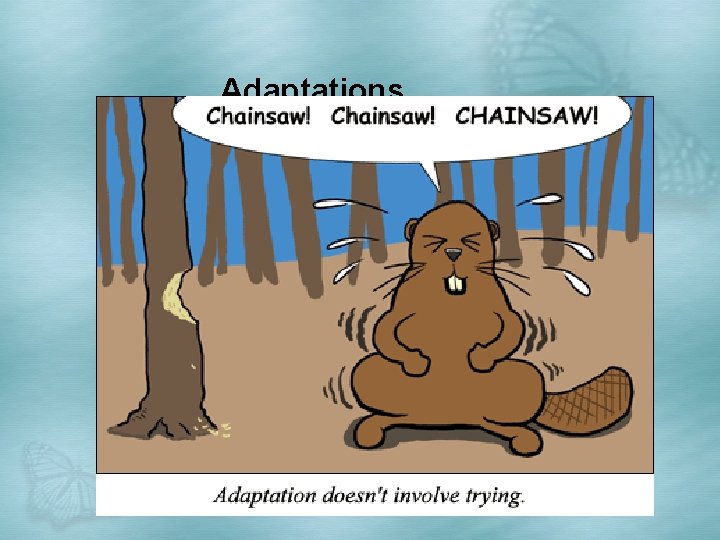
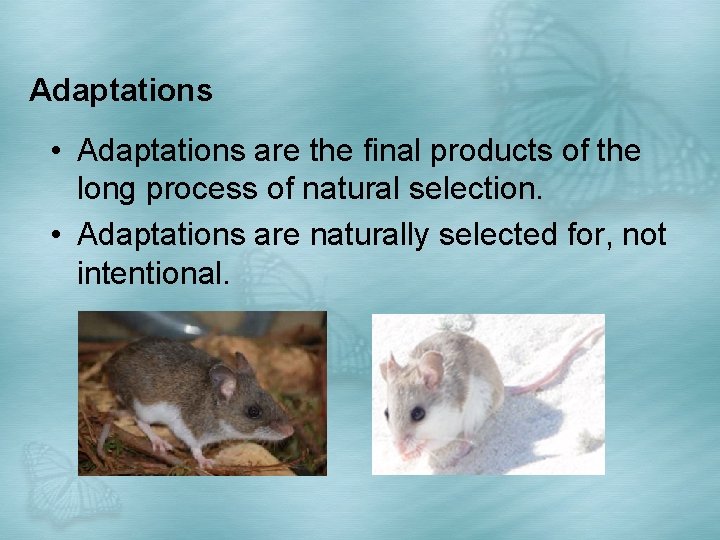
Adaptations • Adaptations are the final products of the long process of natural selection. • Adaptations are naturally selected for, not intentional.
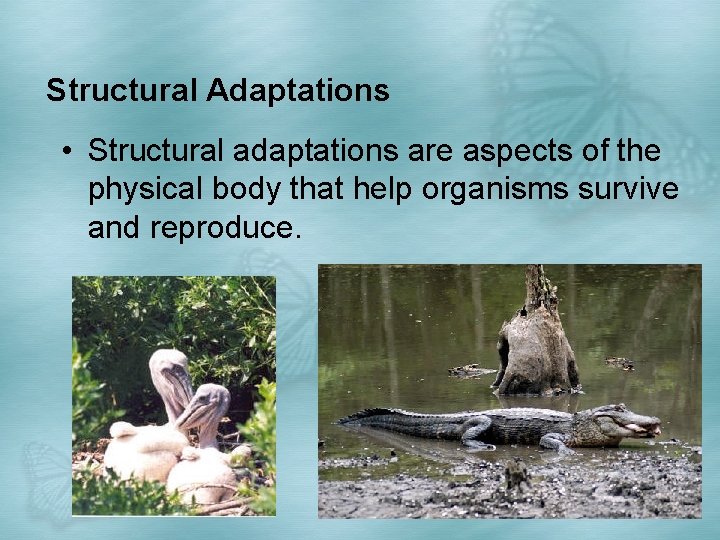
Structural Adaptations • Structural adaptations are aspects of the physical body that help organisms survive and reproduce.
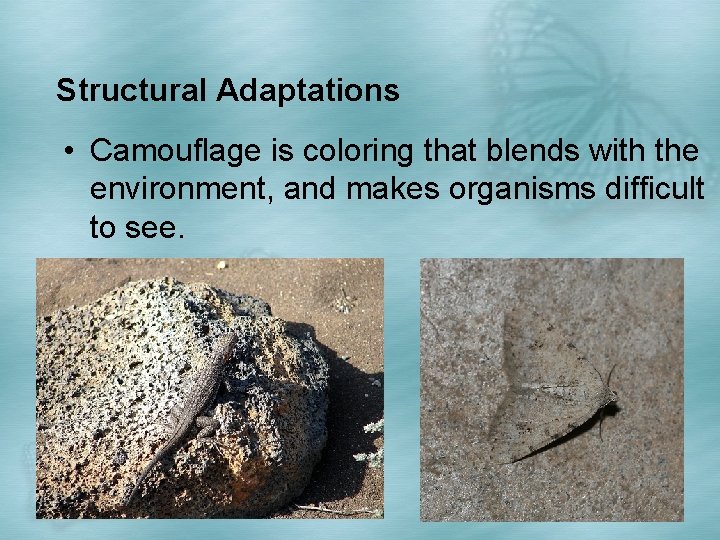
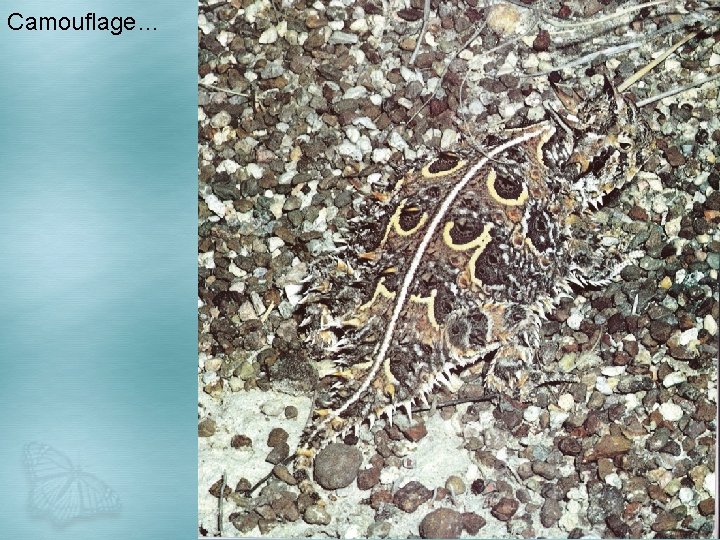
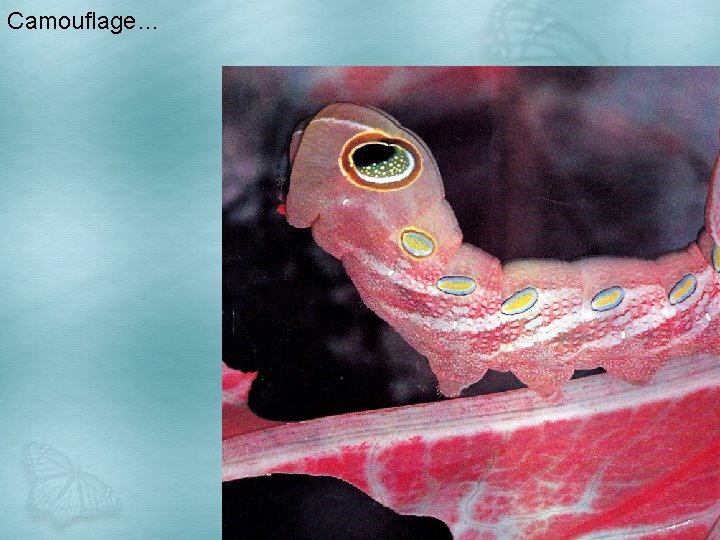
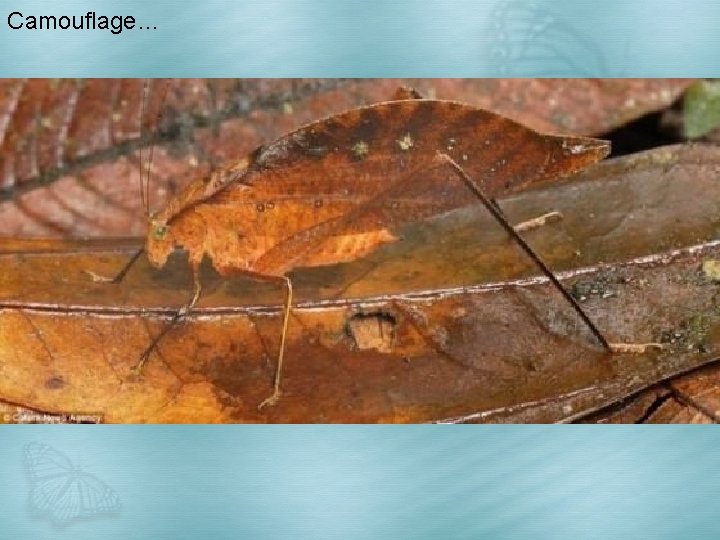
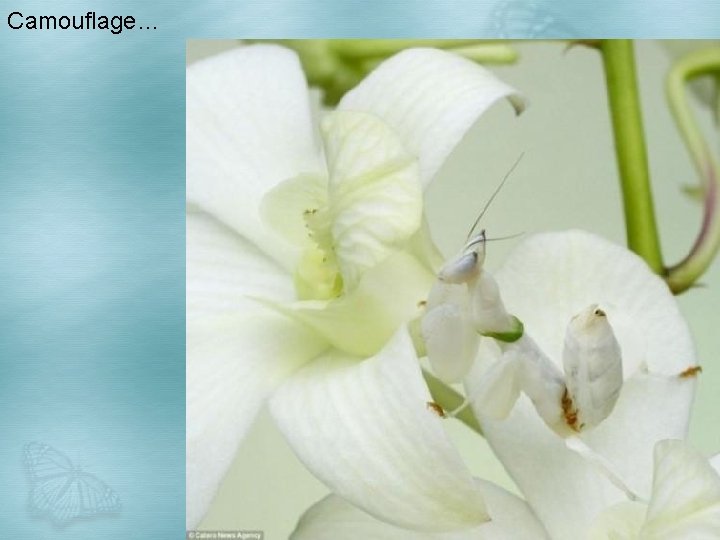
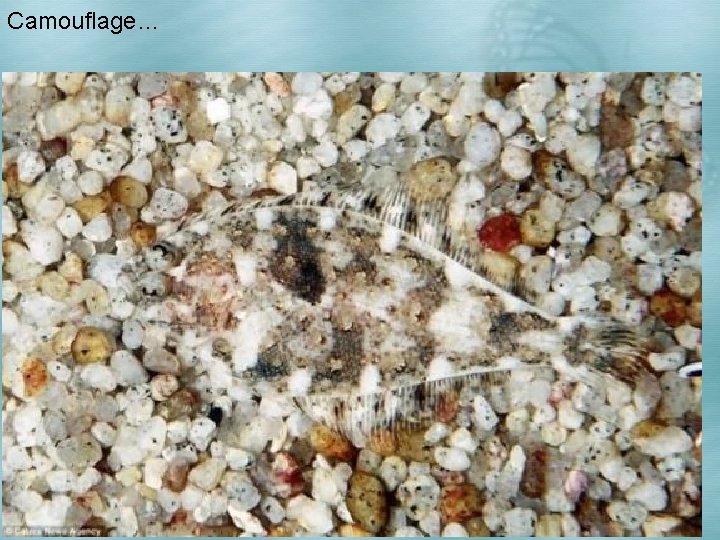
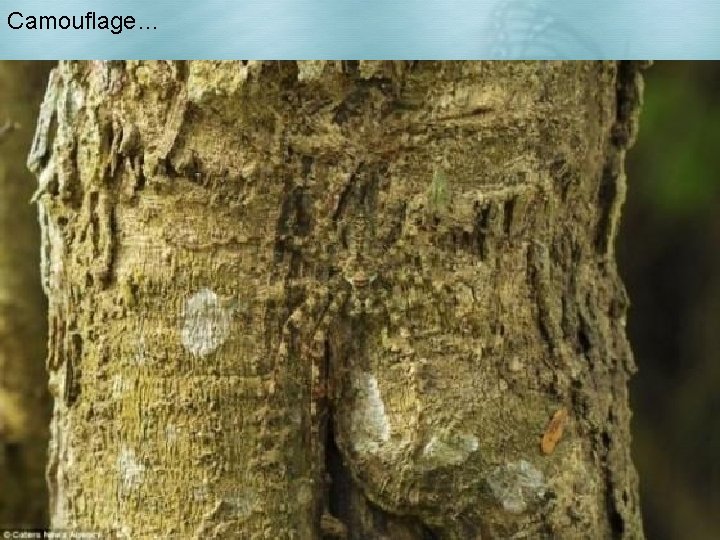
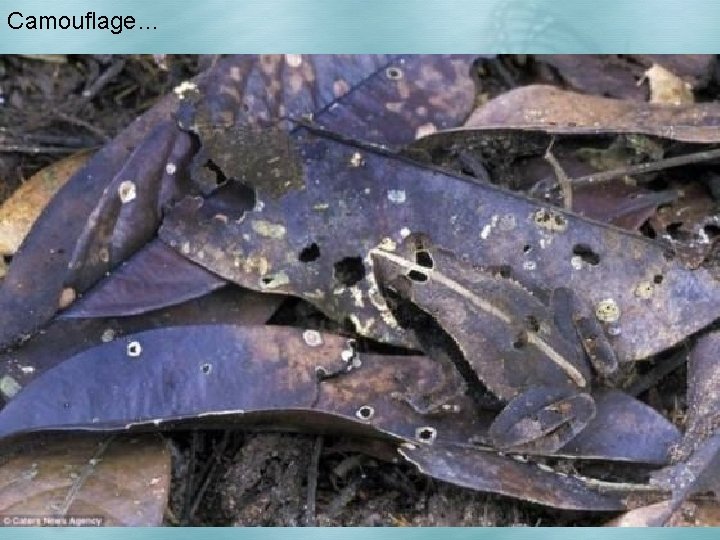
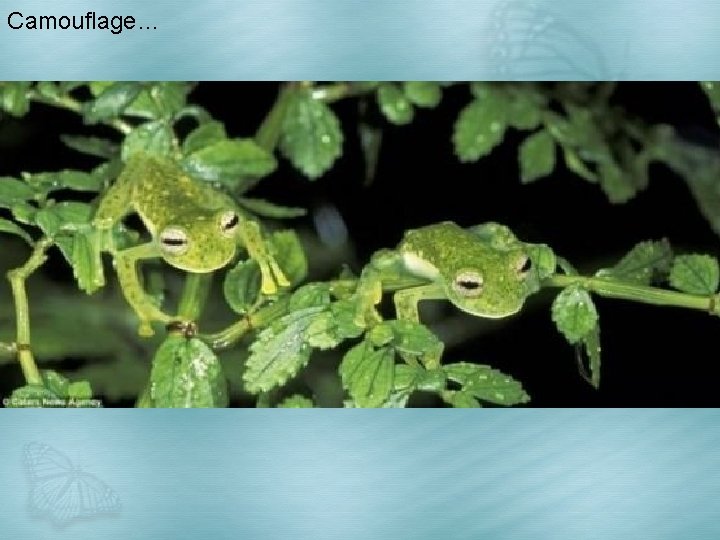
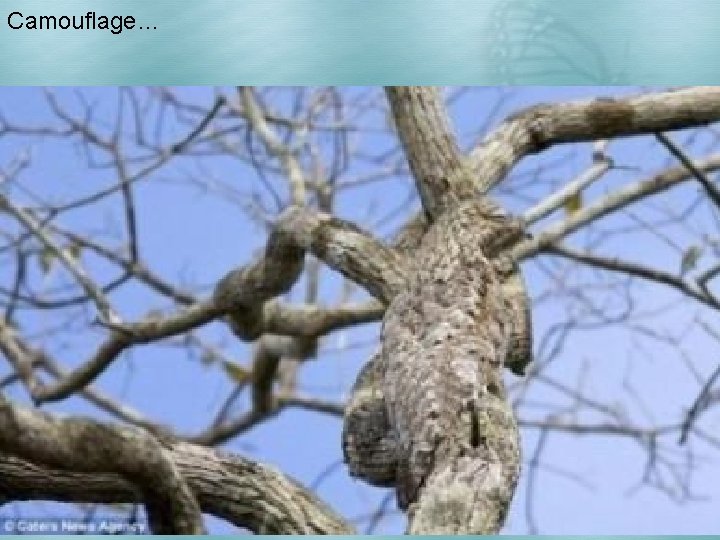
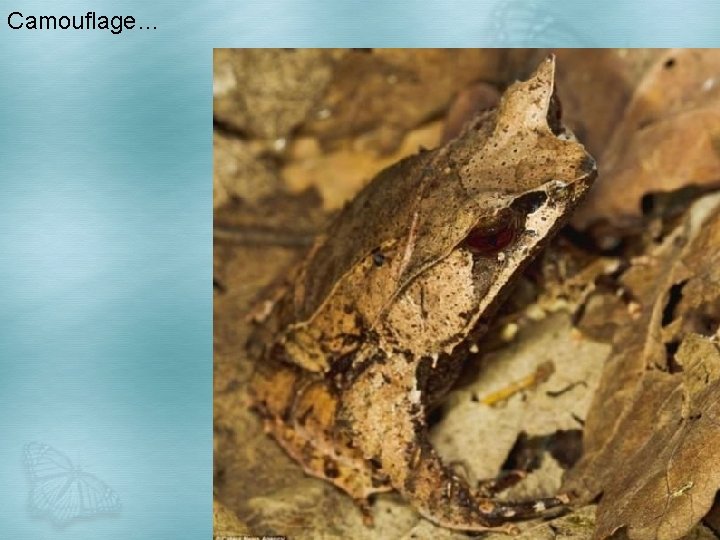
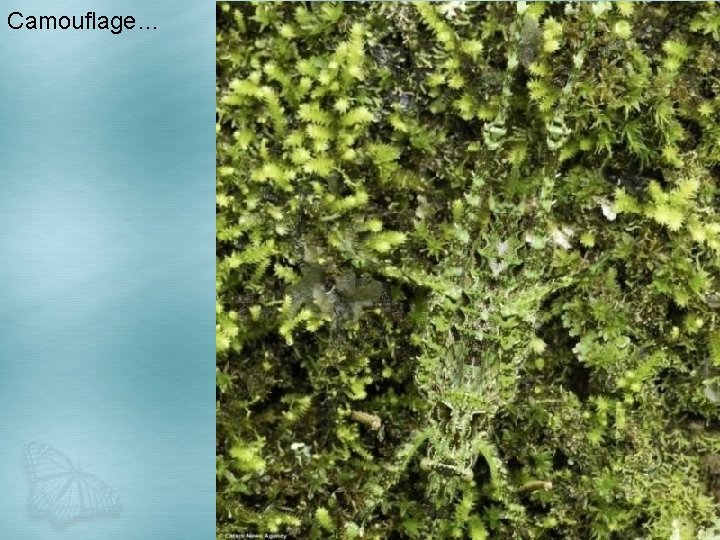
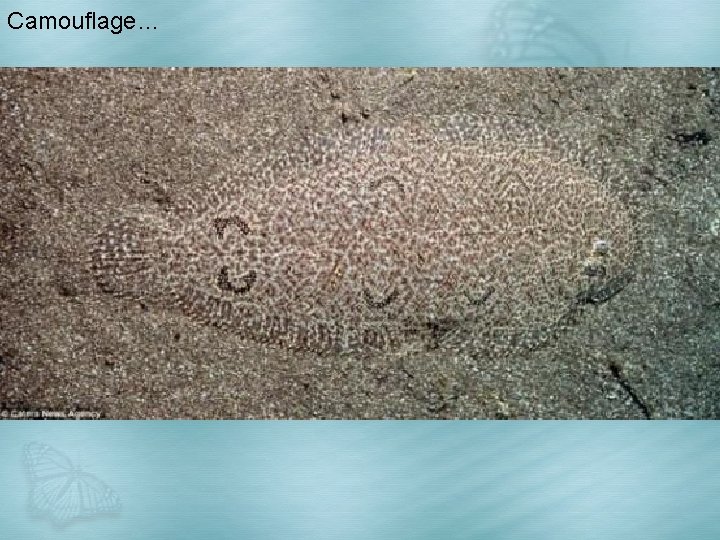
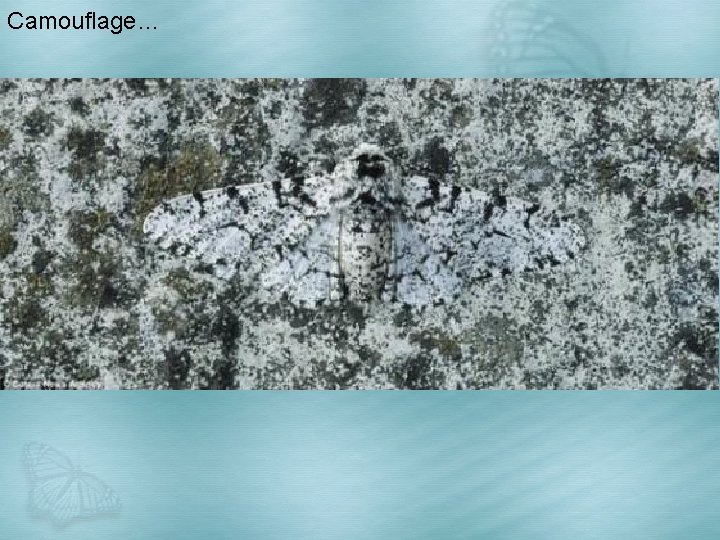
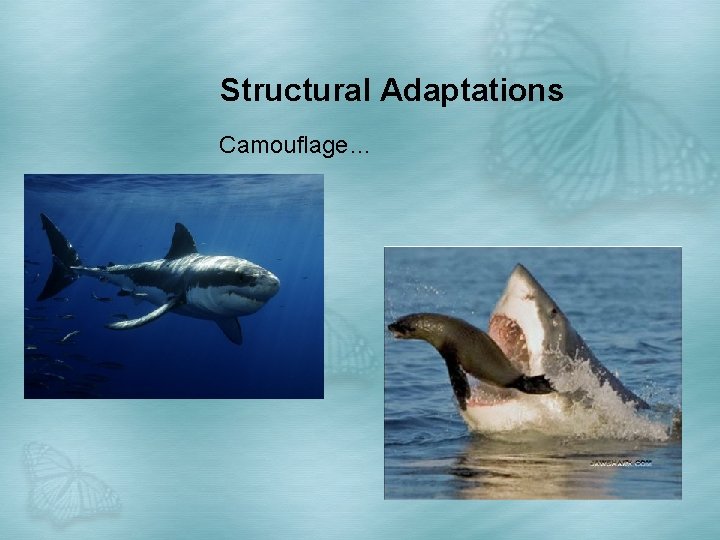
Structural Adaptations • Camouflage is coloring that blends with the environment, and makes organisms difficult to see.
Camouflage…
Camouflage…
Camouflage…
Camouflage…
Camouflage…
Camouflage…
Camouflage…
Camouflage…
Camouflage…
Camouflage…
Camouflage…
Camouflage…
Camouflage…
Structural Adaptations Camouflage…
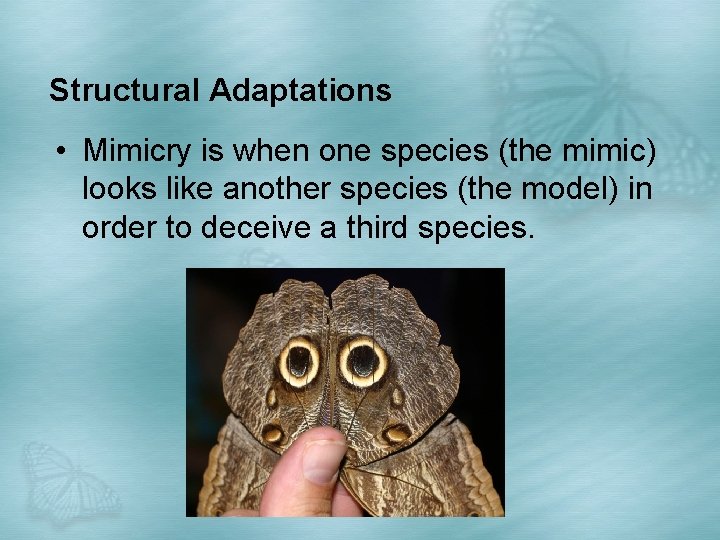
Structural Adaptations • Mimicry is when one species (the mimic) looks like another species (the model) in order to deceive a third species.
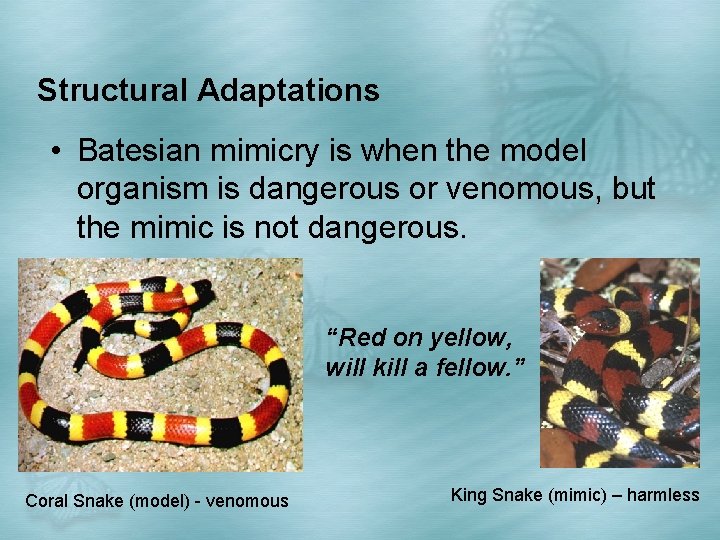
Structural Adaptations • Batesian mimicry is when the model organism is dangerous or venomous, but the mimic is not dangerous. “Red on yellow, will kill a fellow. ” Coral Snake (model) - venomous King Snake (mimic) – harmless
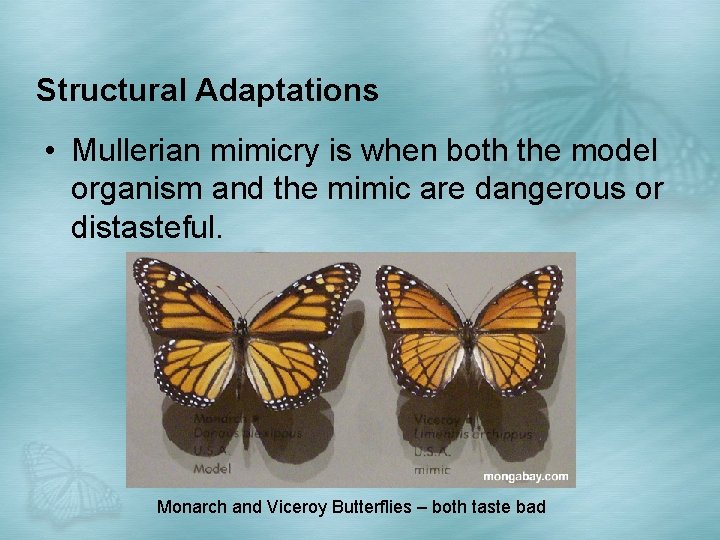
Structural Adaptations • Mullerian mimicry is when both the model organism and the mimic are dangerous or distasteful. Monarch and Viceroy Butterflies – both taste bad
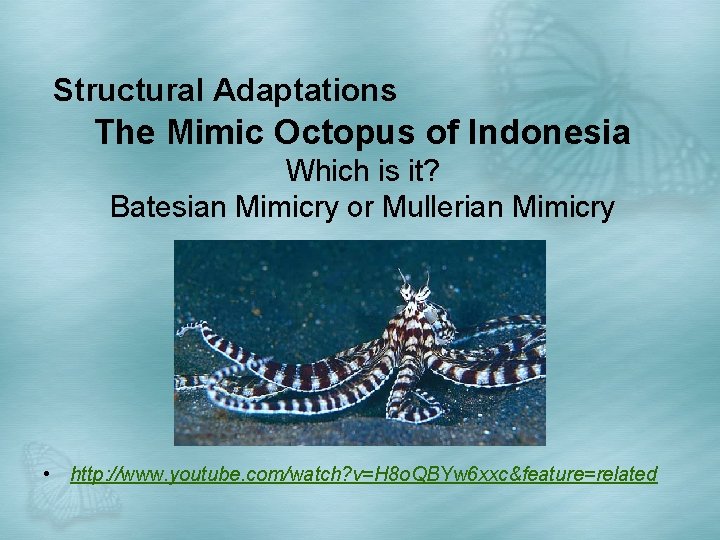
Structural Adaptations The Mimic Octopus of Indonesia Which is it? Batesian Mimicry or Mullerian Mimicry • http: //www. youtube. com/watch? v=H 8 o. QBYw 6 xxc&feature=related
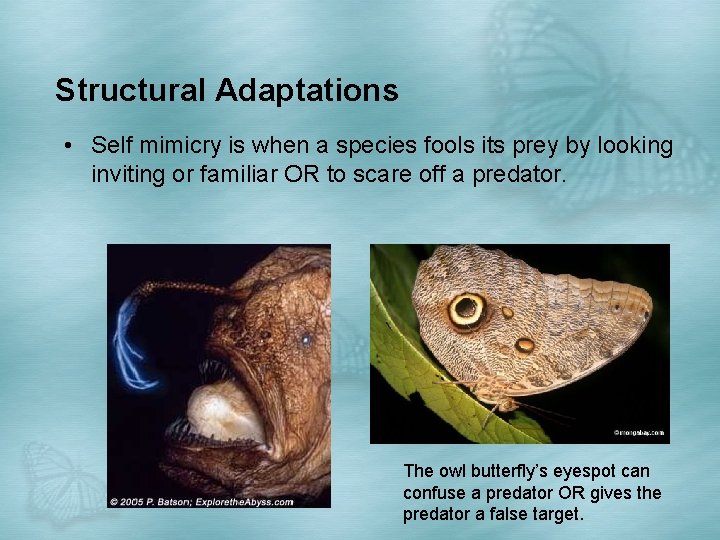
Structural Adaptations • Self mimicry is when a species fools its prey by looking inviting or familiar OR to scare off a predator. The owl butterfly’s eyespot can confuse a predator OR gives the predator a false target.
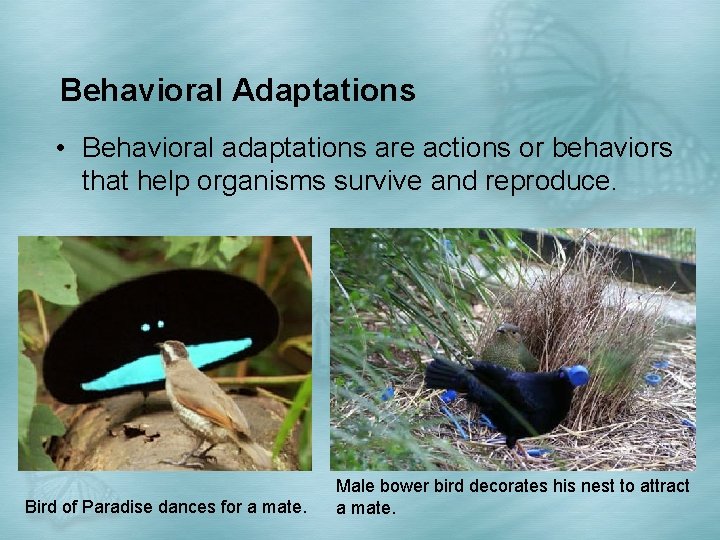
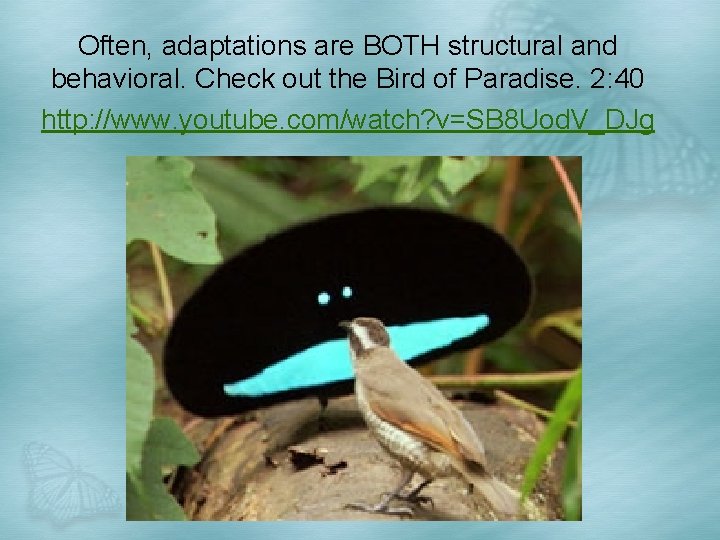
Behavioral Adaptations • Behavioral adaptations are actions or behaviors that help organisms survive and reproduce. Bird of Paradise dances for a mate. Male bower bird decorates his nest to attract a mate.
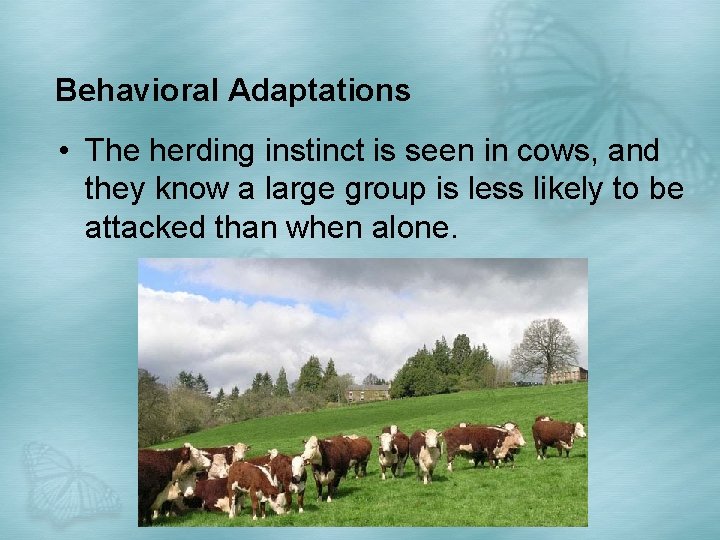
Behavioral Adaptations • The herding instinct is seen in cows, and they know a large group is less likely to be attacked than when alone.
Often, adaptations are BOTH structural and behavioral. Check out the Bird of Paradise. 2: 40 http: //www. youtube. com/watch? v=SB 8 Uod. V_DJg
REVIEW 1. Which of the following provides evidence for evolution? A. Changes in the coloration of peppered moth populations over time. B. The presence of tiny incomplete hind legs on snakes such as boa constrictors C. The fact that island species tend to most closely resemble species found on the nearest mainland. D. All of the above.
REVIEW 2. Which of the following mechanisms of evolution most effectively causes populations to become more adapted to their environments? A. Natural selection B. Mutation pressure C. Genetic drift D. Migration
REVIEW 3. What did Darwin observe about the tortoises and finches in the Galapagos? A. Their large size B. Their similarity to those on the mainland C. Their adaptations to their environments D. Their friendliness
REVIEW 4. What is evolution? A. Adaptations to particular environments B. Genetic change in a population over time C. Natural selection D. Differences in traits
REVIEW 5. What is not an example of an adaptation? A. Inbreeding B. Camoflauge C. Mimcry D. behavior