Chapter 12 Motivation Across Cultures The Nature of

- Slides: 15
Chapter 12 Motivation Across Cultures
The Nature of Motivation • Motivation- A psychological process through which unsatisfied wants or needs lead to drives that are aimed at goals or incentives • 3 Elements 1) Needs 2) Drives 3) Goal Attainment • Intrinsic- Person experiences fulfillment through carrying out an activity itself & helping others • Extrinsic- External environment & result of the activity in the form of competition & compensation/incentive palns are of greater importance
Content & Process Theories of Motivation Content • What arouses, energizes, or initiates EE behavior Process • Work motivation by how EE behavior is initiated, redirected, & halted
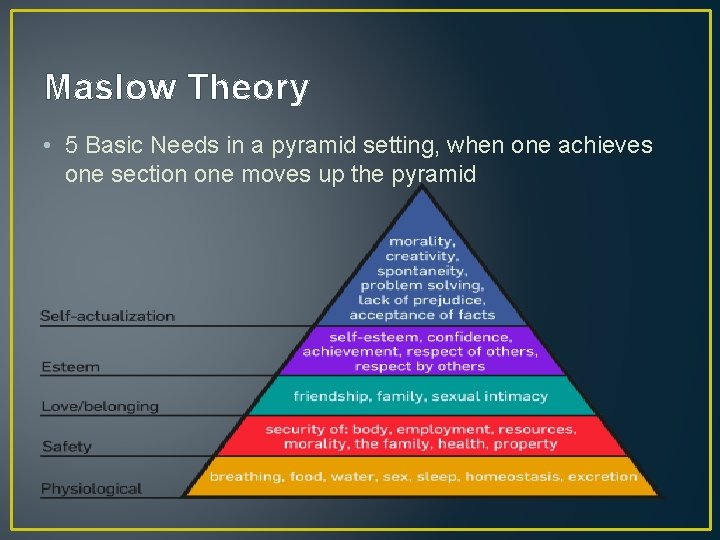
Maslow Theory • 5 Basic Needs in a pyramid setting, when one achieves one section one moves up the pyramid
International Findings on Maslow's Theory • Do people in other cultures around the world have needs that are similar to this theory? • Yes…but the study is dated (Haire, Ghiselli, & Porter) • MNC’s need to be wise to consider the individual country’s or region’s profile & adjust their approach accordingly, Maslow's too Western • Eastern Perspective- Collectivist values
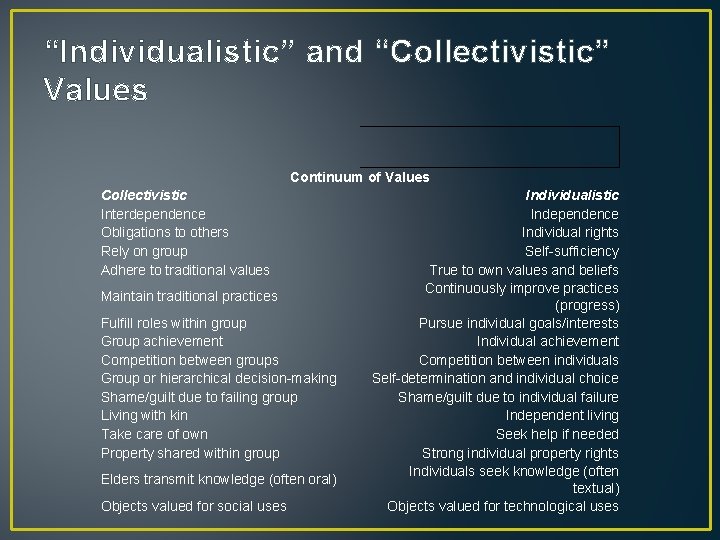
“Individualistic” and “Collectivistic” Values Continuum of Values Collectivistic Interdependence Obligations to others Rely on group Adhere to traditional values Maintain traditional practices Fulfill roles within group Group achievement Competition between groups Group or hierarchical decision-making Shame/guilt due to failing group Living with kin Take care of own Property shared within group Elders transmit knowledge (often oral) Objects valued for social uses Individualistic Independence Individual rights Self-sufficiency True to own values and beliefs Continuously improve practices (progress) Pursue individual goals/interests Individual achievement Competition between individuals Self-determination and individual choice Shame/guilt due to individual failure Independent living Seek help if needed Strong individual property rights Individuals seek knowledge (often textual) Objects valued for technological uses
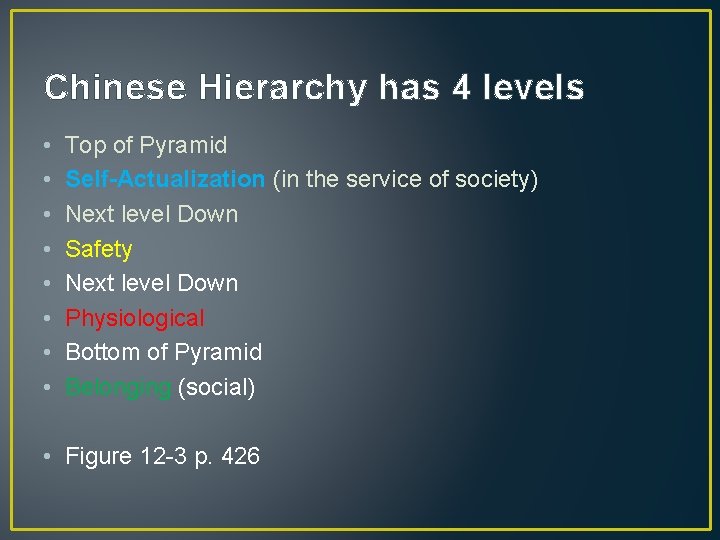
Chinese Hierarchy has 4 levels • • Top of Pyramid Self-Actualization (in the service of society) Next level Down Safety Next level Down Physiological Bottom of Pyramid Belonging (social) • Figure 12 -3 p. 426
Hofstede stated… • “MNC’s focus mostly in giving physical rewards to lowerlevel personnel & on creating for middle- & upper-level personnel a climate in which there is challenge, autonomy, the ability to use ones skills and ones cooperation”. • The need-hierarchy theory is useful in helping identify motivational factors for Intl’ HR Mgrs. , however, other theories as the two-factor theory and others should be examined
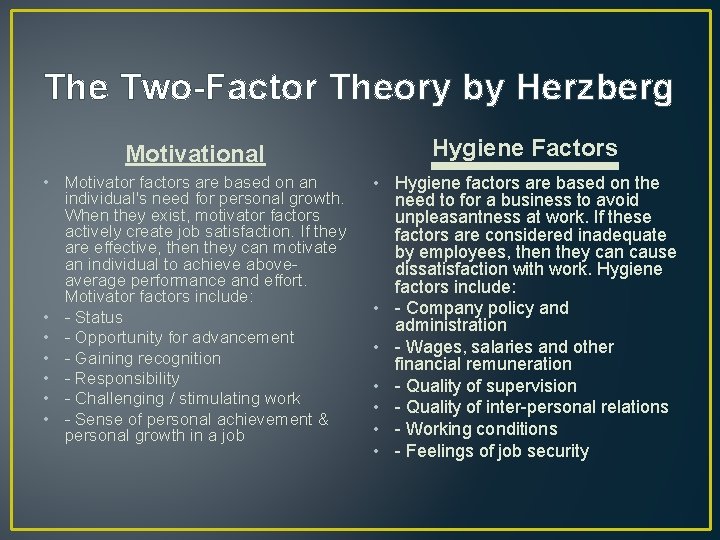
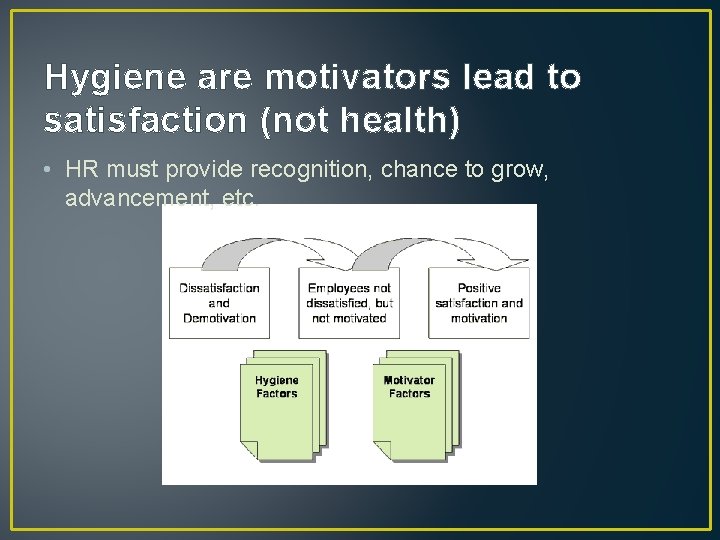
The Two-Factor Theory by Herzberg Motivational Hygiene Factors • Motivator factors are based on an individual's need for personal growth. When they exist, motivator factors actively create job satisfaction. If they are effective, then they can motivate an individual to achieve aboveaverage performance and effort. Motivator factors include: • - Status • - Opportunity for advancement • - Gaining recognition • - Responsibility • - Challenging / stimulating work • - Sense of personal achievement & personal growth in a job • Hygiene factors are based on the need to for a business to avoid unpleasantness at work. If these factors are considered inadequate by employees, then they can cause dissatisfaction with work. Hygiene factors include: • - Company policy and administration • - Wages, salaries and other financial remuneration • - Quality of supervision • - Quality of inter-personal relations • - Working conditions • - Feelings of job security
Hygiene are motivators lead to satisfaction (not health) • HR must provide recognition, chance to grow, advancement, etc.
Job Orientation Inventory (JOI) • Table 12 -5 • 4 Countries of Rankings • Job-Context Factors- For work motivation, factors controlled by the org: hours, conditions, earnings, security, benefits, & promotions • Job-Content Factors- For work motivation, factors internally controlled:
Various Motivation Theories Achievement Motivation Theory • Holds that individuals can have a need to get ahead, to attain success, and to reach objectives Goal-Setting Theory • Process theory that focuses on how individuals go about setting goals & responding to them & the overall impact of this process on motivation • http: //www. youtube. com/watch? v= _tj. Yo. KCBYag Equity Theory • Process theory that focuses on how motivation is affected by people's perception of how fairly they are being treated • http: //www. youtube. com/watch? v= 2 p_4 C 0 Mzne 4 Expectancy Theory • Theory that postulates that motivation is influenced by a persons belief that a) Effort will lead to performance= E to P; b) Performance will lead to specific outcomes= P to O; c) Outcomes will be of value to 1
Motivation Applied: by … • 1) Job Design- Jobs content, the methods that are used on the job, & the way the job relates to other jobs in the org v. QWL= Quality of Work Life: not same around the globe, Table 12 -7 p. 440 v. Sociotechnical Job Designs- Job designs that blend personnel & technology • 2) Work Centrally- The importance of work in a person’s life relative to other areas of interest • 3) Rewards- Mgrs around the globe use some type of a reward to motivate
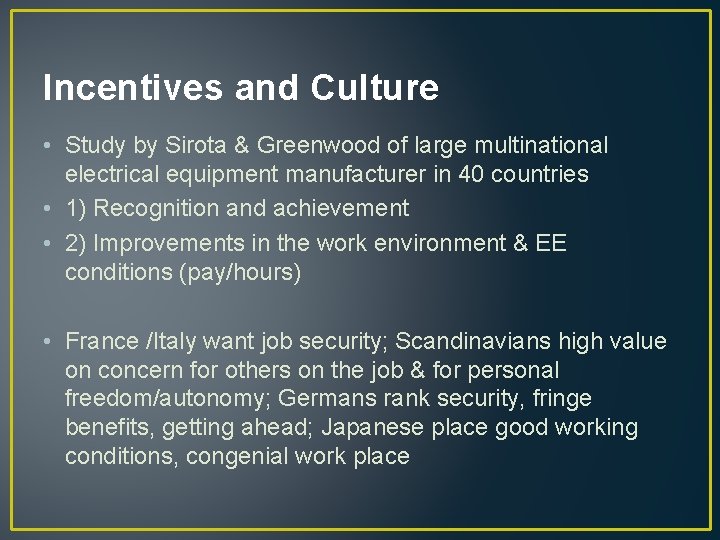
Incentives and Culture • Study by Sirota & Greenwood of large multinational electrical equipment manufacturer in 40 countries • 1) Recognition and achievement • 2) Improvements in the work environment & EE conditions (pay/hours) • France /Italy want job security; Scandinavians high value on concern for others on the job & for personal freedom/autonomy; Germans rank security, fringe benefits, getting ahead; Japanese place good working conditions, congenial work place
Theories are culturally bound • Figure 12 -7 p. 436 • Table 12 -6 p. 438 • http: //www. youtube. com/watch? v=jxa 64 YFy. L_o