Chap 3 Simple Resistive Circuits Contents 3 1


- Slides: 17
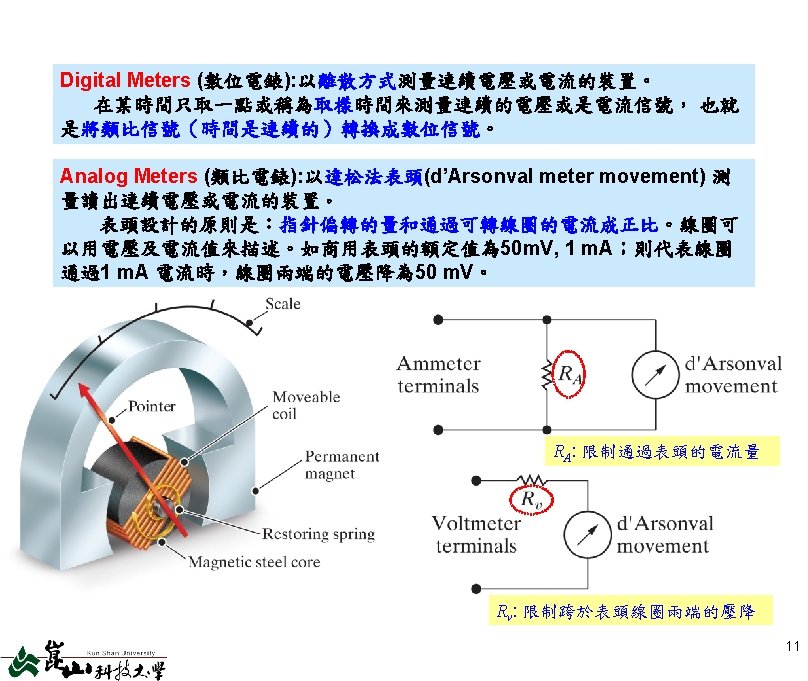
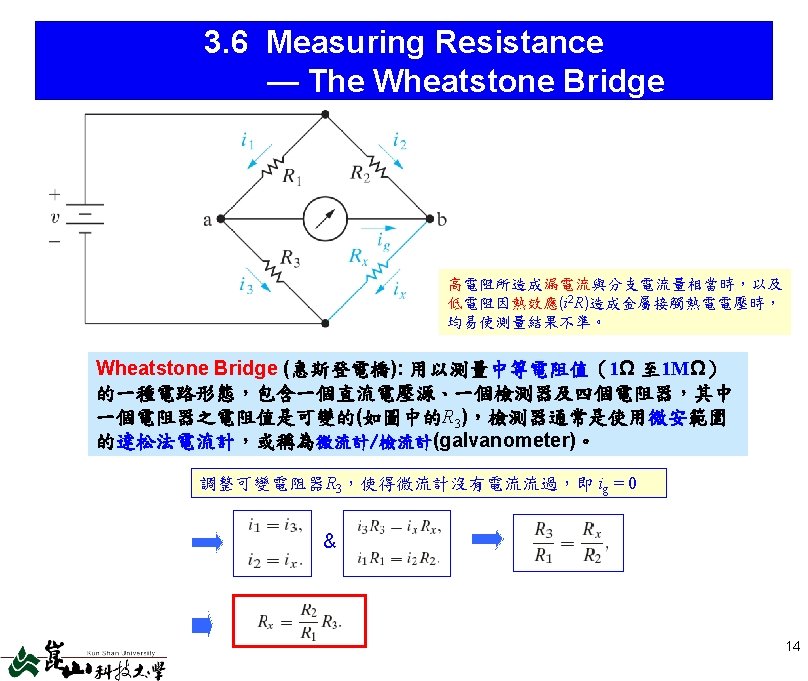
Chap. 3 Simple Resistive Circuits Contents 3. 1 3. 2 3. 3 3. 4 3. 5 3. 6 3. 7 Resistors in Series Resistors in Parallel The Voltage-Divider and Current-Divider Circuits Voltage Division and Current Division Measuring Voltage and Current Measuring Resistance—The Wheatstone Bridge Delta-to-Wye (Pi-to-Tee) Equivalent Circuits Objectives 1. 能分辨電阻器連接之串、並聯方式,並使用其串並聯規則, 求得等效電阻值。 2. 了解如何設計簡單的分壓器及分流器電路。 3. 能適時地利用分壓器及分流器來求解簡單的電路。 4. 當安培計加至電路中以測量電流時,能決定其讀值; 當伏特計加至電路中以測量電壓時,也能決定其讀值。 5. 了解如何利用惠斯登電橋來測量電阻值。 6. 了解如何適時的利用△ -Y 等效電路來求解簡單的電路。 1
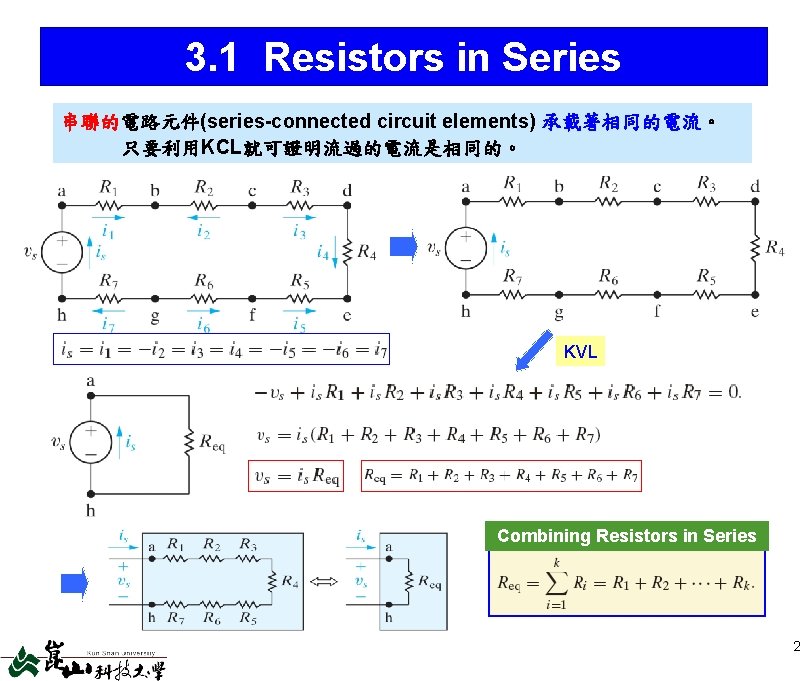
3. 1 Resistors in Series 串聯的電路元件(series-connected circuit elements) 承載著相同的電流。 只要利用KCL就可證明流過的電流是相同的。 KVL Combining Resistors in Series 2
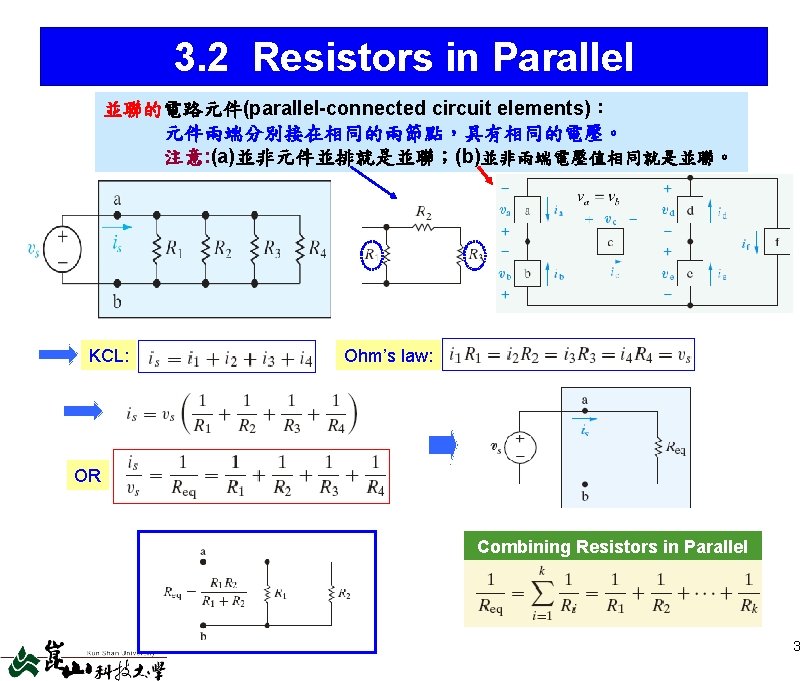
3. 2 Resistors in Parallel 並聯的電路元件(parallel-connected circuit elements): 元件兩端分別接在相同的兩節點,具有相同的電壓。 注意: (a)並非元件並排就是並聯;(b)並非兩端電壓值相同就是並聯。 KCL: Ohm’s law: OR Combining Resistors in Parallel 3
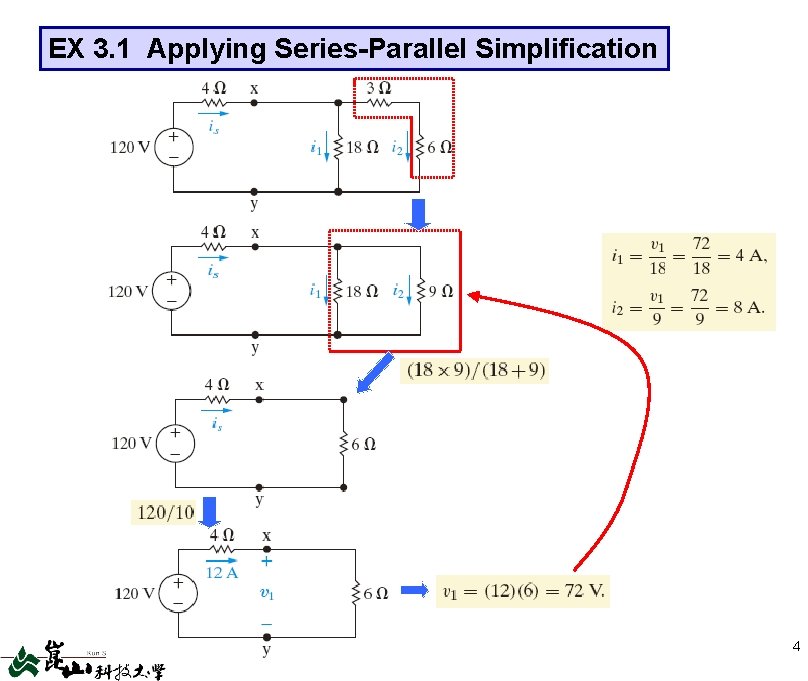
EX 3. 1 Applying Series-Parallel Simplification 4
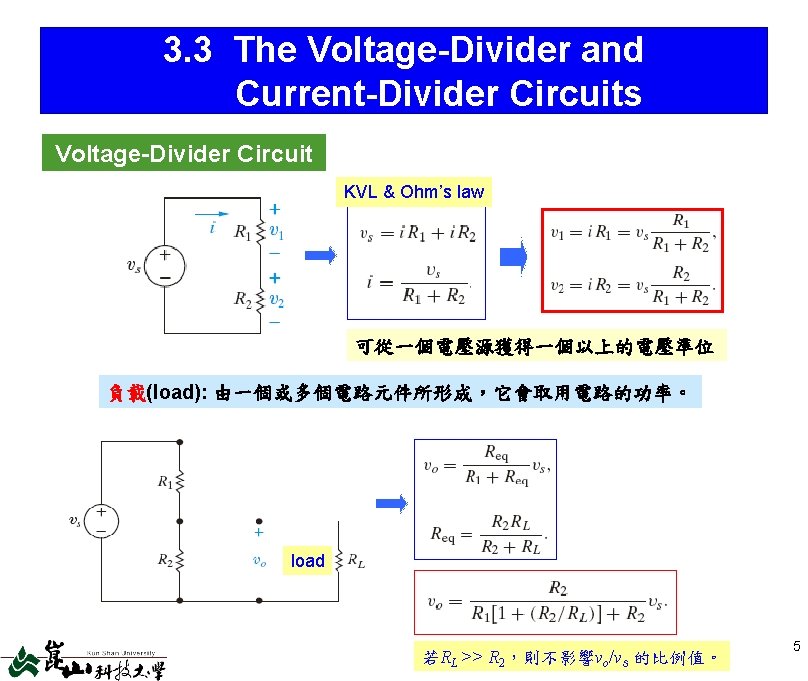
3. 3 The Voltage-Divider and Current-Divider Circuits Voltage-Divider Circuit KVL & Ohm’s law 可從一個電壓源獲得一個以上的電壓準位 負載(load): 由一個或多個電路元件所形成,它會取用電路的功率。 load 若RL >> R 2,則不影響vo/vs 的比例值。 5
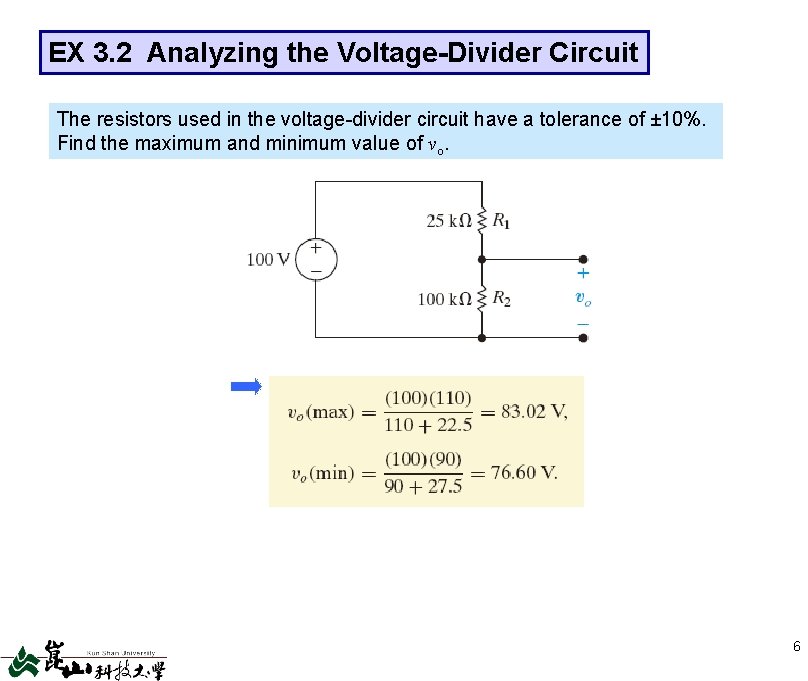
EX 3. 2 Analyzing the Voltage-Divider Circuit The resistors used in the voltage-divider circuit have a tolerance of ± 10%. Find the maximum and minimum value of vo. 6
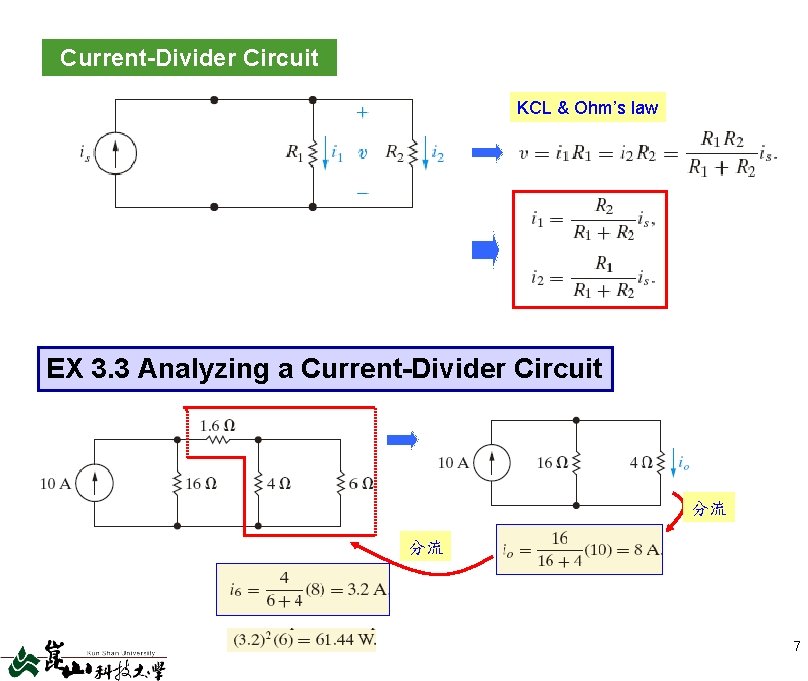
Current-Divider Circuit KCL & Ohm’s law EX 3. 3 Analyzing a Current-Divider Circuit 分流 分流 7
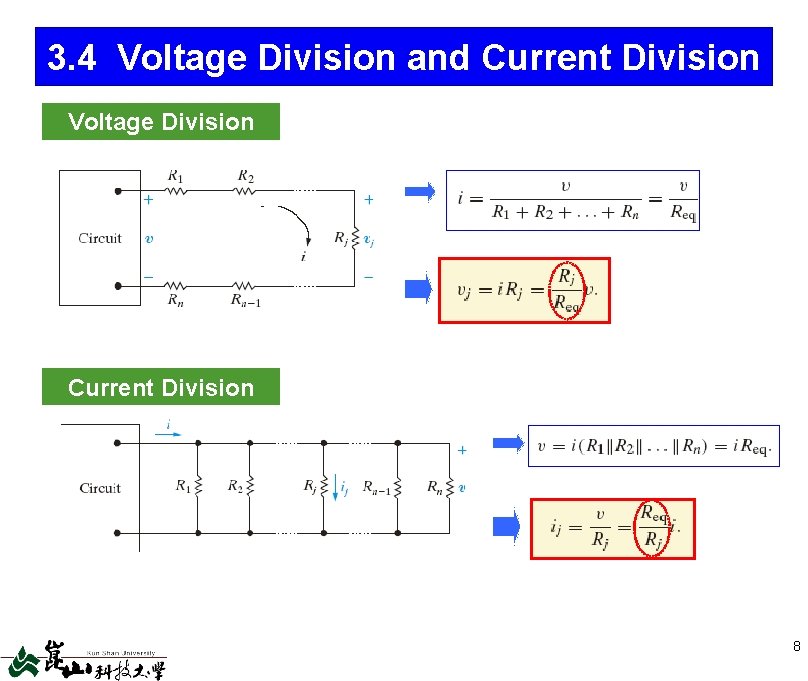
3. 4 Voltage Division and Current Division Voltage Division Current Division 8
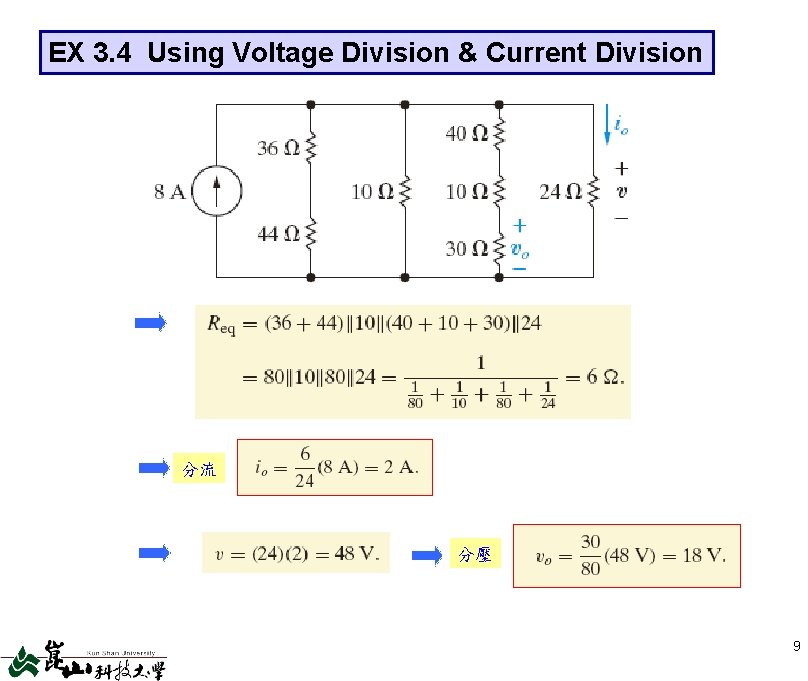
EX 3. 4 Using Voltage Division & Current Division 分流 分壓 9
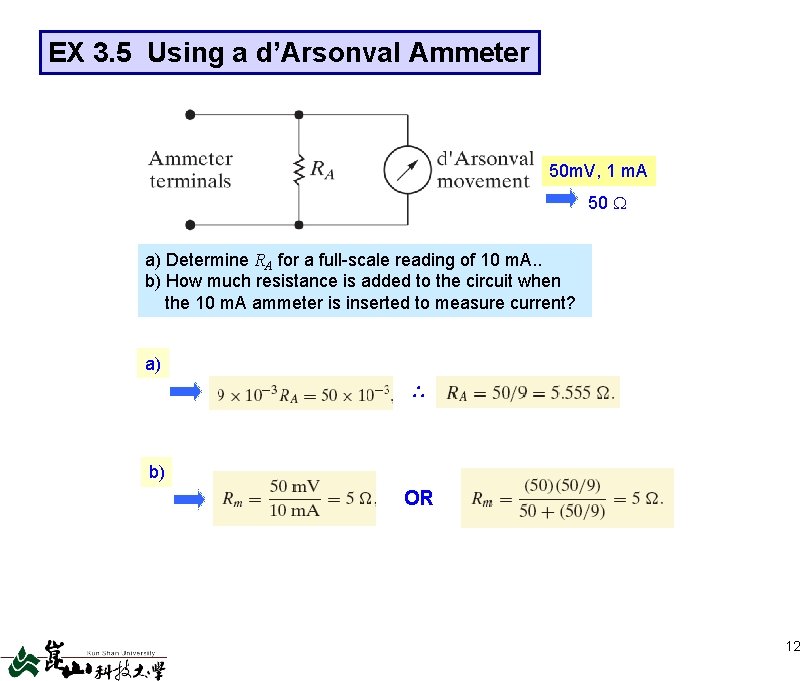
EX 3. 5 Using a d’Arsonval Ammeter 50 m. V, 1 m. A 50 a) Determine RA for a full-scale reading of 10 m. A. . b) How much resistance is added to the circuit when the 10 m. A ammeter is inserted to measure current? a) b) OR 12
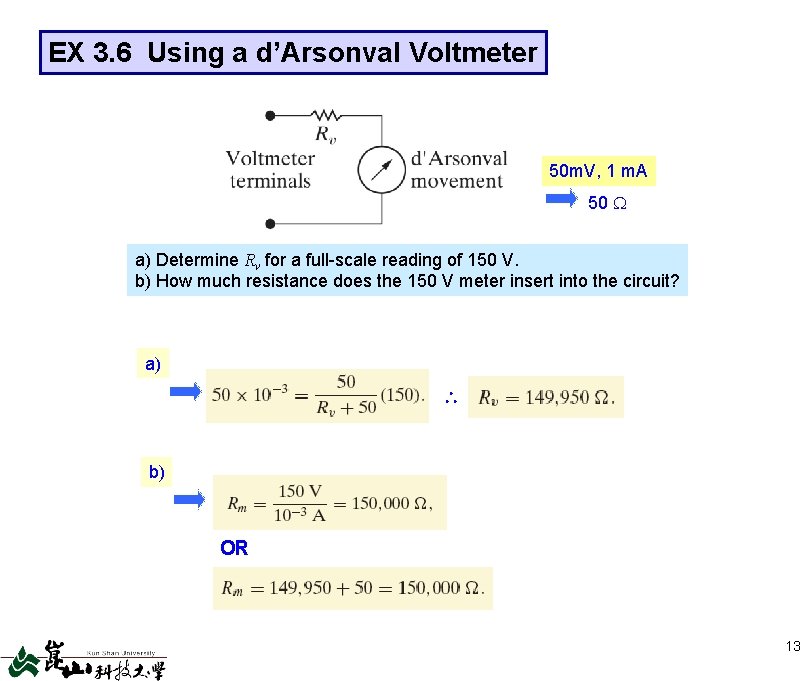
EX 3. 6 Using a d’Arsonval Voltmeter 50 m. V, 1 m. A 50 a) Determine Rv for a full-scale reading of 150 V. b) How much resistance does the 150 V meter insert into the circuit? a) b) OR 13
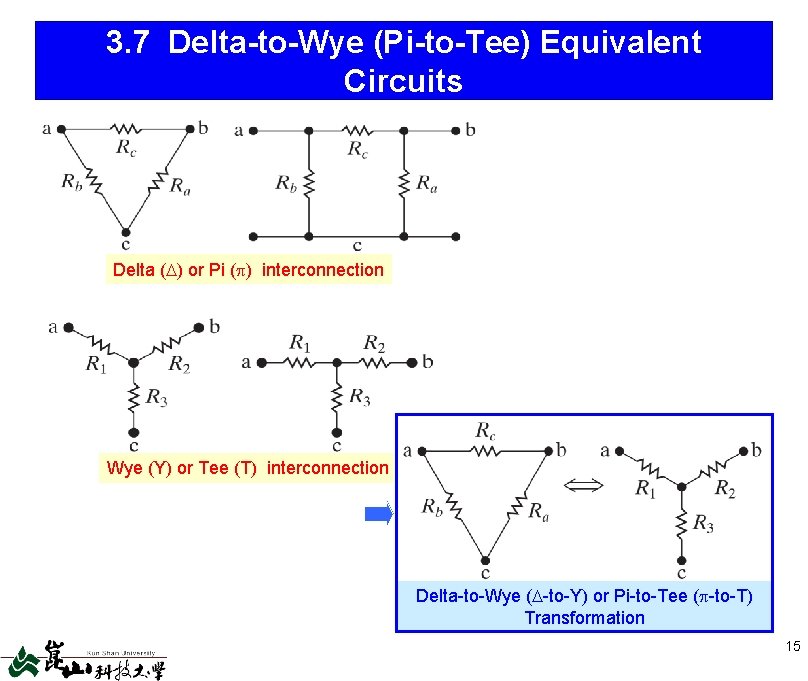
3. 7 Delta-to-Wye (Pi-to-Tee) Equivalent Circuits Delta ( ) or Pi ( ) interconnection Wye (Y) or Tee (T) interconnection Delta-to-Wye ( -to-Y) or Pi-to-Tee ( -to-T) Transformation 15
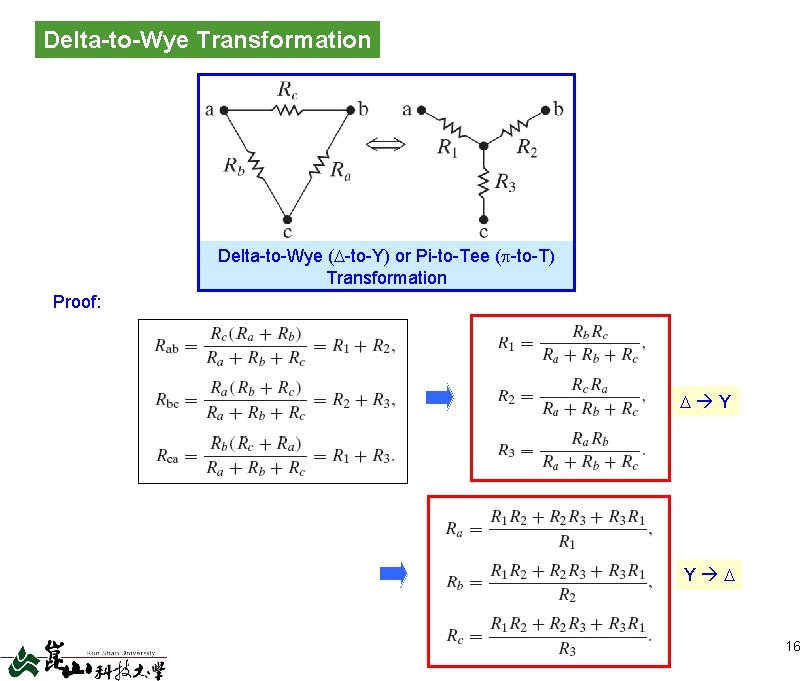
Delta-to-Wye Transformation Delta-to-Wye ( -to-Y) or Pi-to-Tee ( -to-T) Transformation Proof: Y Y 16
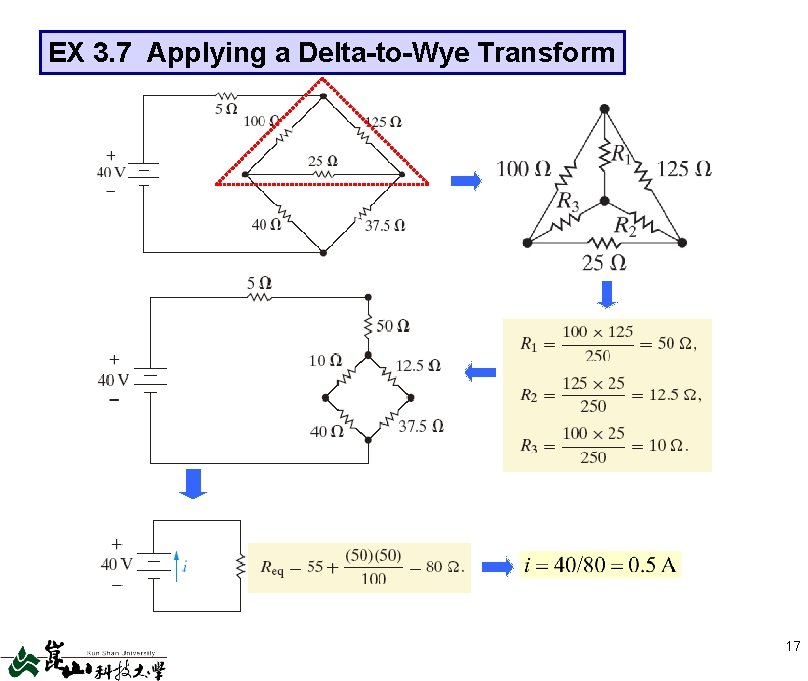
EX 3. 7 Applying a Delta-to-Wye Transform 17