Central Asian Institute for Ecological Research LLP STUDY

- Slides: 14
Central Asian Institute for Ecological Research LLP STUDY OF THE CONDITION OF SURFACE WATER IN SHU-TALAS BASIN IN THE TERRITORY OF KAZAKHSTAN Tovassarov Adylkhan Dadebaevich, General Director, Candidate of Chemical Sciences
Water resources of the Republic of Kazakhstan Due to its geographical position, the Republic of Kazakhstan has a shortage of water resources. The specific water supply of the Republic of Kazakhstan is 37 thousand cubic meters per 1 sq. km or 6 thousand cubic meters person per year. A large territory of Kazakhstan belongs to drainless basins of inland lakes that do not have access to the ocean. Precipitation is negligible, with the exception of mountain regions.
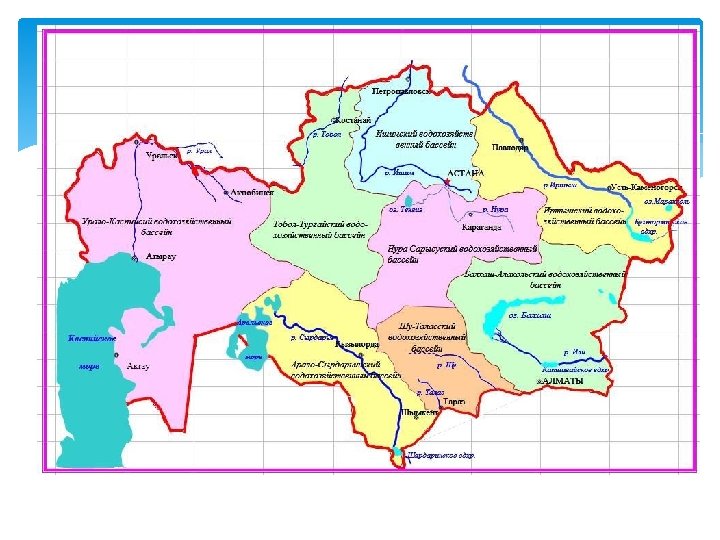
Water basins of the Republic of Kazakhstan In Kazakhstan, 7 of the 8 basins of the main rivers are transboundary: * 1. Aral-Syrdarya water basin 2. Balkhash-Alakol water basin 3. Irtysh water basin 4. Ishimsky water basin 5. Nura-Sarysu water basin 6. Tobol-Torgay water basin 7. Ural-Caspian water basin 8. Shu-Talas water basin
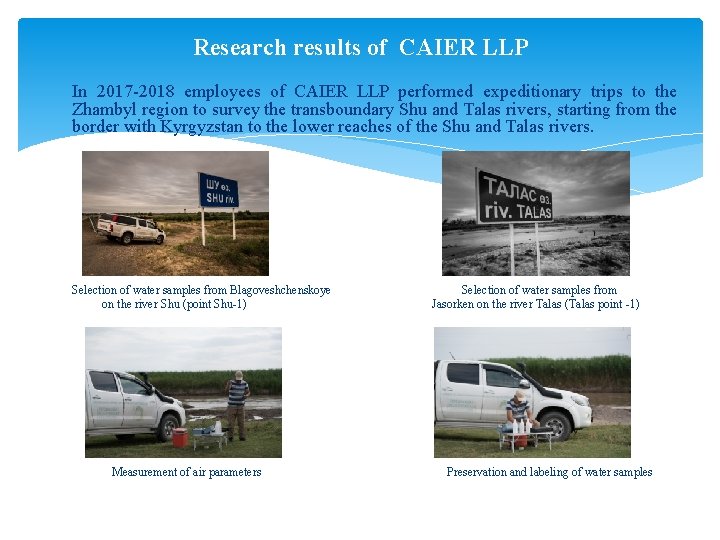
Research results of CAIER LLP In 2017 -2018 employees of CAIER LLP performed expeditionary trips to the Zhambyl region to survey the transboundary Shu and Talas rivers, starting from the border with Kyrgyzstan to the lower reaches of the Shu and Talas rivers. Selection of water samples from Blagoveshchenskoye Selection of water samples from on the river Shu (point Shu-1) Jasorken on the river Talas (Talas point -1) Measurement of air parameters Preservation and labeling of water samples
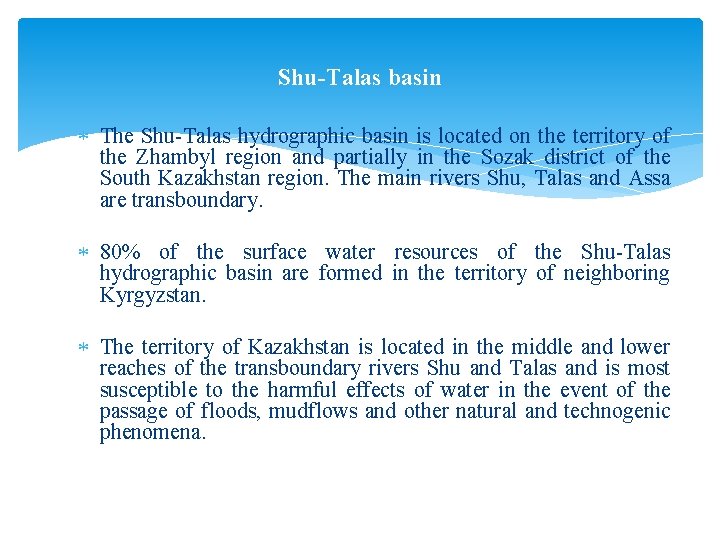
Shu-Talas basin The Shu-Talas hydrographic basin is located on the territory of the Zhambyl region and partially in the Sozak district of the South Kazakhstan region. The main rivers Shu, Talas and Assa are transboundary. 80% of the surface water resources of the Shu-Talas hydrographic basin are formed in the territory of neighboring Kyrgyzstan. The territory of Kazakhstan is located in the middle and lower reaches of the transboundary rivers Shu and Talas and is most susceptible to the harmful effects of water in the event of the passage of floods, mudflows and other natural and technogenic phenomena.
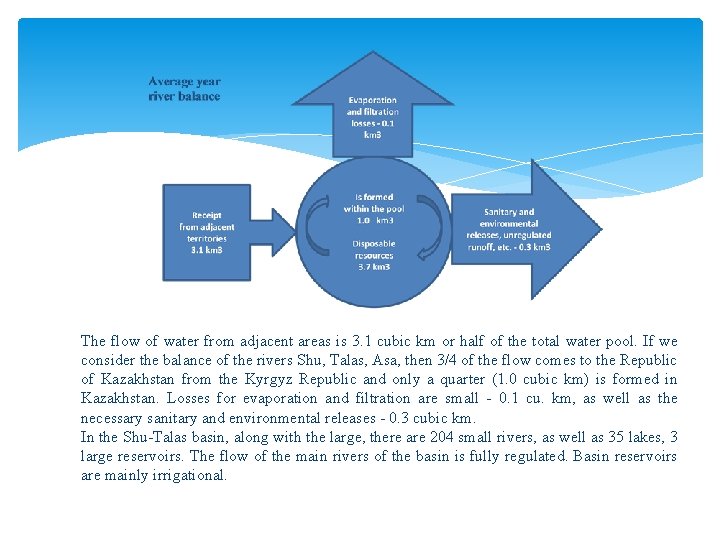
The flow of water from adjacent areas is 3. 1 cubic km or half of the total water pool. If we consider the balance of the rivers Shu, Talas, Asa, then 3/4 of the flow comes to the Republic of Kazakhstan from the Kyrgyz Republic and only a quarter (1. 0 cubic km) is formed in Kazakhstan. Losses for evaporation and filtration are small - 0. 1 cu. km, as well as the necessary sanitary and environmental releases - 0. 3 cubic km. In the Shu-Talas basin, along with the large, there are 204 small rivers, as well as 35 lakes, 3 large reservoirs. The flow of the main rivers of the basin is fully regulated. Basin reservoirs are mainly irrigational.
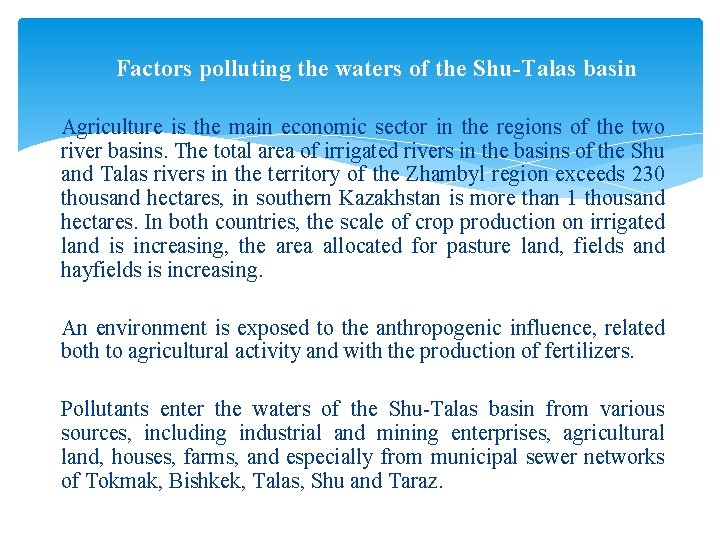
Factors polluting the waters of the Shu-Talas basin Agriculture is the main economic sector in the regions of the two river basins. The total area of irrigated rivers in the basins of the Shu and Talas rivers in the territory of the Zhambyl region exceeds 230 thousand hectares, in southern Kazakhstan is more than 1 thousand hectares. In both countries, the scale of crop production on irrigated land is increasing, the area allocated for pasture land, fields and hayfields is increasing. An environment is exposed to the anthropogenic influence, related both to agricultural activity and with the production of fertilizers. Pollutants enter the waters of the Shu-Talas basin from various sources, including industrial and mining enterprises, agricultural land, houses, farms, and especially from municipal sewer networks of Tokmak, Bishkek, Talas, Shu and Taraz.
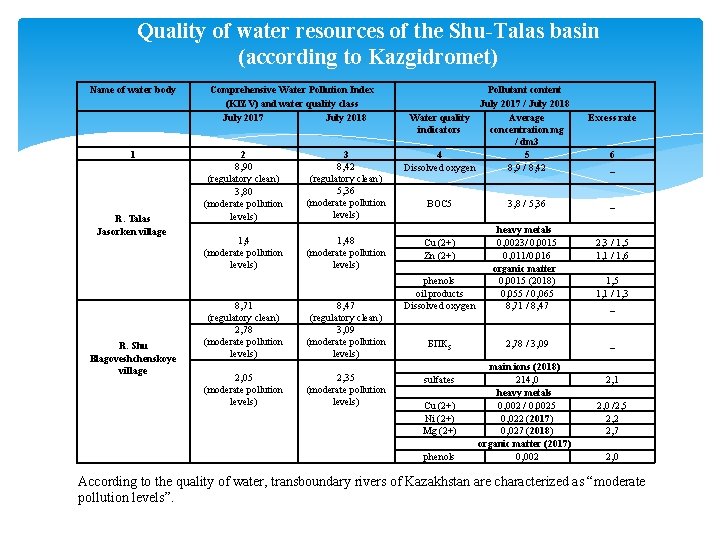
Quality of water resources of the Shu-Talas basin (according to Kazgidromet) Name of water body 1 R. Talas Jasorken village R. Shu Blagoveshchenskoye village Comprehensive Water Pollution Index (KIZV) and water quality class July 2017 July 2018 2 8, 90 (regulatory clean) 3, 80 (moderate pollution levels) 3 8, 42 (regulatory clean) 5, 36 (moderate pollution levels) 1, 48 (moderate pollution levels) 8, 71 (regulatory clean) 2, 78 (moderate pollution levels) 8, 47 (regulatory clean) 3, 09 (moderate pollution levels) 2, 05 (moderate pollution levels) 2, 35 (moderate pollution levels) Pollutant content July 2017 / July 2018 Water quality Average indicators concentration mg / dm 3 4 5 Dissolved oxygen 8, 9 / 8, 42 BOC 5 3, 8 / 5, 36 phenols oil products Dissolved oxygen heavy metals 0, 0023/ 0, 0015 0, 011/0, 016 organic matter 0, 0015 (2018) 0, 055 / 0, 065 8, 71 / 8, 47 БПК 5 2, 78 / 3, 09 Cu (2+) Zn (2+) sulfates Cu (2+) Ni (2+) Mg (2+) phenols main ions (2018) 214, 0 heavy metals 0, 002 / 0, 0025 0, 022 (2017) 0, 027 (2018) organic matter (2017) 0, 002 Excess rate 6 _ _ 2, 3 / 1, 5 1, 1 / 1, 6 1, 5 1, 1 / 1, 3 _ _ 2, 1 2, 0 /2, 5 2, 2 2, 7 2, 0 According to the quality of water, transboundary rivers of Kazakhstan are characterized as “moderate pollution levels”.
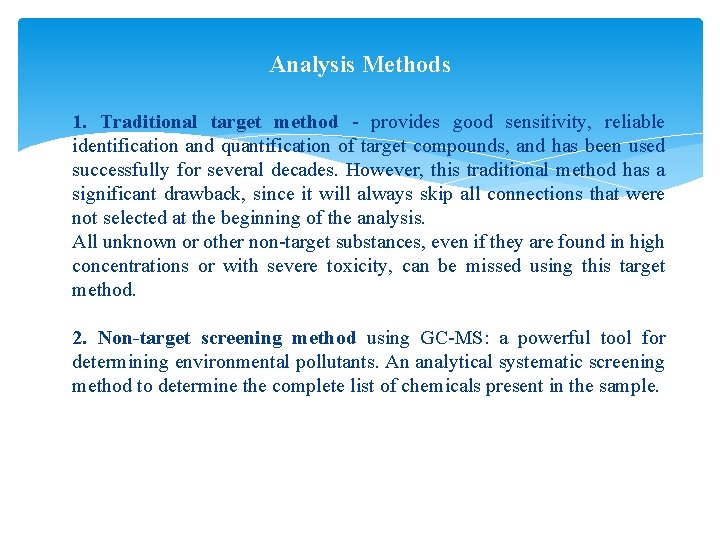
Analysis Methods 1. Traditional target method - provides good sensitivity, reliable identification and quantification of target compounds, and has been used successfully for several decades. However, this traditional method has a significant drawback, since it will always skip all connections that were not selected at the beginning of the analysis. All unknown or other non-target substances, even if they are found in high concentrations or with severe toxicity, can be missed using this target method. 2. Non-target screening method using GC-MS: a powerful tool for determining environmental pollutants. An analytical systematic screening method to determine the complete list of chemicals present in the sample.
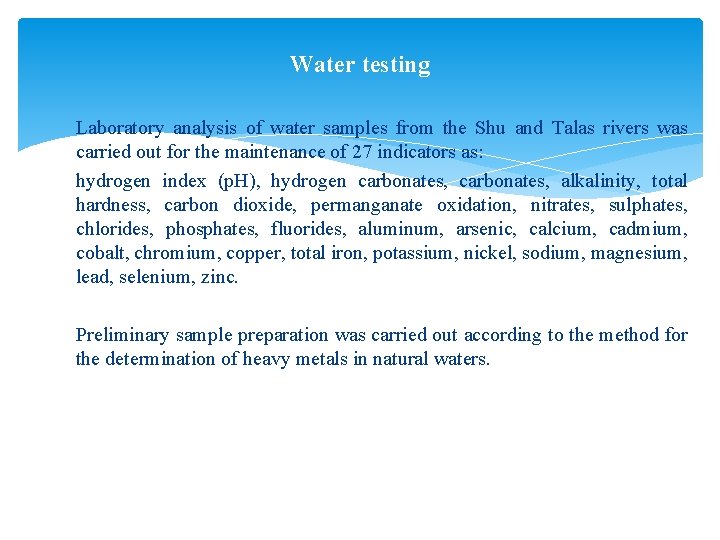
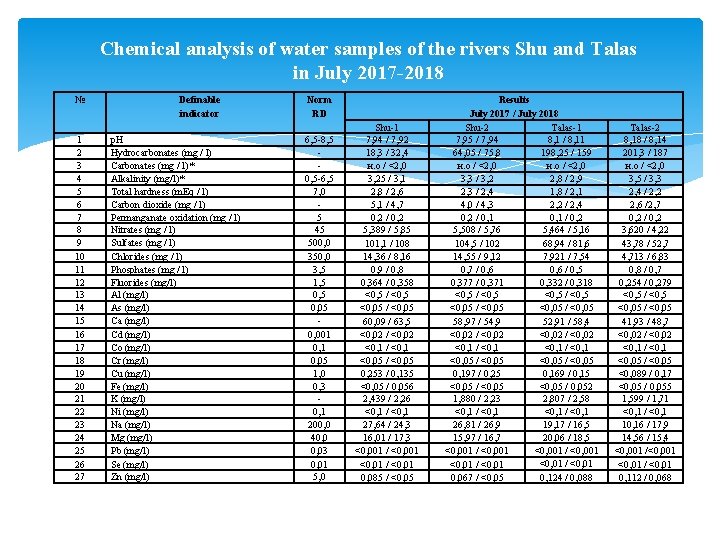
Water testing Laboratory analysis of water samples from the Shu and Talas rivers was carried out for the maintenance of 27 indicators as: hydrogen index (p. H), hydrogen carbonates, alkalinity, total hardness, carbon dioxide, permanganate oxidation, nitrates, sulphates, chlorides, phosphates, fluorides, aluminum, arsenic, calcium, cadmium, cobalt, chromium, copper, total iron, potassium, nickel, sodium, magnesium, lead, selenium, zinc. Preliminary sample preparation was carried out according to the method for the determination of heavy metals in natural waters.
Chemical analysis of water samples of the rivers Shu and Talas in July 2017 -2018 № 1 2 3 4 5 6 7 8 9 10 11 12 13 14 15 16 17 18 19 20 21 22 23 24 25 26 27 Definable indicator р. Н Hydrocarbonates (mg / l) Carbonates (mg / l)* Alkalinity (mg/l)* Total hardness (m. Eq / l) Carbon dioxide (mg / l) Permanganate oxidation (mg / l) Nitrates (mg / l) Sulfates (mg / l) Chlorides (mg / l) Phosphates (mg / l) Fluorides (mg/l) Al (mg/l) As (mg/l) Ca (mg/l) Cd (mg/l) Cо (mg/l) Cr (mg/l) Cu (mg/l) Fe (mg/l) K (mg/l) Ni (mg/l) Na (mg/l) Mg (mg/l) Pb (mg/l) Se (mg/l) Zn (mg/l) Norm RD 6, 5 -8, 5 0, 5 -6, 5 7, 0 5 45 500, 0 350, 0 3, 5 1, 5 0, 05 0, 001 0, 05 1, 0 0, 3 0, 1 200, 0 40, 03 0, 01 5, 0 Shu-1 7, 94 / 7, 92 18, 3 / 32, 4 н. о / ˂2, 0 3, 25 / 3, 1 2, 8 / 2, 6 5, 1 / 4, 7 0, 2 / 0, 2 5, 389 / 5, 85 101, 1 / 108 14, 36 / 8, 16 0, 9 / 0, 8 0, 364 / 0, 358 ˂0, 5 / ˂0, 5 ˂0, 05 / ˂0, 05 60, 09 / 63, 5 ˂0, 02 / ˂0, 02 ˂0, 1 / ˂0, 1 ˂0, 05 / ˂0, 05 0, 253 / 0, 135 ˂0, 05 / 0, 056 2, 439 / 2, 26 ˂0, 1 / ˂0, 1 27, 64 / 24, 3 16, 01 / 17, 3 ˂0, 001 / ˂0, 001 ˂0, 01 / ˂0, 01 0, 085 / ˂0, 05 Results July 2017 / July 2018 Shu-2 Talas-1 7, 95 / 7, 94 8, 1 / 8, 11 64, 05 / 75, 8 198, 25 / 159 н. о / ˂2, 0 3, 3 / 3, 2 2, 8 / 2, 9 2, 3 / 2, 4 1, 8 / 2, 1 4, 0 / 4, 3 2, 2 / 2, 4 0, 2 / 0, 1 / 0, 2 5, 508 / 5, 76 5, 464 / 5, 16 104, 5 / 102 68, 94 / 81, 6 14, 55 / 9, 12 7, 921 / 7, 54 0, 7 / 0, 6 / 0, 5 0, 377 / 0, 371 0, 332 / 0, 318 ˂0, 5 / ˂0, 5 ˂0, 05 / ˂0, 05 58, 97 / 54, 9 52, 91 / 58, 4 ˂0, 02 / ˂0, 02 ˂0, 1 / ˂0, 1 ˂0, 05 / ˂0, 05 0, 197 / 0, 25 0, 169 / 0, 15 ˂0, 05 / 0, 052 1, 880 / 2, 23 2, 807 / 2, 58 ˂0, 1 / ˂0, 1 26, 81 / 26, 9 19, 17 / 16, 5 15, 97 / 16, 7 20, 06 / 18, 5 ˂0, 001 / ˂0, 001 ˂0, 01 / ˂0, 01 0, 067 / ˂0, 05 0, 124 / 0, 088 Talas-2 8, 18 / 8, 14 201, 3 / 187 н. о / ˂2, 0 3, 5 / 3, 3 2, 4 / 2, 2 2, 6 /2, 7 0, 2 / 0, 2 3, 620 / 4, 22 43, 78 / 52, 7 4, 713 / 6, 83 0, 8 / 0, 7 0, 254 / 0, 279 ˂0, 5 / ˂0, 5 ˂0, 05 / ˂0, 05 41, 93 / 48, 7 ˂0, 02 / ˂0, 02 ˂0, 1 / ˂0, 1 ˂0, 05 / ˂0, 05 ˂0, 089 / 0, 17 ˂0, 05 / 0, 055 1, 599 / 1, 71 ˂0, 1 / ˂0, 1 10, 16 / 17, 9 14, 56 / 15, 4 ˂0, 001 /˂0, 001 ˂0, 01 / ˂0, 01 0, 112 / 0, 068
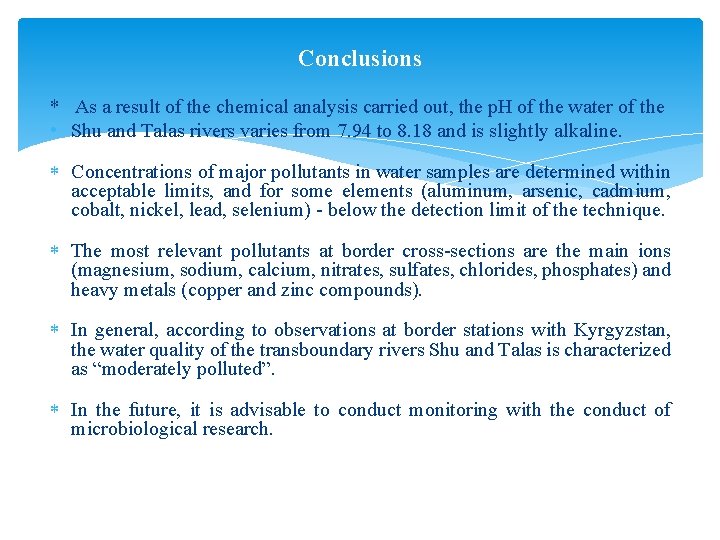
Conclusions * As a result of the chemical analysis carried out, the p. H of the water of the • Shu and Talas rivers varies from 7. 94 to 8. 18 and is slightly alkaline. Concentrations of major pollutants in water samples are determined within acceptable limits, and for some elements (aluminum, arsenic, cadmium, cobalt, nickel, lead, selenium) - below the detection limit of the technique. The most relevant pollutants at border cross-sections are the main ions (magnesium, sodium, calcium, nitrates, sulfates, chlorides, phosphates) and heavy metals (copper and zinc compounds). In general, according to observations at border stations with Kyrgyzstan, the water quality of the transboundary rivers Shu and Talas is characterized as “moderately polluted”. In the future, it is advisable to conduct monitoring with the conduct of microbiological research.
Thanks for attention! Address: LLP "Central Asian Institute for Environmental Research" Dostyk 250, Almaty, Republic of Kazakhstan Tel. : 8 (727) 367 16 83 E-mail: adil@asianecology. com www. asianecology. com