Center for Science of Information Emerging Frontiers of


- Slides: 19
Center for Science of Information Emerging Frontiers of Science of Information Bryn Mawr Howard 2011 STC Directors Meeting Lawrence, KS MIT Princeton Purdue Stanford UC Berkeley UC San Diego UIUC National Science Foundation Science & Technology Centers Program
Center for Science of Information Outline 1. Science of Information 2. Center Mission 1. Integrated Research 2. Education and Diversity 3. Knowledge Transfer 3. Management Structure 1. STC Team 2. STC Staff 3. Management Chart Science & Technology Centers Program 2
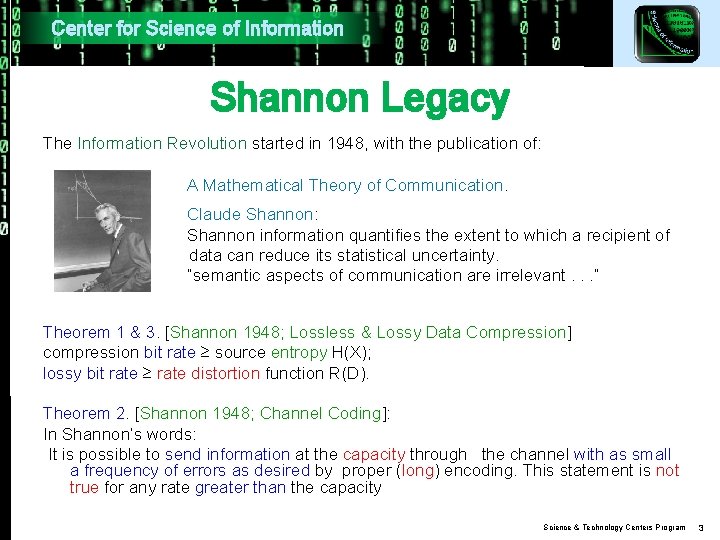
Center for Science of Information Shannon Legacy The Information Revolution started in 1948, with the publication of: A Mathematical Theory of Communication. Claude Shannon: Shannon information quantifies the extent to which a recipient of data can reduce its statistical uncertainty. “semantic aspects of communication are irrelevant. . . ” Theorem 1 & 3. [Shannon 1948; Lossless & Lossy Data Compression] compression bit rate ≥ source entropy H(X); lossy bit rate ≥ rate distortion function R(D). Theorem 2. [Shannon 1948; Channel Coding]: In Shannon’s words: It is possible to send information at the capacity through the channel with as small a frequency of errors as desired by proper (long) encoding. This statement is not true for any rate greater than the capacity Science & Technology Centers Program 3
Center for Science of Information Post-Shannon Challenges 1. Back off from infinity (Ziv’ 97): Extend Shannon findings to finite size data structures (i. e. , sequences, graphs), that is, develop information theory of various data structures beyond first-order asymptotics. Claim: Many interesting information-theoretic phenomena appear in the second-order terms. 2. Science of Information: Information Theory needs to meet new challenges of current applications in biology, communication, knowledge extraction, economics, … To understand new aspects of information in: structure, time, space, and semantics, and dynamic information, limited resources, complexity, representationinvariant information, and cooperation & dependency. Science & Technology Centers Program 4
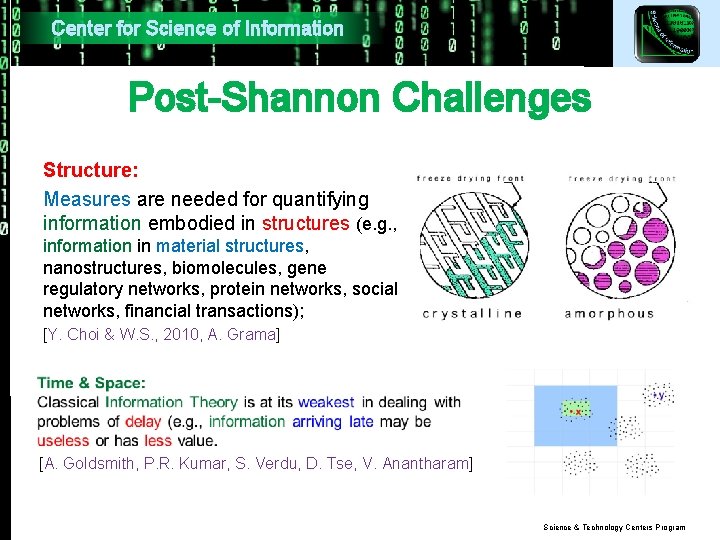
Center for Science of Information Post-Shannon Challenges Structure: Measures are needed for quantifying information embodied in structures (e. g. , information in material structures, nanostructures, biomolecules, gene regulatory networks, protein networks, social networks, financial transactions); [Y. Choi & W. S. , 2010, A. Grama] [A. Goldsmith, P. R. Kumar, S. Verdu, D. Tse, V. Anantharam] Science & Technology Centers Program
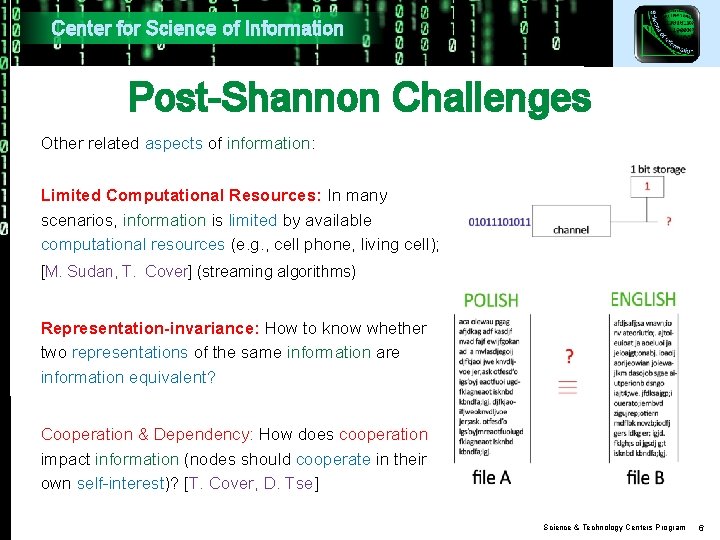
Center for Science of Information Post-Shannon Challenges Other related aspects of information: Limited Computational Resources: In many scenarios, information is limited by available computational resources (e. g. , cell phone, living cell); [M. Sudan, T. Cover] (streaming algorithms) Representation-invariance: How to know whether two representations of the same information are information equivalent? Cooperation & Dependency: How does cooperation impact information (nodes should cooperate in their own self-interest)? [T. Cover, D. Tse] Science & Technology Centers Program 6
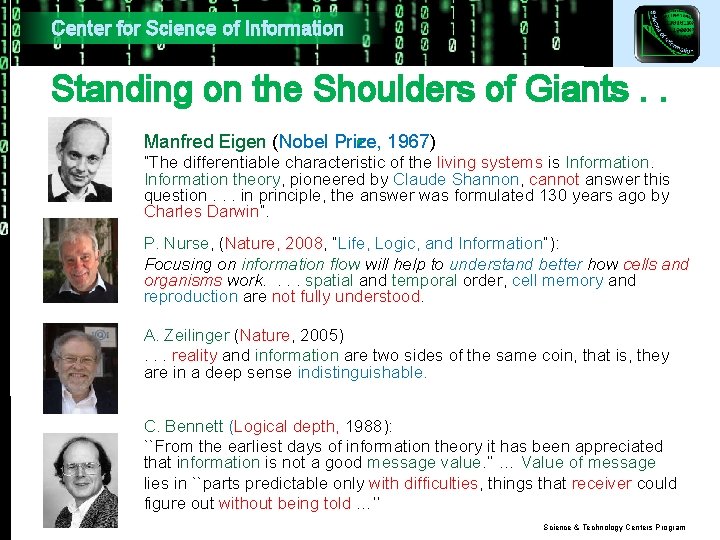
Center for Science of Information Standing on the Shoulders of Giants. . . 1967) Manfred Eigen (Nobel Prize, “The differentiable characteristic of the living systems is Information theory, pioneered by Claude Shannon, cannot answer this question. . . in principle, the answer was formulated 130 years ago by Charles Darwin”. P. Nurse, (Nature, 2008, “Life, Logic, and Information”): Focusing on information flow will help to understand better how cells and organisms work. . spatial and temporal order, cell memory and reproduction are not fully understood. A. Zeilinger (Nature, 2005). . . reality and information are two sides of the same coin, that is, they are in a deep sense indistinguishable. C. Bennett (Logical depth, 1988): ``From the earliest days of information theory it has been appreciated that information is not a good message value. ’’ … Value of message lies in ``parts predictable only with difficulties, things that receiver could figure out without being told …’’ Science & Technology Centers Program
Center for Science of Information Outline 1. Science of Information 2. Center Mission 1. Integrated Research 2. Education and Diversity 3. Knowledge Transfer 3. Management Structure 1. STC Team 2. STC Staff 3. Management Chart Science & Technology Centers Program 8
Center for Science of Information Mission and Center’s Goals Advance science and technology through a new quantitative understanding of the representation, communication and processing of information in biological, physical, social and engineering systems. Some Specific Center’s Goals: • • define core theoretical principles governing transfer of information, develop metrics and methods for information, apply to problems in physical and social sciences, and engineering, offer a venue for multi-disciplinary long-term collaborations, • • • explore effective ways to educate students, train the next generation of researchers, broaden participation of underrepresented groups, • transfer advances in research to education and industry. Science & Technology Centers Program 9
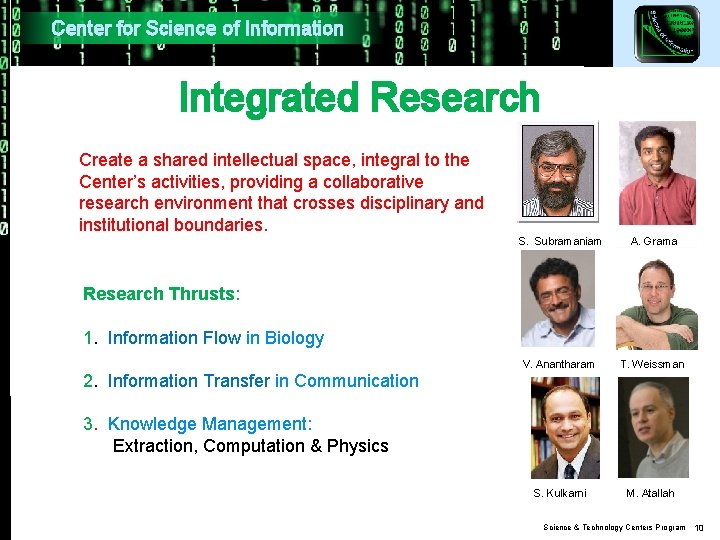
Center for Science of Information Integrated Research Create a shared intellectual space, integral to the Center’s activities, providing a collaborative research environment that crosses disciplinary and institutional boundaries. S. Subramaniam A. Grama V. Anantharam T. Weissman S. Kulkarni M. Atallah Research Thrusts: 1. Information Flow in Biology 2. Information Transfer in Communication 3. Knowledge Management: Extraction, Computation & Physics Science & Technology Centers Program 10
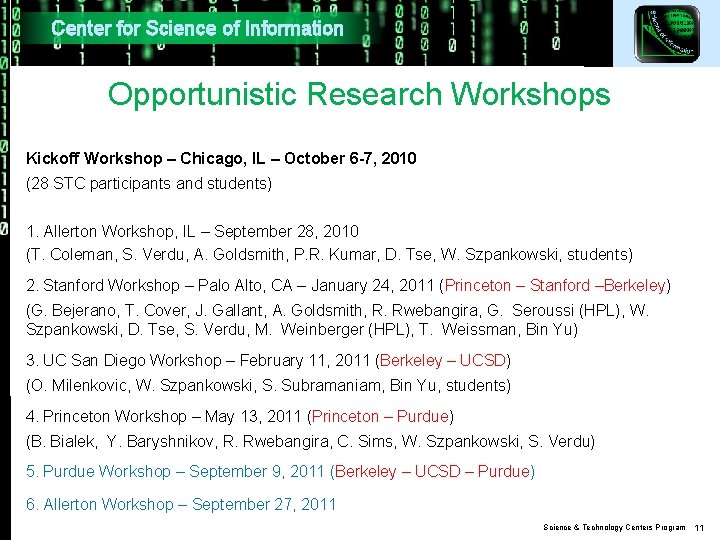
Center for Science of Information Opportunistic Research Workshops Kickoff Workshop – Chicago, IL – October 6 -7, 2010 (28 STC participants and students) 1. Allerton Workshop, IL – September 28, 2010 (T. Coleman, S. Verdu, A. Goldsmith, P. R. Kumar, D. Tse, W. Szpankowski, students) 2. Stanford Workshop – Palo Alto, CA – January 24, 2011 (Princeton – Stanford –Berkeley) (G. Bejerano, T. Cover, J. Gallant, A. Goldsmith, R. Rwebangira, G. Seroussi (HPL), W. Szpankowski, D. Tse, S. Verdu, M. Weinberger (HPL), T. Weissman, Bin Yu) 3. UC San Diego Workshop – February 11, 2011 (Berkeley – UCSD) (O. Milenkovic, W. Szpankowski, S. Subramaniam, Bin Yu, students) 4. Princeton Workshop – May 13, 2011 (Princeton – Purdue) (B. Bialek, Y. Baryshnikov, R. Rwebangira, C. Sims, W. Szpankowski, S. Verdu) 5. Purdue Workshop – September 9, 2011 (Berkeley – UCSD – Purdue) 6. Allerton Workshop – September 27, 2011 Science & Technology Centers Program 11
Center for Science of Information Research Thrusts Life Sciences (UCSD, Purdue, Berkeley, Stanford, Princeton, UIUC) 1. 2. 3. 4. Knowledge extraction from data Dealing with noise in data Classification of modularity from data Dealing with dynamical data Communication (Princeton, Stanford, Berkeley, MIT, UIUC, Purdue) 1. 2. 3. 4. Delay in Information Theory Information and computation New measures and notions of information Interface with life sciences thrust Knowledge Management (MIT, Princeton, Purdue, Stanford) 1. 2. 3. 4. Foundations of Learning, Inference, and Decision-Making Privacy, Security, and Anonymity Data Reduction Application thrusts Science & Technology Centers Program 12
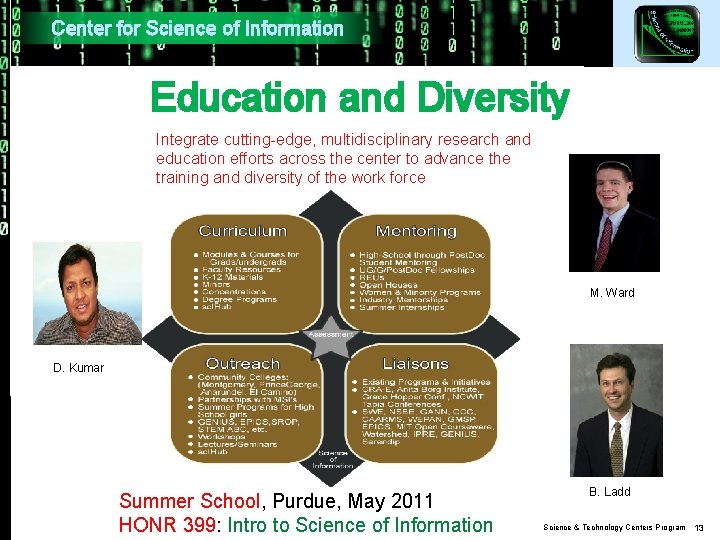
Center for Science of Information Education and Diversity Integrate cutting-edge, multidisciplinary research and education efforts across the center to advance the training and diversity of the work force M. Ward D. Kumar Summer School, Purdue, May 2011 HONR 399: Intro to Science of Information B. Ladd Science & Technology Centers Program 13
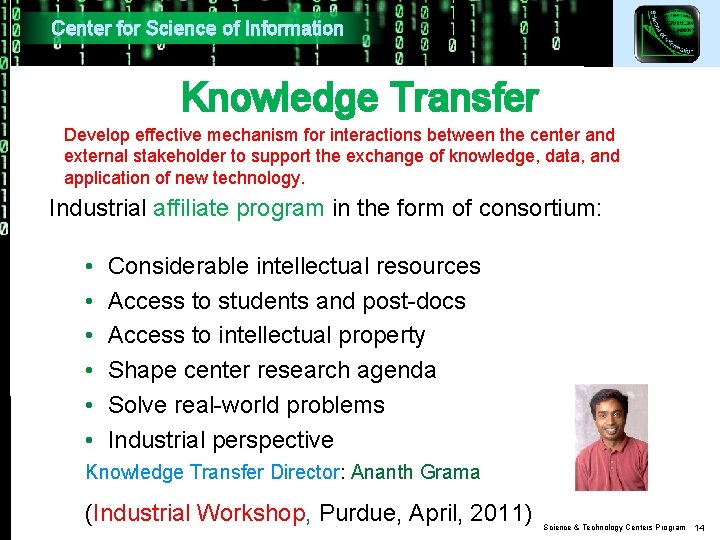
Center for Science of Information Knowledge Transfer Develop effective mechanism for interactions between the center and external stakeholder to support the exchange of knowledge, data, and application of new technology. Industrial affiliate program in the form of consortium: • • • Considerable intellectual resources Access to students and post-docs Access to intellectual property Shape center research agenda Solve real-world problems Industrial perspective Knowledge Transfer Director: Ananth Grama (Industrial Workshop, Purdue, April, 2011) Science & Technology Centers Program 14
Center for Science of Information Outline 1. Science of Information 2. Center Mission 1. Integrated Research 2. Education and Diversity 3. Knowledge Transfer 3. Management Structure 1. STC Team 2. STC Staff 3. Management Chart Science & Technology Centers Program 15
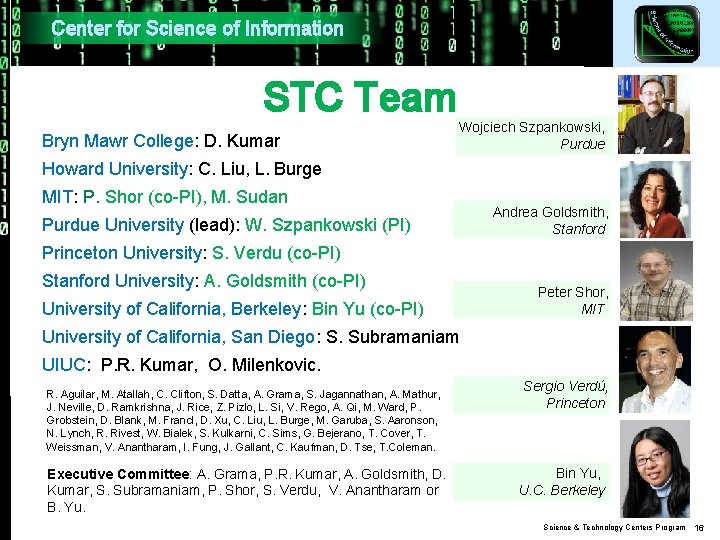
Center for Science of Information STC Team Bryn Mawr College: D. Kumar Wojciech Szpankowski, Purdue Howard University: C. Liu, L. Burge MIT: P. Shor (co-PI), M. Sudan Purdue University (lead): W. Szpankowski (PI) Andrea Goldsmith, Stanford Princeton University: S. Verdu (co-PI) Stanford University: A. Goldsmith (co-PI) University of California, Berkeley: Bin Yu (co-PI) Peter Shor, MIT University of California, San Diego: S. Subramaniam UIUC: P. R. Kumar, O. Milenkovic. R. Aguilar, M. Atallah, C. Clifton, S. Datta, A. Grama, S. Jagannathan, A. Mathur, J. Neville, D. Ramkrishna, J. Rice, Z. Pizlo, L. Si, V. Rego, A. Qi, M. Ward, P. Grobstein, D. Blank, M. Francl, D. Xu, C. Liu, L. Burge, M. Garuba, S. Aaronson, N. Lynch, R. Rivest, W. Bialek, S. Kulkarni, C. Sims, G. Bejerano, T. Cover, T. Weissman, V. Anantharam, I. Fung, J. Gallant, C. Kaufman, D. Tse, T. Coleman. Executive Committee: A. Grama, P. R. Kumar, A. Goldsmith, D. Kumar, S. Subramaniam, P. Shor, S. Verdu, V. Anantharam or B. Yu. Sergio Verdú, Princeton Bin Yu, U. C. Berkeley Science & Technology Centers Program 16
Center for Science of Information Center Participants • Twelve members of National Academies (NAS/NAE) -- Cover, Lynch, Fung, Janson, Kumar, Ramkrishna, Rice, Rivest, Shor, Sims, Verdu, Ziv. • Turing award winner (the highest distinction in Computer Sciences) -- Rivest. • • Three Shannon award winners (the highest distinction in Information Theory) - Cover , Ziv, and Verdu. Two recipients of the Nevanlinna Prize (awarded every 4 years at the International Congress of Mathematicians, for outstanding contributions in Mathematical Aspects of Information Sciences) -- Sudan and Shor. • A Humboldt Research Award -- Szpankowski. Science & Technology Centers Program 17
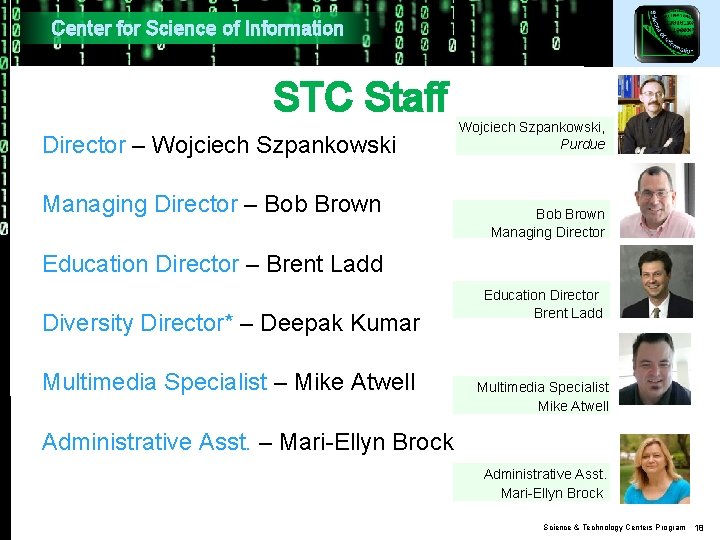
Center for Science of Information STC Staff Director – Wojciech Szpankowski Managing Director – Bob Brown Wojciech Szpankowski, Purdue Bob Brown Managing Director Education Director – Brent Ladd Diversity Director* – Deepak Kumar Multimedia Specialist – Mike Atwell Education Director Brent Ladd Multimedia Specialist Mike Atwell Administrative Asst. – Mari-Ellyn Brock Administrative Asst. Mari-Ellyn Brock Science & Technology Centers Program 18
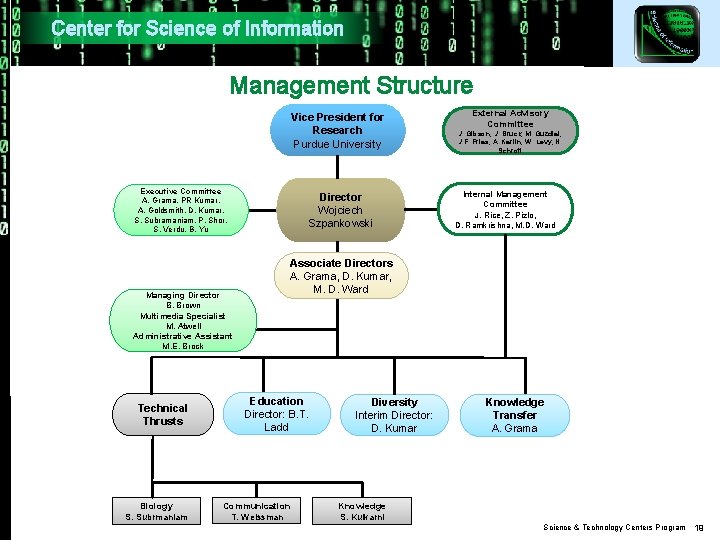
Center for Science of Information Management Structure Vice President for Research Purdue University Executive Committee A. Grama, PR Kumar, A. Goldsmith, D. Kumar, S. Subramaniam, P. Shor, S. Verdu, B. Yu Managing Director B. Brown Multimedia Specialist M. Atwell Administrative Assistant M. E. Brock Technical Thrusts Biology S. Subrmaniam Director Wojciech Szpankowski External Advisory Committee J. Gibson, J. Bruck, M. Guzdial, J. F. Frias, A. Karlin, W. Levy, N. Schroff Internal Management Committee J. Rice, Z. Pizlo, D. Ramkrishna, M. D. Ward Associate Directors A. Grama, D. Kumar, M. D. Ward Education Director: B. T. Ladd Communication T. Weissman Diversity Interim Director: D. Kumar Knowledge Transfer A. Grama Knowledge S. Kulkarni Science & Technology Centers Program 19