CCG MATH PATHWAYS Jonathan Hull Assistant Director Policy

- Slides: 20
CCG & MATH PATHWAYS Jonathan Hull Assistant Director, Policy & Partnership Development University System of Georgia STEM Initiative Meeting, May 18, 2017 1 completega. org
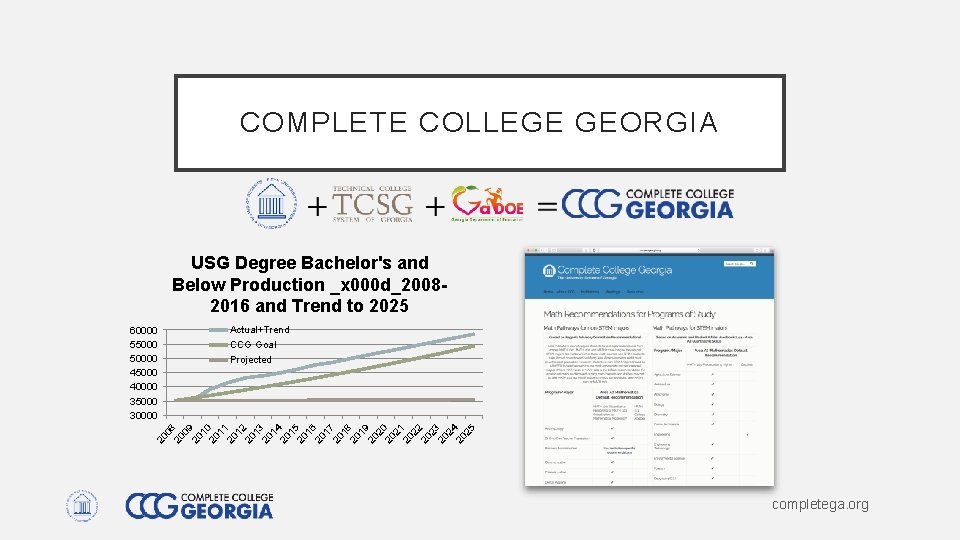
COMPLETE COLLEGE GEORGIA USG Degree Bachelor's and Below Production _x 000 d_20082016 and Trend to 2025 Actual+Trend CCG Goal Projected 20 08 20 09 20 10 20 11 20 12 20 13 20 14 20 15 20 16 20 17 20 18 20 19 20 20 20 21 20 22 20 23 20 24 20 25 60000 550000 45000 40000 35000 30000 completega. org
MATH AND COLLEGE COMPLETION “Mathematics courses are the most significant barrier to degree completion in both STEM and non-STEM fields. ” Karen Saxe and Linda Braddy, A Common Vision for Undergraduate Mathematical Sciences Programs in 2025, Mathematical Association of America, 2015. completega. org
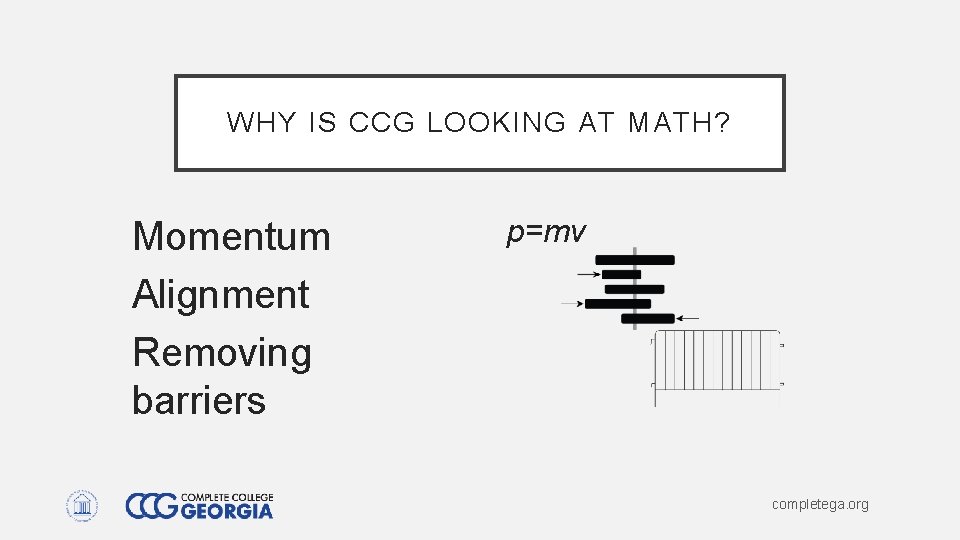
WHY IS CCG LOOKING AT MATH? Momentum Alignment Removing barriers p=mv completega. org
BACKGROUND 2013 USG Mathematics Task Force 8 recommendations #2: “Align gateway mathematics course sequences with academic programs of study. In particular, College Algebra should not be the default class for non. STEM majors. ” completega. org
BACKGROUND 2013 USG Mathematics Task Force “Most students in non-STEM majors would be better served by enrolling in Quantitative Reasoning or Introduction to Mathematical Modeling, possibly followed by a statistics course in Area D (Natural Science, Mathematics, and Technology) of the core curriculum. ” completega. org
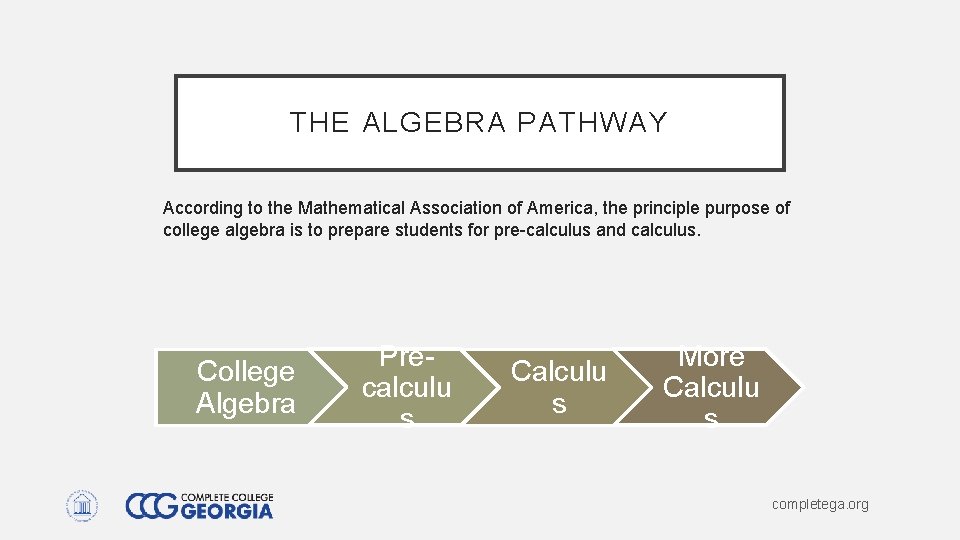
THE ALGEBRA PATHWAY According to the Mathematical Association of America, the principle purpose of college algebra is to prepare students for pre-calculus and calculus. College Algebra Precalculu s Calculu s More Calculu s completega. org
THREE MATH GATEWAYS 1. MATH 1001 Introduction to Quantitative Reasoning 2. MATH 1101 Introduction to Math Modeling 3. MATH 1111 College Algebra completega. org
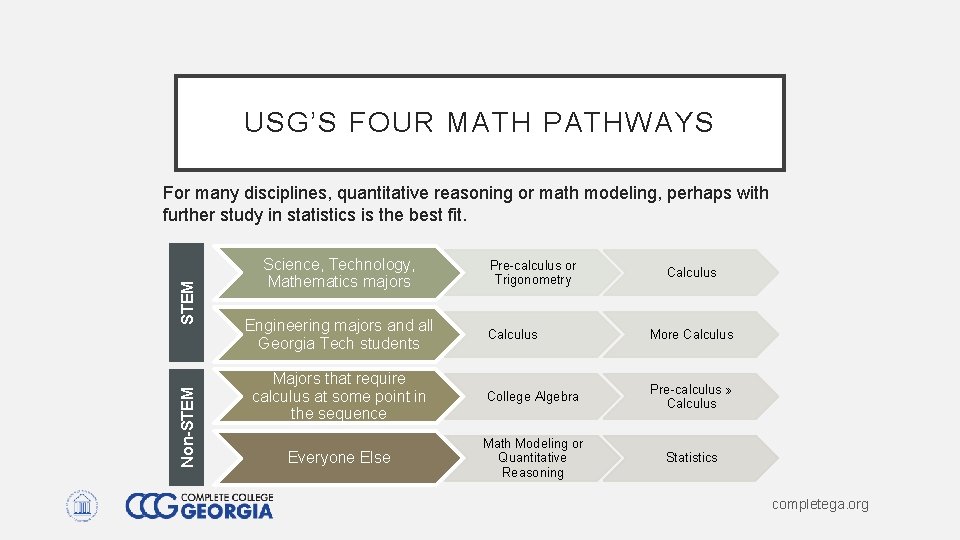
USG’S FOUR MATH PATHWAYS Non-STEM For many disciplines, quantitative reasoning or math modeling, perhaps with further study in statistics is the best fit. Science, Technology, Mathematics majors Engineering majors and all Georgia Tech students Pre-calculus or Trigonometry Calculus More Calculus Majors that require calculus at some point in the sequence College Algebra Pre-calculus » Calculus Everyone Else Math Modeling or Quantitative Reasoning Statistics completega. org
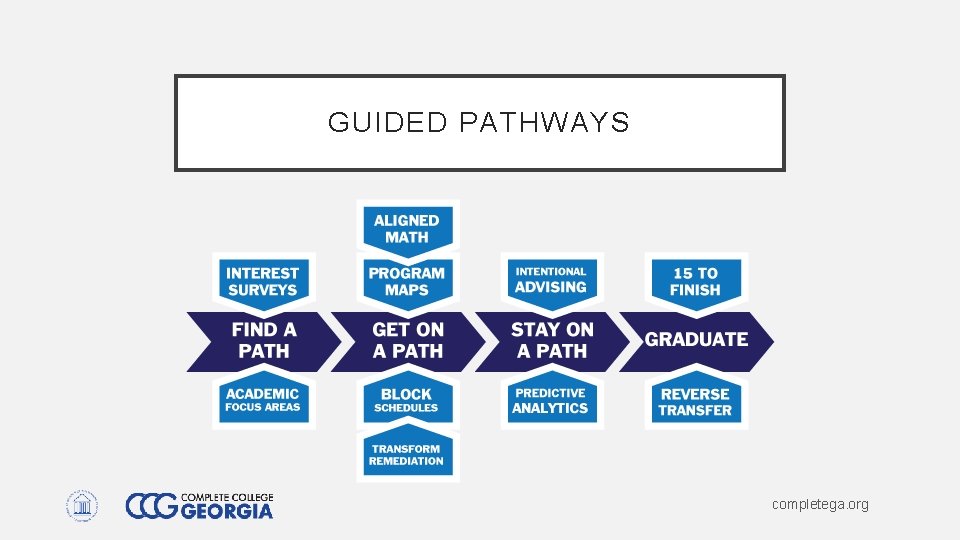
GUIDED PATHWAYS completega. org
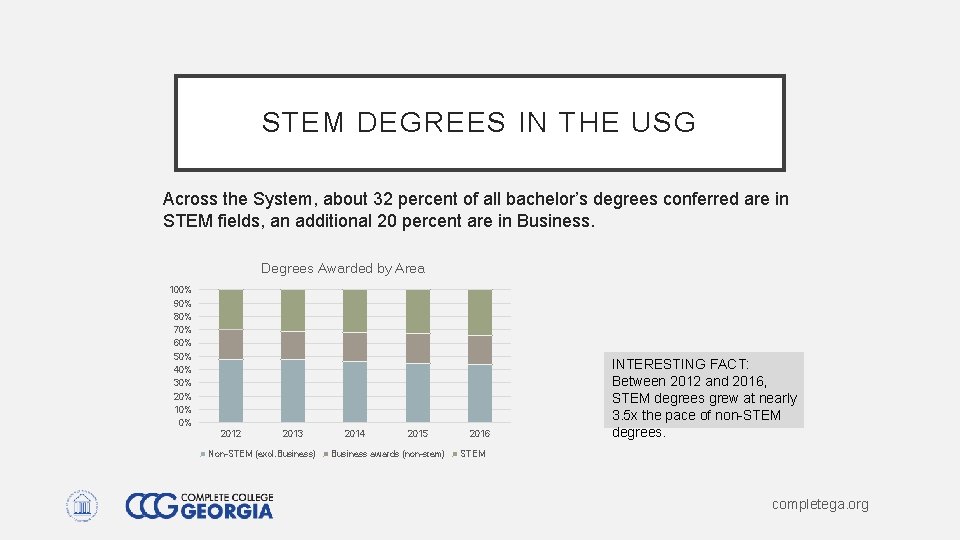
STEM DEGREES IN THE USG Across the System, about 32 percent of all bachelor’s degrees conferred are in STEM fields, an additional 20 percent are in Business. Degrees Awarded by Area 100% 90% 80% 70% 60% 50% 40% 30% 20% 10% 0% 2012 2013 Non-STEM (excl. Business) 2014 2015 Business awards (non-stem) 2016 INTERESTING FACT: Between 2012 and 2016, STEM degrees grew at nearly 3. 5 x the pace of non-STEM degrees. STEM completega. org
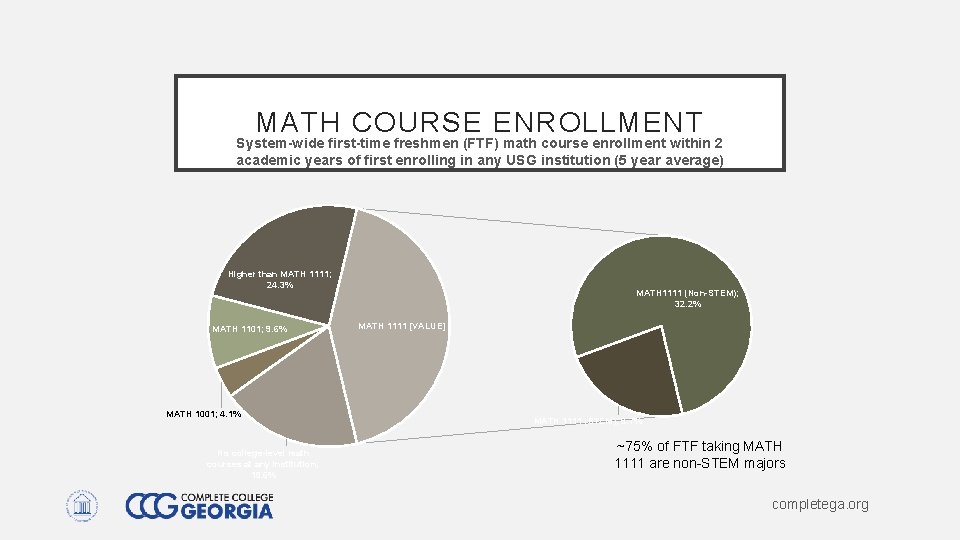
MATH COURSE ENROLLMENT System-wide first-time freshmen (FTF) math course enrollment within 2 academic years of first enrolling in any USG institution (5 year average) Higher than MATH 1111; 24. 3% MATH 1101; 9. 6% MATH 1001; 4. 1% No college-level math courses at any institution; 18. 6% MATH 1111 (Non-STEM); 32. 2% MATH 1111 [VALUE] MATH 1111 (STEM); 9. 7% ~75% of FTF taking MATH 1111 are non-STEM majors completega. org
COLLEGE ALGEBRA = DEFAULT MATH College Algebra (MATH 1111) was the most common first math course at 24 USG institutions in Fall 2014. (ranging from 34% to 90% of students taking College Algebra as their first math course depending on the institution) completega. org
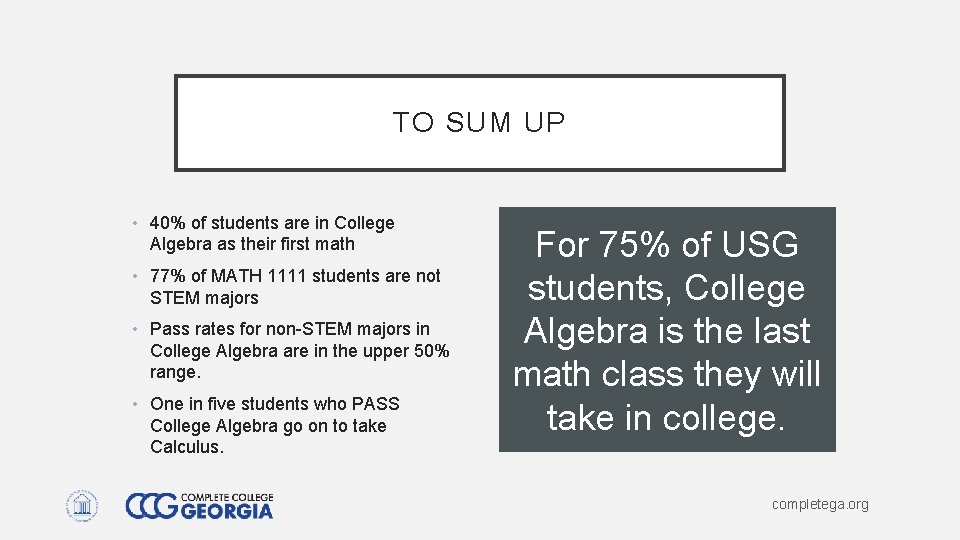
TO SUM UP • 40% of students are in College Algebra as their first math • 77% of MATH 1111 students are not STEM majors • Pass rates for non-STEM majors in College Algebra are in the upper 50% range. • One in five students who PASS College Algebra go on to take Calculus. For 75% of USG students, College Algebra is the last math class they will take in college. completega. org
WHY IS THE CASE? Students may be advised into College Algebra as a “safe” option. Students may be selecting College Algebra on their own. (e. g. , it is guaranteed to “count” even if a student transfers or changes major) (“I’m in college; I’ll take a college math”) completega. org
WHY IS THE CASE? Other departments are skeptical of the rigor of non. College Algebra options. (“Our students need ’real’ math to succeed. ”) College Algebra is being used as a proxy for filtering out candidates from non-STEM disciplines. (”Success in college algebra shows students can think. ”) completega. org
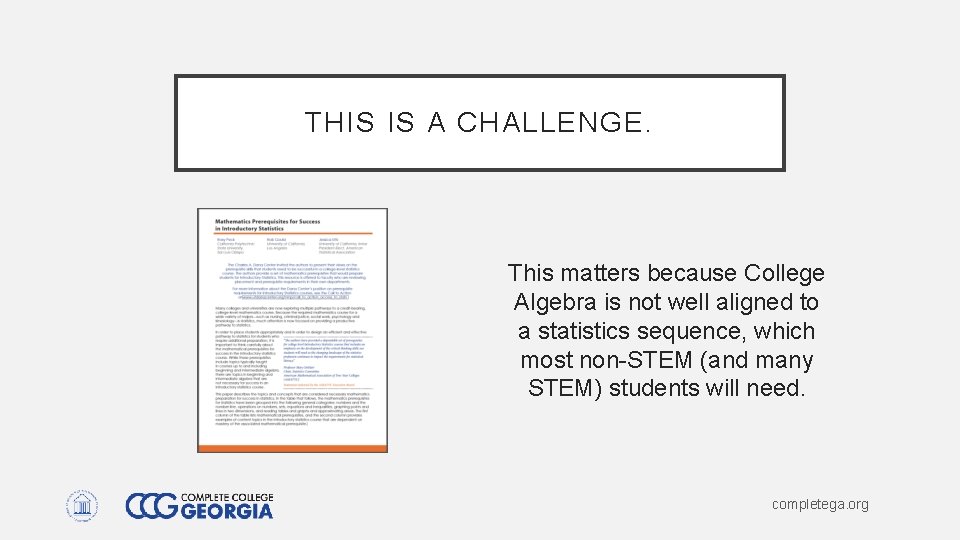
THIS IS A CHALLENGE. This matters because College Algebra is not well aligned to a statistics sequence, which most non-STEM (and many STEM) students will need. completega. org
MULTI-PRONGED SOLUTION üAdvising & Program Maps üDiscipline-specific math recommendations (available at completega. org/math -pathways) q. Assurance of the rigor of non-College Algebra courses q. Research on student outcomes in “other” math courses. completega. org
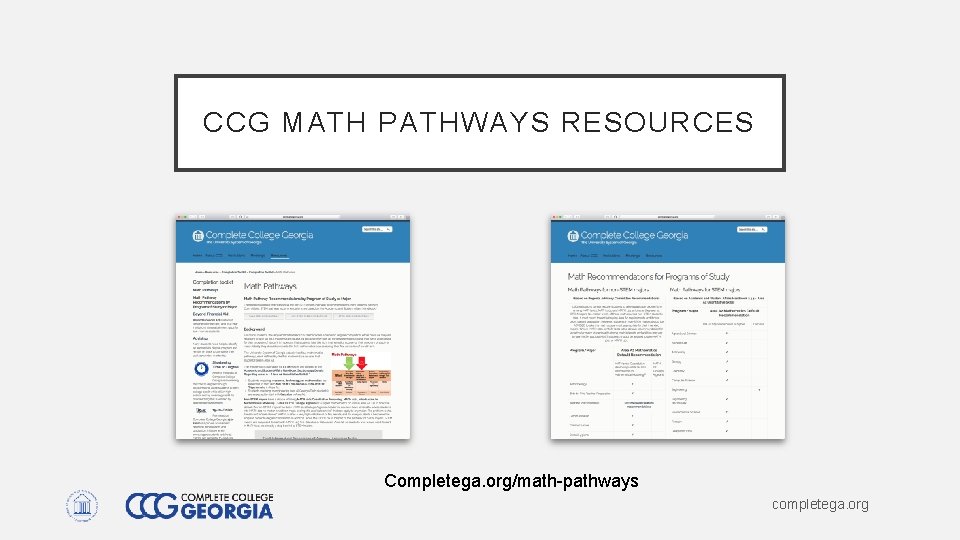
CCG MATH PATHWAYS RESOURCES Completega. org/math-pathways completega. org
THANK YOU Jonathan. Hull@usg. edu 22 completega. org