CAD Computer Aided Design Doru Todinca www cs




- Slides: 11
CAD Computer Aided Design Doru Todinca www. cs. upt. ro/~todinca doru. todinca@cs. upt. ro Course web page: www. cs. upt. ro/~todinca in Teaching, CAD, Or: http: //staff. cs. upt. ro/~todinca/cad/index. html
Structure of the course • • 2 hours lectures, 2 hours lab per week Final grade: 50% lab, 50% written exam The lab is mandatory Web page: http: //staff. cs. upt. ro/~todinca/cad/index. html
Assignments • We will focus on two projects/assignments: – – • • VHDL modeling of a hardware system Modeling a telecommunication system using the OMNe. T++ network simulator One of the assignments is mandatory and will ensure the grade for the lab The other assignment can provide bonus points for the written exam, and even to replace the exam !
CAD: Motivation • We will learn new techniques for modelling and simulation We will write computer programs (more precisely, models) that deal with: • – • Simulation time, the structure of the model, behavior of each module, concurrency, events… The goals of the course: to perform computer aided design of: 1. Hardware systems 2. Telecommunication systems
First goal: designing hardware systems • Lectures: teaching the VHDL language: – – Simulation mechanism Behavioral modelling Structural modelling (less than in previous years) Circuits: registers, MUX-es, finite state machines (FSM), etc • Labs: – VHDL modelling and simulation of • a design from previous years: Booth or Robertson multiplier, other arithmetic devices, or a μP or μC • Or of a new design: fuzzy logic controller (FLC), … – For more details see the webpage
Second goal: telecom systems • Lectures: – Quality of Service (Qo. S) and Qo. S differentiation in Internet • Architectures for Qo. S in Internet: Integrated services (Int. Serv), Differentiated services (Diff. Serv) • Techniques: scheduling, admission control, routing, congestion control, queue management, etc. – Mobile communications: • basics, LTE (4 G), 5 G • Labs: – Learning the OMNe. T++ network simulator: open source network simulator based in C++ – OMNe. T++ model of a part of a Diff. Serv architecture, or of a part of a mobile system – Collection and interpretation of the simulation results
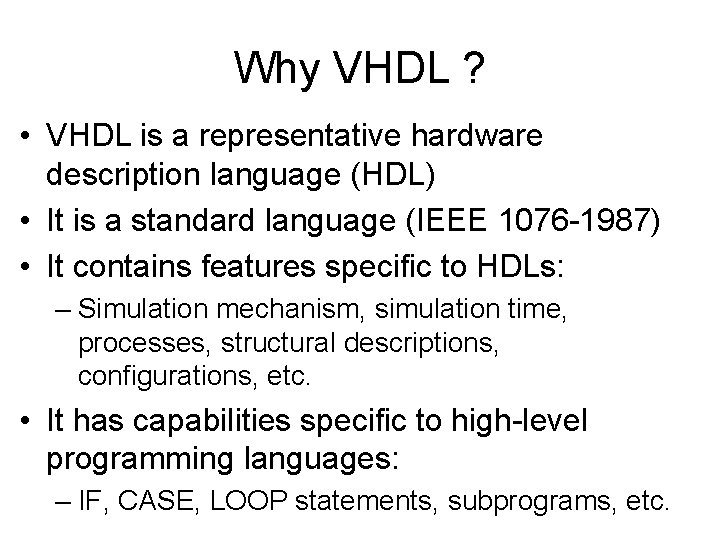
Why VHDL ? • VHDL is a representative hardware description language (HDL) • It is a standard language (IEEE 1076 -1987) • It contains features specific to HDLs: – Simulation mechanism, simulation time, processes, structural descriptions, configurations, etc. • It has capabilities specific to high-level programming languages: – IF, CASE, LOOP statements, subprograms, etc.
Why OMNe. T++ ? • There are many network simulators: – Commercial: OPNET, SES/Workbench – Non-commercial: ns 2, ns 3, … • OMNe. T++ is a free (non-commercial) open-source network simulator • It is easy to learn and to use: – It is based on C/C++ for behavioral modeling – Uses predefined functions that model modules’ behavior (handle. Message, activity, finish, initialize)
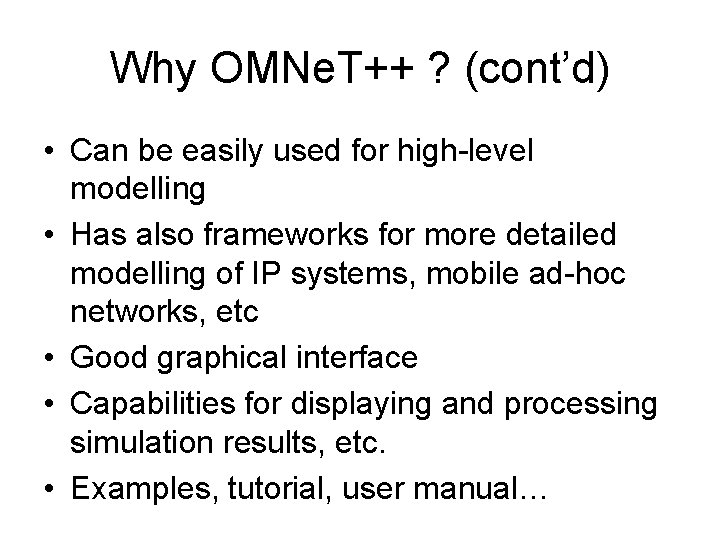
Why OMNe. T++ ? (cont’d) • Can be easily used for high-level modelling • Has also frameworks for more detailed modelling of IP systems, mobile ad-hoc networks, etc • Good graphical interface • Capabilities for displaying and processing simulation results, etc. • Examples, tutorial, user manual…
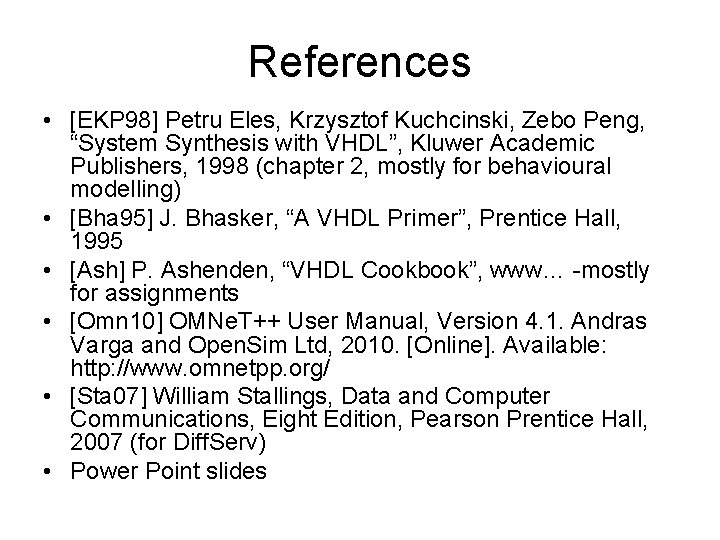
References • [EKP 98] Petru Eles, Krzysztof Kuchcinski, Zebo Peng, “System Synthesis with VHDL”, Kluwer Academic Publishers, 1998 (chapter 2, mostly for behavioural modelling) • [Bha 95] J. Bhasker, “A VHDL Primer”, Prentice Hall, 1995 • [Ash] P. Ashenden, “VHDL Cookbook”, www… -mostly for assignments • [Omn 10] OMNe. T++ User Manual, Version 4. 1. Andras Varga and Open. Sim Ltd, 2010. [Online]. Available: http: //www. omnetpp. org/ • [Sta 07] William Stallings, Data and Computer Communications, Eight Edition, Pearson Prentice Hall, 2007 (for Diff. Serv) • Power Point slides
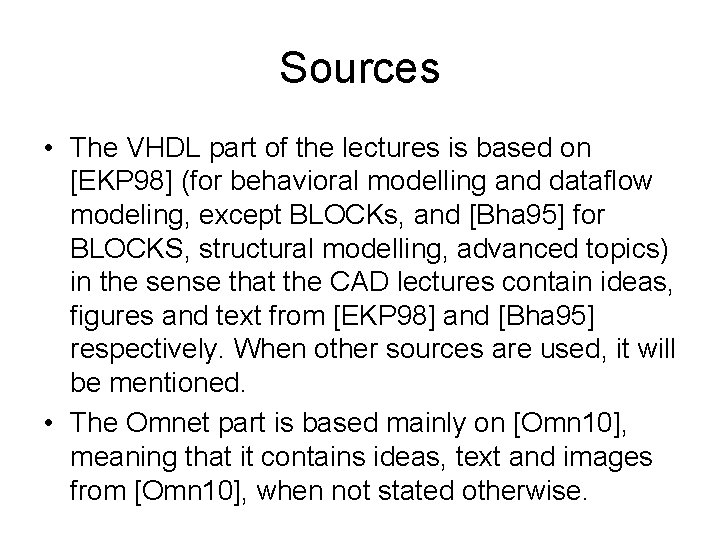
Sources • The VHDL part of the lectures is based on [EKP 98] (for behavioral modelling and dataflow modeling, except BLOCKs, and [Bha 95] for BLOCKS, structural modelling, advanced topics) in the sense that the CAD lectures contain ideas, figures and text from [EKP 98] and [Bha 95] respectively. When other sources are used, it will be mentioned. • The Omnet part is based mainly on [Omn 10], meaning that it contains ideas, text and images from [Omn 10], when not stated otherwise.