Au Nanorods and Pd Nanoparticles Sriram Chandrasekhar Prof
- Slides: 11
Au Nanorods and Pd Nanoparticles Sriram Chandrasekhar Prof. Michael S. Wong Department of Chemical and Biomolecular Engineering Rice University, Houston, TX
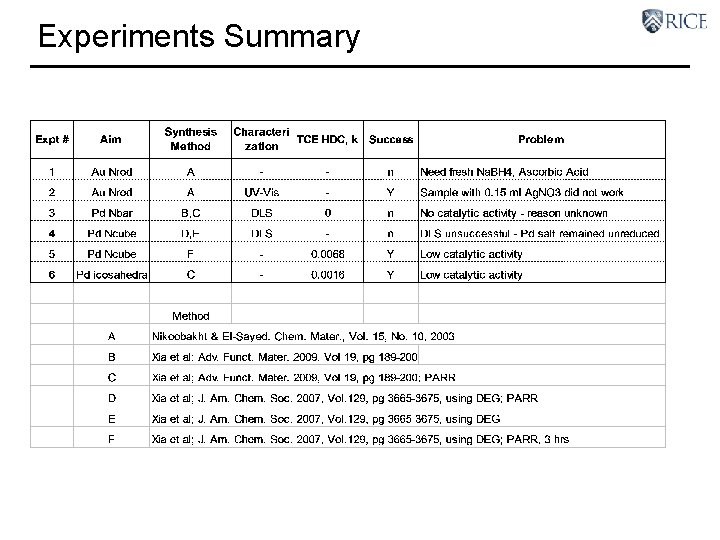
Experiments Summary
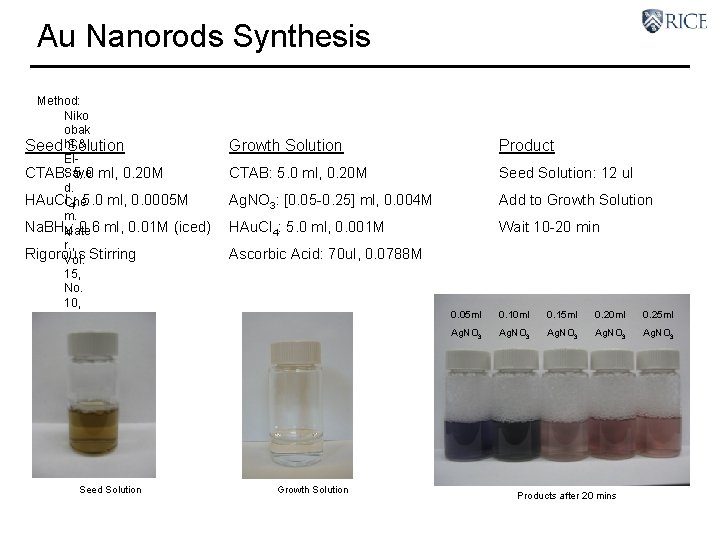
Au Nanorods Synthesis Method: Niko obak & Seed ht. Solution El. CTAB: Saye 5. 0 ml, 0. 20 M d. HAu. Cl. Che 4: 5. 0 ml, 0. 0005 M m. Na. BHMate 4: 0. 6 ml, 0. 01 M (iced) r. , Rigorous Vol. Stirring 15, No. 10, 2003 Seed Solution Growth Solution Product CTAB: 5. 0 ml, 0. 20 M Seed Solution: 12 ul Ag. NO 3: [0. 05 -0. 25] ml, 0. 004 M Add to Growth Solution HAu. Cl 4: 5. 0 ml, 0. 001 M Wait 10 -20 min Ascorbic Acid: 70 ul, 0. 0788 M Growth Solution 0. 05 ml 0. 10 ml 0. 15 ml 0. 20 ml 0. 25 ml Ag. NO 3 Products after 20 mins
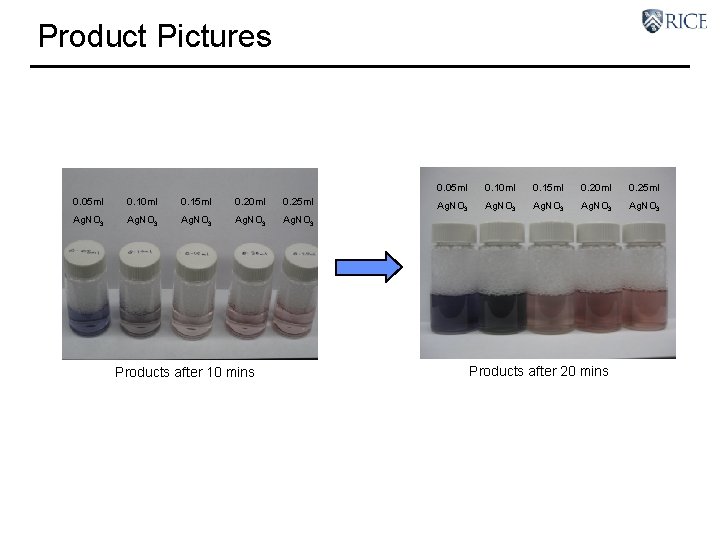
Product Pictures 0. 05 ml 0. 10 ml 0. 15 ml 0. 20 ml 0. 25 ml Ag. NO 3 Products after 10 mins 0. 05 ml 0. 10 ml 0. 15 ml 0. 20 ml 0. 25 ml Ag. NO 3 Products after 20 mins
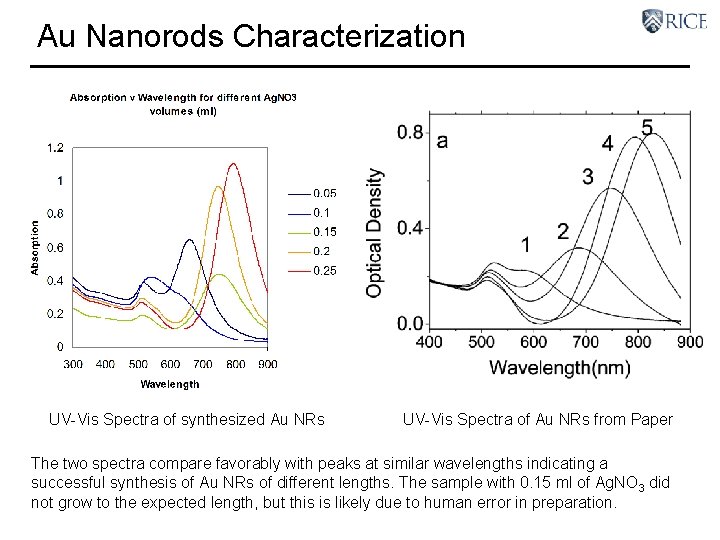
Au Nanorods Characterization UV-Vis Spectra of synthesized Au NRs UV-Vis Spectra of Au NRs from Paper The two spectra compare favorably with peaks at similar wavelengths indicating a successful synthesis of Au NRs of different lengths. The sample with 0. 15 ml of Ag. NO 3 did not grow to the expected length, but this is likely due to human error in preparation.
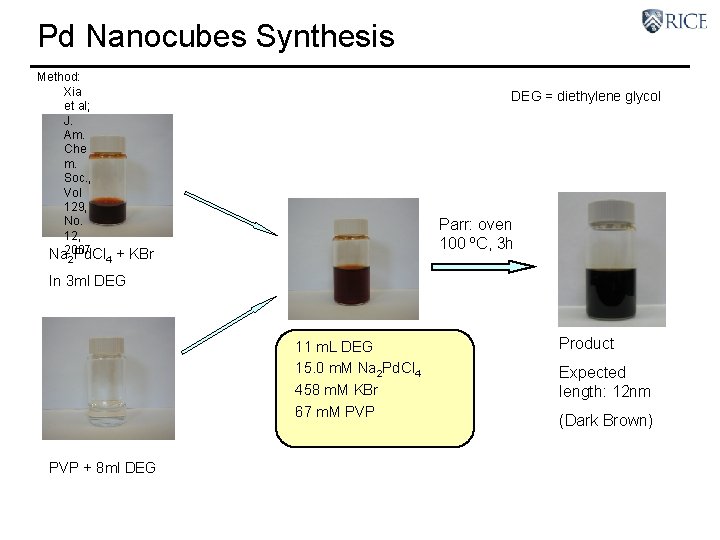
Pd Nanocubes Synthesis Method: Xia et al; J. Am. Che m. Soc. , Vol 129, No. 12, Na 2007 Pd. Cl 2 DEG = diethylene glycol 4 Parr: oven 100 ºC, 3 h + KBr In 3 ml DEG 11 m. L DEG 15. 0 m. M Na 2 Pd. Cl 4 458 m. M KBr 67 m. M PVP + 8 ml DEG Product Expected length: 12 nm (Dark Brown)
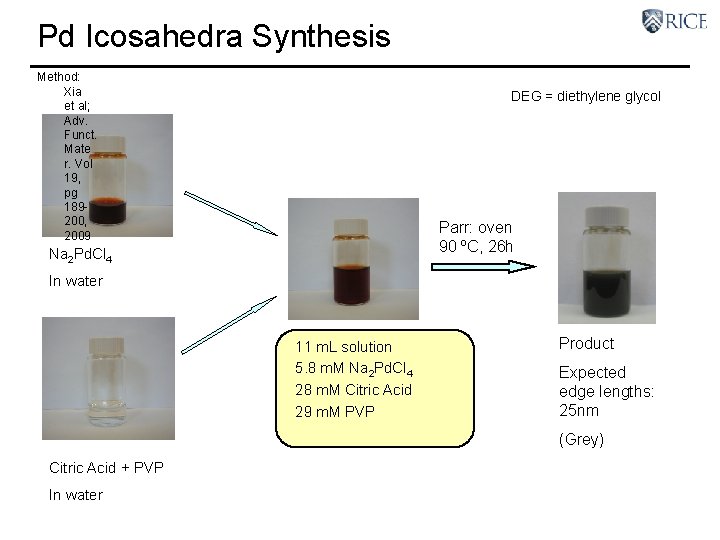
Pd Icosahedra Synthesis Method: Xia et al; Adv. Funct. Mate r. Vol 19, pg 189200, 2009 DEG = diethylene glycol Parr: oven 90 ºC, 26 h Na 2 Pd. Cl 4 In water 11 m. L solution 5. 8 m. M Na 2 Pd. Cl 4 28 m. M Citric Acid 29 m. M PVP Product Expected edge lengths: 25 nm (Grey) Citric Acid + PVP In water
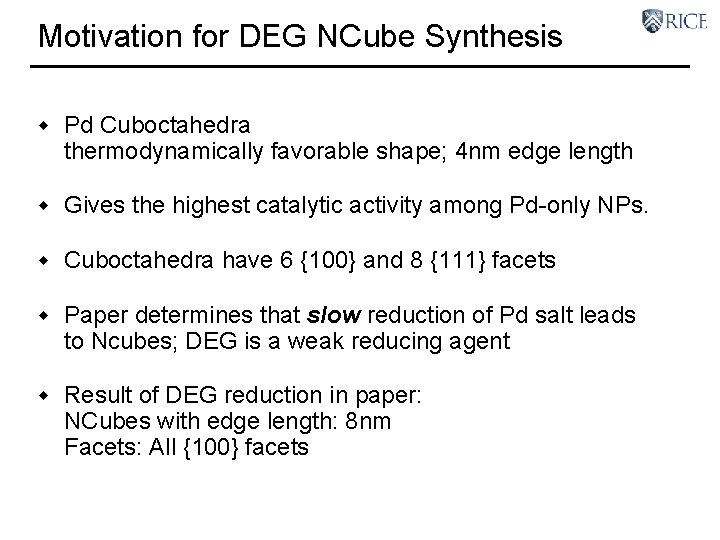
Motivation for DEG NCube Synthesis w Pd Cuboctahedra thermodynamically favorable shape; 4 nm edge length w Gives the highest catalytic activity among Pd-only NPs. w Cuboctahedra have 6 {100} and 8 {111} facets w Paper determines that slow reduction of Pd salt leads to Ncubes; DEG is a weak reducing agent w Result of DEG reduction in paper: NCubes with edge length: 8 nm Facets: All {100} facets
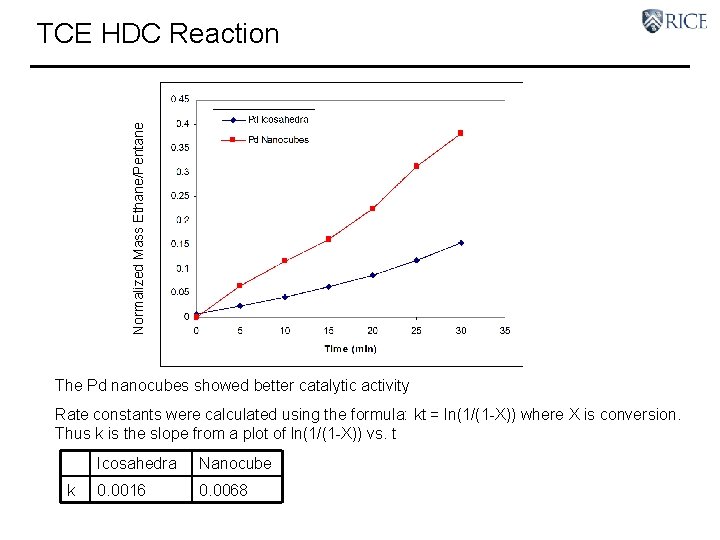
Normalized Mass Ethane/Pentane TCE HDC Reaction The Pd nanocubes showed better catalytic activity Rate constants were calculated using the formula: kt = ln(1/(1 -X)) where X is conversion. Thus k is the slope from a plot of ln(1/(1 -X)) vs. t k Icosahedra Nanocube 0. 0016 0. 0068
Au@Pd Core/Shell Nbars w Au NR Synthesis: same procedure as described above w Required chemicals are available