
Neat and Discrete Carbon Nanoparticles Fullerenes and Nanotubes
Neat and Discrete Carbon Nanoparticles Fullerenes and Nanotubes
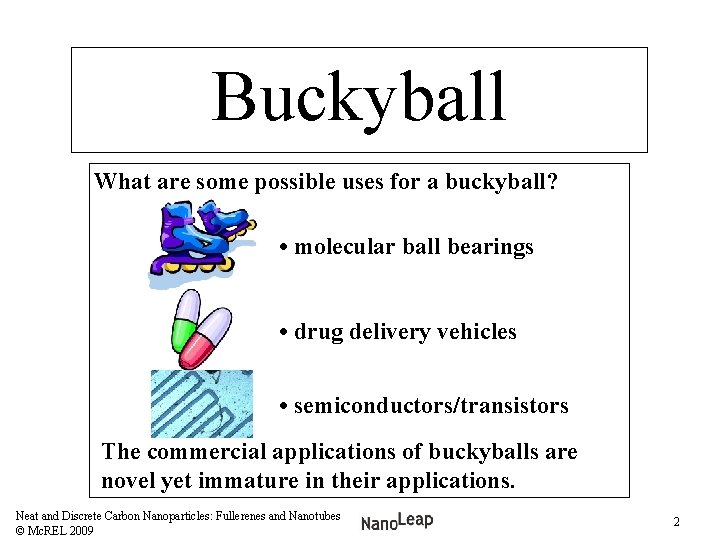
Buckyball What are some possible uses for a buckyball? • molecular ball bearings • drug delivery vehicles • semiconductors/transistors The commercial applications of buckyballs are novel yet immature in their applications. Neat and Discrete Carbon Nanoparticles: Fullerenes and Nanotubes © Mc. REL 2009 2
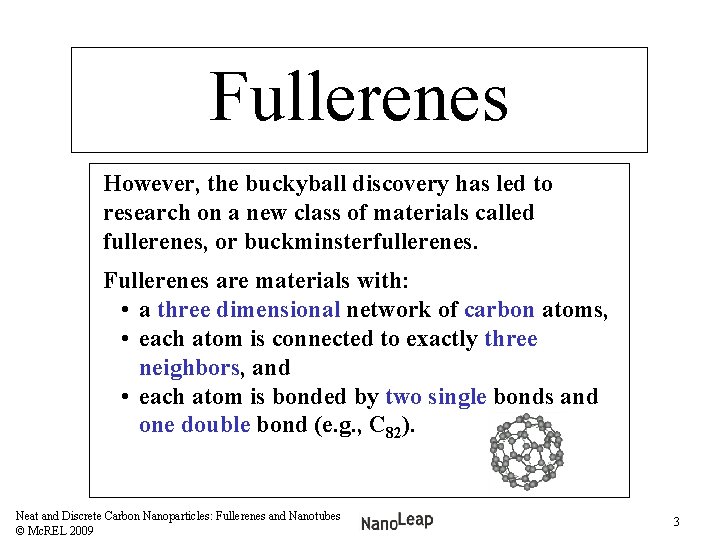
Fullerenes However, the buckyball discovery has led to research on a new class of materials called fullerenes, or buckminsterfullerenes. Fullerenes are materials with: • a three dimensional network of carbon atoms, • each atom is connected to exactly three neighbors, and • each atom is bonded by two single bonds and one double bond (e. g. , C 82). Neat and Discrete Carbon Nanoparticles: Fullerenes and Nanotubes © Mc. REL 2009 3
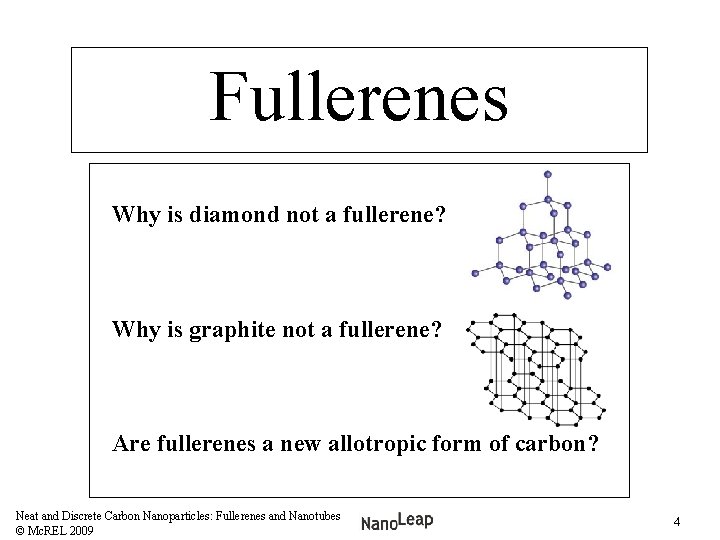
Fullerenes Why is diamond not a fullerene? Why is graphite not a fullerene? Are fullerenes a new allotropic form of carbon? Neat and Discrete Carbon Nanoparticles: Fullerenes and Nanotubes © Mc. REL 2009 4
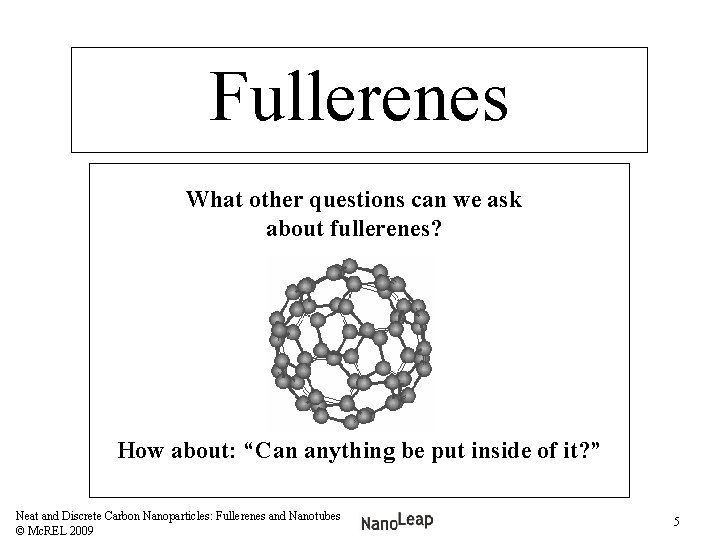
Fullerenes What other questions can we ask about fullerenes? How about: “Can anything be put inside of it? ” Neat and Discrete Carbon Nanoparticles: Fullerenes and Nanotubes © Mc. REL 2009 5
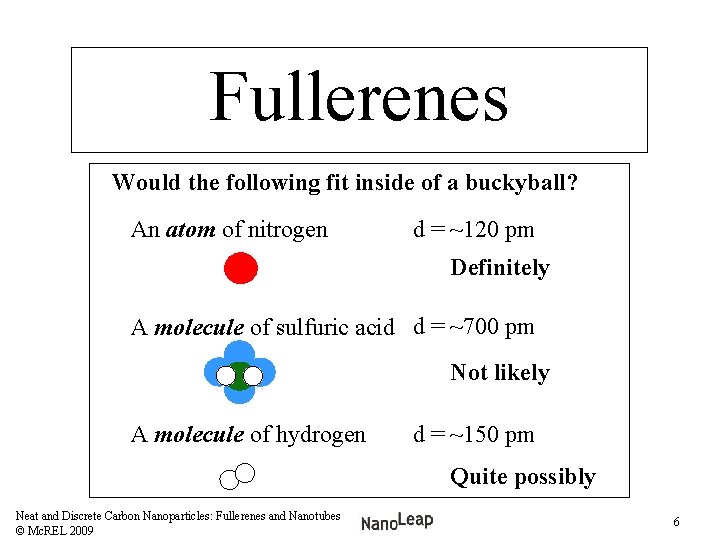
Fullerenes Would the following fit inside of a buckyball? An atom of nitrogen d = ~120 pm Definitely A molecule of sulfuric acid d = ~700 pm Not likely A molecule of hydrogen d = ~150 pm Quite possibly Neat and Discrete Carbon Nanoparticles: Fullerenes and Nanotubes © Mc. REL 2009 6
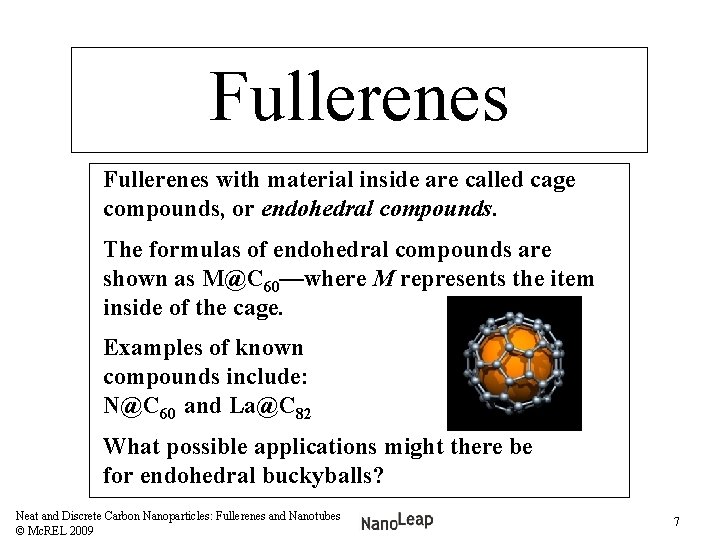
Fullerenes with material inside are called cage compounds, or endohedral compounds. The formulas of endohedral compounds are shown as M@C 60—where M represents the item inside of the cage. Examples of known compounds include: N@C 60 and La@C 82 What possible applications might there be for endohedral buckyballs? Neat and Discrete Carbon Nanoparticles: Fullerenes and Nanotubes © Mc. REL 2009 7
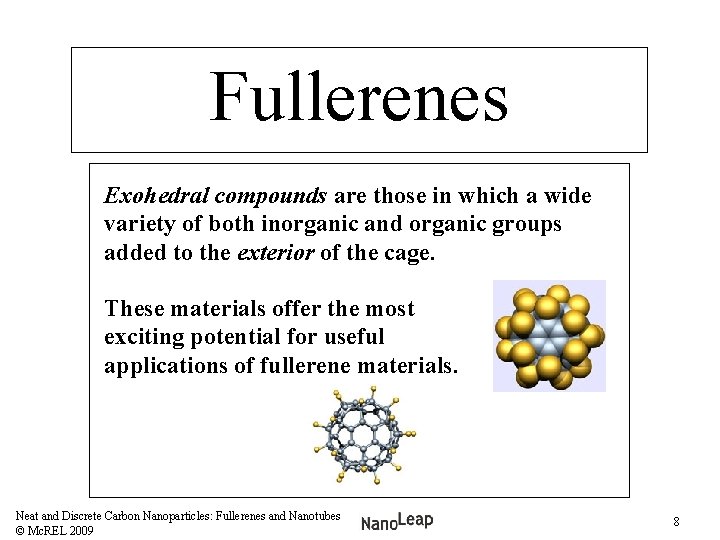
Fullerenes Exohedral compounds are those in which a wide variety of both inorganic and organic groups added to the exterior of the cage. These materials offer the most exciting potential for useful applications of fullerene materials. Neat and Discrete Carbon Nanoparticles: Fullerenes and Nanotubes © Mc. REL 2009 8

Fullerenes Combination endo- and exohedral compounds have also been synthesized. An interesting example is: Gd@C 82(OH)n The gadolinium (Gd) is inside the cage and the outside is covered with hydroxyl groups. Gd@C 82(OH)n is a possible enhancement material for magnetic resonance imaging, MRI. Neat and Discrete Carbon Nanoparticles: Fullerenes and Nanotubes © Mc. REL 2009 9
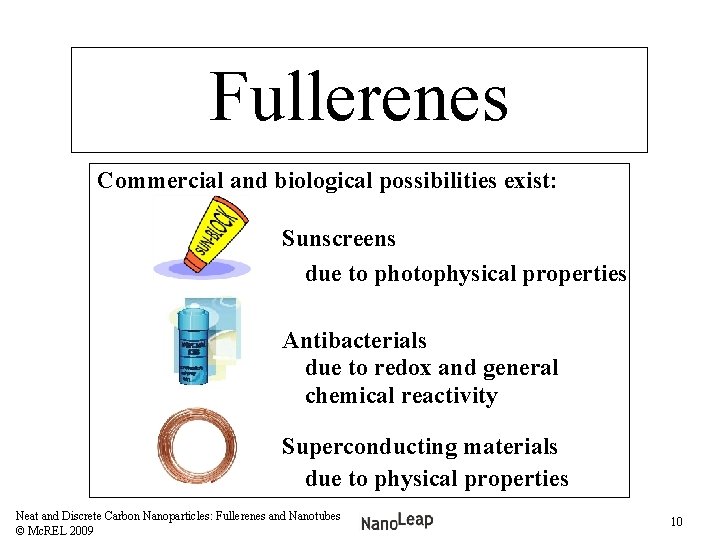
Fullerenes Commercial and biological possibilities exist: Sunscreens due to photophysical properties Antibacterials due to redox and general chemical reactivity Superconducting materials due to physical properties Neat and Discrete Carbon Nanoparticles: Fullerenes and Nanotubes © Mc. REL 2009 10
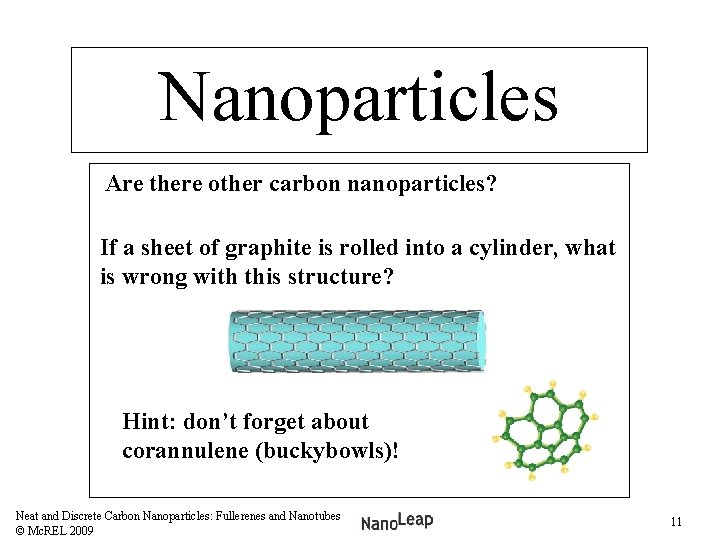
Nanoparticles Are there other carbon nanoparticles? If a sheet of graphite is rolled into a cylinder, what is wrong with this structure? Hint: don’t forget about corannulene (buckybowls)! Neat and Discrete Carbon Nanoparticles: Fullerenes and Nanotubes © Mc. REL 2009 11
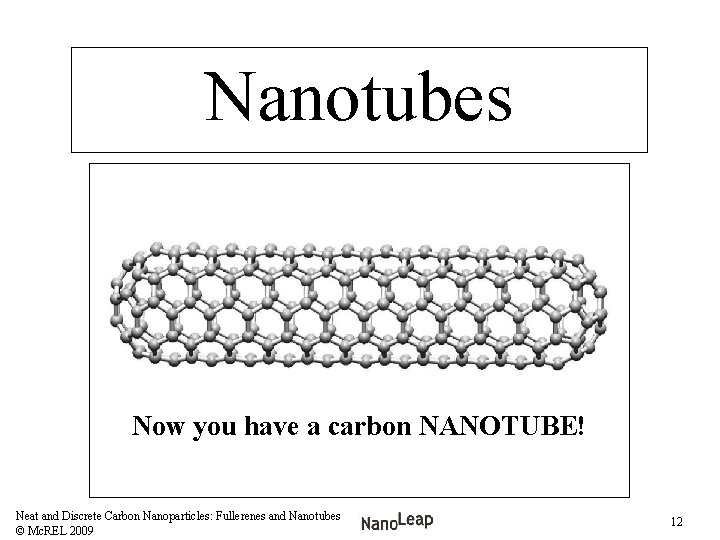
Nanotubes Now you have a carbon NANOTUBE! Neat and Discrete Carbon Nanoparticles: Fullerenes and Nanotubes © Mc. REL 2009 12
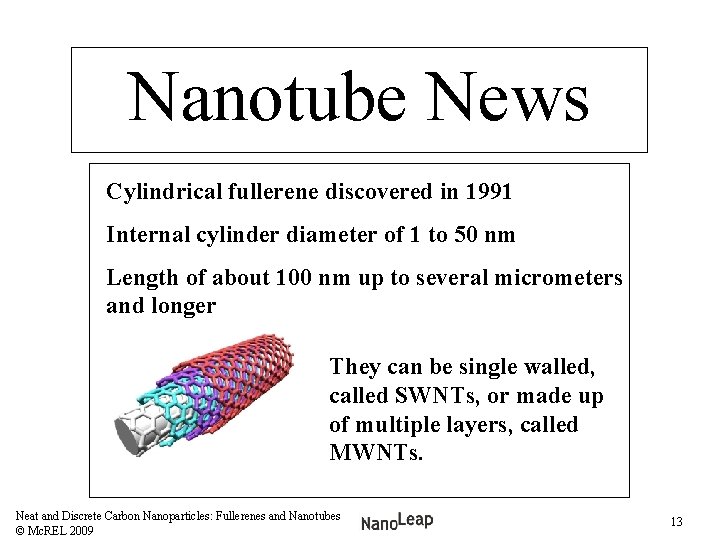
Nanotube News Cylindrical fullerene discovered in 1991 Internal cylinder diameter of 1 to 50 nm Length of about 100 nm up to several micrometers and longer They can be single walled, called SWNTs, or made up of multiple layers, called MWNTs. Neat and Discrete Carbon Nanoparticles: Fullerenes and Nanotubes © Mc. REL 2009 13
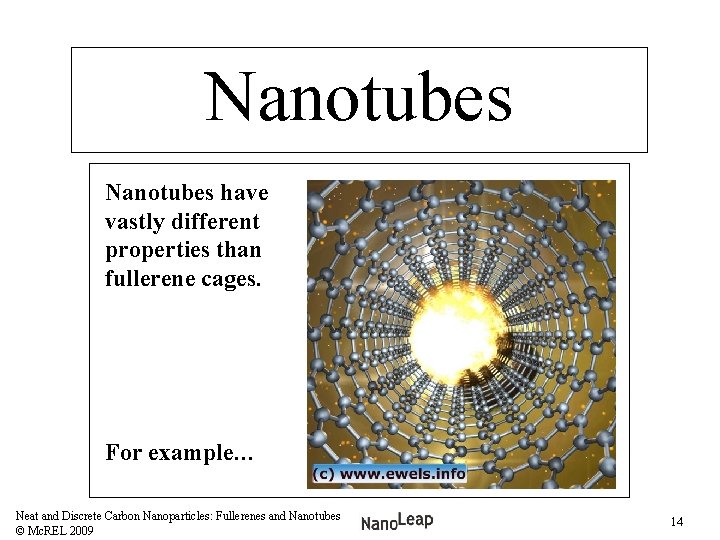
Nanotubes have vastly different properties than fullerene cages. For example… Neat and Discrete Carbon Nanoparticles: Fullerenes and Nanotubes © Mc. REL 2009 14
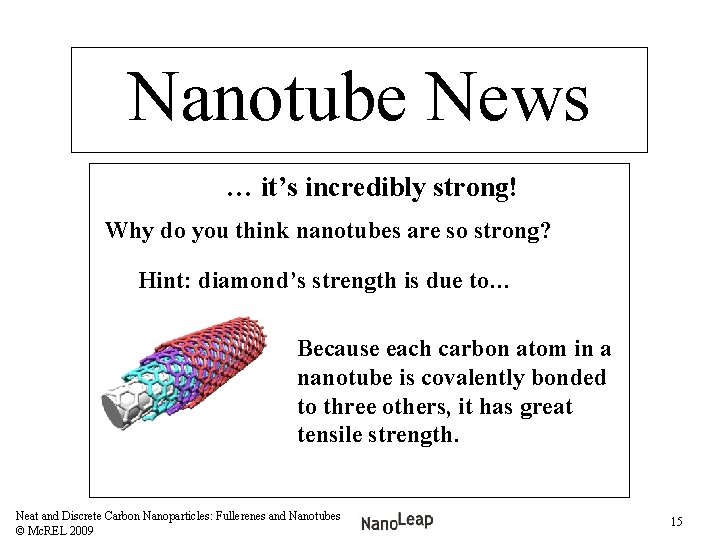
Nanotube News … it’s incredibly strong! Why do you think nanotubes are so strong? Hint: diamond’s strength is due to… Because each carbon atom in a nanotube is covalently bonded to three others, it has great tensile strength. Neat and Discrete Carbon Nanoparticles: Fullerenes and Nanotubes © Mc. REL 2009 15
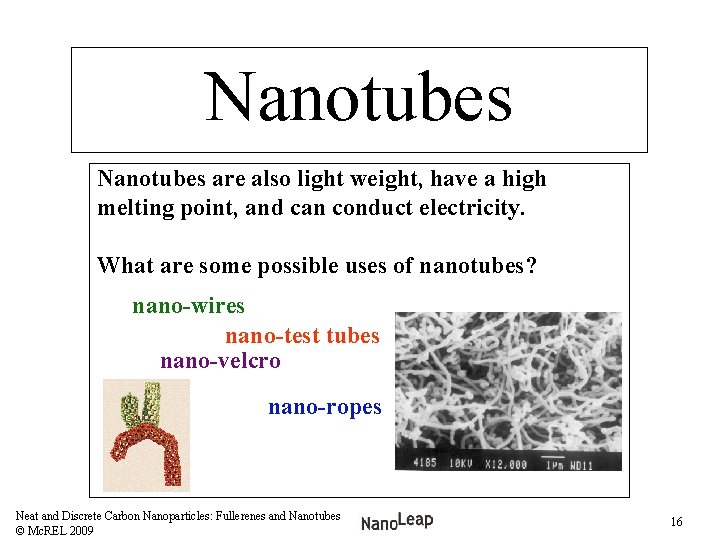
Nanotubes are also light weight, have a high melting point, and can conduct electricity. What are some possible uses of nanotubes? nano-wires nano-test tubes nano-velcro nano-ropes Neat and Discrete Carbon Nanoparticles: Fullerenes and Nanotubes © Mc. REL 2009 16
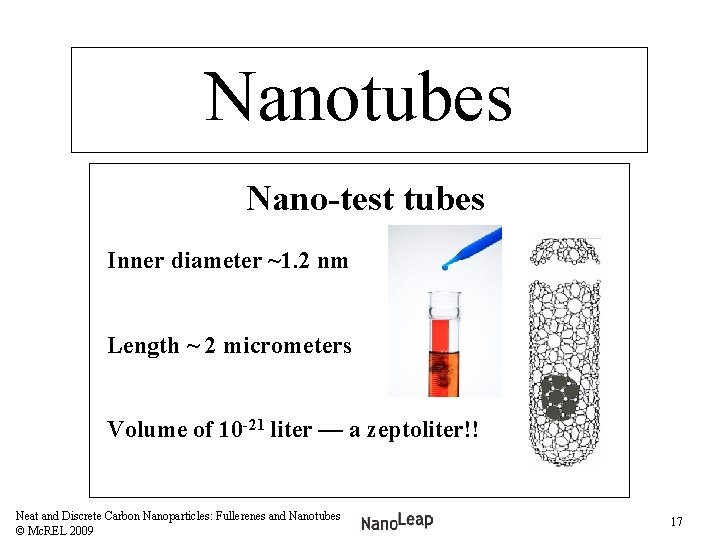
Nanotubes Nano-test tubes Inner diameter ~1. 2 nm Length ~ 2 micrometers Volume of 10 -21 liter — a zeptoliter!! Neat and Discrete Carbon Nanoparticles: Fullerenes and Nanotubes © Mc. REL 2009 17
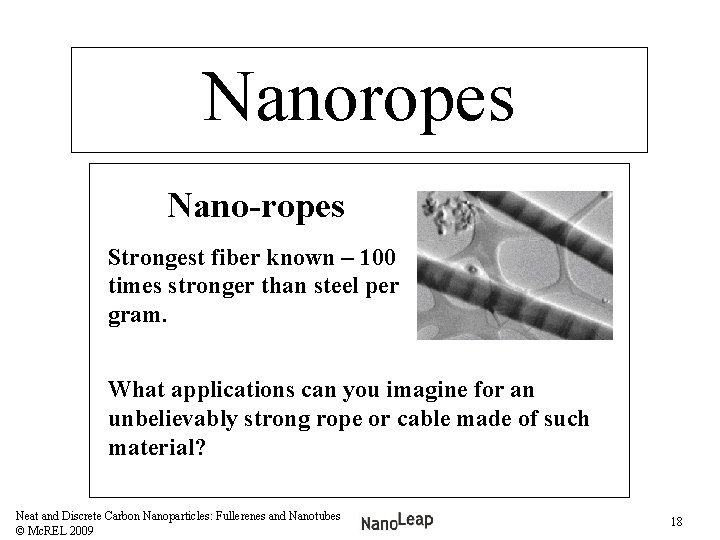
Nanoropes Nano-ropes Strongest fiber known – 100 times stronger than steel per gram. What applications can you imagine for an unbelievably strong rope or cable made of such material? Neat and Discrete Carbon Nanoparticles: Fullerenes and Nanotubes © Mc. REL 2009 18
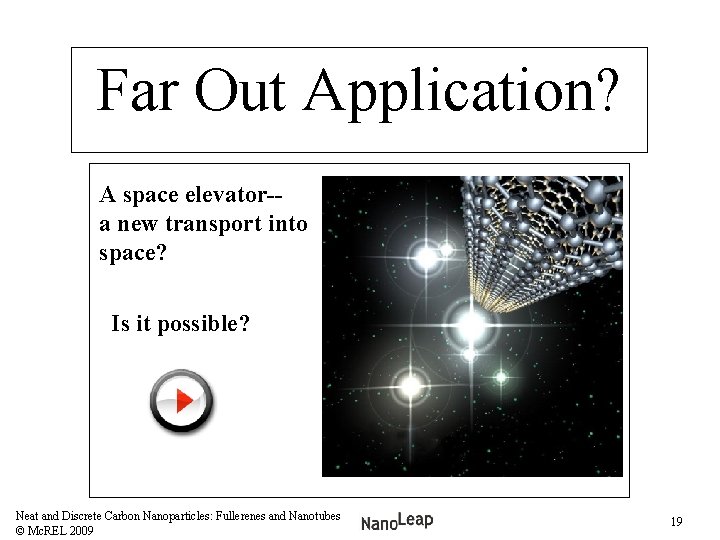
Far Out Application? A space elevator-a new transport into space? Is it possible? Neat and Discrete Carbon Nanoparticles: Fullerenes and Nanotubes © Mc. REL 2009 19
Far Out Application? Some other things to think about: Environmental advantages Lightning hazards Collisions with space junk Radiation damage to the ribbon Is there a limit to how large it can be? How it is initially deployed? Neat and Discrete Carbon Nanoparticles: Fullerenes and Nanotubes © Mc. REL 2009 20
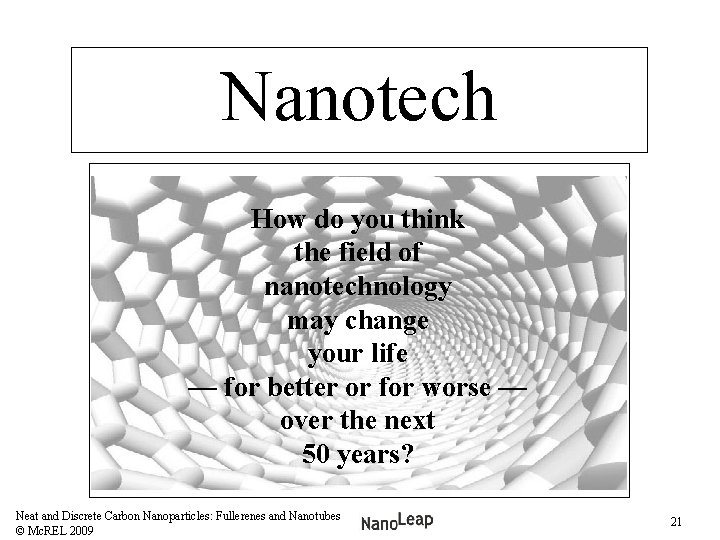
Nanotech How do you think the field of nanotechnology may change your life — for better or for worse — over the next 50 years? Neat and Discrete Carbon Nanoparticles: Fullerenes and Nanotubes © Mc. REL 2009 21
Making Connections 1. Name three carbon allotropes. 2. Compare and contrast cylindrical and spherical fullerenes and their unique characteristics. 3. What are some possible applications of discrete carbon nanoparticles? 4. What are some possible applications of extendable nanoparticles? Neat and Discrete Carbon Nanoparticles: Fullerenes and Nanotubes © Mc. REL 2009 22
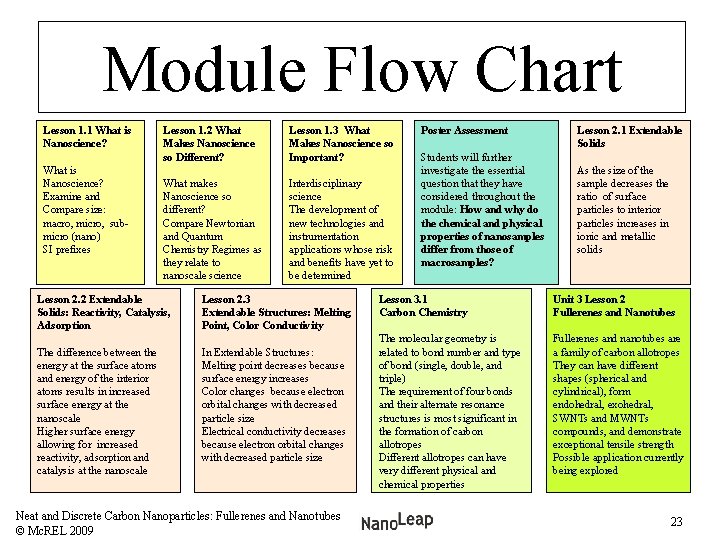
Module Flow Chart Lesson 1. 1 What is Nanoscience? Examine and Compare size: macro, micro, submicro (nano) SI prefixes Lesson 1. 2 What Makes Nanoscience so Different? Lesson 1. 3 What Makes Nanoscience so Important? What makes Nanoscience so different? Compare Newtonian and Quantum Chemistry Regimes as they relate to nanoscale science Interdisciplinary science The development of new technologies and instrumentation applications whose risk and benefits have yet to be determined Lesson 2. 2 Extendable Solids: Reactivity, Catalysis, Adsorption Lesson 2. 3 Extendable Structures: Melting Point, Color Conductivity The difference between the energy at the surface atoms and energy of the interior atoms results in increased surface energy at the nanoscale Higher surface energy allowing for increased reactivity, adsorption and catalysis at the nanoscale In Extendable Structures: Melting point decreases because surface energy increases Color changes because electron orbital changes with decreased particle size Electrical conductivity decreases because electron orbital changes with decreased particle size Neat and Discrete Carbon Nanoparticles: Fullerenes and Nanotubes © Mc. REL 2009 Poster Assessment Students will further investigate the essential question that they have considered throughout the module: How and why do the chemical and physical properties of nanosamples differ from those of macrosamples? Lesson 2. 1 Extendable Solids As the size of the sample decreases the ratio of surface particles to interior particles increases in ionic and metallic solids Lesson 3. 1 Carbon Chemistry Unit 3 Lesson 2 Fullerenes and Nanotubes The molecular geometry is related to bond number and type of bond (single, double, and triple) The requirement of four bonds and their alternate resonance structures is most significant in the formation of carbon allotropes Different allotropes can have very different physical and chemical properties Fullerenes and nanotubes are a family of carbon allotropes They can have different shapes (spherical and cylindrical), form endohedral, exohedral, SWNTs and MWNTs compounds, and demonstrate exceptional tensile strength Possible application currently being explored 23
- Slides: 23