AP Lit Comp 214 18 1 The Revelation
- Slides: 17
AP Lit & Comp 2/14 ‘ 18 1. “The Revelation” 2. Debrief ATOTC essays 3. For next class…
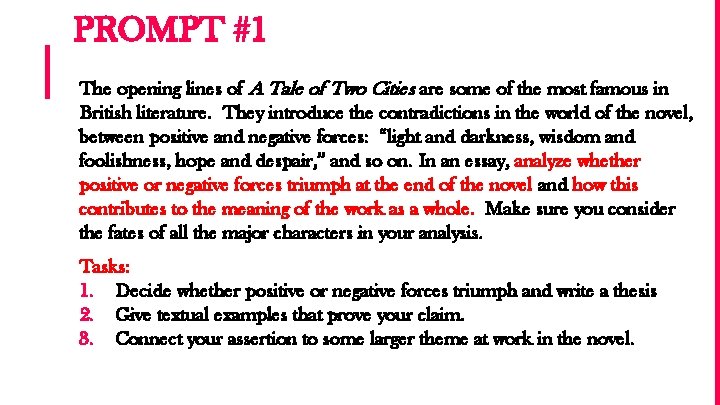
PROMPT #1 The opening lines of A Tale of Two Cities are some of the most famous in British literature. They introduce the contradictions in the world of the novel, between positive and negative forces: “light and darkness, wisdom and foolishness, hope and despair, ” and so on. In an essay, analyze whether positive or negative forces triumph at the end of the novel and how this contributes to the meaning of the work as a whole. Make sure you consider the fates of all the major characters in your analysis. Tasks: 1. Decide whether positive or negative forces triumph and write a thesis 2. Give textual examples that prove your claim. 3. Connect your assertion to some larger theme at work in the novel.
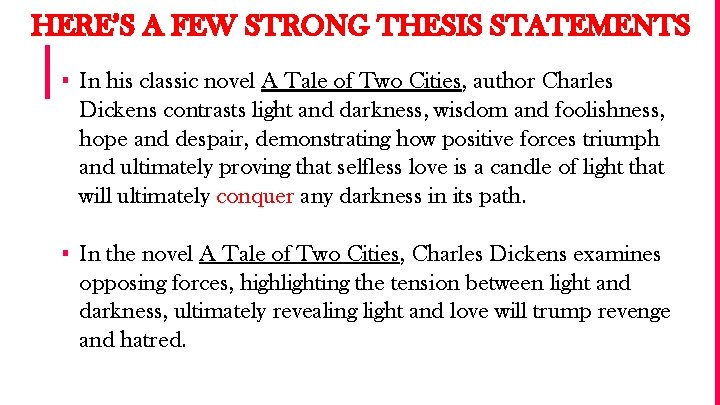
HERE’S A FEW STRONG THESIS STATEMENTS ▪ In his classic novel A Tale of Two Cities, author Charles Dickens contrasts light and darkness, wisdom and foolishness, hope and despair, demonstrating how positive forces triumph and ultimately proving that selfless love is a candle of light that will ultimately conquer any darkness in its path. ▪ In the novel A Tale of Two Cities, Charles Dickens examines opposing forces, highlighting the tension between light and darkness, ultimately revealing light and love will trump revenge and hatred.
SAMPLE BODY PARAGRAPH FOR PROMPT #1 ▪ The revolution depicted in A Tale of Two Cities is anything but light. The streets run red with the blood of both the innocent and the guilty, the citizens of France slowly starve, and desperation forces the populace to commit atrocities. History remembers this time as a bloody and violent mess, and it would be easy for the goodness in Dickens novel to fall prey to the ravaging blackness of violence and despair, yet Dickens chooses to let righteousness triumph over wickedness time and time again. Dr. Manette is imprisoned in the Bastille for helping a young girl who was viciously taken advantage of. In solitary confinement for many years, he loses his mind and sinks into madness that continues to return, even after his release. However, his daughter, Lucie, with her symbolically golden hair, is able to bring him back to life through her tender care. The man that was lost to the bitter violence shown by the Marquis is resurrected through the selfless love of his daughter. Ultimately, light wins as Manette continues to flourish and cherish the good in his life, rather than dwell in the misery of his past.
SAMPLE BODY PARAGRAPH FOR PROMPT #1 ▪ Contrary to Lucie’s light, Dickens highlights the hatred and malice of the revolutionaries, Madame Defarge, and the nobles of the French Revolution. Madame Defarge serves as Lucie’s polar opposite, taking it upon herself to ensure nobles are killed in her quest for revenge against the Evremondes. This stands out as a purely evil act of revenge which ultimately clashes with the love and kindess of Lucie. However, since Defarge’s revenge is based on bloodlust and hatred, there is no room for her redemption, and this leads to her downfall/death. Additionally, the nobles of France heighten this rift between good and evil due to their mistreatment of the peasants. Unlike Lucie, the nobles have no compassion for their actions, ultimately leading to their eventual demise at the hands of the peasants. This lack of compassion from either side (nobles or peasants) strengthens Dickens’s argument of how hatred and revenge will never triumph over light.
PROMPT #2 ▪ Choose a complex and important character in A Tale of Two Cities who might— on the basis of the character’s actions alone—be considered evil or immoral. In a well-organized essay, explain both how and why the full presentation of the character in the work makes the reader react more sympathetically than he otherwise might and how this contributes to the meaning of the work as a whole. Avoid plot summary. ▪ TASKS ▪ 1. Choose a character and construct a thesis that focuses on how the full presentation of the character makes him/her more sympathetic. Connect to theme. ▪ 2. Write a thesis that demonstrates the above. ▪ 3. Use textual examples to show the immoral/evil side of the character versus the more sympathetic version – tie the author’s complex presentation of this character to a significant theme.
PROMPT #3 ▪ In great literature, no scene of violence exists for its own sake. Choose a scene or scenes in A Tale of Two Cities that confronts the reader with violence. In a well-organized essay, explain the significance of your choice and how the scene or scenes contribute to the meaning of the work as a whole. ▪ TASKS ▪ 1. Choose a violent scene or scenes from ATOTC. ▪ 2. Decide what the scene/scenes represent beyond the literal violence itself. ▪ 3. Show this to the reader with specific textual examples ▪ 4. Connect the symbolic/deeper meaning of the scenes to an important theme from the work.
STRONG THESIS FOR PROMPT #3 ▪ In the historical fiction novel A Tale of Two Cities, Charles Dickens highlights a series of violent events inflicted by both the revolutionaries and the aristocracy during the times of the French Revolution, thus expressing to readers the power struggle that occurred during this time between the two groups, ultimately revealing that in trying to attain and maintain power, an individual or group of people become corrupted and take actions otherwise deemed gruesome or evil.
BODY PARAGRAPH FOR PROMPT #3 One example of the violence in the novel that reveals power’s prodding grip on humans is when Charles return to Paris. Worried about him, his wife, Lucie; daughter, little Lucie; and father-in-law, Dr. Manette; follow suit in an effort to find him. When they arrive, they go straight to Jarvis Lorry’s office and their is a scene outside the window. A large flow of revolutionaries in the square in line sharpening the weapons they are using to slaughter their aristocratic enemies on a large grindstone. Dickens does not explicitly explain the violence in this scene but heavily implies it. He explains the prevalence of red spreading all over the sharpening stone and all over the people in the courtyard. Dickens, heavy in his metaphors, eloquently and purposefully leaves out the actual descriptions of the violence to further guide the reader in understanding what this scene symbolizes, which has everything to do with the retaliation tactics of the revolutionaries. While they rightly felt discriminated against, the bloody, continual slaughtering of anyone associated with the aristocracy is unnecessary and gruesome. In this scene, the implied violence of the revolutionaries reveal that in these people trying to attain power over their suppressors, they ultimately fall victim to the morally degrading quicksand that power can suck humans into.
PROMPT #4 ▪ The poet Percy Bysshe Shelley wrote: ▪ “Power like a desolating pestilence, ▪ Pollutes whate’er it touches. ” ▪ Using examples from A Tale of Two Cities as support, you should defend or challenge Shelley’s assertion and explain how this assertion contributes to the meaning of the work as a whole.
THESIS FOR PROMPT #4 ▪ In the novel A Tale of Two Cities, Charles Dickens juxtaposes the corrupted power of the aristocrats and the rising power of the rebellion during the French Revolution, ultimately revealing that one’s moral compass often becomes blurred in the face of power. ▪ There are many positions of power in the our world which provide fuel for a debate: does power corrupt those it is given to? The poet Percy Shelley writes that power pollutes whatever it touches, and Charles Dickens, in A Tale of Two Cities reinforces this point. Dickens weaves a story set in the French Revolution and the subsequent Reign of Terror, ultimately higholighting how even actions taken in good faith can become severely detrimental due to the corrupting nature of power.
THESIS FOR PROMPT #4 ▪ In the writings of Percy Bysshe Shelley, power is described as “a desolating pestilence” that “pollutes whate’er it touches, ” which is defended by the corrupt royalty figures, the vengeful Madame Defarge, and the hungry revolutionaries of Charles Dickens’s A Tale of Two Cities, ultimately supporting that power and revenge are devouring forces that are insatiable once indulged.
BODY PARAGRAPH FOR PROMPT #4 Dickens makes it very clear from the beginning of the novel that the French aristocrats are a group of villians. The reader sees an example of this through the character of the Marquis Evremonde who runs over a small child with his carriage and scorns the common folk who are upset about the death, throwing a coin at them from his carriage as if that will repay the debt. The Marquis regards the working class as no better than dogs, and believes that a single coin can make up for the loss of one of their lives. He has so much power and money that he has lost his humanity and turned greedy and selfish. Later in the novel, the readers sees what the aristocrats are truly capable of as we follow the story of Darnay’s father and uncle working a man to death and forcing him to pull their carriage for not letting them have his wife. They take the wife for their own pleasure anyway and drive her to the point of madness and death. These disgusting and horrible acts commited by men in possession of a great deal of power truly show the depth of the cruelty an excess of power can lead to.
BODY PARAGRAPH FOR PROMPT #4 ▪ Dickens illuminates the abuse of power by the nobility and aristocrats throughout the novel. Early in the story, a scene is depicted where peasants are trying to drink up wine that has spilled in their filthy streets. Meanwhile a French nobleman is being fed chocolate by three of his servants. There are children starving while others are being served delicacies, clearly demonstrating corrupted power and wealth of the aristocrats. Furthermore, Dickens highlights this corrupted abuse of power when the Marquis, a French nobleman, runs over an impoverished child with his carriage. Instead of consoling the dead child’s family and taking personal responsibility, or being held accountable by the court, he merely tosses a few gold coins at the child’s father and inquires about the harm done his horses. Again, power has corrupted the nobility, making them seem superior and above the law. Moreover, Dickens depicts another case where the aristocrats relish in their power to remain above the law. (paragraph continued on next slide. )
BODY PARAGRAPH FOR PROMPT #4 ▪ (Continued from previous slide) ▪ Moreover, Dickens depicts another case where the aristocrats relish in their power to remain above the law. One of the Evremonde brothers, who comes from wealth, kidnaps the wife of a peasant, rapes her, kills her brother, and ultimately is the cause of her death. He recruits Dr. Manette to treat the girl as she was on her deathbed, and vows to seek vengeance on him if he informs anyone of his nefarious and detested actions. When they discover that Dr. Mannete wrote a letter about the case, the Evremondes imprison him for eighteen years in the Bastille. As described, power has corrupted the moral compass of the elite. Children, the starved, and the innocent are all deemed unworthy of their time as the nobles live and prosper above the laws.
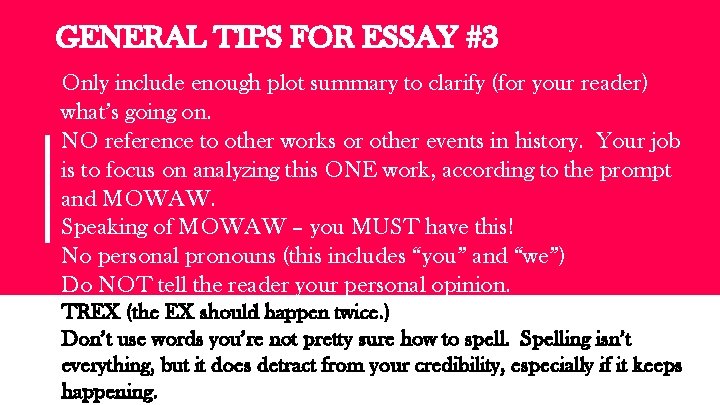
GENERAL TIPS FOR ESSAY #3 Only include enough plot summary to clarify (for your reader) what’s going on. NO reference to other works or other events in history. Your job is to focus on analyzing this ONE work, according to the prompt and MOWAW. Speaking of MOWAW – you MUST have this! No personal pronouns (this includes “you” and “we”) Do NOT tell the reader your personal opinion. TREX (the EX should happen twice. ) Don’t use words you’re not pretty sure how to spell. Spelling isn’t everything, but it does detract from your credibility, especially if it keeps happening.
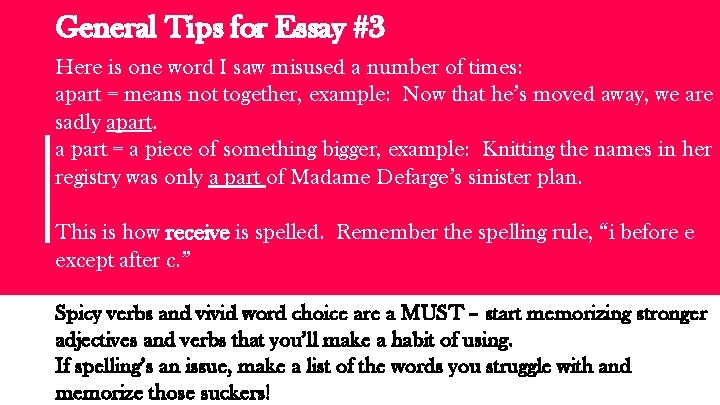
General Tips for Essay #3 Here is one word I saw misused a number of times: apart = means not together, example: Now that he’s moved away, we are sadly apart. a part = a piece of something bigger, example: Knitting the names in her registry was only a part of Madame Defarge’s sinister plan. This is how receive is spelled. Remember the spelling rule, “i before e except after c. ” Spicy verbs and vivid word choice are a MUST – start memorizing stronger adjectives and verbs that you’ll make a habit of using. If spelling’s an issue, make a list of the words you struggle with and memorize those suckers!