
PHYS 214 The Nature of Physics Spring 2018

- Slides: 27
PHYS 214: The Nature of Physics, Spring 2018 Instructor: • Prof. Wei Xie • Office: Room: 254, Physics Building • Phone: 765 -494 -8743 • Email: wxie@purdue. edu • Website: http: //www. physics. purdue. edu/people/faculty/wxie. shtml Lecture: • Monday, Wednesday and Friday: 08: 30 -09: 20 am. • Room 114, Physics Building • please read the textbook before the corresponding lecture according to the Class Schedule at the end of the syllabus. • one pre-lecture quiz before each lecture most of the time. • quizzes during every class using the i. Clicker starting from the second week. • purchase an Iclicker from the bookstore. • register your Iclicker serial number (clicker ID) in the student grade book on CHIP (NOT the Iclicker Web site). 1/7/2011 1
Homework and Pre-lecture Quizzes through CHIP • All homework assignments and pre-lecture quizzes are to be worked on and submitted using the Computerized Homework in Physics (CHIP) system. http: //chip. physics. purdue. edu/public/214/spring 2020/ • The first time you log on to CHIP this semester using your career account username and password, immediately do two things: • Register your i. Clicker for this course (even if you registered it for another course), • Open and read the on-line Instructions link at http: //chip. physics. purdue. edu/public/stu/handout. pdf http: //chip. physics. purdue. edu/public/instruct. html • You must sign on to CHIP using your userid and password to find out which problems are assigned to you. • Each correct response submitted before the primary deadline and within the allowed attempt number limits will receive 100% credit. No credit is given after that. Attempt number limit for numerical problems is 5 tries. Past the attempt number limits, you will receive no credits. 1/7/2011 2
• Opening the Pre-Lecture Quiz immediately begins the count-down 5 minute clock. Once you start the clock, you must finish the Quiz in one sitting. • If you have medical or other emergencies and wish to request special excuses for submitting CHIP homework late, you need to contact me. I can set up a grace period for you for particular assignments. • All the questions related to CHIP should be sent to wxie@purdue. edu. Getting Help from Office Hours • discussing with your classmate on homework and quizzes are strongly encouraged. Study group is a good way to go. • One TA in the help center room 290. o Wed. : 10: 30 am - 12: 00 pm o Fri. : 10: 30 am - 12: 00 pm • You can also get help from me through office hours. The preferred way of communication with me is Email. I have an open-door policy where you may visit me at any time. I will also be available by appointment. 1/7/2011 3
Exams • Midterm Exam : Wednesday 03/11, 8: 30 am-9: 20 am in room 114 (covers Chap. 1 - 9), unless noted otherwise. • Final Exam: to be announced. • If you have a conflict or are sick, you must contact me as soon as possible before the exam. Generally, you should not assume that a make-up exam will be given and unexcused absences will be scored as zero. All exams are closed book. All formulas you may need are provided in the exams themselves. • If you have official university permission to obtain special arrangement for an exam (such as extended time), please contact me well before the scheduled exam date so that proper arrangements can be made. 1/7/2011 4
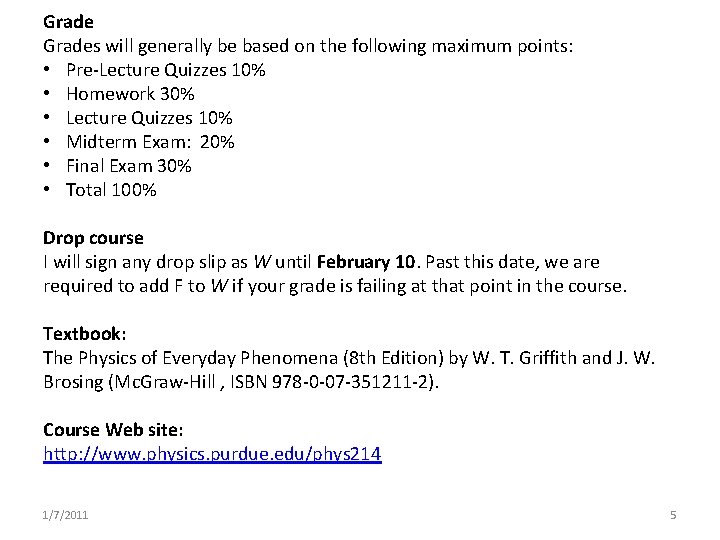
Grades will generally be based on the following maximum points: • Pre-Lecture Quizzes 10% • Homework 30% • Lecture Quizzes 10% • Midterm Exam: 20% • Final Exam 30% • Total 100% Drop course I will sign any drop slip as W until February 10. Past this date, we are required to add F to W if your grade is failing at that point in the course. Textbook: The Physics of Everyday Phenomena (8 th Edition) by W. T. Griffith and J. W. Brosing (Mc. Graw-Hill , ISBN 978 -0 -07 -351211 -2). Course Web site: http: //www. physics. purdue. edu/phys 214 1/7/2011 5
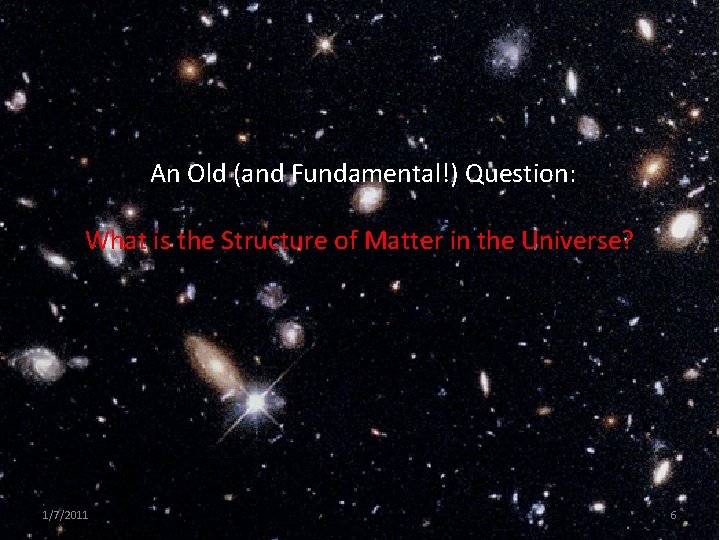
An Old (and Fundamental!) Question: What is the Structure of Matter in the Universe? 1/7/2011 6
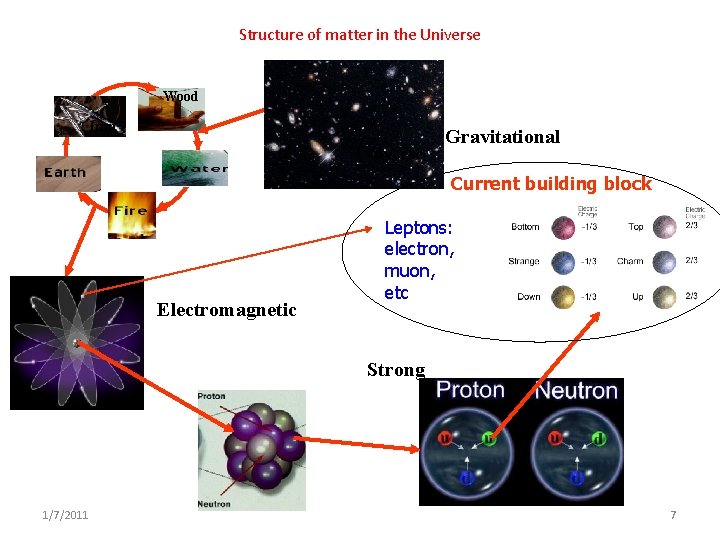
Structure of matter in the Universe Wood Huge scale Iron Universe Gravitational Current building block scale ~ 10 -10 m Electromagnetic Leptons: electron, muon, etc scale ~ 10 -15 m Strong 1/7/2011 7
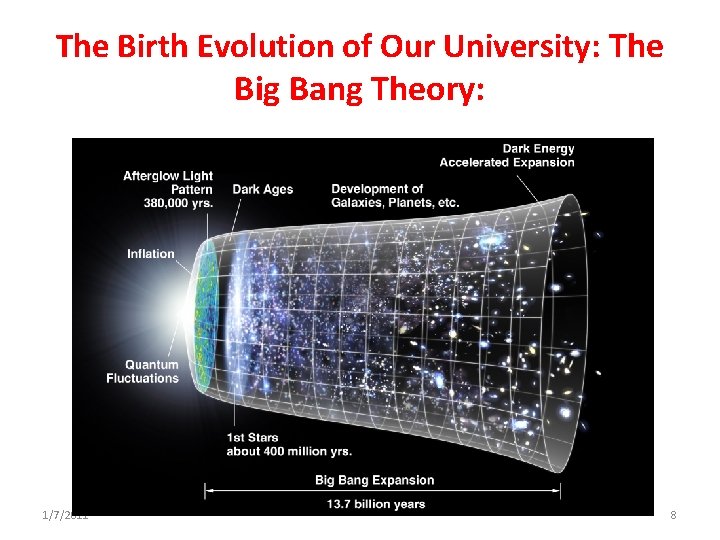
The Birth Evolution of Our University: The Big Bang Theory: 1/7/2011 8
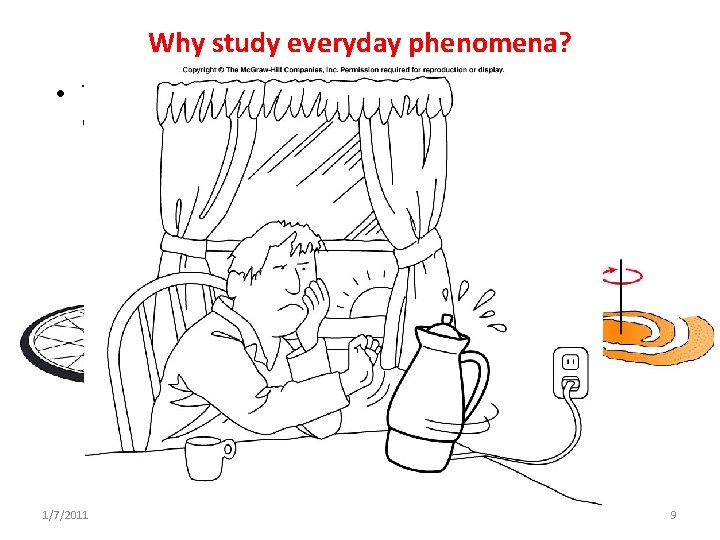
Why study everyday phenomena? • The same physical principles that govern our everyday experiences also govern the entire universe – A bicycle wheel, an atom, and a galaxy all operate according to laws for angular momentum. 1/7/2011 9
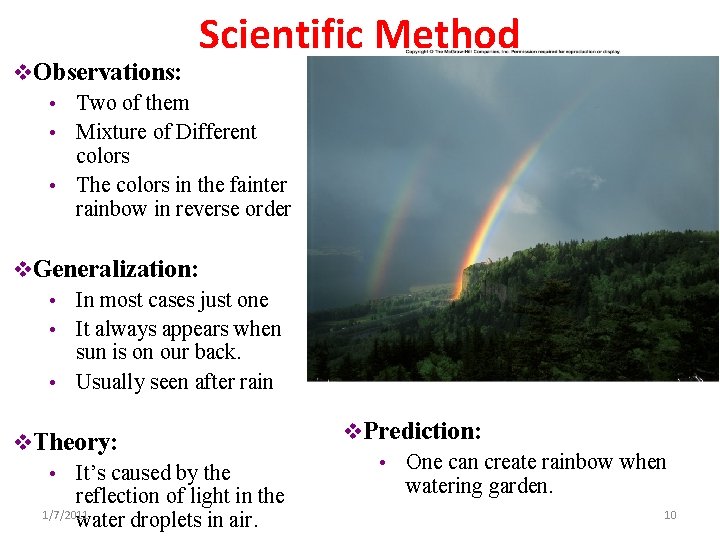
Scientific Method v. Observations: • Two of them • Mixture of Different colors • The colors in the fainter rainbow in reverse order v. Generalization: • In most cases just one • It always appears when sun is on our back. • Usually seen after rain v. Theory: • It’s caused by the reflection of light in the 1/7/2011 water droplets in air. v. Prediction: • One can create rainbow when watering garden. 10
1/7/2011 11
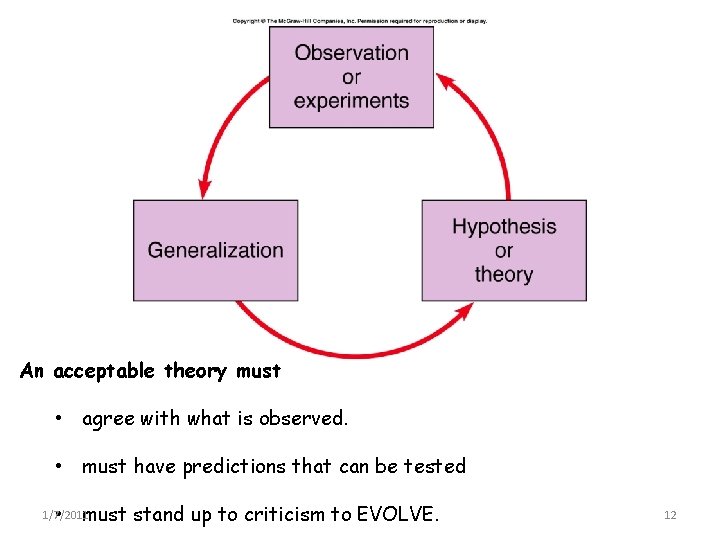
An acceptable theory must • agree with what is observed. • must have predictions that can be tested • must stand up to criticism to EVOLVE. 1/7/2011 12
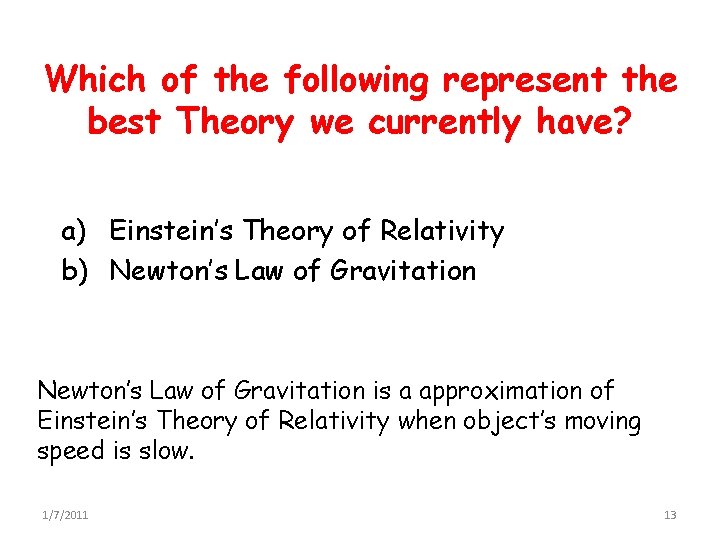
Which of the following represent the best Theory we currently have? a) Einstein’s Theory of Relativity b) Newton’s Law of Gravitation is a approximation of Einstein’s Theory of Relativity when object’s moving speed is slow. 1/7/2011 13
Scope of Physics • The study of the basic nature of matter • The most fundamental science – Explains fundamental interactions of chemistry, biology, etc. at the atomic or molecular level • The most quantitative science – Heavy use of mathematics – Numerical measurements • Can be described more simply and cleanly than other sciences • NOT just a collection of facts to memorize! 1/7/2011 14
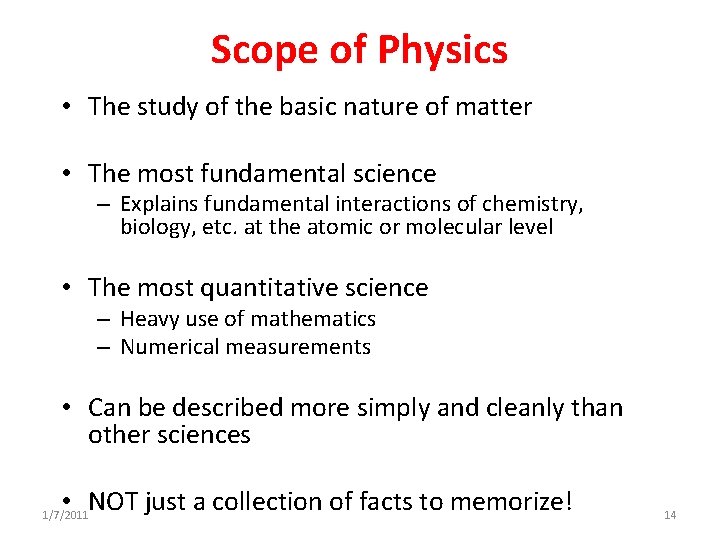
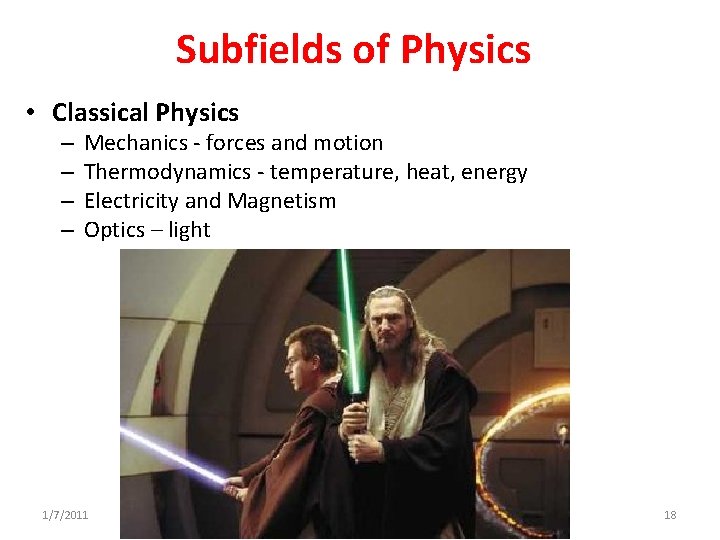
Subfields of Physics • Classical Physics – Mechanics - forces and motion 1/7/2011 15
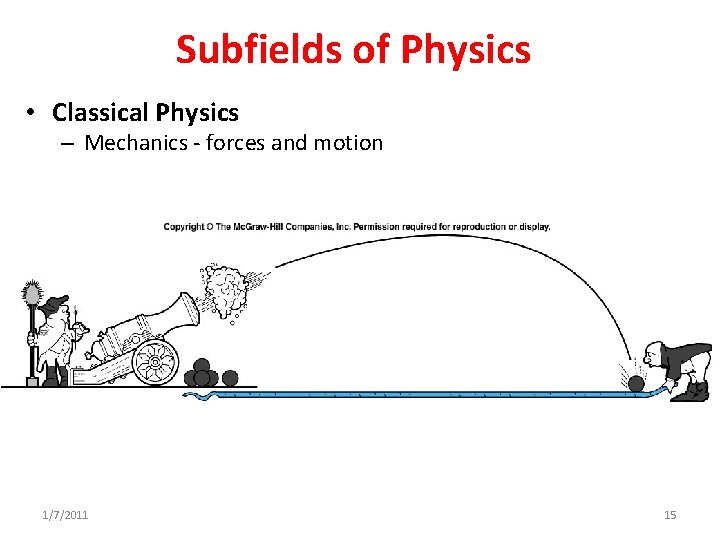
Subfields of Physics • Classical Physics – Mechanics - forces and motion – Thermodynamics - temperature, heat, energy 1/7/2011 16
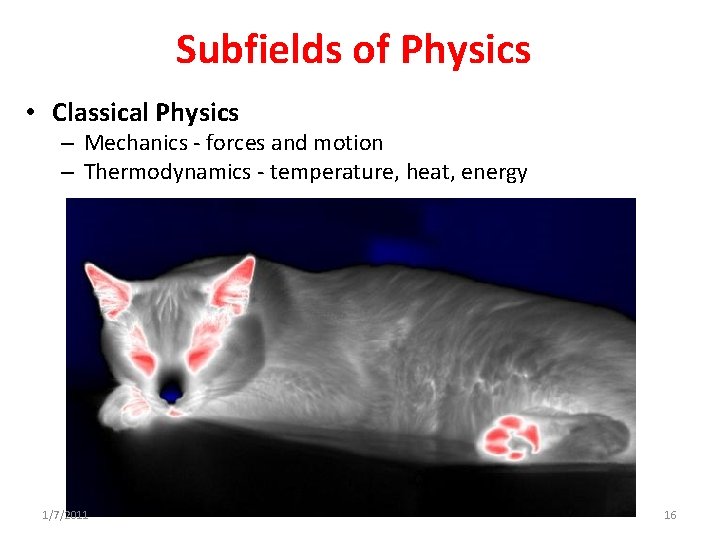
Subfields of Physics • Classical Physics – Mechanics - forces and motion – Thermodynamics - temperature, heat, energy – Electricity and Magnetism 1/7/2011 17
Subfields of Physics • Classical Physics – – Mechanics - forces and motion Thermodynamics - temperature, heat, energy Electricity and Magnetism Optics – light 1/7/2011 18
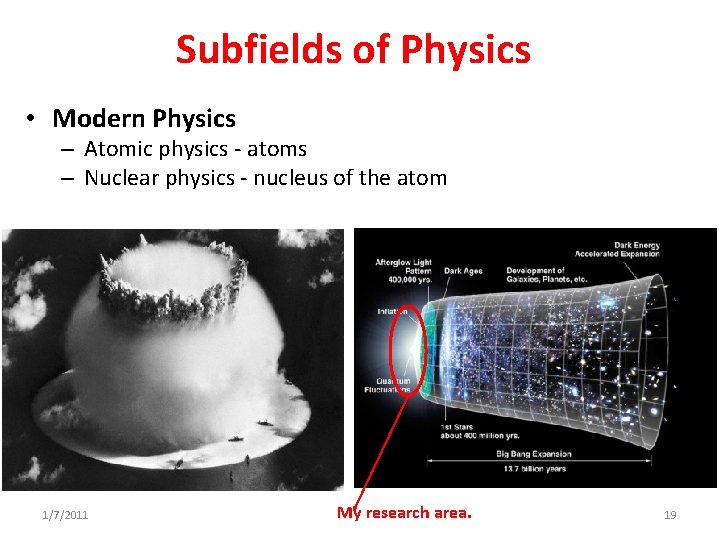
Subfields of Physics • Modern Physics – Atomic physics - atoms – Nuclear physics - nucleus of the atom 1/7/2011 My research area. 19
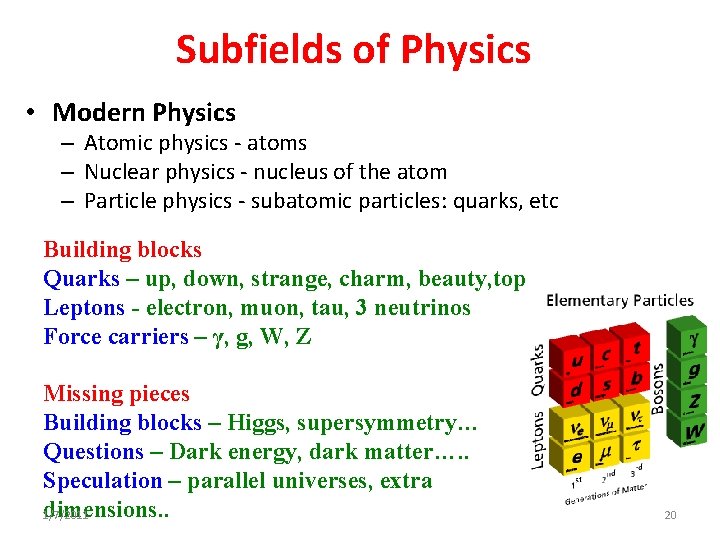
Subfields of Physics • Modern Physics – Atomic physics - atoms – Nuclear physics - nucleus of the atom – Particle physics - subatomic particles: quarks, etc Building blocks Quarks – up, down, strange, charm, beauty, top Leptons - electron, muon, tau, 3 neutrinos Force carriers – γ, g, W, Z Missing pieces Building blocks – Higgs, supersymmetry… Questions – Dark energy, dark matter…. . Speculation – parallel universes, extra dimensions. . 1/7/2011 20
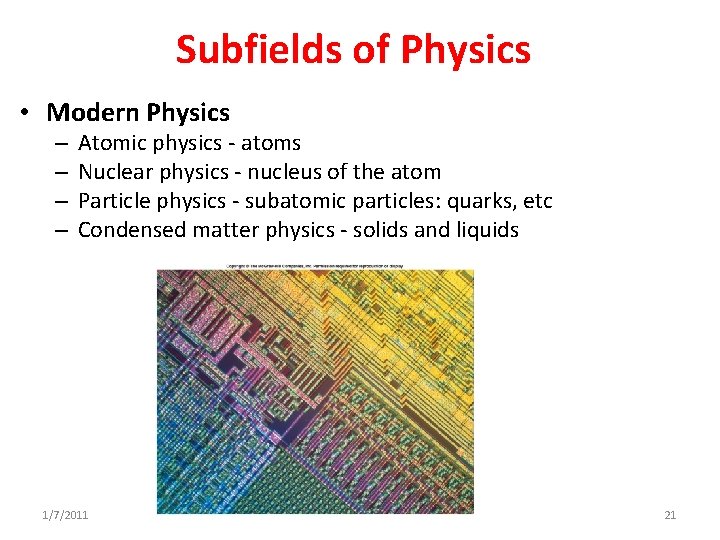
Subfields of Physics • Modern Physics – – Atomic physics - atoms Nuclear physics - nucleus of the atom Particle physics - subatomic particles: quarks, etc Condensed matter physics - solids and liquids 1/7/2011 21
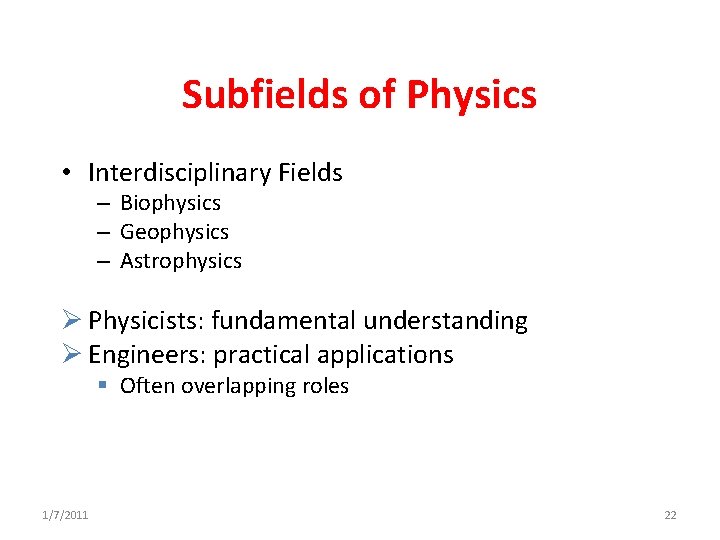
Subfields of Physics • Interdisciplinary Fields – Biophysics – Geophysics – Astrophysics Ø Physicists: fundamental understanding Ø Engineers: practical applications § Often overlapping roles 1/7/2011 22
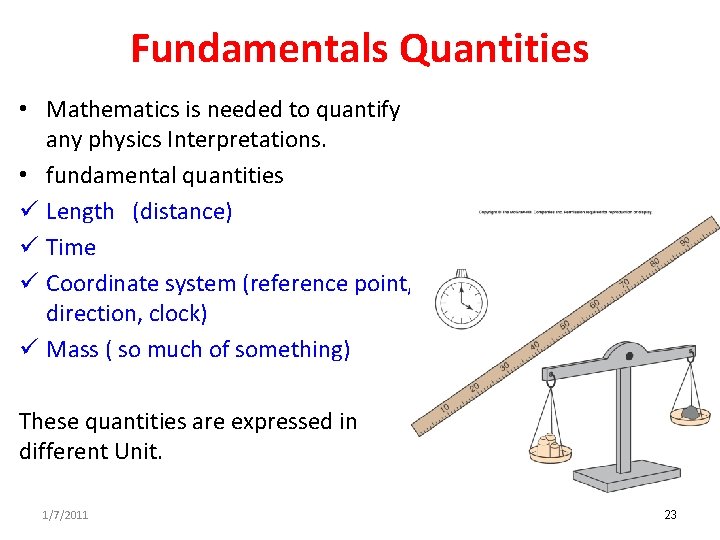
Fundamentals Quantities • Mathematics is needed to quantify any physics Interpretations. • fundamental quantities ü Length (distance) ü Time ü Coordinate system (reference point, direction, clock) ü Mass ( so much of something) These quantities are expressed in different Unit. 1/7/2011 23
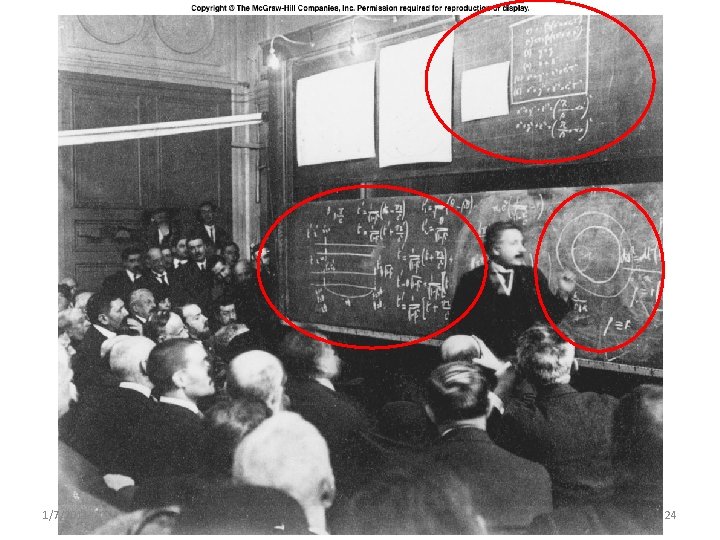
Fig. 1. 2 1/7/2011 24
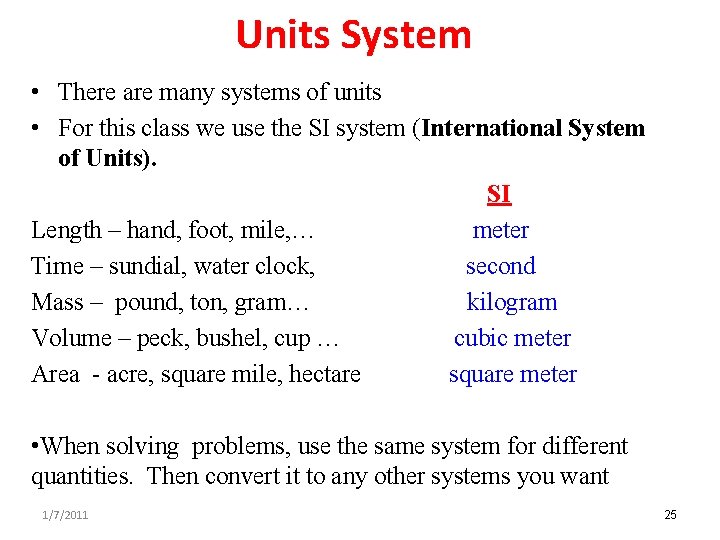
Units System • There are many systems of units • For this class we use the SI system (International System of Units). SI Length – hand, foot, mile, … meter Time – sundial, water clock, second Mass – pound, ton, gram… kilogram Volume – peck, bushel, cup … cubic meter Area - acre, square mile, hectare square meter • When solving problems, use the same system for different quantities. Then convert it to any other systems you want 1/7/2011 25
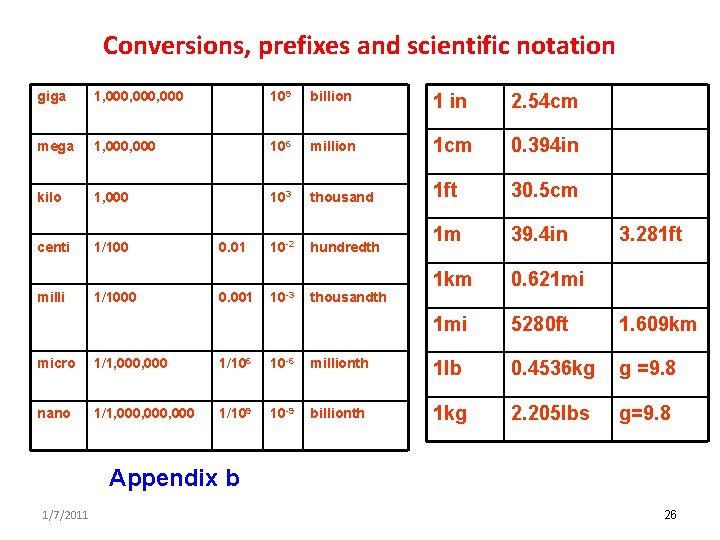
Conversions, prefixes and scientific notation giga 1, 000, 000 109 billion 1 in 2. 54 cm mega 1, 000 106 million 1 cm 0. 394 in kilo 1, 000 103 thousand 1 ft 30. 5 cm centi 1/100 0. 01 10 -2 hundredth 1 m 39. 4 in 0. 001 10 -3 1 km 0. 621 mi 5280 ft 1. 609 km milli 1/1000 thousandth 3. 281 ft micro 1/1, 000 1/106 10 -6 millionth 1 lb 0. 4536 kg g =9. 8 nano 1/1, 000, 000 1/109 10 -9 billionth 1 kg 2. 205 lbs g=9. 8 Appendix b 1/7/2011 26
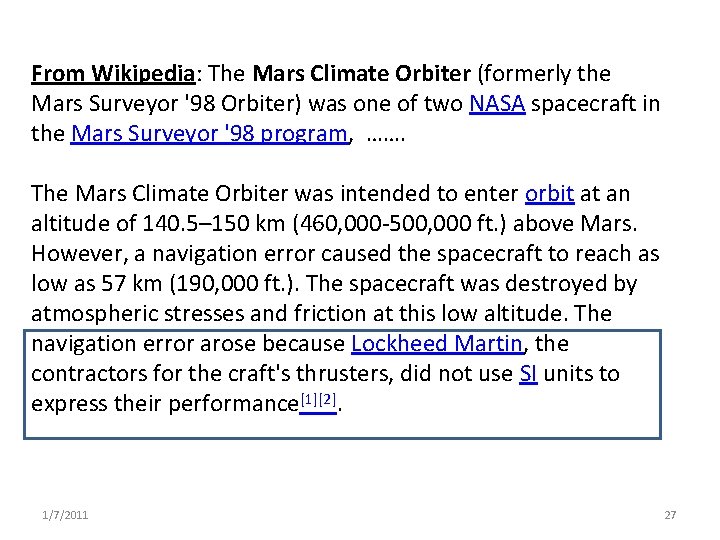
From Wikipedia: The Mars Climate Orbiter (formerly the Mars Surveyor '98 Orbiter) was one of two NASA spacecraft in the Mars Surveyor '98 program, ……. The Mars Climate Orbiter was intended to enter orbit at an altitude of 140. 5– 150 km (460, 000 -500, 000 ft. ) above Mars. However, a navigation error caused the spacecraft to reach as low as 57 km (190, 000 ft. ). The spacecraft was destroyed by atmospheric stresses and friction at this low altitude. The navigation error arose because Lockheed Martin, the contractors for the craft's thrusters, did not use SI units to express their performance[1][2]. 1/7/2011 27