Antepartum Hemorrhage I Placenta Previa Prof Aly Kholeif
- Slides: 12
Antepartum Hemorrhage I. Placenta Previa Prof Aly Kholeif
Ø Definition of antepartum hemorrhage Ø Obstetrical hemorrhage and Maternal mortality: q Direct causes: 66% Obstetrical hemorrhage is the most important q Indirect causes: 34% Ø Etiological classification of antepartum hge: 1. Placenta previa 2. Placental abruption 3. Others: e. g vasa previa
I. Placenta Previa § Definition: The placenta is implanted partially or totally in the lower uterine segment § Incidence: 20 -40 % of antepartum hemorrhage. It’s increasing due to the marked increase of CS § Risk factors: 1. Age of the patient 2. Parity 3. Previous operations e. g CS 4. Large sized placenta 5. Placental abnormalities e. g Accessory placenta
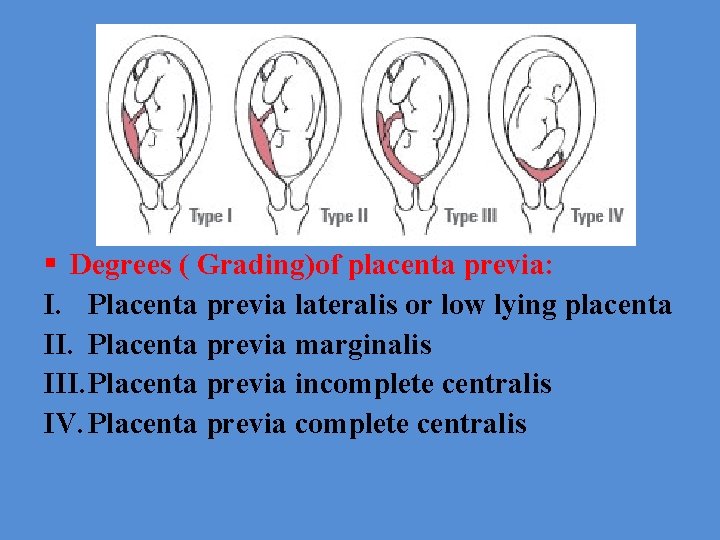
§ Degrees ( Grading)of placenta previa: I. Placenta previa lateralis or low lying placenta II. Placenta previa marginalis III. Placenta previa incomplete centralis IV. Placenta previa complete centralis
• Another Classification of Placenta Previa: I. Major: Placenta previa covering the internal cervical os completely or incompletely II. Minor: Placenta previa away from the internal os
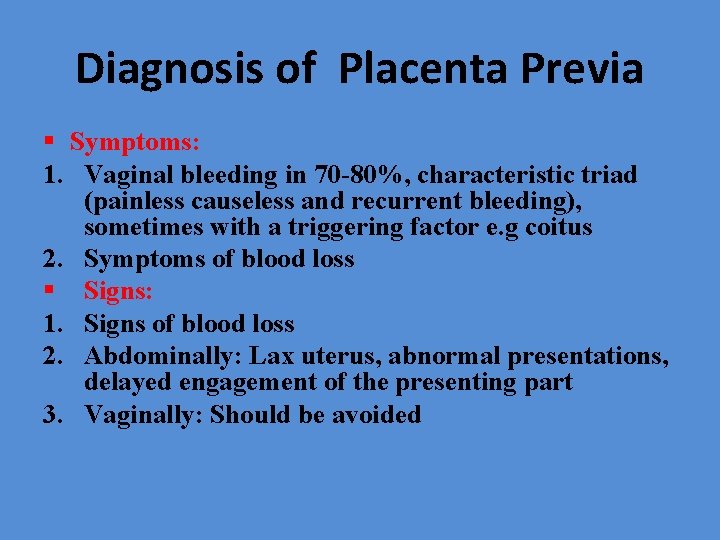
Diagnosis of Placenta Previa § Symptoms: 1. Vaginal bleeding in 70 -80%, characteristic triad (painless causeless and recurrent bleeding), sometimes with a triggering factor e. g coitus 2. Symptoms of blood loss § Signs: 1. Signs of blood loss 2. Abdominally: Lax uterus, abnormal presentations, delayed engagement of the presenting part 3. Vaginally: Should be avoided
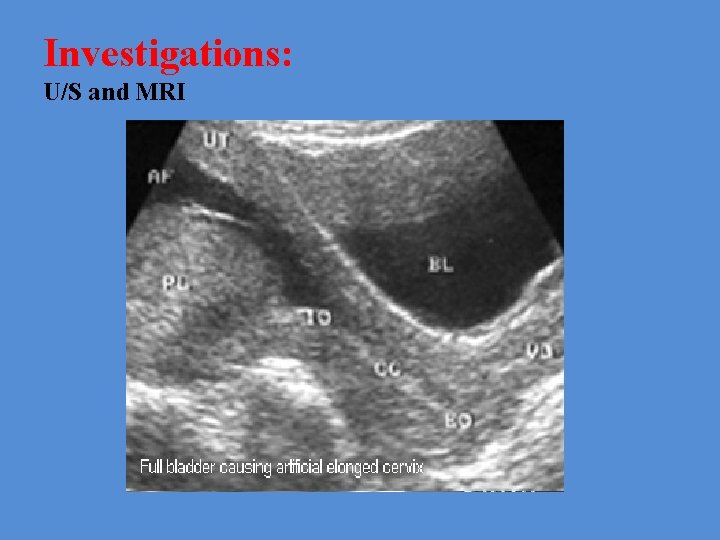
Investigations: U/S and MRI
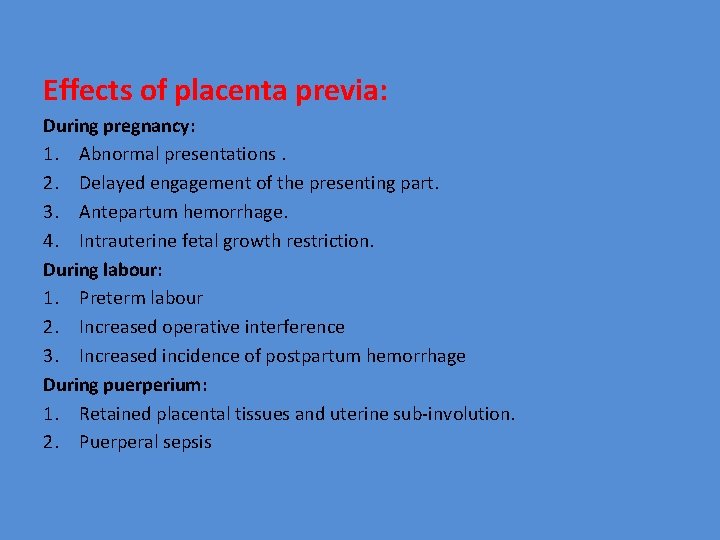
Effects of placenta previa: During pregnancy: 1. Abnormal presentations. 2. Delayed engagement of the presenting part. 3. Antepartum hemorrhage. 4. Intrauterine fetal growth restriction. During labour: 1. Preterm labour 2. Increased operative interference 3. Increased incidence of postpartum hemorrhage During puerperium: 1. Retained placental tissues and uterine sub-involution. 2. Puerperal sepsis
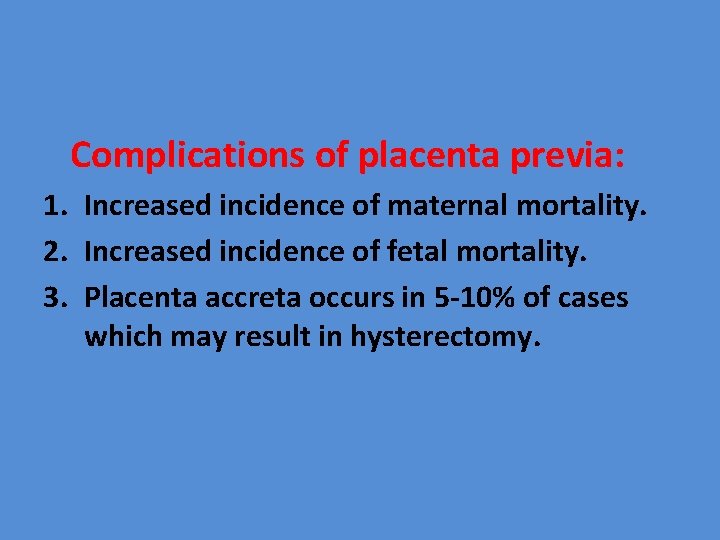
Complications of placenta previa: 1. Increased incidence of maternal mortality. 2. Increased incidence of fetal mortality. 3. Placenta accreta occurs in 5 -10% of cases which may result in hysterectomy.
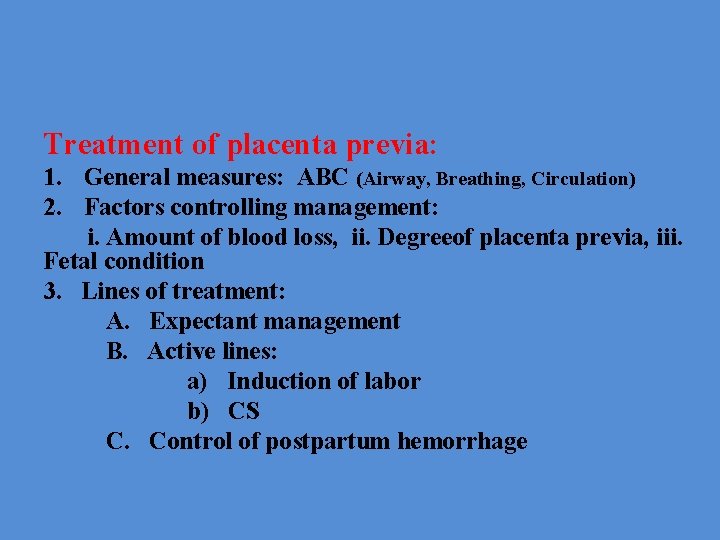
Treatment of placenta previa: 1. General measures: ABC (Airway, Breathing, Circulation) 2. Factors controlling management: i. Amount of blood loss, ii. Degreeof placenta previa, iii. Fetal condition 3. Lines of treatment: A. Expectant management B. Active lines: a) Induction of labor b) CS C. Control of postpartum hemorrhage
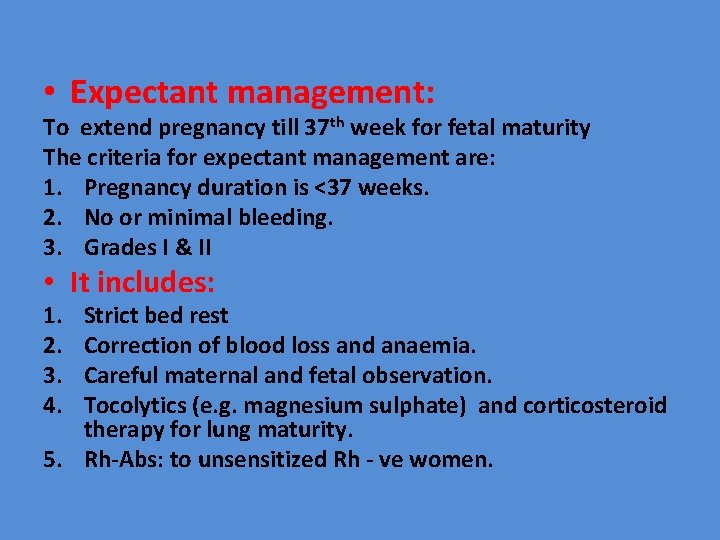
• Expectant management: To extend pregnancy till 37 th week for fetal maturity The criteria for expectant management are: 1. Pregnancy duration is <37 weeks. 2. No or minimal bleeding. 3. Grades I & II • It includes: 1. 2. 3. 4. Strict bed rest Correction of blood loss and anaemia. Careful maternal and fetal observation. Tocolytics (e. g. magnesium sulphate) and corticosteroid therapy for lung maturity. 5. Rh-Abs: to unsensitized Rh - ve women.
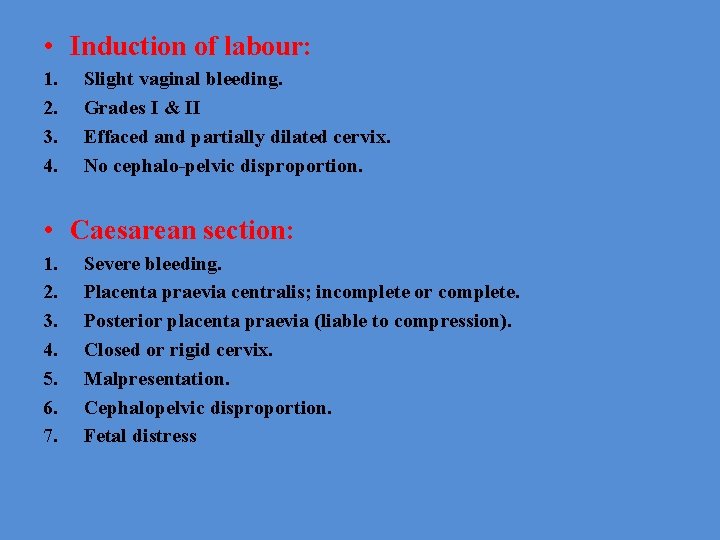
• Induction of labour: 1. 2. 3. 4. Slight vaginal bleeding. Grades I & II Effaced and partially dilated cervix. No cephalo-pelvic disproportion. • Caesarean section: 1. 2. 3. 4. 5. 6. 7. Severe bleeding. Placenta praevia centralis; incomplete or complete. Posterior placenta praevia (liable to compression). Closed or rigid cervix. Malpresentation. Cephalopelvic disproportion. Fetal distress