Andrey Zinchenko Joint Institute for Nuclear Research on
- Slides: 13
Andrey Zinchenko – Joint Institute for Nuclear Research on behalf of the NA 48/2 Collaboration (email: Andrei. Zinchenko@cern. ch) Outline: ● The NA 48/2 experiment ● Theoretical Motivations ● Search for LNV K± → π∓µ±µ± decay – Majorana neutrinos ● Search for resonances in K± → π±µ+µ– decays ● Prospects for the NA 62 experiment The 14 th International Conference on Meson Nucleon Physics and the Structure of the Nucleon July 25 30, 2016 in Kyoto, Japan
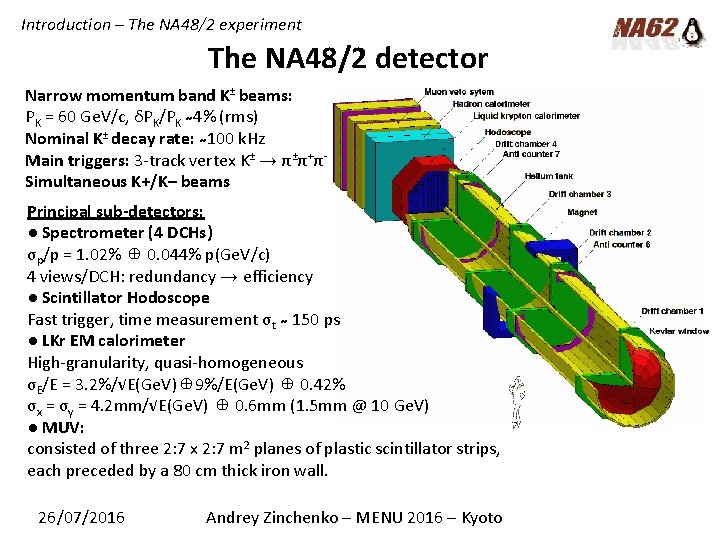
Introduction – The NA 48/2 experiment The NA 48/2 detector Narrow momentum band K± beams: PK = 60 Ge. V/c, δPK/PK 4% (rms) Nominal K± decay rate: 100 k. Hz Main triggers: 3 track vertex K± → π±π+π Simultaneous K+/K– beams Principal sub-detectors: ● Spectrometer (4 DCHs) σp/p = 1. 02% ⊕ 0. 044% p(Ge. V/c) 4 views/DCH: redundancy → efficiency ● Scintillator Hodoscope Fast trigger, time measurement σt 150 ps ● LKr EM calorimeter High granularity, quasi homogeneous σE/E = 3. 2%/√E(Ge. V)⊕ 9%/E(Ge. V) ⊕ 0. 42% σx = σy = 4. 2 mm/√E(Ge. V) ⊕ 0. 6 mm (1. 5 mm @ 10 Ge. V) ● MUV: consisted of three 2: 7 x 2: 7 m 2 planes of plastic scintillator strips, each preceded by a 80 cm thick iron wall. 26/07/2016 Andrey Zinchenko – MENU 2016 – Kyoto
Theoretical Motivations Majorana Neutrinos Asaka. Shaposhnikov model (νMSM) [Asaka and Shaposhnikov, PLB 620 (2005) 17]: Dark Matter + Baryon Asymmetry of the Universe (BAU) + low mass of SM ν can be explained by adding three sterile Majorana neutrinos Ni to the SM ● N 1 is the lightest O(ke. V) → Dark Matter candidate ● N 2, N 3 are nearly degenerate (100 Me. V to few Ge. V) to tune CPV phases and extra CKM sources of baryon asymmetry. N 2, N 3 produce standard neutrino masses through seesaw with a Yukawa coupling of ~ 10 8 Activesterile neutrino mixing (U matrix): Effective vertices involving the sterile neutrinos Ni, the W±, Z bosons and SM leptons BR(K± → µ±N 4) x BR(N 4 → π∓µ±) ~ |Uµ 4|4 Inflatons Shaposhnikov-Tkachev model [Shaposhnikov and Tkachev, PLB 639 (2006) 414]: νMSM + a real scalar field (inflaton χ) with scale invariant couplings Explains Universe homogeneity and isotropy on large scales/structures on smaller scales ● χ Higgs mixing with mixing angle θ χ in Kaon decays [mχ < 354 Me. V/c 2] ● χ Higgs coupling → Universe reheating ● χ is unstable: τ ~ (10 8 10 12) s 26/07/2016 Andrey Zinchenko – MENU 2016 – Kyoto
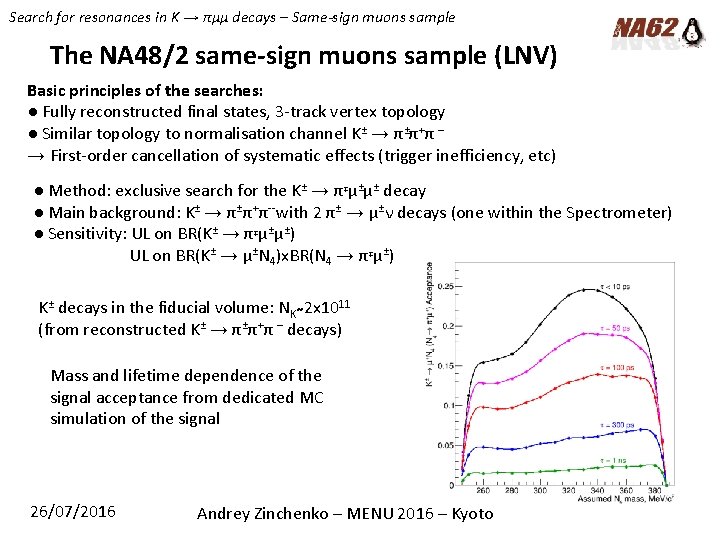
Search for resonances in K → πµµ decays – Same-sign muons sample The NA 48/2 same-sign muons sample (LNV) Basic principles of the searches: ● Fully reconstructed final states, 3 track vertex topology ● Similar topology to normalisation channel K± → π±π+π ‒ → First order cancellation of systematic effects (trigger inefficiency, etc) ● Method: exclusive search for the K± → π∓µ±µ± decay ● Main background: K± → π±π+π with 2 π± → µ±ν decays (one within the Spectrometer) ● Sensitivity: UL on BR(K± → π∓µ±µ±) UL on BR(K± → µ±N 4)x. BR(N 4 → π∓µ±) K± decays in the fiducial volume: NK 2 x 10¹¹ (from reconstructed K± → π±π+π ‒ decays) Mass and lifetime dependence of the signal acceptance from dedicated MC simulation of the signal 26/07/2016 Andrey Zinchenko – MENU 2016 – Kyoto
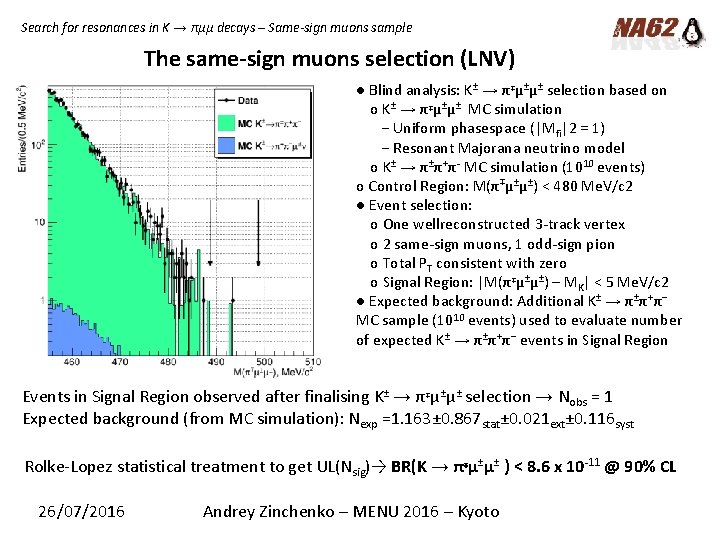
Search for resonances in K → πµµ decays – Same-sign muons sample The same-sign muons selection (LNV) ● Blind analysis: K± → π∓µ±µ± selection based on o K± → π∓µ±µ± MC simulation − Uniform phasespace (|Mfi|2 = 1) − Resonant Majorana neutrino model o K± → π±π+π MC simulation (1010 events) o Control Region: M(π∓µ±µ±) < 480 Me. V/c 2 ● Event selection: o One wellreconstructed 3 track vertex o 2 same sign muons, 1 odd sign pion o Total PT consistent with zero o Signal Region: |M(π∓µ±µ±) – MK| < 5 Me. V/c 2 ● Expected background: Additional K± → π±π+π‒ MC sample (1010 events) used to evaluate number of expected K± → π±π+π‒ events in Signal Region Events in Signal Region observed after finalising K± → π∓µ±µ± selection → Nobs = 1 Expected background (from MC simulation): Nexp =1. 163± 0. 867 stat± 0. 021 ext± 0. 116 syst Rolke Lopez statistical treatment to get UL(Nsig)→ BR(K → π∓µ±µ± ) < 8. 6 x 10 -11 @ 90% CL 26/07/2016 Andrey Zinchenko – MENU 2016 – Kyoto
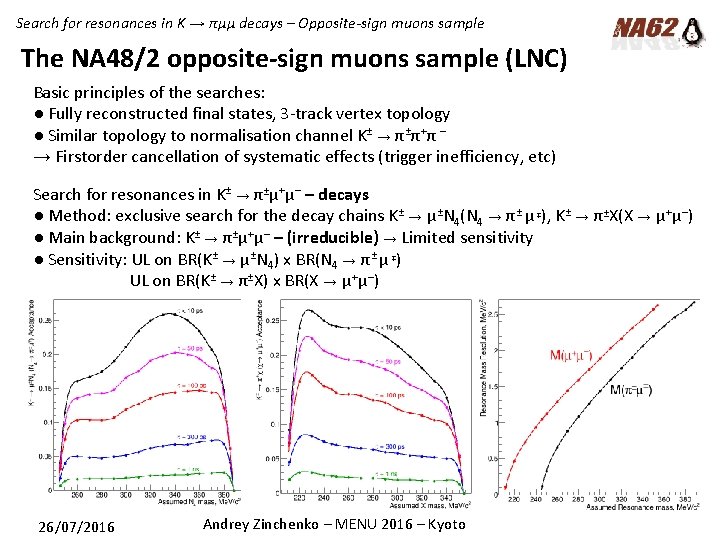
Search for resonances in K → πµµ decays – Opposite-sign muons sample The NA 48/2 opposite-sign muons sample (LNC) Basic principles of the searches: ● Fully reconstructed final states, 3 track vertex topology ● Similar topology to normalisation channel K± → π±π+π ‒ → Firstorder cancellation of systematic effects (trigger inefficiency, etc) Search for resonances in K± → π±µ+µ‒ – decays ● Method: exclusive search for the decay chains K± → µ±N 4(N 4 → π± µ ∓), K± → π±X(X → µ+µ‒) ● Main background: K± → π±µ+µ‒ – (irreducible) → Limited sensitivity ● Sensitivity: UL on BR(K± → µ±N 4) x BR(N 4 → π± µ ∓) UL on BR(K± → π±X) x BR(X → µ+µ‒) 26/07/2016 Andrey Zinchenko – MENU 2016 – Kyoto
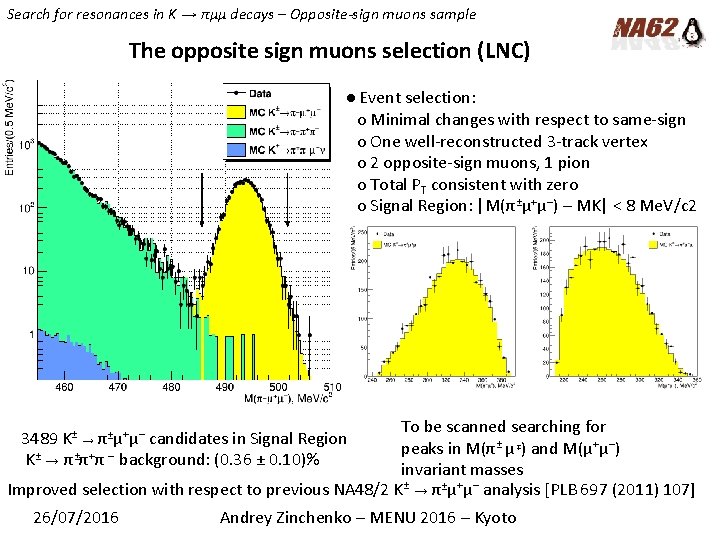
Search for resonances in K → πµµ decays – Opposite-sign muons sample The opposite sign muons selection (LNC) ● Event selection: o Minimal changes with respect to same sign o One well reconstructed 3 track vertex o 2 opposite sign muons, 1 pion o Total PT consistent with zero o Signal Region: |M(π±µ+µ‒) – MK| < 8 Me. V/c 2 To be scanned searching for peaks in M(π± µ ∓) and M(µ+µ‒) invariant masses Improved selection with respect to previous NA 48/2 K± → π±µ+µ‒ analysis [PLB 697 (2011) 107] 3489 K± → π±µ+µ‒ candidates in Signal Region K± → π±π+π ‒ background: (0. 36 ± 0. 10)% 26/07/2016 Andrey Zinchenko – MENU 2016 – Kyoto
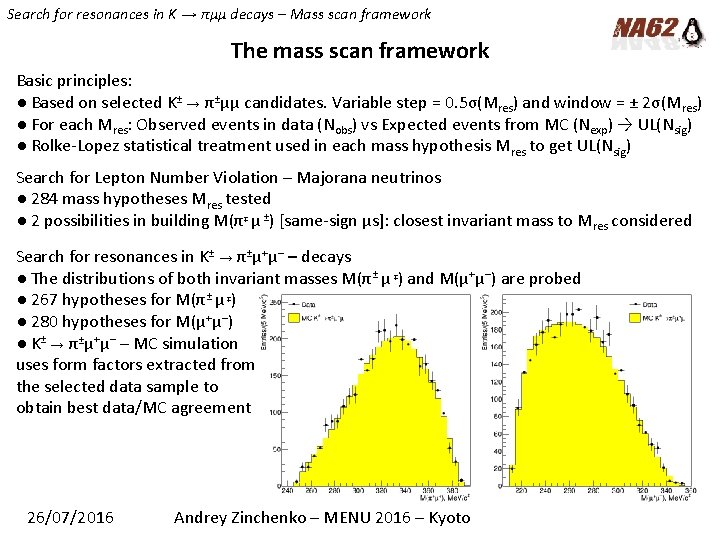
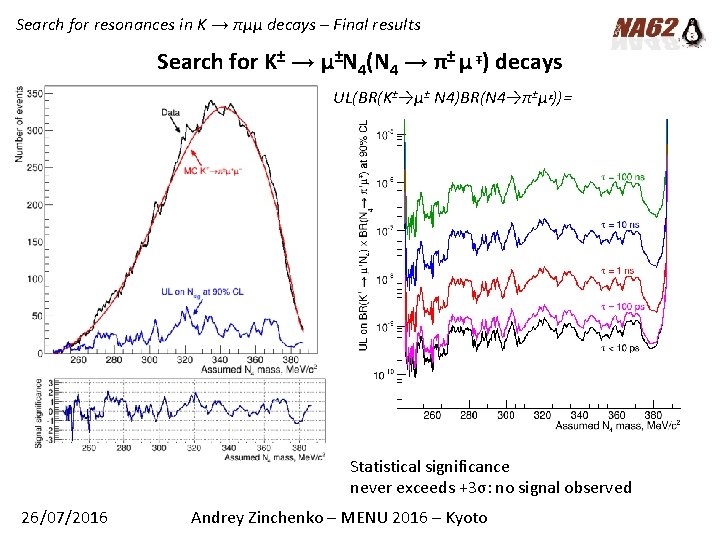
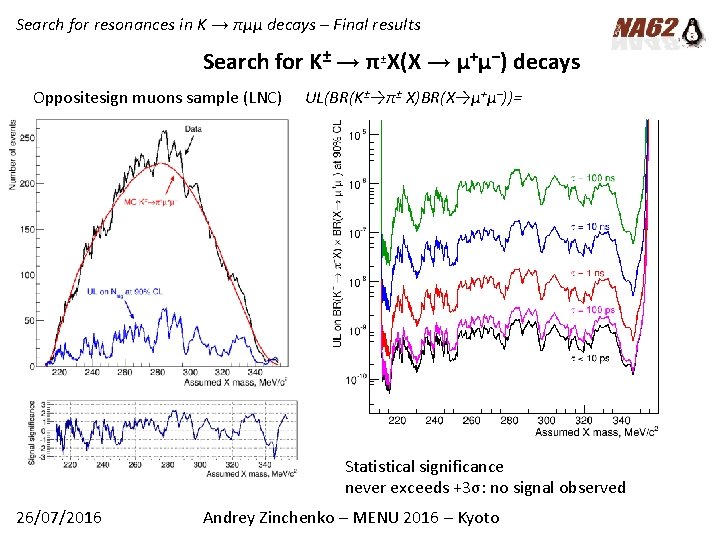
Search for resonances in K → πµµ decays – Mass scan framework The mass scan framework Basic principles: ● Based on selected K± → π±µµ candidates. Variable step = 0. 5σ(Mres) and window = ± 2σ(Mres) ● For each Mres: Observed events in data (Nobs) vs Expected events from MC (Nexp) → UL(Nsig) ● Rolke Lopez statistical treatment used in each mass hypothesis Mres to get UL(Nsig) Search for Lepton Number Violation – Majorana neutrinos ● 284 mass hypotheses Mres tested ● 2 possibilities in building M(π∓ µ ±) [same sign µs]: closest invariant mass to Mres considered Search for resonances in K± → π±µ+µ‒ – decays ● The distributions of both invariant masses M(π± µ ∓) and M(µ+µ‒) are probed ● 267 hypotheses for M(π± µ ∓) ● 280 hypotheses for M(µ+µ‒) ● K± → π±µ+µ‒ – MC simulation uses form factors extracted from the selected data sample to obtain best data/MC agreement 26/07/2016 Andrey Zinchenko – MENU 2016 – Kyoto
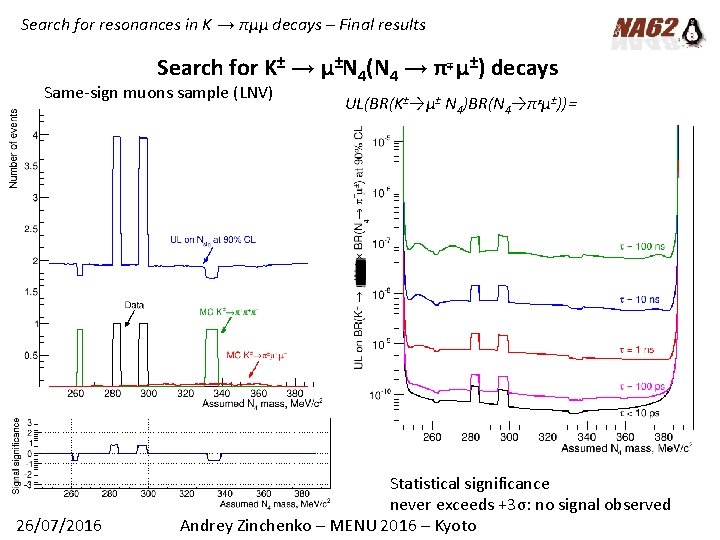
Search for resonances in K → πµµ decays – Final results Search for K± → µ±N 4(N 4 → π∓ µ±) decays Same sign muons sample (LNV) 26/07/2016 UL(BR(K±→μ± N 4)BR(N 4→π∓μ±))= Statistical significance never exceeds +3σ: no signal observed Andrey Zinchenko – MENU 2016 – Kyoto
Search for resonances in K → πµµ decays – Final results Search for K± → µ±N 4(N 4 → π± µ ∓) decays UL(BR(K±→μ± N 4)BR(N 4→π±μ∓))= Statistical significance never exceeds +3σ: no signal observed 26/07/2016 Andrey Zinchenko – MENU 2016 – Kyoto
Search for resonances in K → πµµ decays – Final results Search for K± → π±X(X → µ+µ‒) decays Oppositesign muons sample (LNC) UL(BR(K±→π± X)BR(X→μ+μ–))= Statistical significance never exceeds +3σ: no signal observed 26/07/2016 Andrey Zinchenko – MENU 2016 – Kyoto
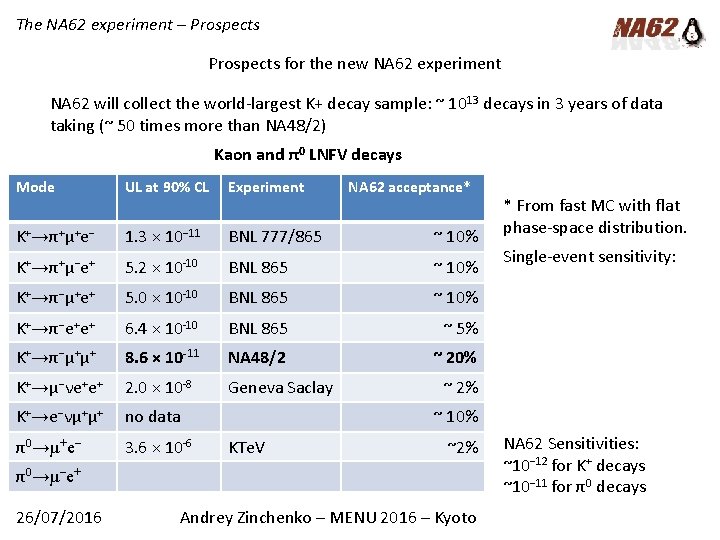
The NA 62 experiment – Prospects for the new NA 62 experiment NA 62 will collect the world largest K+ decay sample: ~ 1013 decays in 3 years of data taking (~ 50 times more than NA 48/2) Kaon and π0 LNFV decays Mode UL at 90% CL Experiment NA 62 acceptance* K+→π+µ+e− 1. 3 × 10− 11 BNL 777/865 ~ 10% K+→π+µ−e+ 5. 2 × 10 10 BNL 865 ~ 10% K+→π−µ+e+ 5. 0 × 10 10 BNL 865 ~ 10% K+→π−e+e+ 6. 4 × 10 10 BNL 865 ~ 5% K+→π−µ+µ+ 8. 6 × 10 -11 NA 48/2 ~ 20% K+→µ−νe+e+ 2. 0 × 10 8 Geneva Saclay K+→e−νµ+µ+ no data π0→µ+e‒ 3. 6 × 10 6 Single event sensitivity: ~ 2% ~ 10% KTe. V ~2% π0→µ‒e+ 26/07/2016 * From fast MC with flat phase space distribution. Andrey Zinchenko – MENU 2016 – Kyoto NA 62 Sensitivities: ~10− 12 for K+ decays ~10− 11 for π0 decays
Conclusions The NA 48/2 experiment at CERN was exposed to 2 x 10¹¹ K± decays in 2003 2004 ● New NA 48/2 results presented for the first time today: − Search for LNV K± → π∓µ±µ± decay: ● BR(K± → π∓µ±µ± ) < 8. 6 x 10 -11 @ 90% CL [World Best Limit] ● Factor of 10 improvement with respect to previous best limit [1. 1 x 10 9 @ 90% CL] − Search for K± → µ±N 4(N 4 → π∓ µ±) decays [Majorana neutrinos] ● Limits on BR products of the order of 10 10 for neutrino lifetimes < 100 ps − Search for K± → µ±N 4(N 4 → π± µ ∓) decays [LNC heavy neutrinos] ● Limits on BR products of the order of 10 9 for neutrino lifetimes < 100 ps − Search for K± → π±X(X → µ+µ‒) decays [Inflatons, …] ● Limits on BR products of the order of 10 9 for resonance lifetimes < 100 ps ● Prospects for the new NA 62 experiment: ● Major beam and detector upgrades for K+ → π+νν : improved performances ● NA 62 will collect the world largest K+ decay sample ( 1013) in 3 years of data taking ● Potential sensitivities ~ 10 12 for K decays, ~ 10 11 for π0 decays 26/07/2016 Andrey Zinchenko – MENU 2016 – Kyoto