
Superconductivity from repulsion Andrey Chubukov University of Minnesota
Superconductivity from repulsion Andrey Chubukov University of Minnesota School and workshop on “Novel materials and novel theories” Trieste, August 10 , 2015
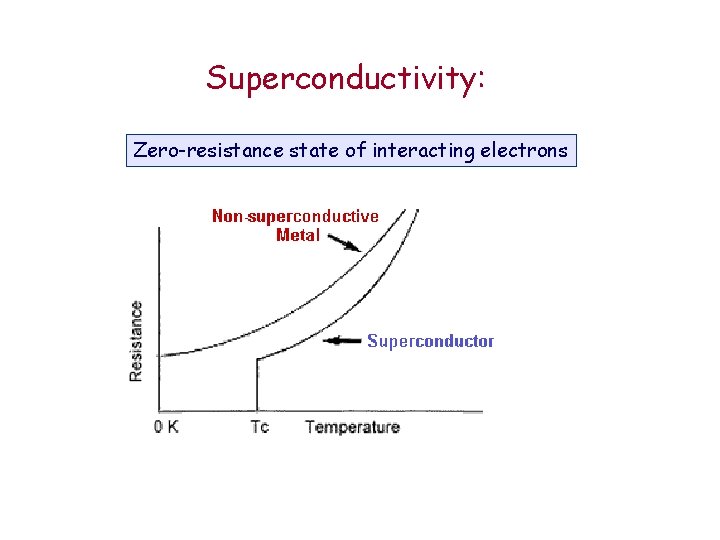
Superconductivity: Zero-resistance state of interacting electrons
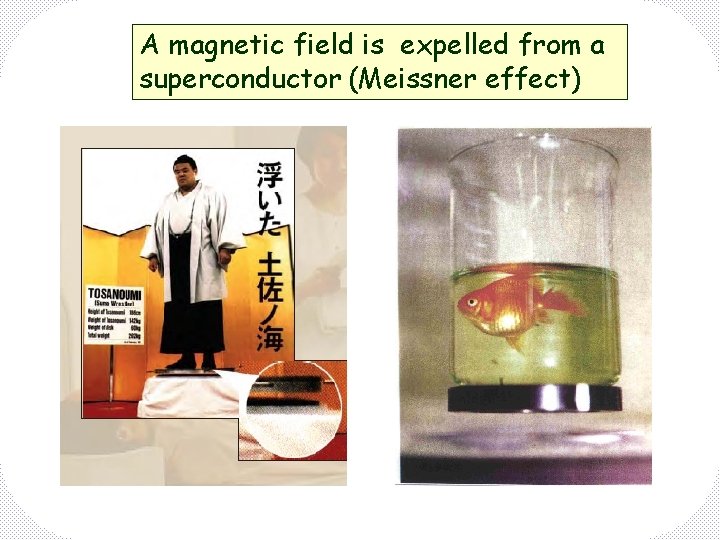
A magnetic field is expelled from a superconductor (Meissner effect)
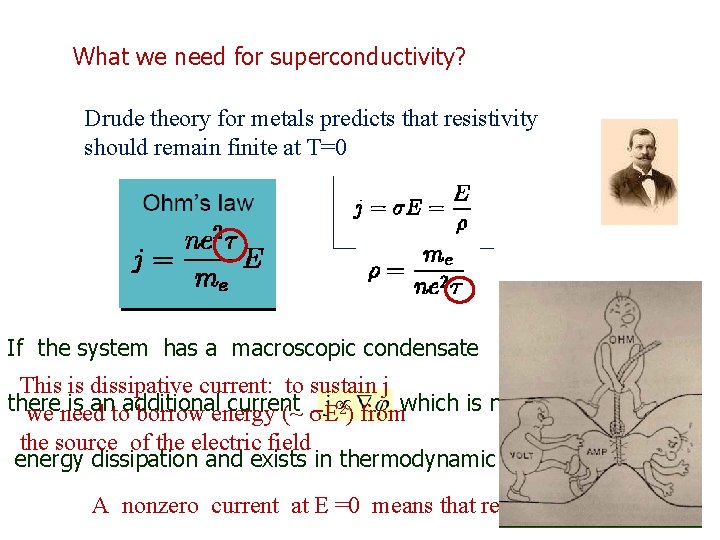
What we need for superconductivity? Drude theory for metals predicts that resistivity should remain finite at T=0 If the system has a macroscopic condensate , then This is dissipative current: to sustain j there is antoadditional current , which is not accompanied by we need borrow energy (~ s. E 2) from the source of the electric field energy dissipation and exists in thermodynamic equilibrium at E=0 A nonzero current at E =0 means that resistivity is zero
Once we have a condensate, we have superconductivity For bosons, the appearance of a condensate is natural, because bosons tend to cluster at zero momentum (Bose-Einstein condensation) But electrons are fermions, and two fermions simply cannot exist in one quantum state. However, if two fermions form a bound state at zero momentum, a bound pair becomes a boson, and bosons do condense. We need to pair fermions into a bound state.
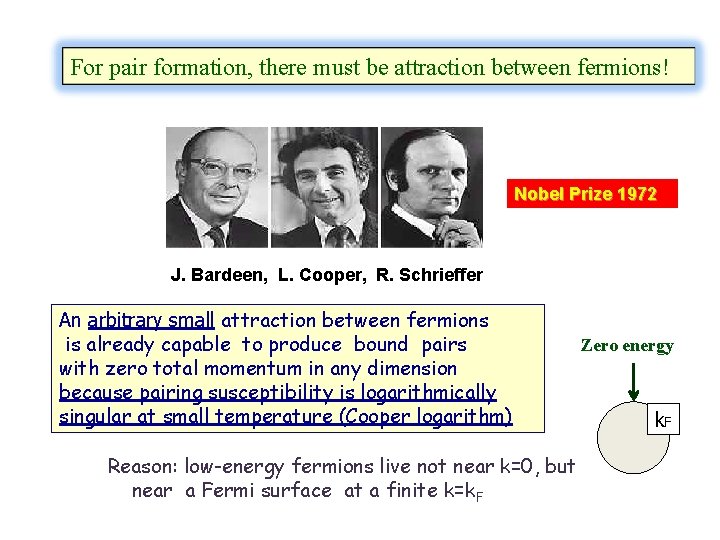
For pair formation, there must be attraction between fermions! Nobel Prize 1972 J. Bardeen, L. Cooper, R. Schrieffer An arbitrary small attraction between fermions is already capable to produce bound pairs with zero total momentum in any dimension because pairing susceptibility is logarithmically singular at small temperature (Cooper logarithm) Reason: low-energy fermions live not near k=0, but near a Fermi surface at a finite k=k. F Zero energy k. F
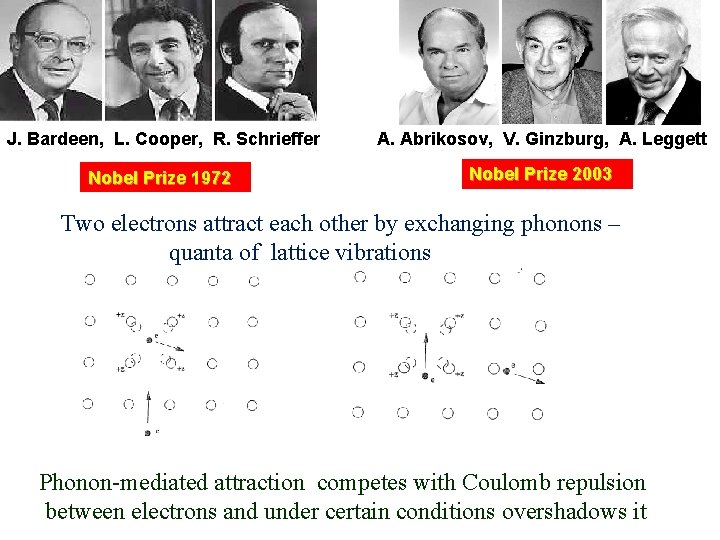
J. Bardeen, L. Cooper, R. Schrieffer A. Abrikosov, V. Ginzburg, A. Leggett Nobel Prize 1972 Nobel Prize 2003 Two electrons attract each other by exchanging phonons – quanta of lattice vibrations Phonon-mediated attraction competes with Coulomb repulsion between electrons and under certain conditions overshadows it
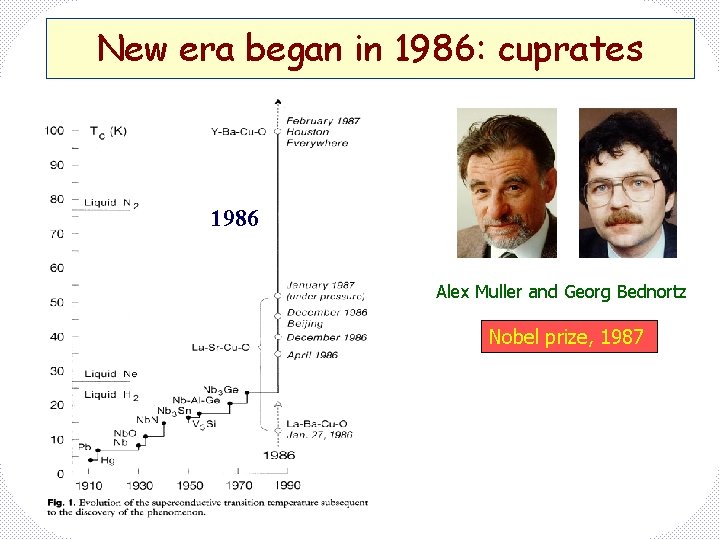
New era began in 1986: cuprates 1986 Alex Muller and Georg Bednortz Nobel prize, 1987
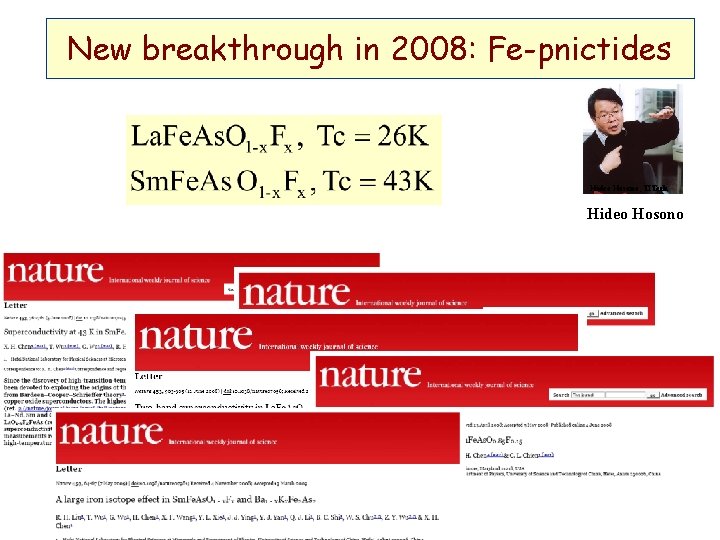
New breakthrough in 2008: Fe-pnictides Hideo Hosono, TITech Hideo Hosono
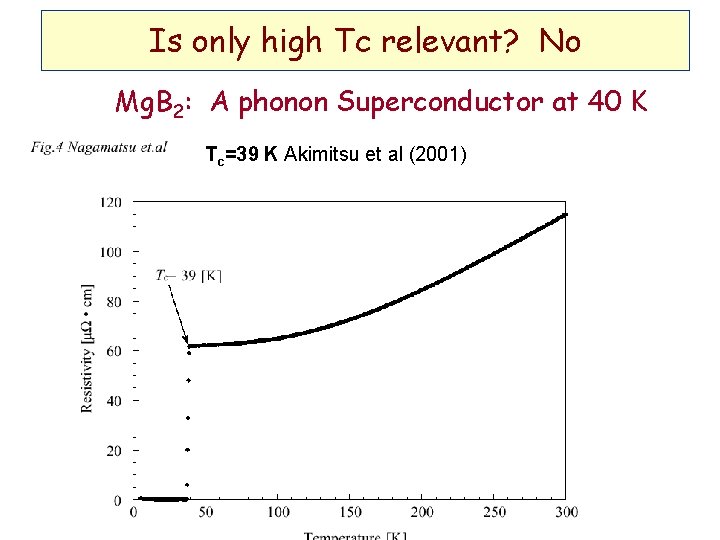
Is only high Tc relevant? No Mg. B 2: A phonon Superconductor at 40 K Tc=39 K Akimitsu et al (2001)
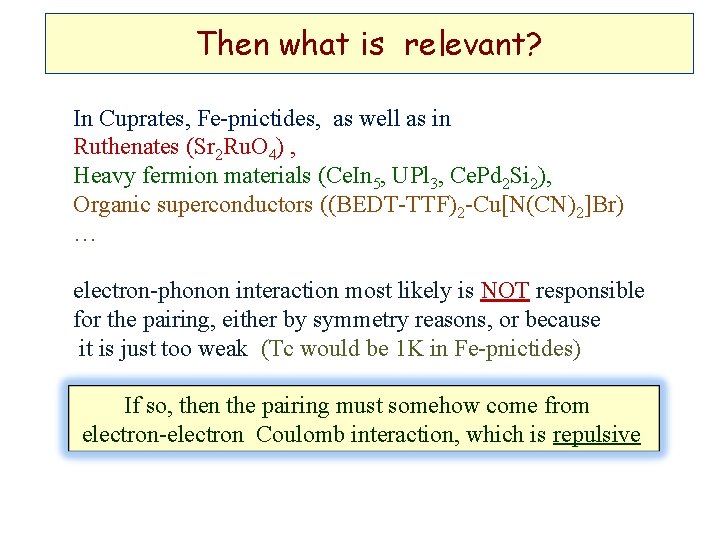
Then what is relevant? In Cuprates, Fe-pnictides, as well as in Ruthenates (Sr 2 Ru. O 4) , Heavy fermion materials (Ce. In 5, UPl 3, Ce. Pd 2 Si 2), Organic superconductors ((BEDT-TTF)2 -Cu[N(CN)2]Br) … electron-phonon interaction most likely is NOT responsible for the pairing, either by symmetry reasons, or because it is just too weak (Tc would be 1 K in Fe-pnictides) If so, then the pairing must somehow come from electron-electron Coulomb interaction, which is repulsive
Superconductivity from repulsive interaction How one possibly get a bound fermion pair out of repulsion?
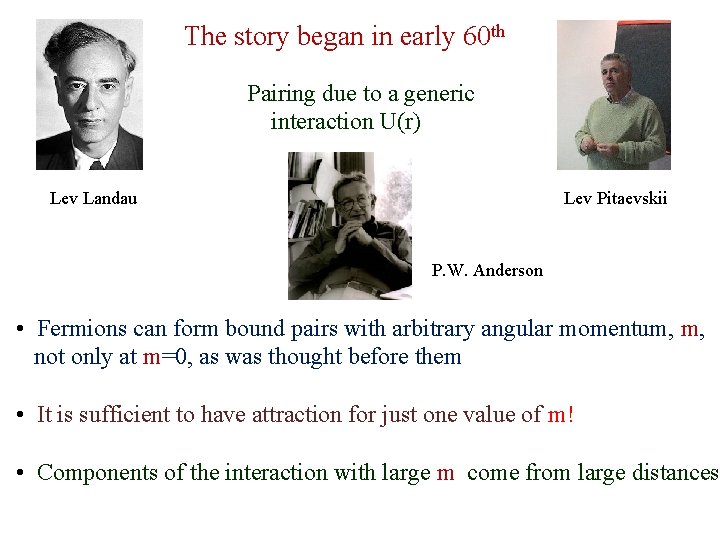
The story began in early 60 th Pairing due to a generic interaction U(r) Lev Landau Lev Pitaevskii P. W. Anderson • Fermions can form bound pairs with arbitrary angular momentum, m, not only at m=0, as was thought before them • It is sufficient to have attraction for just one value of m! • Components of the interaction with large m come from large distances.
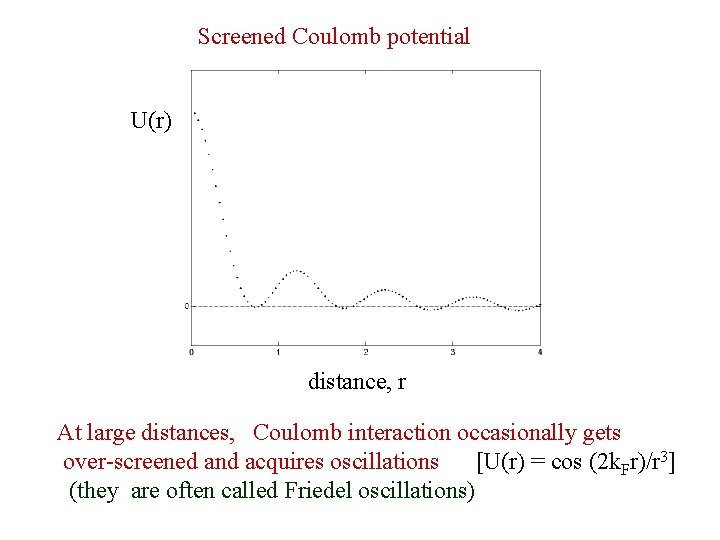
Screened Coulomb potential U(r) distance, r At large distances, Coulomb interaction occasionally gets over-screened and acquires oscillations [U(r) = cos (2 k. Fr)/r 3] (they are often called Friedel oscillations)
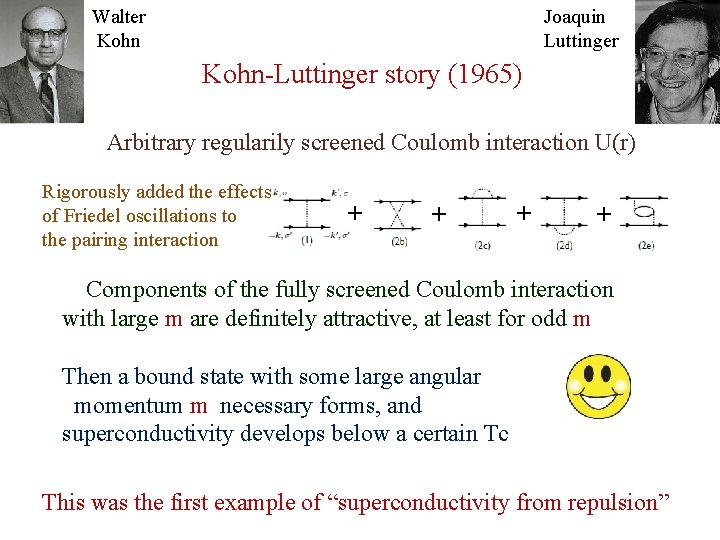
Walter Kohn Joaquin Luttinger Kohn-Luttinger story (1965) Arbitrary regularily screened Coulomb interaction U(r) Rigorously added the effects of Friedel oscillations to the pairing interaction + + Components of the fully screened Coulomb interaction with large m are definitely attractive, at least for odd m Then a bound state with some large angular momentum m necessary forms, and superconductivity develops below a certain Tc This was the first example of “superconductivity from repulsion”
A (somewhat) simplified version of Kohn-Luttinger (KL) analysis applies to systems with small Hubbard interaction U To first order in U, there is a repulsion in the s-wave (m =0) channel and nothing in channels with other angular momenta To second order in U, attraction emerges in all other channels, the largest one for m=1 (p-wave) Fay and Layzer, 1968 In 1965, most theorists believed that the pairing in 3 He should be with m=2. KL obtained Tc ~ EF exp [-2. 5 m 4], substituted m=2, found Tc~10 -17 K A few years later experiments found that for 3 He, m=1. The KL effect actually persists down to m=1. If KL substituted m=1 into their formula, they would obtain Tc (m=1)~ 10 -3 EF ~ 10 -3 K (close to Tc ~3 m. K in 3 He)
For the rest of the talk I will explore KL idea that the effective pairing interaction is different from a bare repulsive U due to screening by other fermions, and may have attractive components in some channels
For lattice systems we cannot expand in angular harmonics (they are no longer orthogonal), and there is NO generic proof that “any system must become a superconductor at low enough T”. Nevertheless, KL-type reasoning gives us good understanding of non-phononic superconductivity
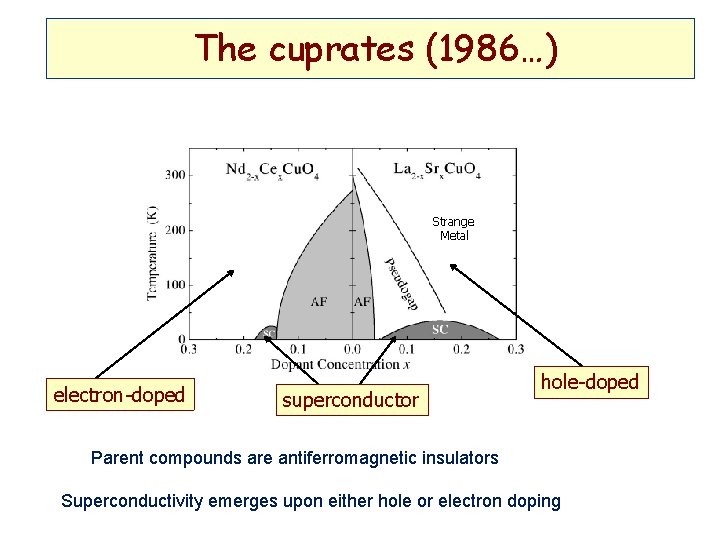
The cuprates (1986…) Strange Metal electron-doped superconductor hole-doped Parent compounds are antiferromagnetic insulators Superconductivity emerges upon either hole or electron doping
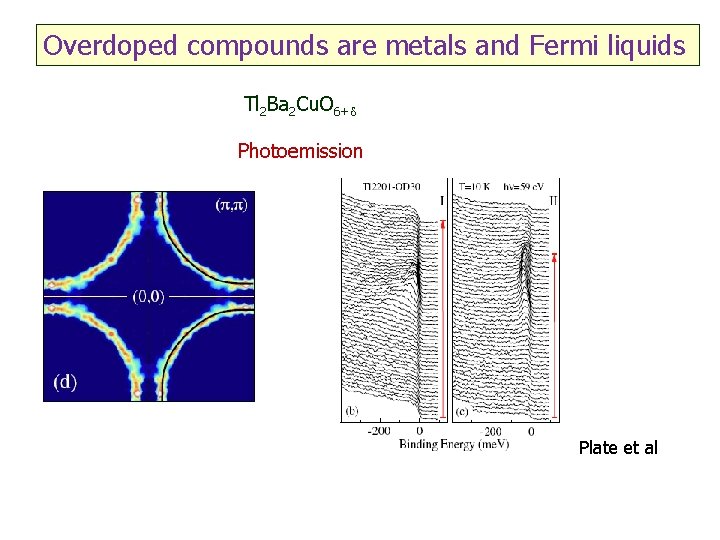
Overdoped compounds are metals and Fermi liquids Tl 2 Ba 2 Cu. O 6+d Photoemission Plate et al
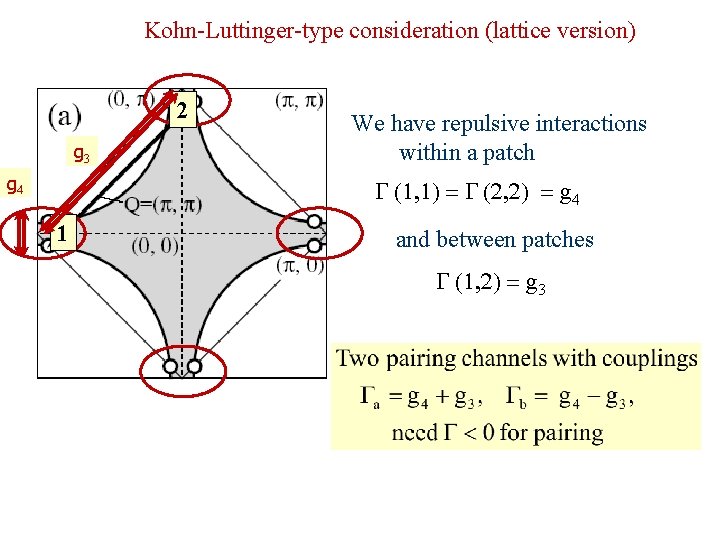
Kohn-Luttinger-type consideration (lattice version) 2 g 3 g 4 We have repulsive interactions within a patch G (1, 1) = G (2, 2) = g 4 1 and between. I patches G (1, 2) = g 3
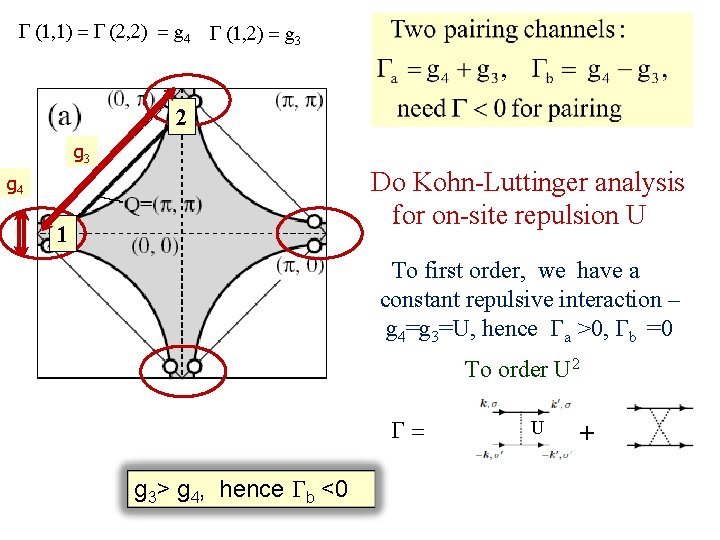
G (1, 1) = G (2, 2) = g 4 G (1, 2) = g 3 2 g 3 Do Kohn-Luttinger analysis for on-site repulsion U g 4 I 1 To first order, we have a constant repulsive interaction – g 4=g 3=U, hence Ga >0, Gb =0 To order U 2 G= g 3> g 4, hence Gb <0 U +
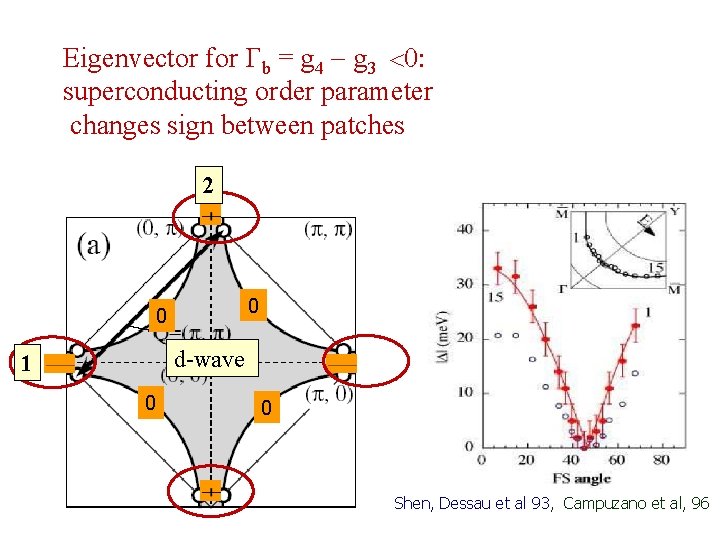
Eigenvector for Gb = g 4 - g 3 <0: superconducting order parameter changes sign between patches 2 0 0 + d-wave 1 0 0 Shen, Dessau et al 93, Campuzano et al, 96
Spin-fluctuation approach (pairing by spin fluctuations) is an extension of KL approach to include higher-order terms. One generally gets better numerical accuracy + can potentially capture new physics, however, the attraction in d-wave channel already comes from controlled perturbative expansion to second order in U
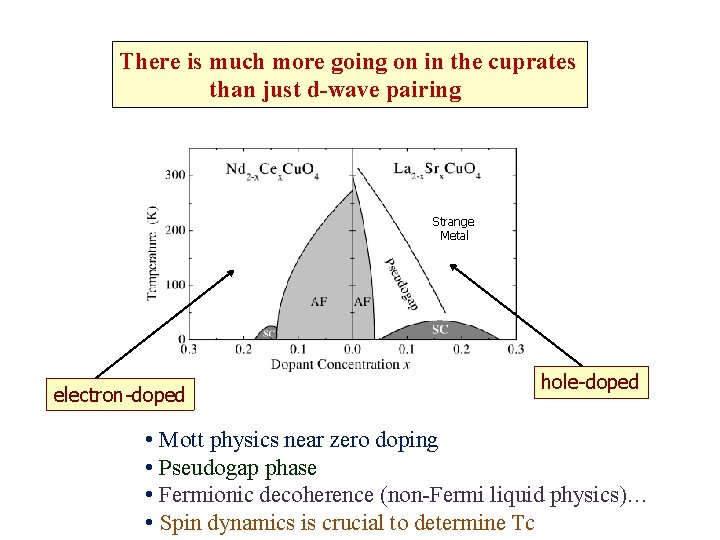
There is much more going on in the cuprates than just d-wave pairing Strange Metal electron-doped hole-doped • Mott physics near zero doping • Pseudogap phase • Fermionic decoherence (non-Fermi liquid physics)… • Spin dynamics is crucial to determine Tc
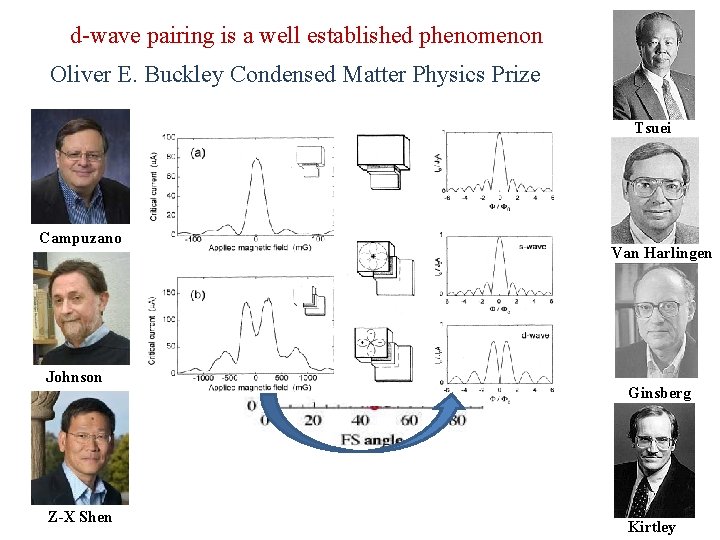
d-wave pairing is a well established phenomenon Oliver E. Buckley Condensed Matter Physics Prize Tsuei Campuzano Johnson Z-X Shen Van Harlingen Ginsberg Kirtley
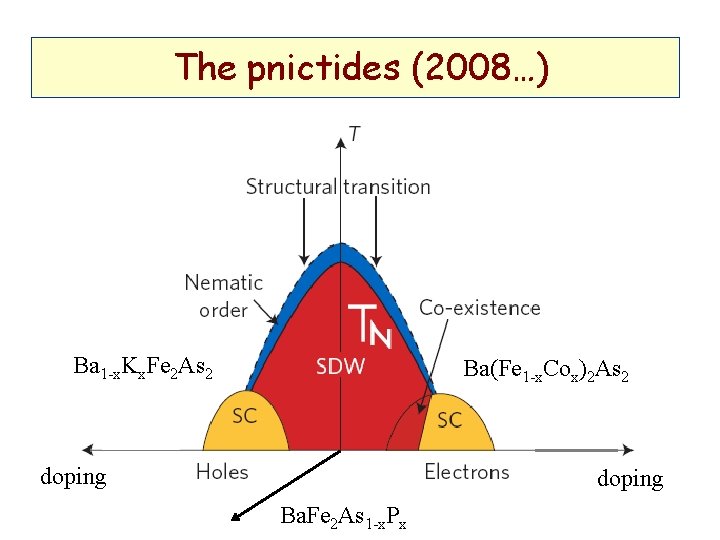
The pnictides (2008…) Weakly/moderately doped Fe-pnictides Ba 1 -x. Kx. Fe 2 As 2 Ba(Fe 1 -x. Cox)2 As 2 doping Ba. Fe 2 As 1 -x. Px
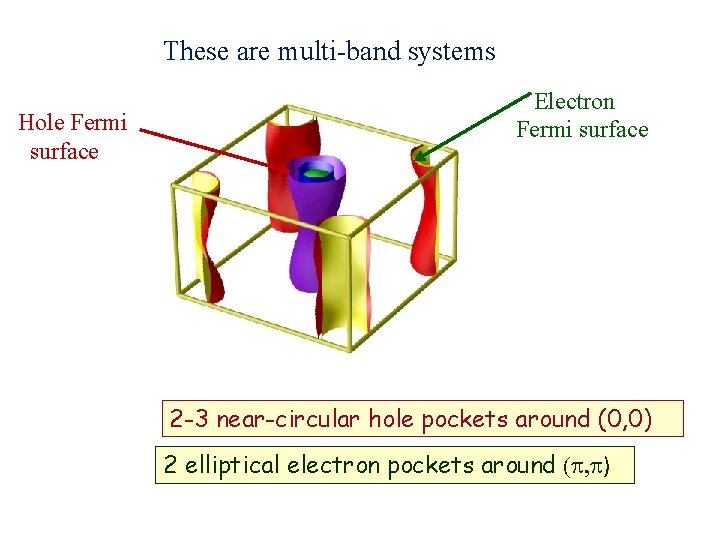
These are multi-band systems Hole Fermi surface Electron Fermi surface 2 -3 near-circular hole pockets around (0, 0) 2 elliptical electron pockets around (p, p)
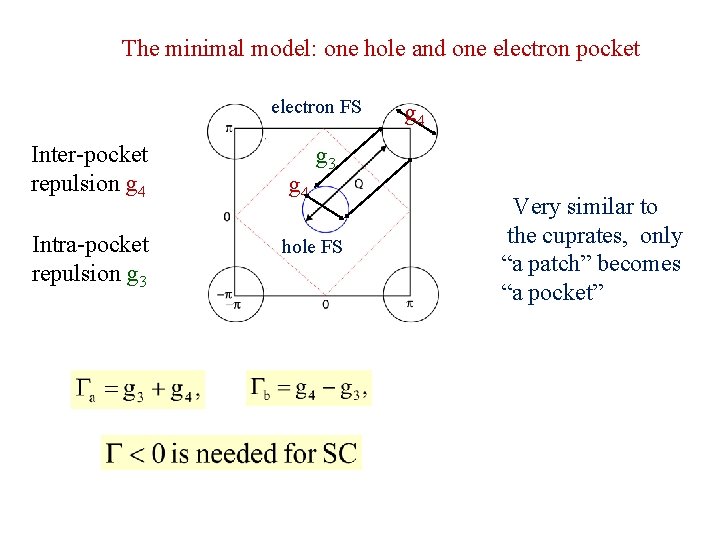
The minimal model: one hole and one electron pocket electron FS Inter-pocket repulsion g 4 Intra-pocket repulsion g 3 g 4 g 3 hole FS Very similar to the cuprates, only “a patch” becomes “a pocket”
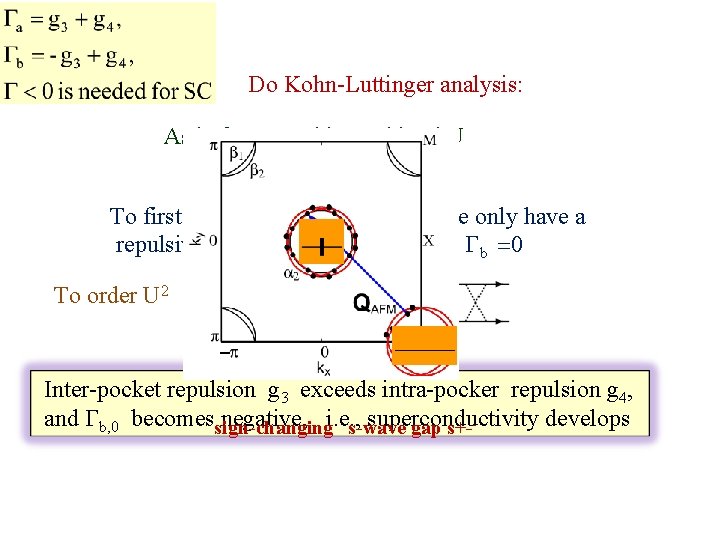
Do Kohn-Luttinger analysis: As before, consider Hubbard U To first order in U, g 4=g 3=U, and we only have a repulsive s-wave component Ga, >0, Gb =0 To order U 2 G 0 = + Inter-pocket repulsion g 3 exceeds intra-pocker repulsion g 4, and Gb, 0 becomessign-changing negative, i. e. , superconductivity develops s-wave gap s+--
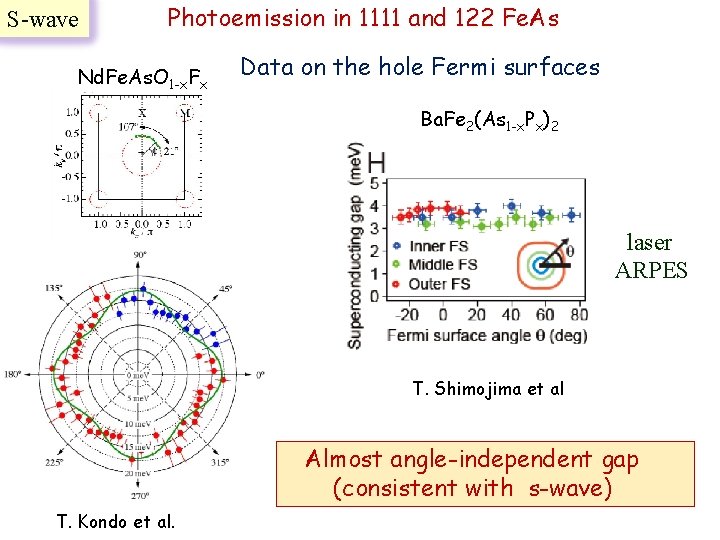
S-wave Photoemission in 1111 and 122 Fe. As Nd. Fe. As. O 1 -x. Fx Data on the hole Fermi surfaces Ba. Fe 2(As 1 -x. Px)2 laser ARPES T. Shimojima et al Almost angle-independent gap (consistent with s-wave) T. Kondo et al.
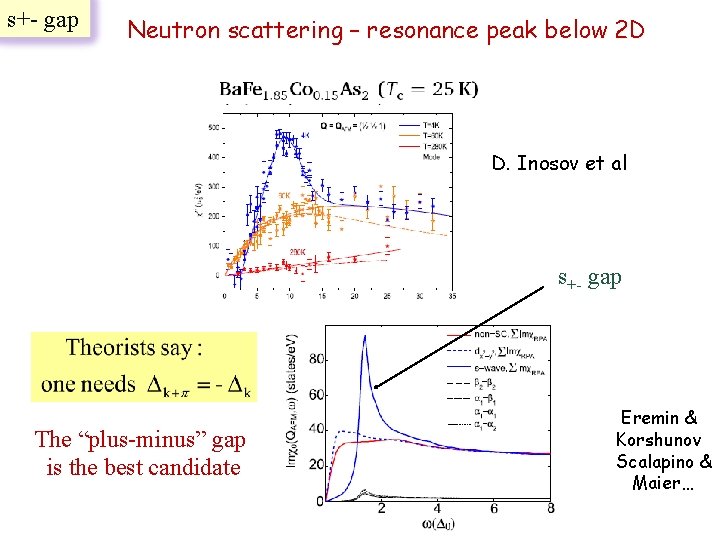
s+- gap Neutron scattering – resonance peak below 2 D D. Inosov et al s+- gap D. Inosov et al. The “plus-minus” gap is the best candidate Eremin & Korshunov Scalapino & Maier…
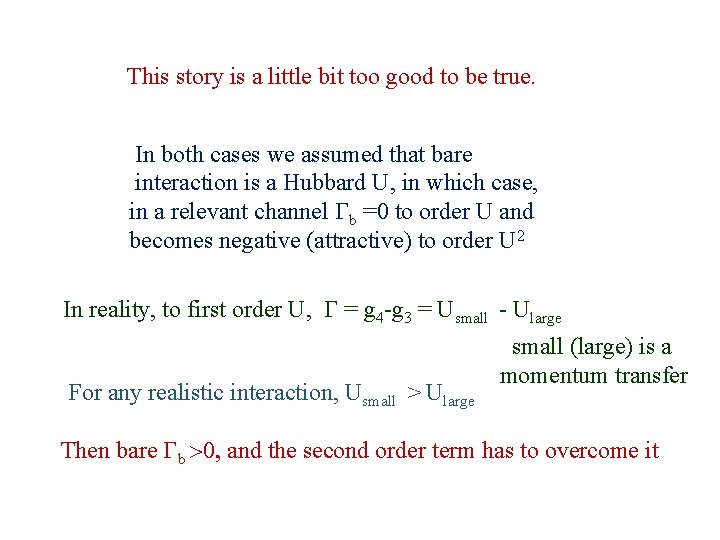
This story is a little bit too good to be true. In both cases we assumed that bare interaction is a Hubbard U, in which case, in a relevant channel Gb =0 to order U and becomes negative (attractive) to order U 2 In reality, to first order U, G = g 4 -g 3 = Usmall - Ularge For any realistic interaction, Usmall > Ularge small (large) is a momentum transfer Then bare Gb >0, and the second order term has to overcome it
Physicists, we have a problem
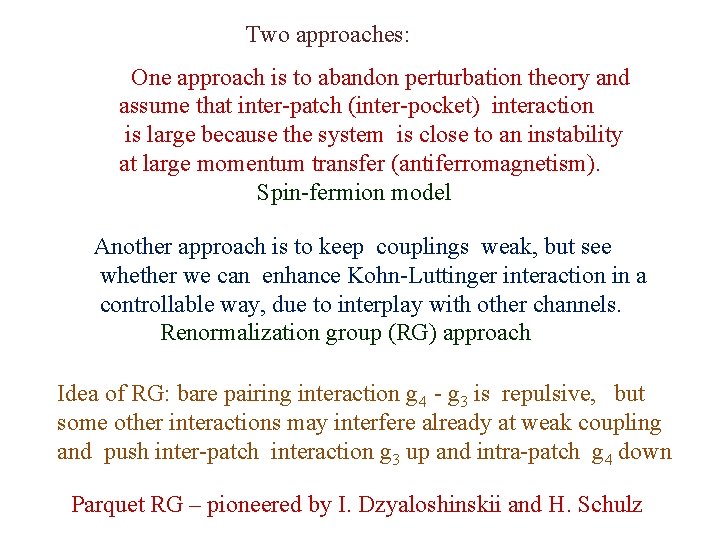
Two approaches: One approach is to abandon perturbation theory and assume that inter-patch (inter-pocket) interaction is large because the system is close to an instability at large momentum transfer (antiferromagnetism). Spin-fermion model Another approach is to keep couplings weak, but see whether we can enhance Kohn-Luttinger interaction in a controllable way, due to interplay with other channels. Renormalization group (RG) approach Idea of RG: bare pairing interaction g 4 - g 3 is repulsive, but some other interactions may interfere already at weak coupling and push inter-patch interaction g 3 up and intra-patch g 4 down Parquet RG – pioneered by I. Dzyaloshinskii and H. Schulz
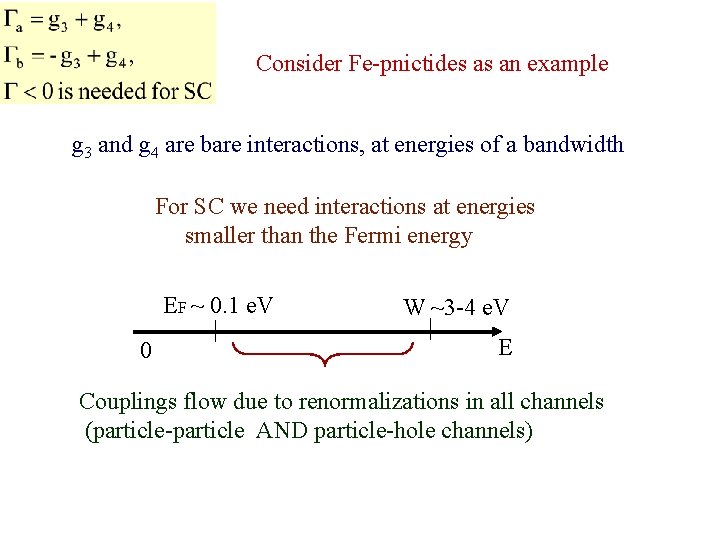
Consider Fe-pnictides as an example g 3 and g 4 are bare interactions, at energies of a bandwidth For SC we need interactions at energies smaller than the Fermi energy 0 EF ~ 0. 1 e. V | W ~3 -4 e. V | E Couplings flow due to renormalizations in all channels (particle-particle AND particle-hole channels)
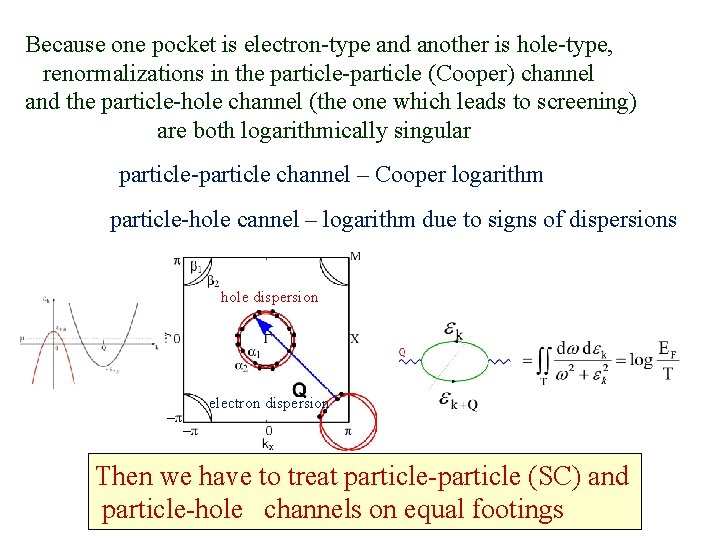
Because one pocket is electron-type and another is hole-type, renormalizations in the particle-particle (Cooper) channel and the particle-hole channel (the one which leads to screening) are both logarithmically singular particle-particle channel – Cooper logarithm particle-hole cannel – logarithm due to signs of dispersions hole dispersion electron dispersion Then we have to treat particle-particle (SC) and particle-hole channels on equal footings
The presence of logarithms is actually a blessing Conventional perturbation theory: expansion in g we can do controllable expansion when g <<1 When there are logarithms in perturbation theory, we can extend theoretical analysis in a controllable way by summing up infinite series in perturbation theory in g * log W/T and neglecting g 2 * log W/T, etc… The most known example – BCS theory of superconductivity (summing up Cooper logarithms in the particle-particle channel) g + g 2 * log W/T + g 3 *(log W/T)2 + … = g/(1 -g * log W/T) superconductivity at Tc = W e-1/g Now we want to do the same when there are log W/T terms in both particle-particle and particle-hole channel
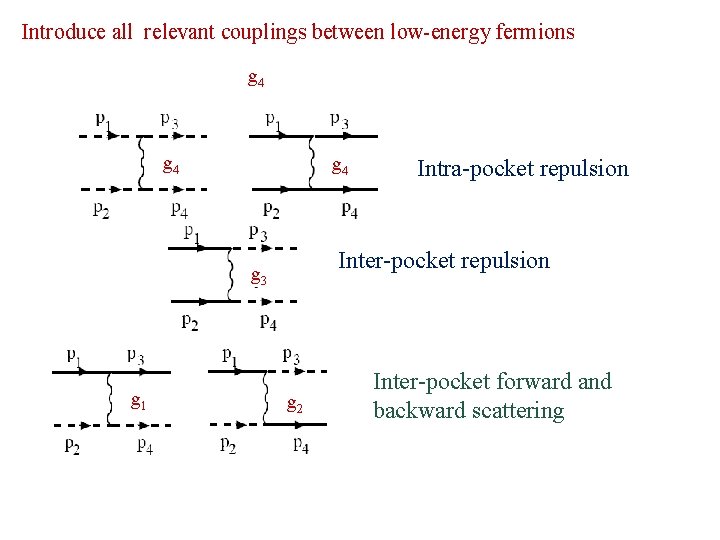
Introduce all relevant couplings between low-energy fermions g 4 ug 44 g 4 Inter-pocket repulsion g 3 vg 1 Intra-pocket repulsion vg 2 Inter-pocket forward and backward scattering
What these other interactions g 1 and g 2 do? They lead to either spin-density-wave or charge-density-wave Each of these orders obviously competes with superconductivity, but in the process of developing spin or charge order, fluctuations in the corresponding channels modify superconducting interactions, and modification is different for intra-pocket and inter-pocket interactions
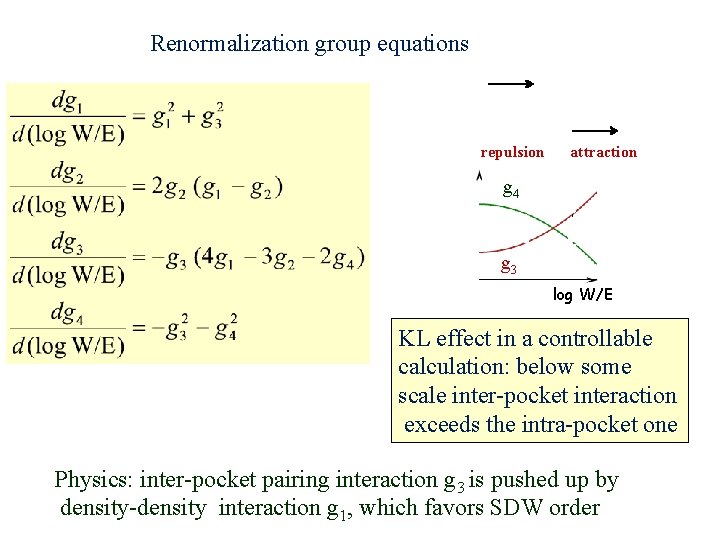
Renormalization group equations repulsion 2 attraction g 4 g 3 log W/E KL effect in a controllable calculation: below some scale inter-pocket interaction exceeds the intra-pocket one Physics: inter-pocket pairing interaction g 3 is pushed up by density-density interaction g 1, which favors SDW order
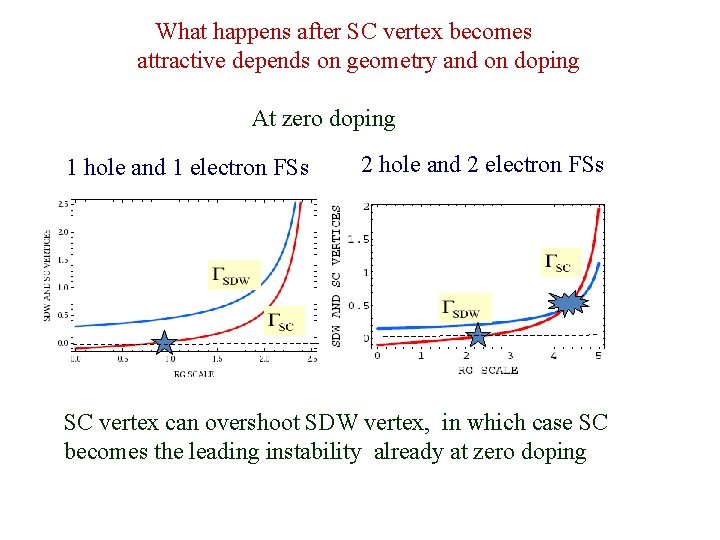
What happens after SC vertex becomes attractive depends on geometry and on doping At zero doping 1 hole and 1 electron FSs 2 hole and 2 electron FSs SC vertex can overshoot SDW vertex, in which case SC becomes the leading instability already at zero doping
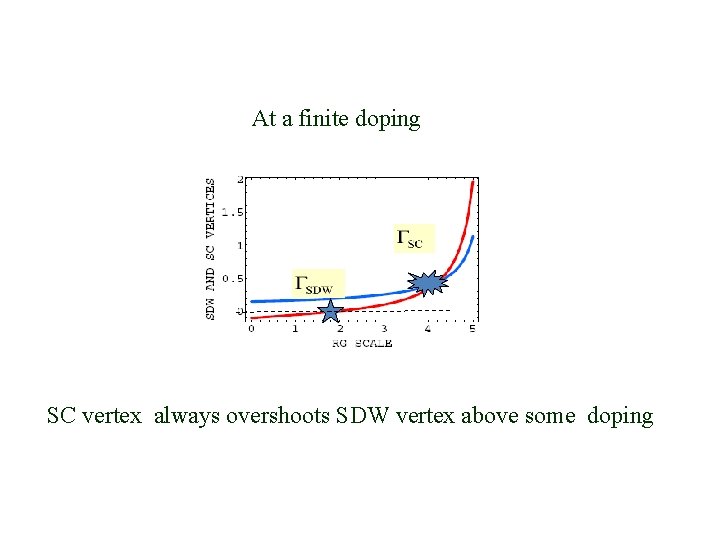
At a finite doping SC vertex always overshoots SDW vertex above some doping
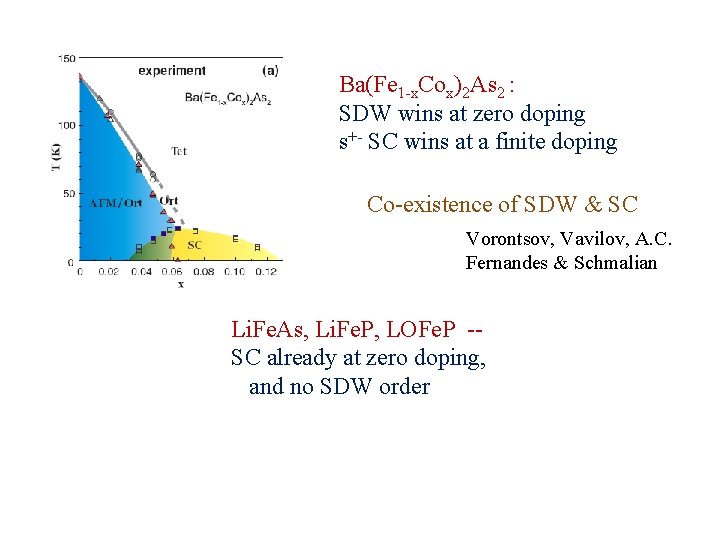
Ba(Fe 1 -x. Cox)2 As 2 : SDW wins at zero doping s+- SC wins at a finite doping Co-existence of SDW & SC Vorontsov, Vavilov, A. C. Fernandes & Schmalian Li. Fe. As, Li. Fe. P, LOFe. P -SC already at zero doping, and no SDW order
The same behavior has been found in the cuprates In both cases the essential aspect of the physics is the mutual support between superconducting and spin-density-wave fluctuations: magnetic fluctuations enhance tendency to superconductivity and superconducting fluctuations enhance tendency to magnetism However, once one order sets in, it fights against the appearance of the other one Competition == good, monopoly == bad (at least for superconductivity)
Conclusions There are numerous examples when superconductivity (which requires pairing of fermions into bound states) comes from repulsive electron-electron interaction The generic idea how to get superconductivity from repulsion goes back to Kohn and Luttinger KL physics d-wave superconductivity in cuprates leads to: s-wave superconductivity in Fe-pnictides (s+-) In both cases, fluctuations in the spin-density-wave channel enhance tendency to superconductivity by reducing the repulsive part of the interaction and enhancing the attractive part => the system self-generates an attraction below some scale.

THANK YOU
- Slides: 47