Ancient Greek for Everyone A New Digital Resource

- Slides: 18
Ancient Greek for Everyone: A New Digital Resource for Beginning Greek Unit 3 part 3: Neuter Nouns 2015 edition Wilfred E. Major wmajor@lsu. edu
Ancient Greek for Everyone AGE Unit 3: Neuter Nouns • You have learned the basics of masculine and feminine nouns in Greek. • Now we add neuter nouns, the final gender.
Ancient Greek for Everyone • A NOUN indicates a person, place or thing. • A Greek noun, however, normally communicates THREE pieces of information: – Gender – Number – Case
Ancient Greek for Everyone Building a Greek Noun • All the nouns in this unit have been either masculine or feminine in gender and have used the same endings to indicate number and case. • This part of the unit adds nouns that are neuter in gender. • Grammatically, neuter means that the noun is “neither” masculine nor feminine.
Ancient Greek for Everyone Building a Greek Noun • The Neuter Law: two rules apply to all neuter words in Greek. • (1) The nominative singular and the accusative singular must be identical. • (2) The nominative plural and the accusative plural must both end in a short -α.
Ancient Greek for Everyone Building a Greek Noun • The Neuter Law: two rules apply to all neuter words in Greek. The nouns in this unit meet the requirements as follows: • (1) The nominative singular and the accusative singular add no ending to the stem. • (2) The nominative plural and the accusative plural add short –α to the stem.
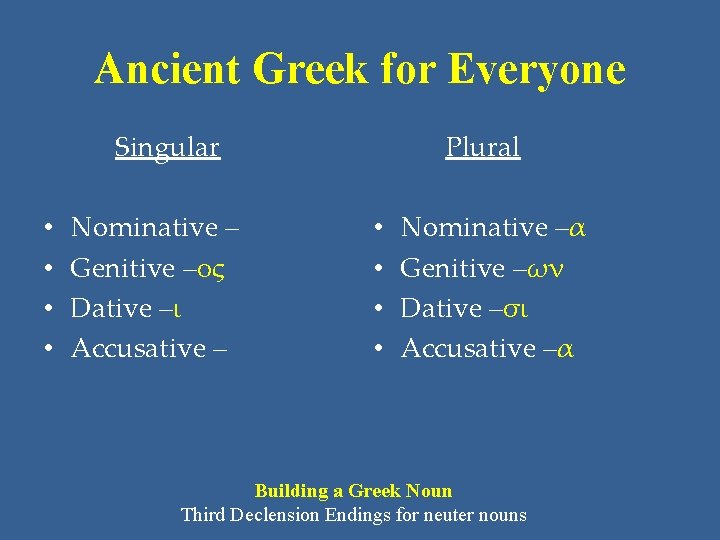
Ancient Greek for Everyone Singular • • Nominative – Genitive –ος Dative –ι Accusative – Plural • • Nominative –α Genitive –ων Dative –σι Accusative –α Building a Greek Noun Third Declension Endings for neuter nouns
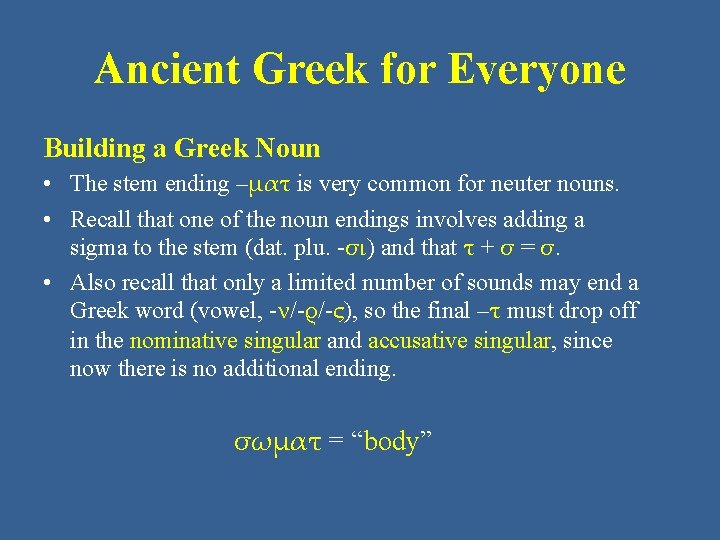
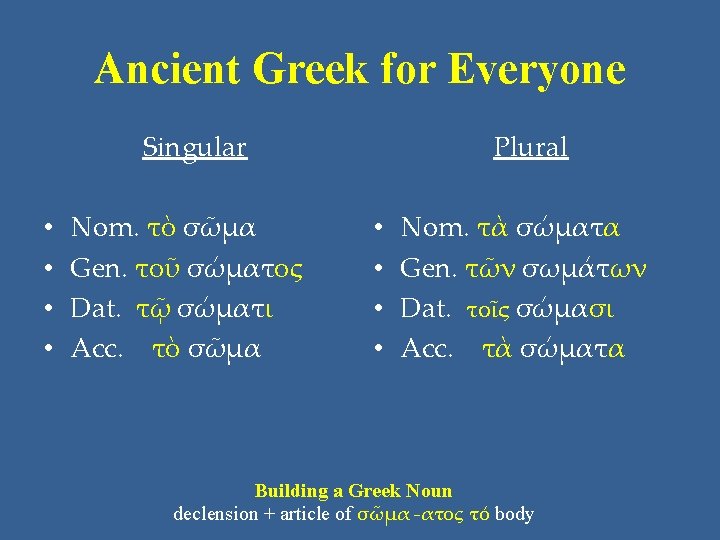
Ancient Greek for Everyone Building a Greek Noun • The stem ending –ματ is very common for neuter nouns. • Recall that one of the noun endings involves adding a sigma to the stem (dat. plu. -σι) and that τ + σ = σ. • Also recall that only a limited number of sounds may end a Greek word (vowel, -ν/-ρ/-ς), so the final –τ must drop off in the nominative singular and accusative singular, since now there is no additional ending. σωματ = “body”
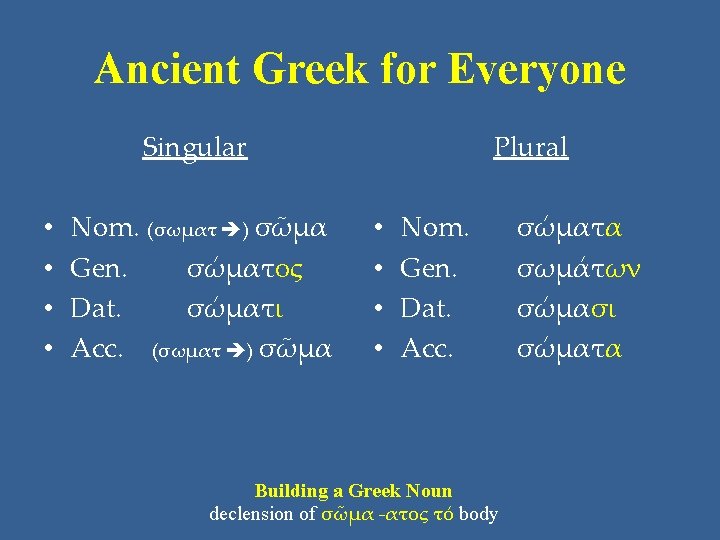
Ancient Greek for Everyone Singular • • Nom. (σωματ ) σῶμα Gen. σώματος Dat. σώματι Acc. (σωματ ) σῶμα Plural • • Nom. Gen. Dat. Acc. Building a Greek Noun declension of σῶμα -ατος τό body σώματα σωμάτων σώμασι σώματα
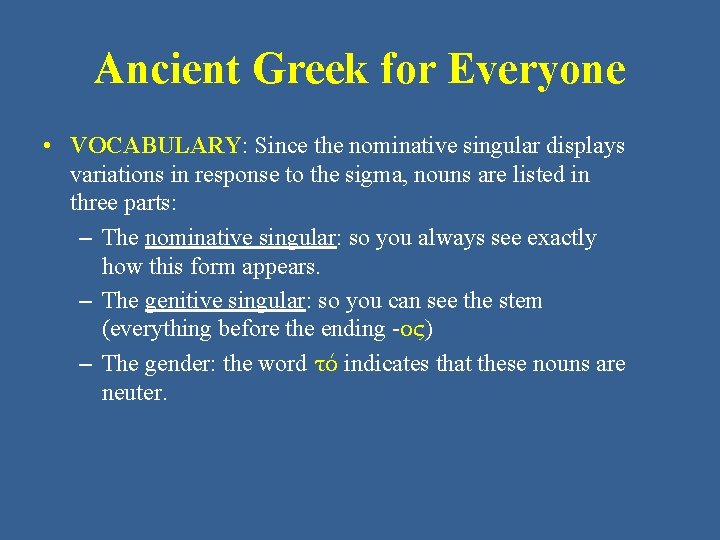
Ancient Greek for Everyone • VOCABULARY: Since the nominative singular displays variations in response to the sigma, nouns are listed in three parts: – The nominative singular: so you always see exactly how this form appears. – The genitive singular: so you can see the stem (everything before the ending -ος) – The gender: the word τό indicates that these nouns are neuter.
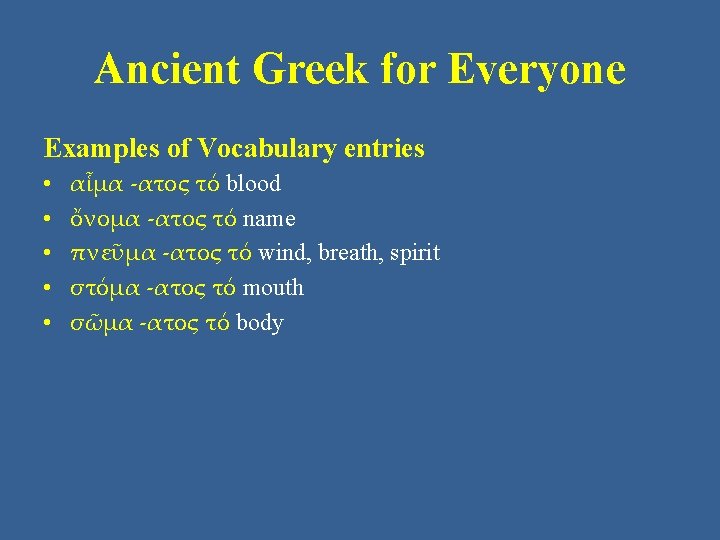
Ancient Greek for Everyone Examples of Vocabulary entries • • • αἷμα -ατος τό blood ὄνομα -ατος τό name πνεῦμα -ατος τό wind, breath, spirit στόμα -ατος τό mouth σῶμα -ατος τό body
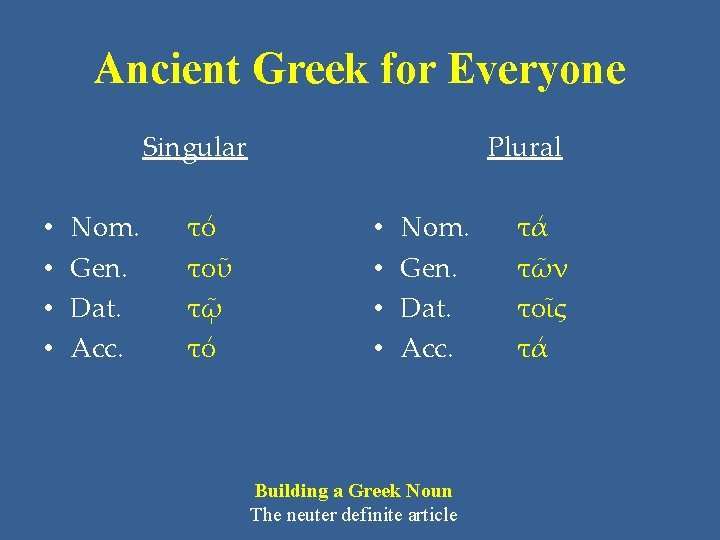
Ancient Greek for Everyone Building a Greek Noun • The word τό indicates the noun is neuter in gender. • This is the neuter form of the definite article in Greek. As with masculine and feminine nouns, the article must match its noun in gender, number and case. • The neuter definite article is the same as the masculine definite article, but with the Neuter Law applied.
Ancient Greek for Everyone Singular • • Nom. Gen. Dat. Acc. τό τοῦ τῷ τό Plural • • Nom. Gen. Dat. Acc. Building a Greek Noun The neuter definite article τά τῶν τοῖς τά
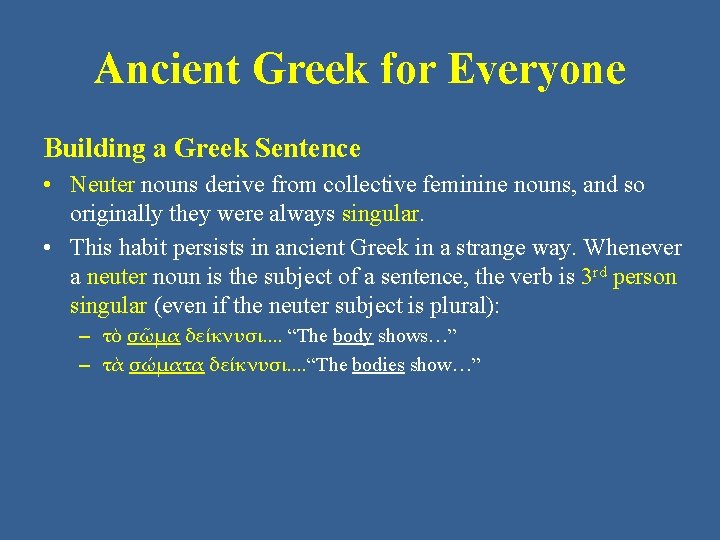
Ancient Greek for Everyone Building a Greek Sentence • Neuter nouns derive from collective feminine nouns, and so originally they were always singular. • This habit persists in ancient Greek in a strange way. Whenever a neuter noun is the subject of a sentence, the verb is 3 rd person singular (even if the neuter subject is plural): – τὸ σῶμα δείκνυσι. . “The body shows…” – τὰ σώματα δείκνυσι. . “The bodies show…”
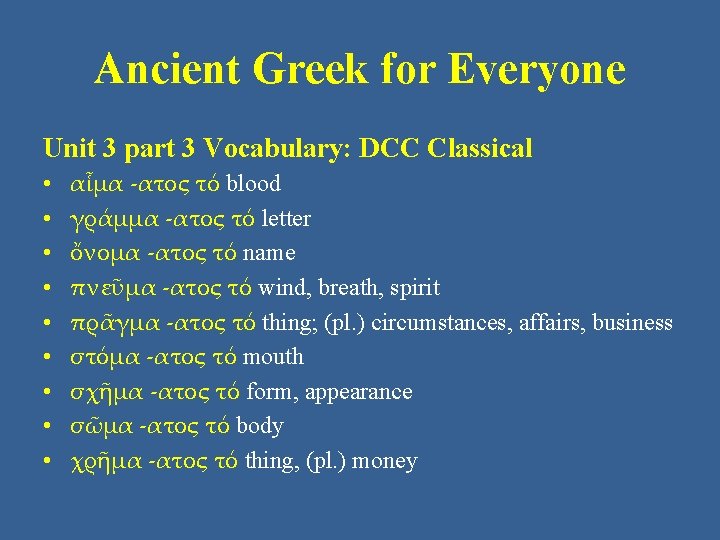
Ancient Greek for Everyone Unit 3 part 3 Vocabulary: DCC Classical • • • αἷμα -ατος τό blood γράμμα -ατος τό letter ὄνομα -ατος τό name πνεῦμα -ατος τό wind, breath, spirit πρᾶγμα -ατος τό thing; (pl. ) circumstances, affairs, business στόμα -ατος τό mouth σχῆμα -ατος τό form, appearance σῶμα -ατος τό body χρῆμα -ατος τό thing, (pl. ) money
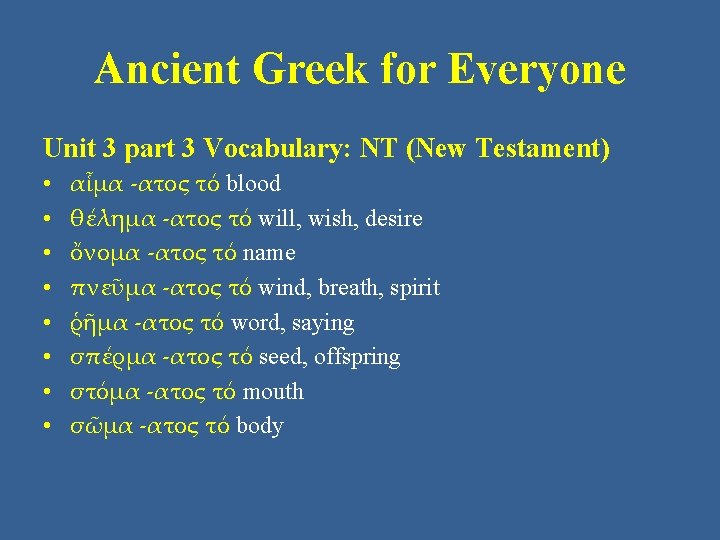
Ancient Greek for Everyone Unit 3 part 3 Vocabulary: NT (New Testament) • • αἷμα -ατος τό blood θέλημα -ατος τό will, wish, desire ὄνομα -ατος τό name πνεῦμα -ατος τό wind, breath, spirit ῥῆμα -ατος τό word, saying σπέρμα -ατος τό seed, offspring στόμα -ατος τό mouth σῶμα -ατος τό body
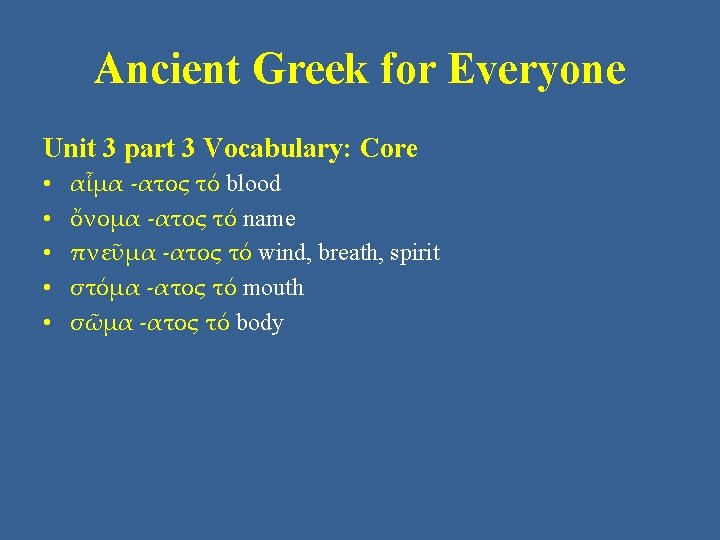
Ancient Greek for Everyone Unit 3 part 3 Vocabulary: Core • • • αἷμα -ατος τό blood ὄνομα -ατος τό name πνεῦμα -ατος τό wind, breath, spirit στόμα -ατος τό mouth σῶμα -ατος τό body