Anatomy project Yongsheng Gao Consultant Terminologist Group meeting

- Slides: 30
Anatomy project Yongsheng Gao Consultant Terminologist Group meeting, 2016/03/22
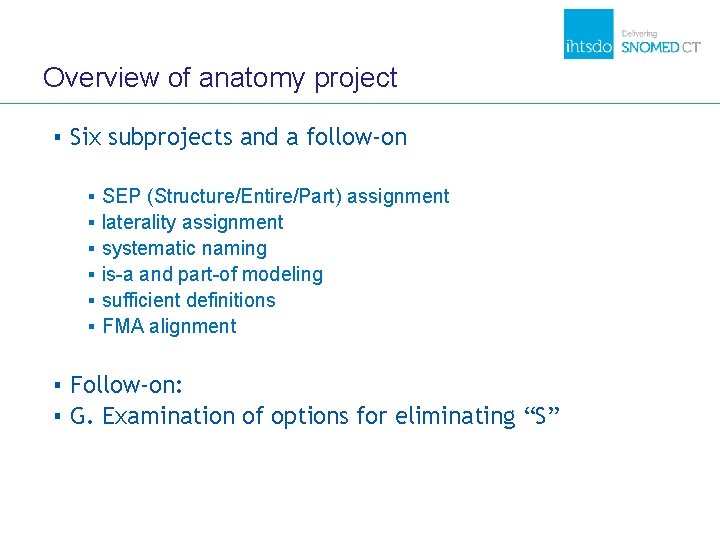
Overview of anatomy project ▪ Six subprojects and a follow-on ▪ ▪ ▪ SEP (Structure/Entire/Part) assignment laterality assignment systematic naming is-a and part-of modeling sufficient definitions FMA alignment ▪ Follow-on: ▪ G. Examination of options for eliminating “S”
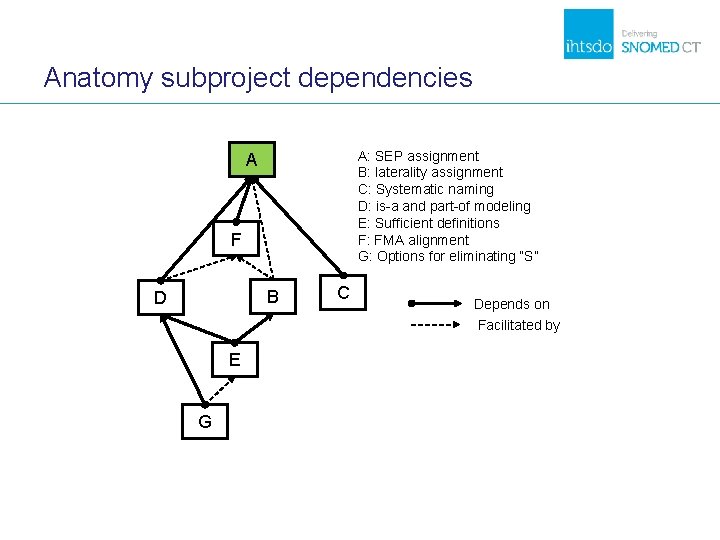
Anatomy subproject dependencies A: SEP assignment B: laterality assignment C: Systematic naming D: is-a and part-of modeling E: Sufficient definitions F: FMA alignment G: Options for eliminating “S” A F B D C Depends on Facilitated by E G
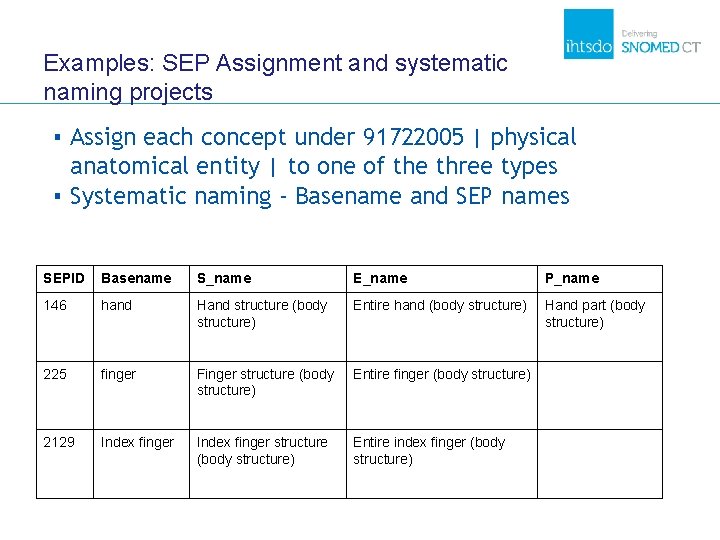
Examples: SEP Assignment and systematic naming projects ▪ Assign each concept under 91722005 | physical anatomical entity | to one of the three types ▪ Systematic naming - Basename and SEP names SEPID Basename S_name E_name P_name 146 hand Hand structure (body structure) Entire hand (body structure) Hand part (body structure) 225 finger Finger structure (body structure) Entire finger (body structure) 2129 Index finger structure (body structure) Entire index finger (body structure)
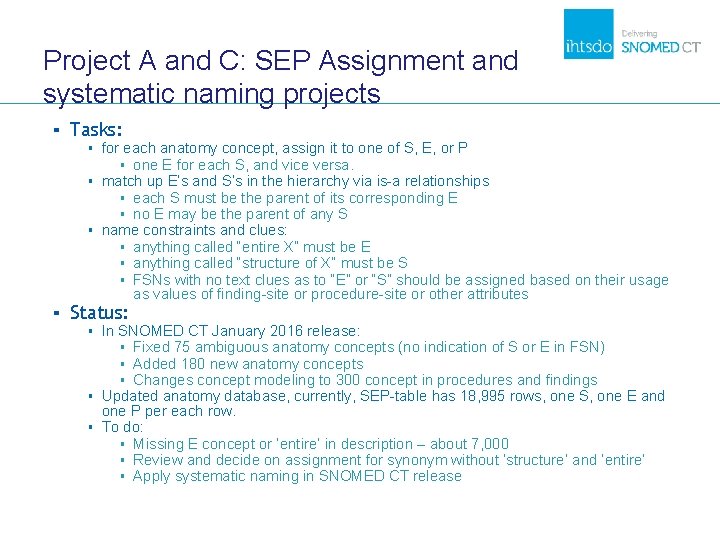
Project A and C: SEP Assignment and systematic naming projects ▪ Tasks: ▪ for each anatomy concept, assign it to one of S, E, or P ▪ one E for each S, and vice versa. ▪ match up E’s and S’s in the hierarchy via is-a relationships ▪ each S must be the parent of its corresponding E ▪ no E may be the parent of any S ▪ name constraints and clues: ▪ anything called “entire X” must be E ▪ anything called “structure of X” must be S ▪ FSNs with no text clues as to “E” or “S” should be assigned based on their usage as values of finding-site or procedure-site or other attributes ▪ Status: ▪ In SNOMED CT January 2016 release: ▪ Fixed 75 ambiguous anatomy concepts (no indication of S or E in FSN) ▪ Added 180 new anatomy concepts ▪ Changes concept modeling to 300 concept in procedures and findings ▪ Updated anatomy database, currently, SEP-table has 18, 995 rows, one S, one E and one P per each row. ▪ To do: ▪ Missing E concept or ‘entire’ in description – about 7, 000 ▪ Review and decide on assignment for synonym without ‘structure’ and ‘entire’ ▪ Apply systematic naming in SNOMED CT release
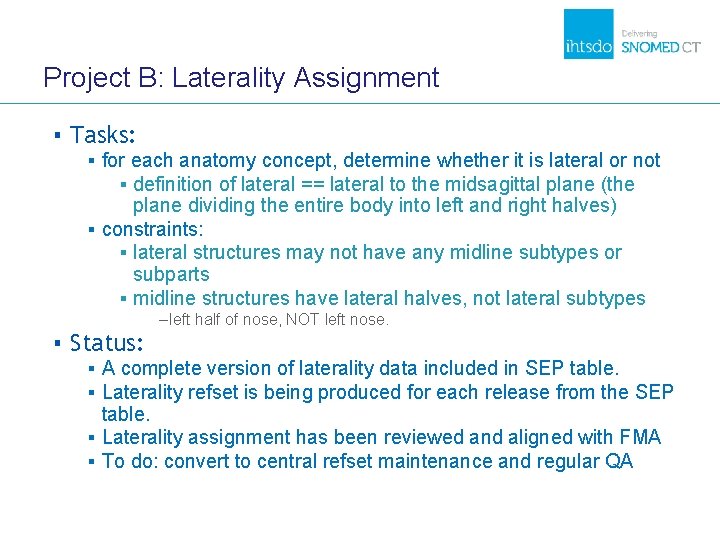
Project B: Laterality Assignment ▪ Tasks: ▪ for each anatomy concept, determine whether it is lateral or not ▪ definition of lateral == lateral to the midsagittal plane (the plane dividing the entire body into left and right halves) ▪ constraints: ▪ lateral structures may not have any midline subtypes or subparts ▪ midline structures have lateral halves, not lateral subtypes – left half of nose, NOT left nose. ▪ Status: ▪ A complete version of laterality data included in SEP table. ▪ Laterality refset is being produced for each release from the SEP table. ▪ Laterality assignment has been reviewed and aligned with FMA ▪ To do: convert to central refset maintenance and regular QA
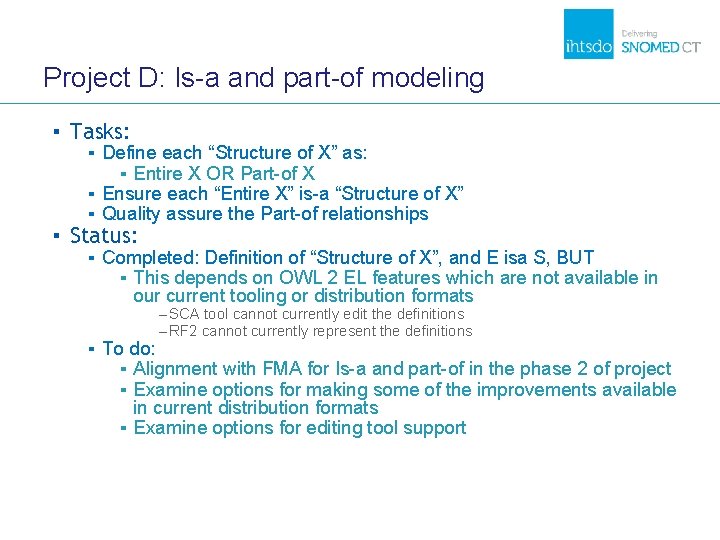
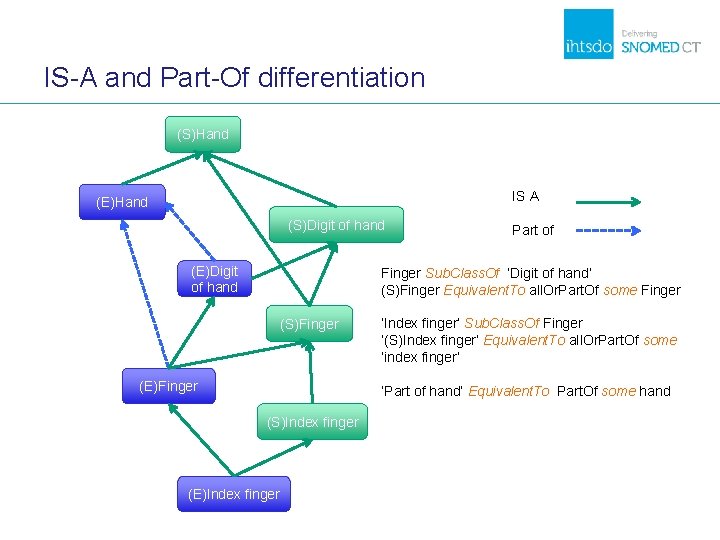
Project D: Is-a and part-of modeling ▪ Tasks: ▪ Define each “Structure of X” as: ▪ Entire X OR Part-of X ▪ Ensure each “Entire X” is-a “Structure of X” ▪ Quality assure the Part-of relationships ▪ Status: ▪ Completed: Definition of “Structure of X”, and E isa S, BUT ▪ This depends on OWL 2 EL features which are not available in our current tooling or distribution formats – SCA tool cannot currently edit the definitions – RF 2 cannot currently represent the definitions ▪ To do: ▪ Alignment with FMA for Is-a and part-of in the phase 2 of project ▪ Examine options for making some of the improvements available in current distribution formats ▪ Examine options for editing tool support
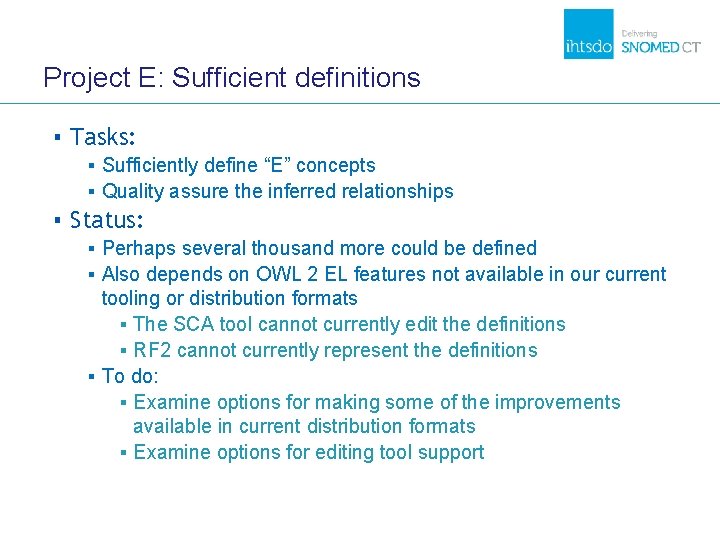
Project E: Sufficient definitions ▪ Tasks: ▪ Sufficiently define “E” concepts ▪ Quality assure the inferred relationships ▪ Status: ▪ Perhaps several thousand more could be defined ▪ Also depends on OWL 2 EL features not available in our current tooling or distribution formats ▪ The SCA tool cannot currently edit the definitions ▪ RF 2 cannot currently represent the definitions ▪ To do: ▪ Examine options for making some of the improvements available in current distribution formats ▪ Examine options for editing tool support
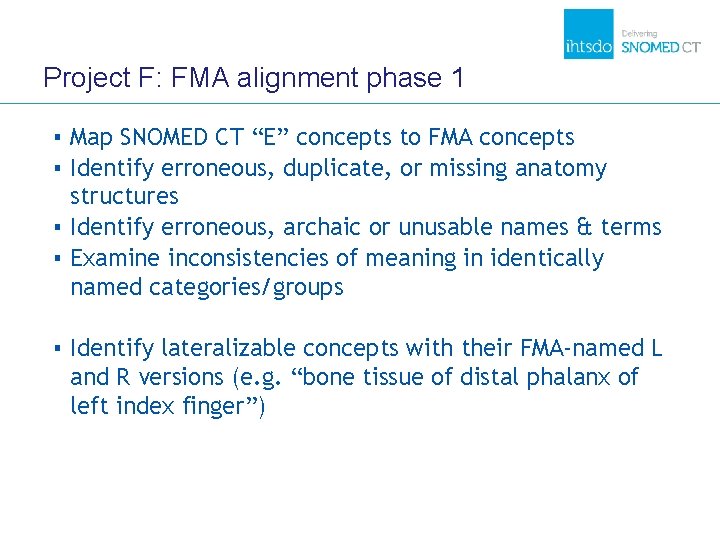
Project F: FMA alignment phase 1 ▪ Map SNOMED CT “E” concepts to FMA concepts ▪ Identify erroneous, duplicate, or missing anatomy structures ▪ Identify erroneous, archaic or unusable names & terms ▪ Examine inconsistencies of meaning in identically named categories/groups ▪ Identify lateralizable concepts with their FMA-named L and R versions (e. g. “bone tissue of distal phalanx of left index finger”)
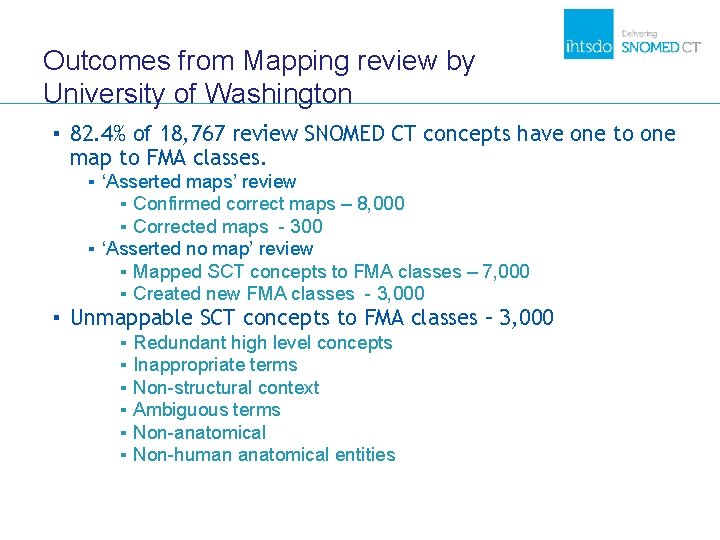
Outcomes from Mapping review by University of Washington ▪ 82. 4% of 18, 767 review SNOMED CT concepts have one to one map to FMA classes. ▪ ‘Asserted maps’ review ▪ Confirmed correct maps – 8, 000 ▪ Corrected maps - 300 ▪ ‘Asserted no map’ review ▪ Mapped SCT concepts to FMA classes – 7, 000 ▪ Created new FMA classes - 3, 000 ▪ Unmappable SCT concepts to FMA classes – 3, 000 ▪ ▪ ▪ Redundant high level concepts Inappropriate terms Non-structural context Ambiguous terms Non-anatomical Non-human anatomical entities
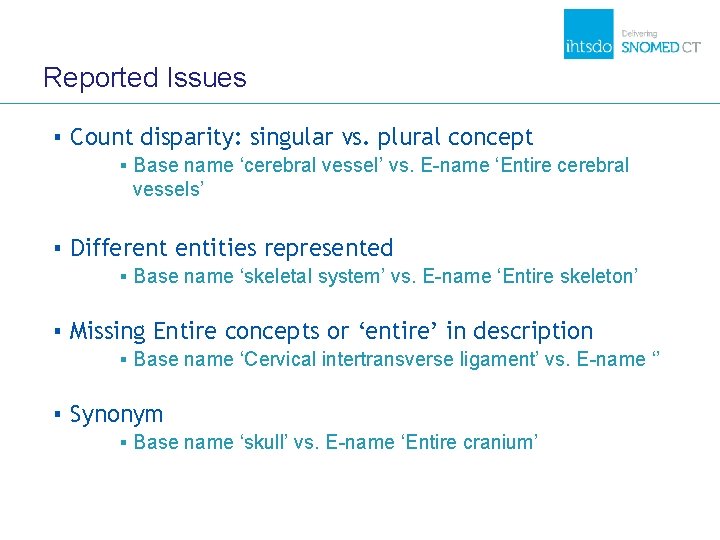
Reported Issues ▪ Count disparity: singular vs. plural concept ▪ Base name ‘cerebral vessel’ vs. E-name ‘Entire cerebral vessels’ ▪ Different entities represented ▪ Base name ‘skeletal system’ vs. E-name ‘Entire skeleton’ ▪ Missing Entire concepts or ‘entire’ in description ▪ Base name ‘Cervical intertransverse ligament’ vs. E-name ‘’ ▪ Synonym ▪ Base name ‘skull’ vs. E-name ‘Entire cranium’
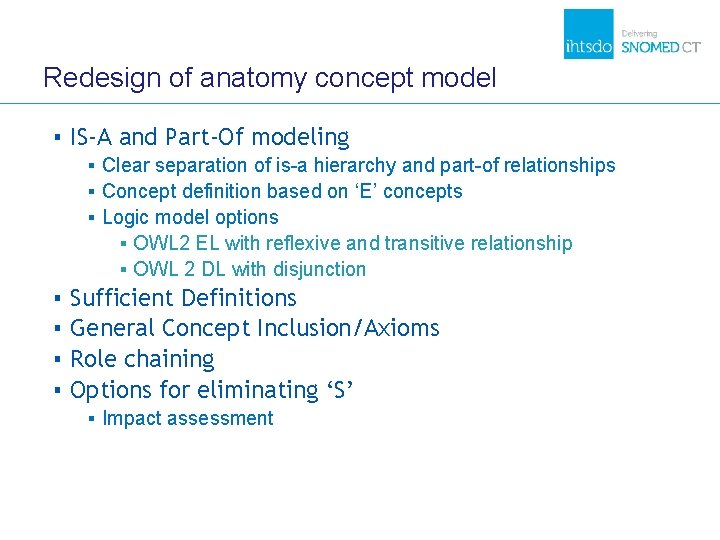
Redesign of anatomy concept model ▪ IS-A and Part-Of modeling ▪ Clear separation of is-a hierarchy and part-of relationships ▪ Concept definition based on ‘E’ concepts ▪ Logic model options ▪ OWL 2 EL with reflexive and transitive relationship ▪ OWL 2 DL with disjunction ▪ ▪ Sufficient Definitions General Concept Inclusion/Axioms Role chaining Options for eliminating ‘S’ ▪ Impact assessment
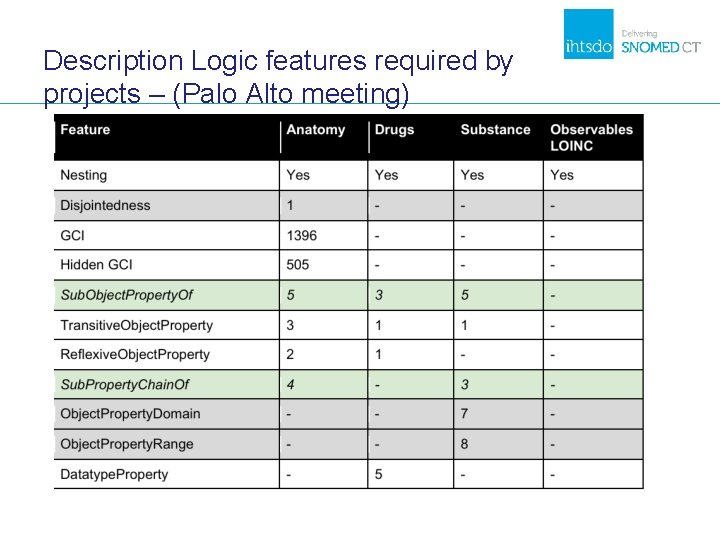
Description Logic features required by projects – (Palo Alto meeting)
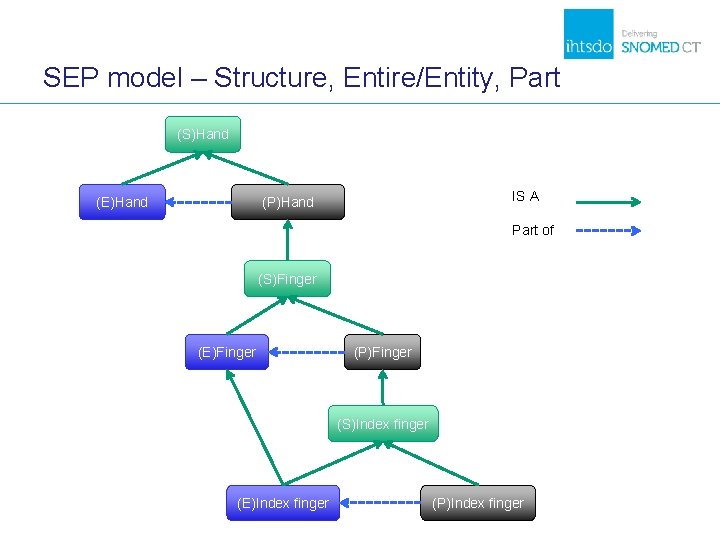
SEP model – Structure, Entire/Entity, Part (S)Hand (E)Hand IS A (P)Hand Part of (S)Finger (E)Finger (P)Finger (S)Index finger (E)Index finger (P)Index finger
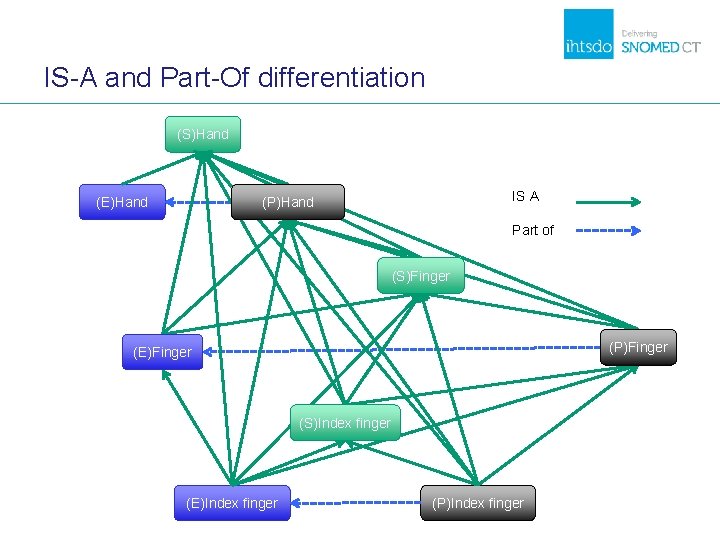
IS-A and Part-Of differentiation (S)Hand (E)Hand IS A (P)Hand Part of (S)Finger (P)Finger (E)Finger (S)Index finger (E)Index finger (P)Index finger
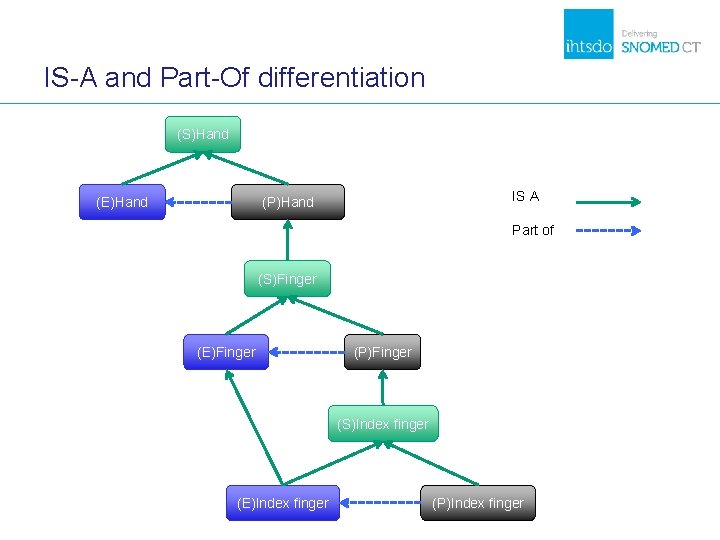
IS-A and Part-Of differentiation (S)Hand (E)Hand IS A (P)Hand Part of (S)Finger (E)Finger (P)Finger (S)Index finger (E)Index finger (P)Index finger
IS-A and Part-Of differentiation (S)Hand IS A (E)Hand (S)Digit of hand (E)Digit of hand Part of Finger Sub. Class. Of ‘Digit of hand’ (S)Finger Equivalent. To all. Or. Part. Of some Finger (S)Finger (E)Finger ‘Index finger’ Sub. Class. Of Finger ‘(S)Index finger’ Equivalent. To all. Or. Part. Of some ‘index finger’ ‘Part of hand’ Equivalent. To Part. Of some hand (S)Index finger (E)Index finger
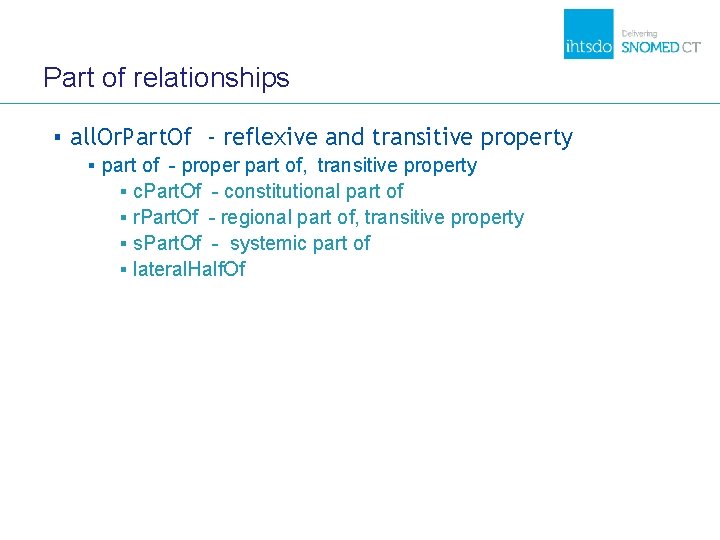
Part of relationships ▪ all. Or. Part. Of - reflexive and transitive property ▪ part of - proper part of, transitive property ▪ c. Part. Of - constitutional part of ▪ r. Part. Of - regional part of, transitive property ▪ s. Part. Of - systemic part of ▪ lateral. Half. Of
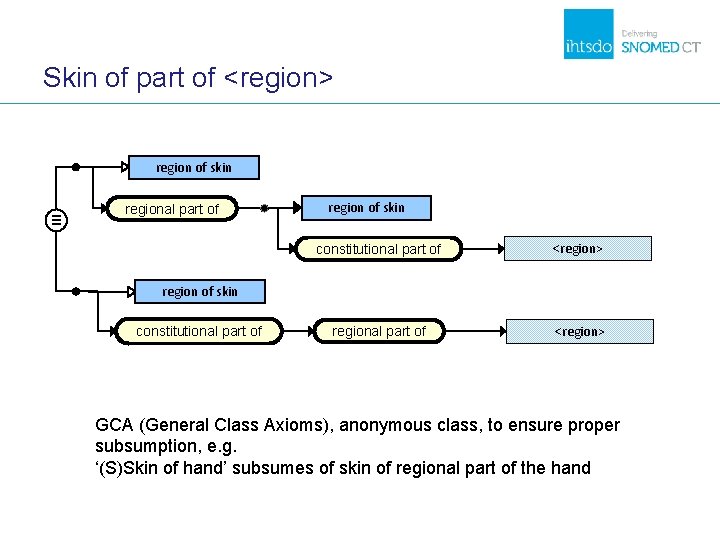
Skin of part of <region> region of skin ≡ regional part of region of skin constitutional part of <region> region of skin constitutional part of GCA (General Class Axioms), anonymous class, to ensure proper subsumption, e. g. ‘(S)Skin of hand’ subsumes of skin of regional part of the hand
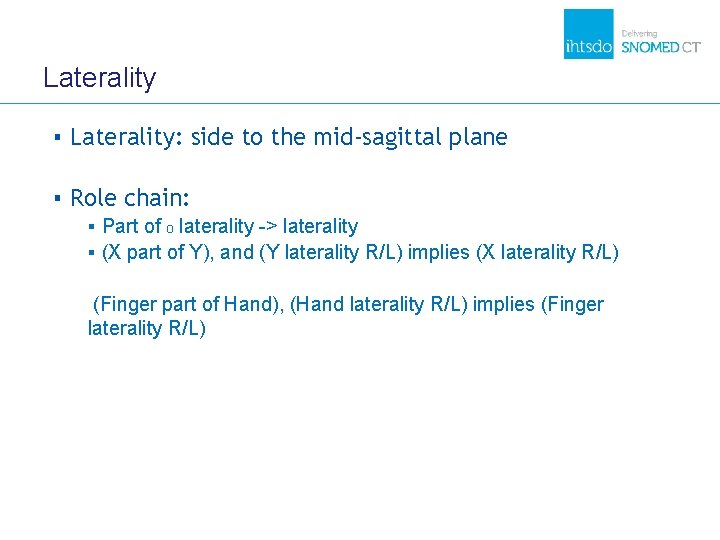
Laterality ▪ Laterality: side to the mid-sagittal plane ▪ Role chain: ▪ Part of o laterality -> laterality ▪ (X part of Y), and (Y laterality R/L) implies (X laterality R/L) (Finger part of Hand), (Hand laterality R/L) implies (Finger laterality R/L)
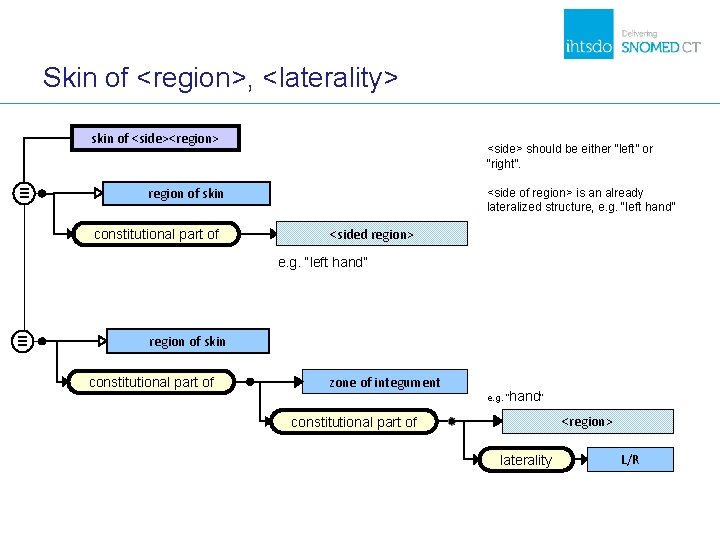
Skin of <region>, <laterality> skin of <side><region> ≡ <side> should be either “left” or “right”. region of skin constitutional part of <side of region> is an already lateralized structure, e. g. “left hand” <sided region> e. g. “left hand” ≡ region of skin constitutional part of zone of integument e. g. “hand” <region> constitutional part of laterality L/R
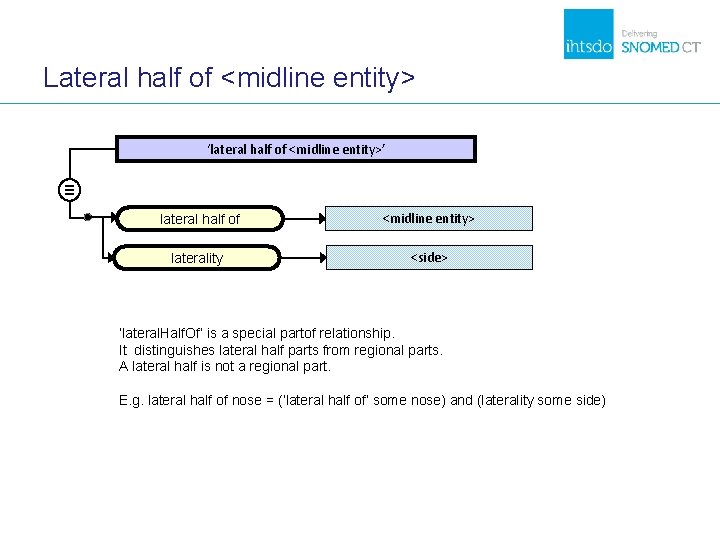
Lateral half of <midline entity> ‘lateral half of <midline entity>’ ≡ lateral half of <midline entity> laterality <side> ‘lateral. Half. Of’ is a special partof relationship. It distinguishes lateral half parts from regional parts. A lateral half is not a regional part. E. g. lateral half of nose = (‘lateral half of’ some nose) and (laterality some side)
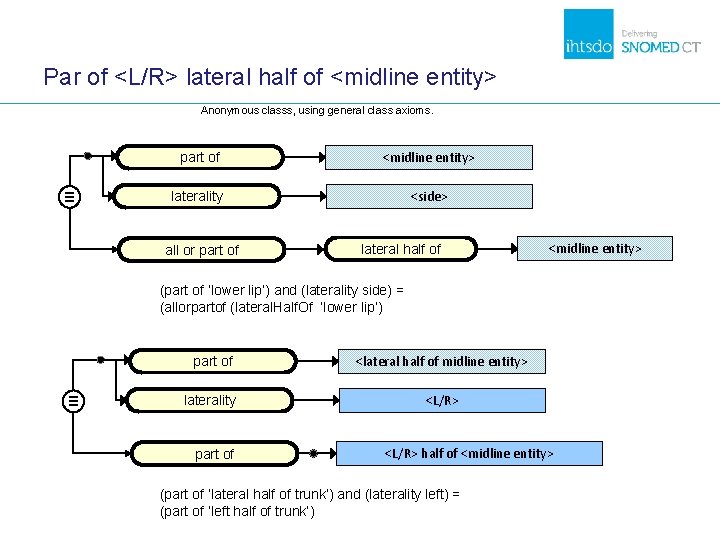
Par of <L/R> lateral half of <midline entity> Anonymous classs, using general class axioms. ≡ part of <midline entity> laterality <side> all or part of lateral half of <midline entity> (part of ‘lower lip’) and (laterality side) = (allorpartof (lateral. Half. Of ‘lower lip’) ≡ part of <lateral half of midline entity> laterality <L/R> part of <L/R> half of <midline entity> (part of ‘lateral half of trunk’) and (laterality left) = (part of ‘left half of trunk’)
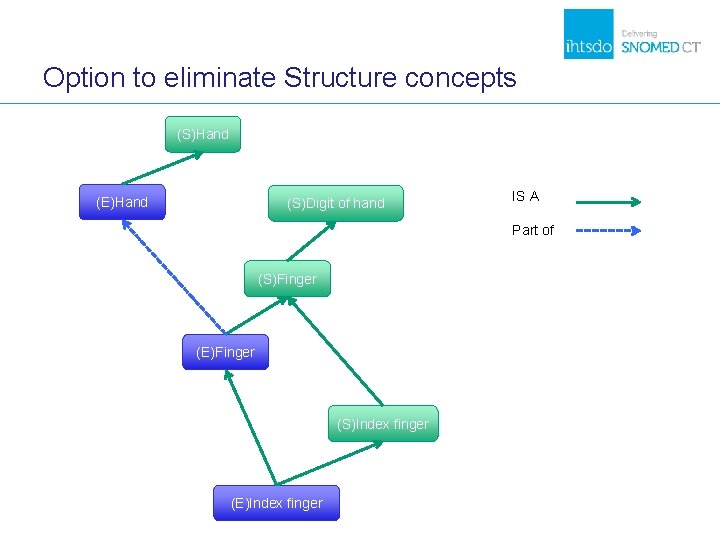
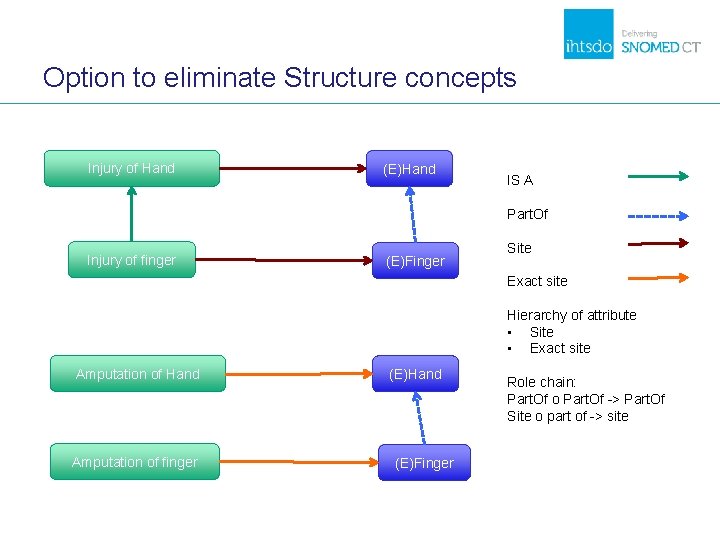
Option to eliminate Structure concepts (S)Hand (E)Hand (S)Digit of hand IS A Part of (S)Finger (E)Finger (S)Index finger (E)Index finger
Option to eliminate Structure concepts Injury of Hand (E)Hand IS A Part. Of Injury of finger (E)Finger Site Exact site Hierarchy of attribute • Site • Exact site Amputation of Hand Amputation of finger (E)Hand (E)Finger Role chain: Part. Of o Part. Of -> Part. Of Site o part of -> site
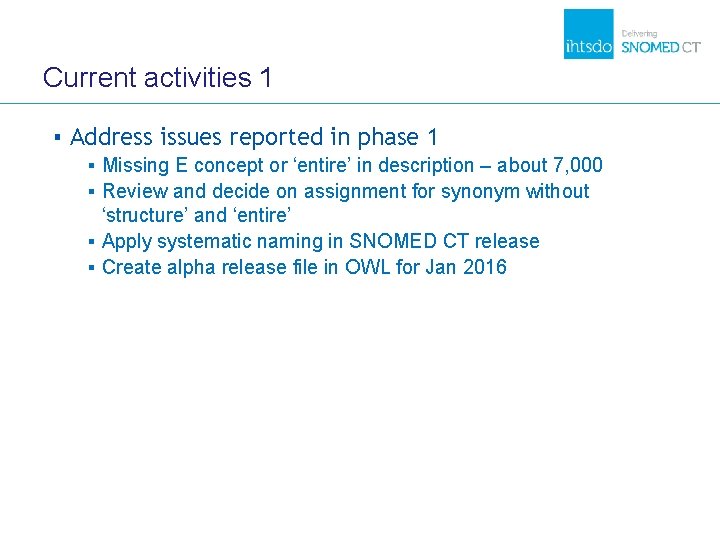
Current activities 1 ▪ Address issues reported in phase 1 ▪ Missing E concept or ‘entire’ in description – about 7, 000 ▪ Review and decide on assignment for synonym without ‘structure’ and ‘entire’ ▪ Apply systematic naming in SNOMED CT release ▪ Create alpha release file in OWL for Jan 2016
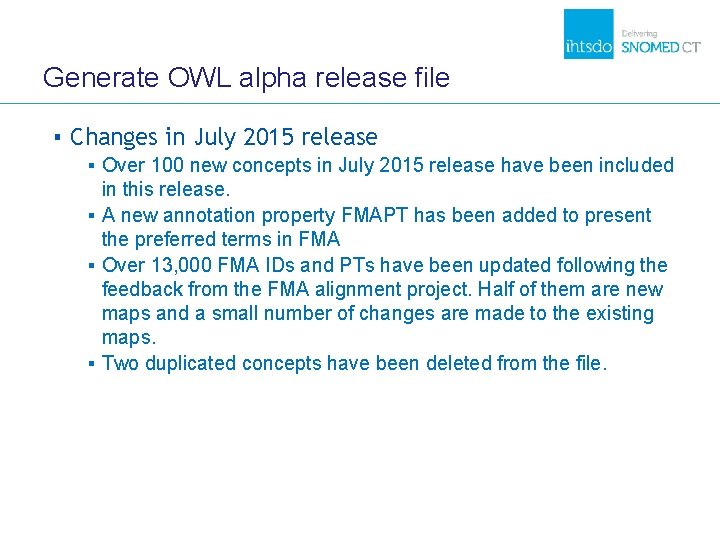
Generate OWL alpha release file ▪ Changes in July 2015 release ▪ Over 100 new concepts in July 2015 release have been included in this release. ▪ A new annotation property FMAPT has been added to present the preferred terms in FMA ▪ Over 13, 000 FMA IDs and PTs have been updated following the feedback from the FMA alignment project. Half of them are new maps and a small number of changes are made to the existing maps. ▪ Two duplicated concepts have been deleted from the file.
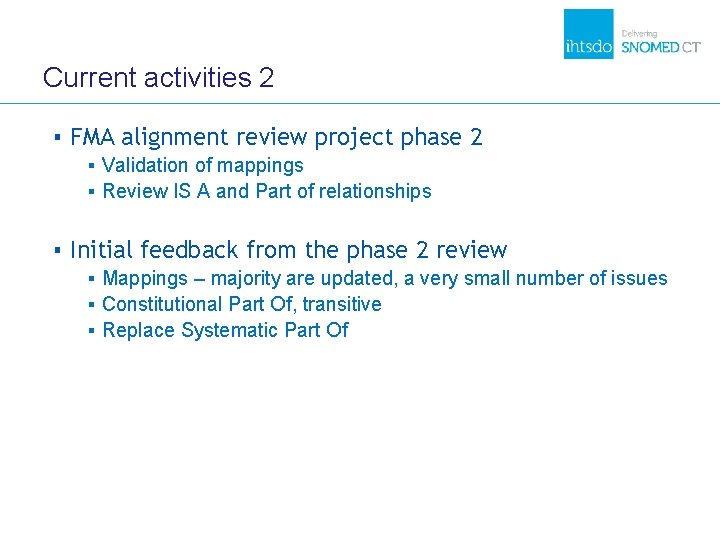
Current activities 2 ▪ FMA alignment review project phase 2 ▪ Validation of mappings ▪ Review IS A and Part of relationships ▪ Initial feedback from the phase 2 review ▪ Mappings – majority are updated, a very small number of issues ▪ Constitutional Part Of, transitive ▪ Replace Systematic Part Of
Current activities 3 ▪ Routine requests management and Internal Quality improvement ▪ Revise anatomy concept model focusing on possibility of eliminating GCI
Dependencies ▪ Completion of review in relation to the FMA ▪ Update of SEP in SNOMED CT ▪ Concept model redesign and update ▪ Release format ▪ Authoring tool