American Red Cross National Capital Region 2 nd
- Slides: 15
American Red Cross – National Capital Region 2 nd Annual Disaster Preparedness Summit “Navigating the New Normal: Key Considerations for Older Adults, Family Caregivers and Human Services Providers Before a Natural Disaster Strikes” Rawle Andrews Jr. , Esq. Regional Vice President, AARP Chair, Disaster Management ERG 28 January 2020 1
OVERVIEW I. New Normal – Current State of Weather & Climate related Natural Disasters and an Aging America II. U. S. Public Sector & First Responders III. Family Caregivers IV. AARP, VOADs and Individual Volunteers V. Recommendations 2
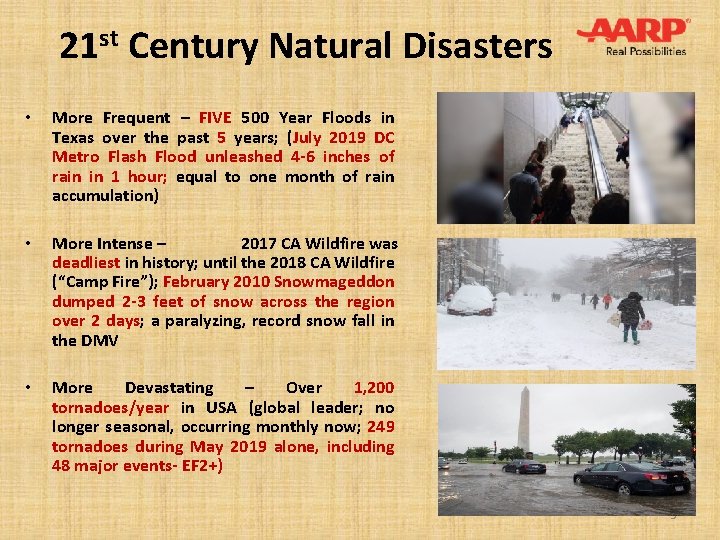
21 st Century Natural Disasters • More Frequent – FIVE 500 Year Floods in Texas over the past 5 years; (July 2019 DC Metro Flash Flood unleashed 4 -6 inches of rain in 1 hour; equal to one month of rain accumulation) • More Intense – 2017 CA Wildfire was deadliest in history; until the 2018 CA Wildfire (“Camp Fire”); February 2010 Snowmageddon dumped 2 -3 feet of snow across the region over 2 days; a paralyzing, record snow fall in the DMV • More Devastating – Over 1, 200 tornadoes/year in USA (global leader; no longer seasonal, occurring monthly now; 249 tornadoes during May 2019 alone, including 48 major events- EF 2+) 3
Extreme Weather Events • Dynamic Technological Gains over the past 20 years; still No way to stop or divert major weather and climate events from landfall • Better intelligence of where the most extreme events are likely to occur • Some improvement in early warning systems and response times (still devastating) • Government/1 st Responder disaster plans too often are “one size fits all” plans (needs of frail elderly and rapidly aging population not really considered; KSAs for 1 st Responders and US Public Health Commissioned Corps et al. must evolve to meet new and emerging demands) • What and Where we build in the US is antiquated for the severity of 21 st Century extreme weather events (The Need: Establish new building codes; retrofit existing structures; better preparation to withstand the next disaster; and increased public outreach to increase awareness of risks, including use or creation of 211 disaster registries to aid 1 st Responders; sharper consumer protection and anti-fraud laws). • Few residents are truly aware of the risks; even fewer making time to prepare • Flooding is the #1 natural disaster in the United States • The “Daily Grind” in the USA does not include Disaster Preparation by individuals, families and communities, particularly on Blue Sky days (need a fire drill mentality) 4
What 2030 Really Means Weather Happens; Systems Fail • A Tragic but familiar narrative: Older Americans and the disabled are disproportionately impacted by Natural Disasters -- q 75% of death toll from Hurricane Katrina were residents 60 and older q Nearly 50% of death toll from Hurricane Sandy were residents 60 older q Median Age of 2018 CA Camp Fire victim was 71 years old (avg. age of victim in 2017 CA wild fire was 73) • Older adults with chronic conditions also suffer Life-threatening indignities q Medical appointments cancelled (e. g. , dialysis) q Power outages adversely affect refrigerated medicine (e. g. , insulin) and in-home medical equipment • Power Outages are the Norm in Disasters q Awareness of aging is growing, but no one really knows where the elderly and disabled reside outside of Institutions q Older Adults are the least likely to evacuate q Priority Restoration programs by energy companies only work if NHs/ALFs are on the list before the disaster; and these lists are shared with 1 st Responders 5
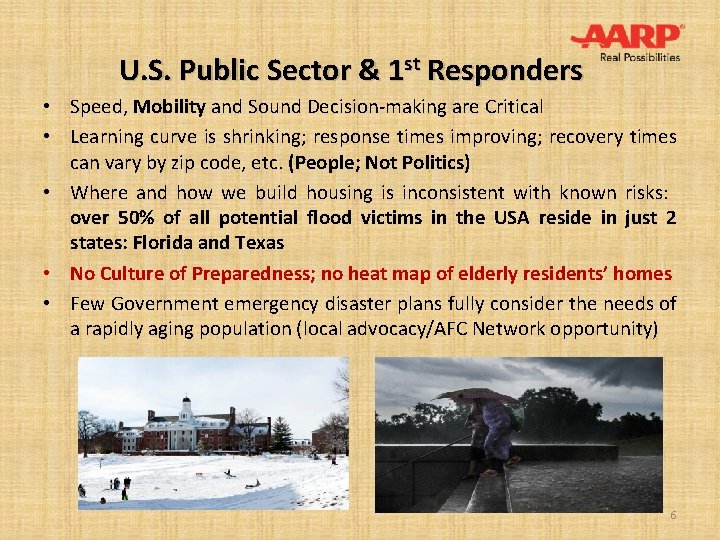
U. S. Public Sector & 1 st Responders • Speed, Mobility and Sound Decision-making are Critical • Learning curve is shrinking; response times improving; recovery times can vary by zip code, etc. (People; Not Politics) • Where and how we build housing is inconsistent with known risks: over 50% of all potential flood victims in the USA reside in just 2 states: Florida and Texas • No Culture of Preparedness; no heat map of elderly residents’ homes • Few Government emergency disaster plans fully consider the needs of a rapidly aging population (local advocacy/AFC Network opportunity) 6
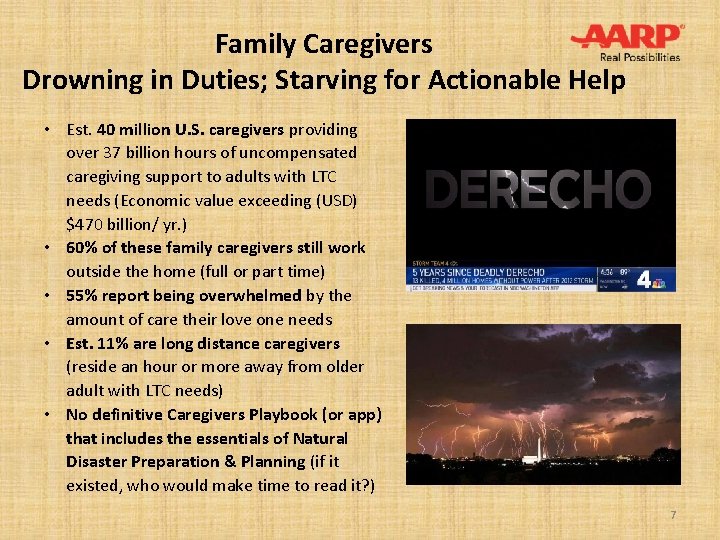
Family Caregivers Drowning in Duties; Starving for Actionable Help • Est. 40 million U. S. caregivers providing over 37 billion hours of uncompensated caregiving support to adults with LTC needs (Economic value exceeding (USD) $470 billion/ yr. ) • 60% of these family caregivers still work outside the home (full or part time) • 55% report being overwhelmed by the amount of care their love one needs • Est. 11% are long distance caregivers (reside an hour or more away from older adult with LTC needs) • No definitive Caregivers Playbook (or app) that includes the essentials of Natural Disaster Preparation & Planning (if it existed, who would make time to read it? ) 7
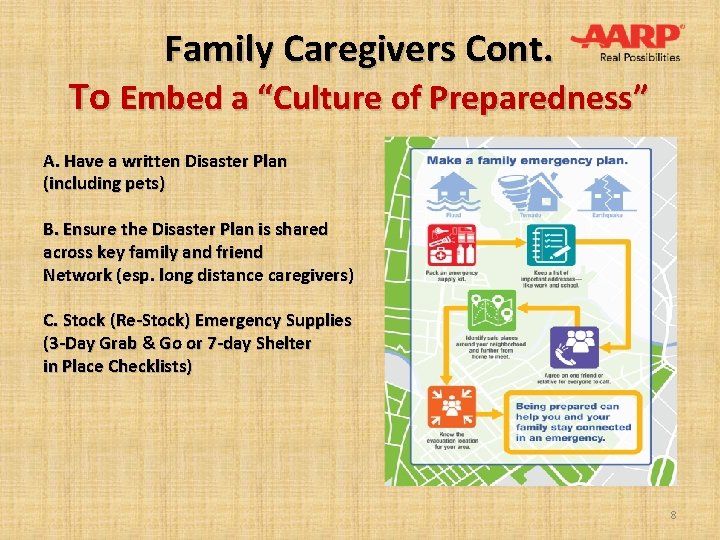
Family Caregivers Cont. To Embed a “Culture of Preparedness” A. Have a written Disaster Plan (including pets) B. Ensure the Disaster Plan is shared across key family and friend Network (esp. long distance caregivers) C. Stock (Re-Stock) Emergency Supplies (3 -Day Grab & Go or 7 -day Shelter in Place Checklists) 8
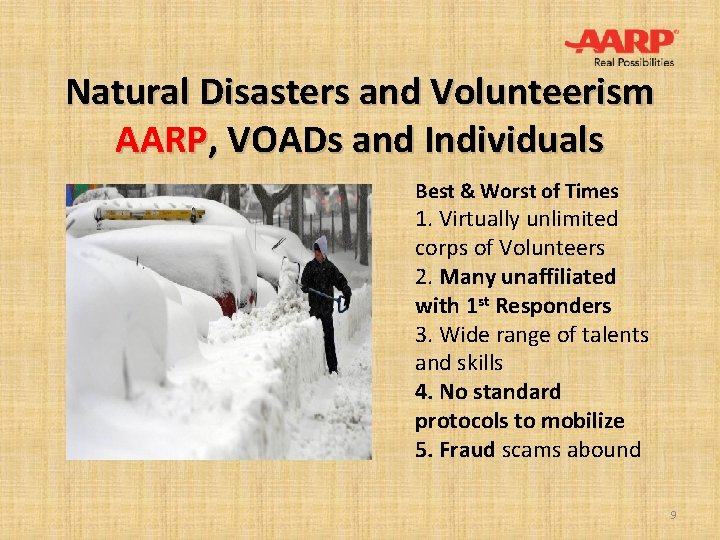
Natural Disasters and Volunteerism AARP, VOADs and Individuals Best & Worst of Times 1. Virtually unlimited corps of Volunteers 2. Many unaffiliated with 1 st Responders 3. Wide range of talents and skills 4. No standard protocols to mobilize 5. Fraud scams abound 9
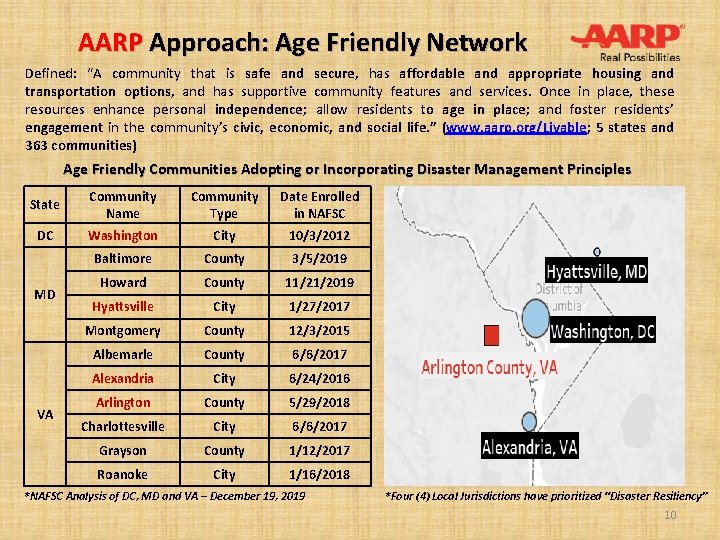
AARP Approach: Age Friendly Network Defined: “A community that is safe and secure, has affordable and appropriate housing and transportation options, and has supportive community features and services. Once in place, these resources enhance personal independence; allow residents to age in place; and foster residents’ engagement in the community’s civic, economic, and social life. ” (www. aarp. org/Livable; 5 states and 363 communities) Age Friendly Communities Adopting or Incorporating Disaster Management Principles State Community Name Community Type Date Enrolled in NAFSC DC Washington City 10/3/2012 Baltimore County 3/5/2019 Howard County 11/21/2019 Hyattsville City 1/27/2017 Montgomery County 12/3/2015 Albemarle County 6/6/2017 Alexandria City 6/24/2016 Arlington County 5/29/2018 Charlottesville City 6/6/2017 Grayson County 1/12/2017 Roanoke City 1/16/2018 MD VA *NAFSC Analysis of DC, MD and VA – December 19, 2019 *Four (4) Local Jurisdictions have prioritized “Disaster Resiliency” 10
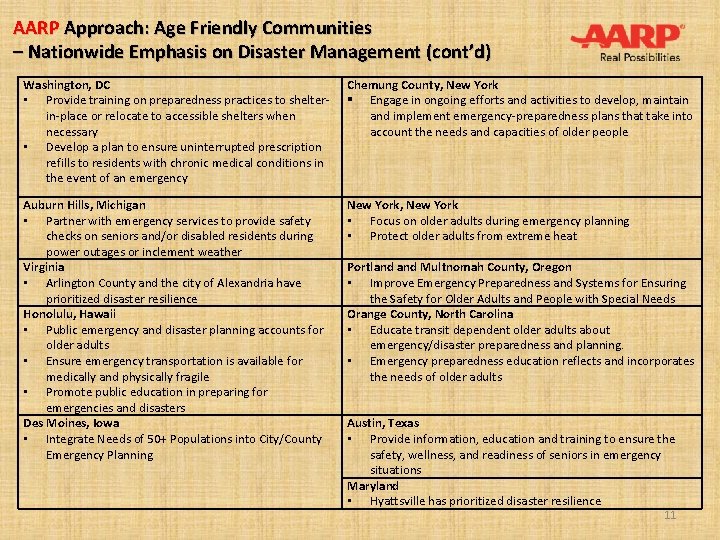
AARP Approach: Age Friendly Communities – Nationwide Emphasis on Disaster Management (cont’d) Washington, DC • Provide training on preparedness practices to shelterin-place or relocate to accessible shelters when necessary • Develop a plan to ensure uninterrupted prescription refills to residents with chronic medical conditions in the event of an emergency Chemung County, New York § Engage in ongoing efforts and activities to develop, maintain and implement emergency-preparedness plans that take into account the needs and capacities of older people Auburn Hills, Michigan • Partner with emergency services to provide safety checks on seniors and/or disabled residents during power outages or inclement weather Virginia • Arlington County and the city of Alexandria have prioritized disaster resilience Honolulu, Hawaii • Public emergency and disaster planning accounts for older adults • Ensure emergency transportation is available for medically and physically fragile • Promote public education in preparing for emergencies and disasters Des Moines, Iowa • Integrate Needs of 50+ Populations into City/County Emergency Planning New York, New York • Focus on older adults during emergency planning • Protect older adults from extreme heat Portland Multnomah County, Oregon • Improve Emergency Preparedness and Systems for Ensuring the Safety for Older Adults and People with Special Needs Orange County, North Carolina • Educate transit dependent older adults about emergency/disaster preparedness and planning. • Emergency preparedness education reflects and incorporates the needs of older adults Austin, Texas • Provide information, education and training to ensure the safety, wellness, and readiness of seniors in emergency situations Maryland • Hyattsville has prioritized disaster resilience 11
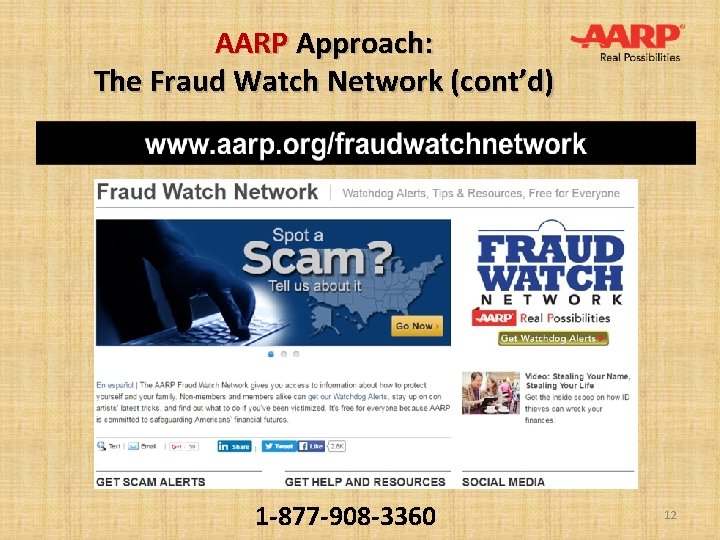
AARP Approach: The Fraud Watch Network (cont’d) 1 -877 -908 -3360 12
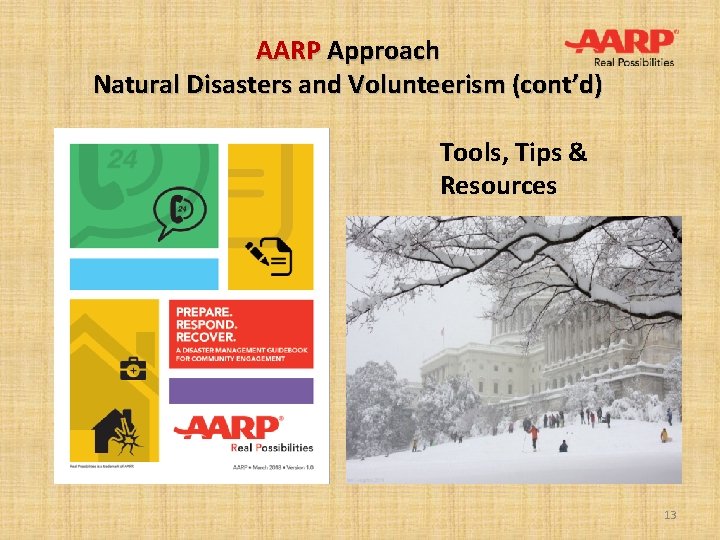
AARP Approach Natural Disasters and Volunteerism (cont’d) Tools, Tips & Resources 13
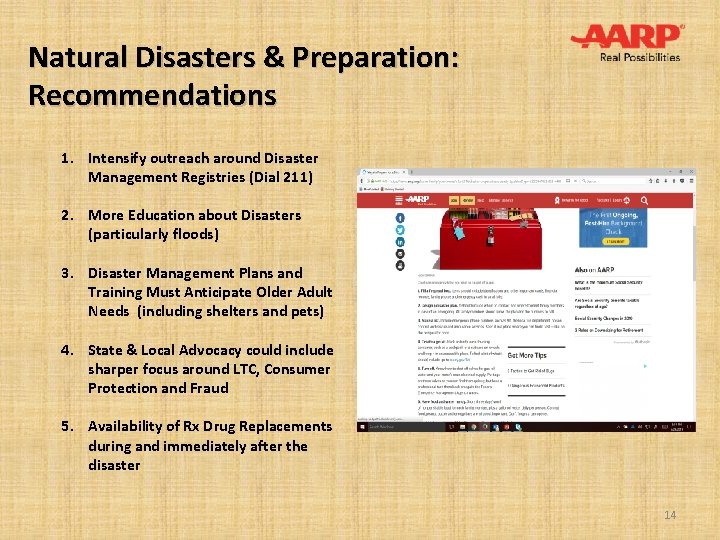
Natural Disasters & Preparation: Recommendations 1. Intensify outreach around Disaster Management Registries (Dial 211) 2. More Education about Disasters (particularly floods) 3. Disaster Management Plans and Training Must Anticipate Older Adult Needs (including shelters and pets) 4. State & Local Advocacy could include sharper focus around LTC, Consumer Protection and Fraud 5. Availability of Rx Drug Replacements during and immediately after the disaster 14
Q&A 15