All Teach All Learn Milnes Primary School 2019
- Slides: 15
All Teach, All Learn Milne’s Primary School 2019 – 2020 Session: Maths “Beyond Number”
Numeracy and Mathematics �Maths is an important part of our curriculum and is taught daily in all classes. �Staff modify the programmes of study to give all pupils relevant and appropriately challenging work at each level. �Where possible real life situations and experiences are used by teachers to make the children's learning more meaningful. �We all use mathematics in our everyday life. We need to highlight this and use this as rich teaching opportunities.
Organisers �Number and Number Processes �Estimating and Rounding �Fractions, Decimal Fractions and Percentages �Multiples, Factors and Primes �Patterns and Relationships �Expressions and Equations �Money �Measurement �Time �Properties of 2 D Shapes and 3 D Objects �Angles, Symmetry and Transformation �Data and Analysis �Ideas of Chance and Uncertainty
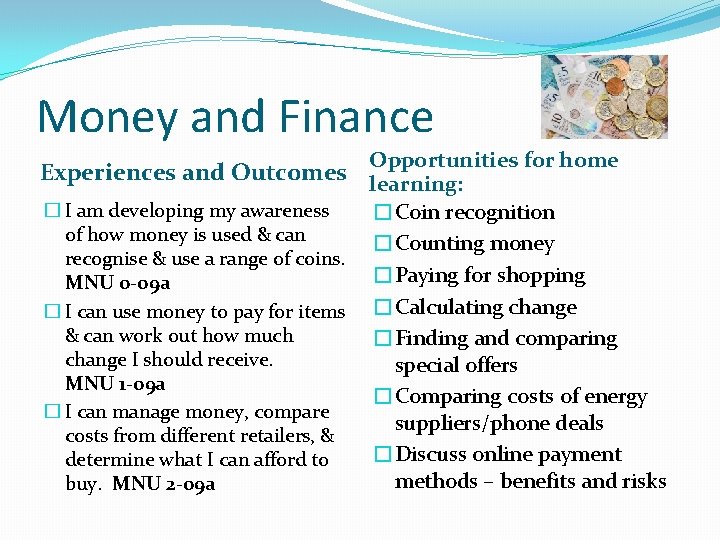
Money and Finance Opportunities for home Experiences and Outcomes learning: � I am developing my awareness �Coin recognition of how money is used & can �Counting money recognise & use a range of coins. �Paying for shopping MNU 0 -09 a � I can use money to pay for items �Calculating change & can work out how much �Finding and comparing change I should receive. special offers MNU 1 -09 a �Comparing costs of energy � I can manage money, compare suppliers/phone deals costs from different retailers, & �Discuss online payment determine what I can afford to methods – benefits and risks buy. MNU 2 -09 a
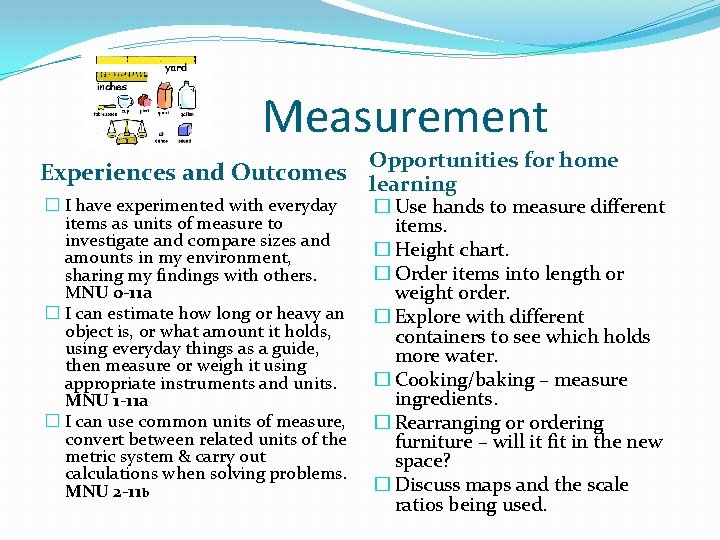
Measurement Opportunities for home Experiences and Outcomes learning � I have experimented with everyday items as units of measure to investigate and compare sizes and amounts in my environment, sharing my findings with others. MNU 0 -11 a � I can estimate how long or heavy an object is, or what amount it holds, using everyday things as a guide, then measure or weigh it using appropriate instruments and units. MNU 1 -11 a � I can use common units of measure, convert between related units of the metric system & carry out calculations when solving problems. MNU 2 -11 b � Use hands to measure different items. � Height chart. � Order items into length or weight order. � Explore with different containers to see which holds more water. � Cooking/baking – measure ingredients. � Rearranging or ordering furniture – will it fit in the new space? � Discuss maps and the scale ratios being used.
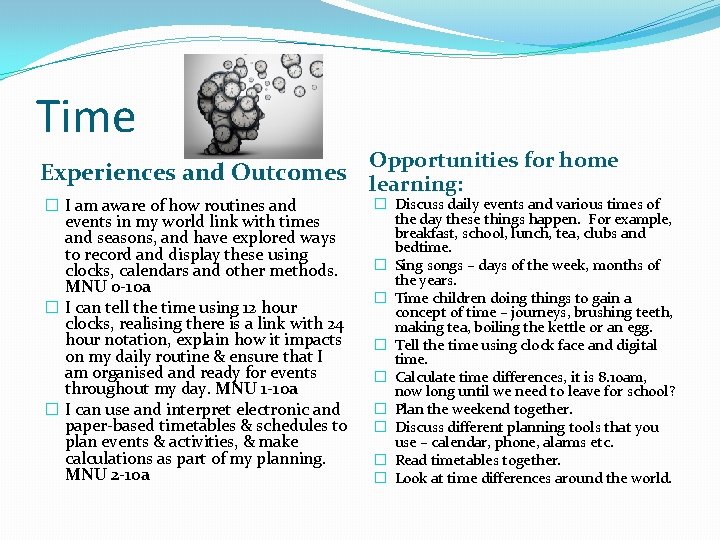
Time Opportunities for home Experiences and Outcomes learning: � I am aware of how routines and events in my world link with times and seasons, and have explored ways to record and display these using clocks, calendars and other methods. MNU 0 -10 a � I can tell the time using 12 hour clocks, realising there is a link with 24 hour notation, explain how it impacts on my daily routine & ensure that I am organised and ready for events throughout my day. MNU 1 -10 a � I can use and interpret electronic and paper-based timetables & schedules to plan events & activities, & make calculations as part of my planning. MNU 2 -10 a � Discuss daily events and various times of the day these things happen. For example, breakfast, school, lunch, tea, clubs and bedtime. � Sing songs – days of the week, months of the years. � Time children doing things to gain a concept of time – journeys, brushing teeth, making tea, boiling the kettle or an egg. � Tell the time using clock face and digital time. � Calculate time differences, it is 8. 10 am, now long until we need to leave for school? � Plan the weekend together. � Discuss different planning tools that you use – calendar, phone, alarms etc. � Read timetables together. � Look at time differences around the world.
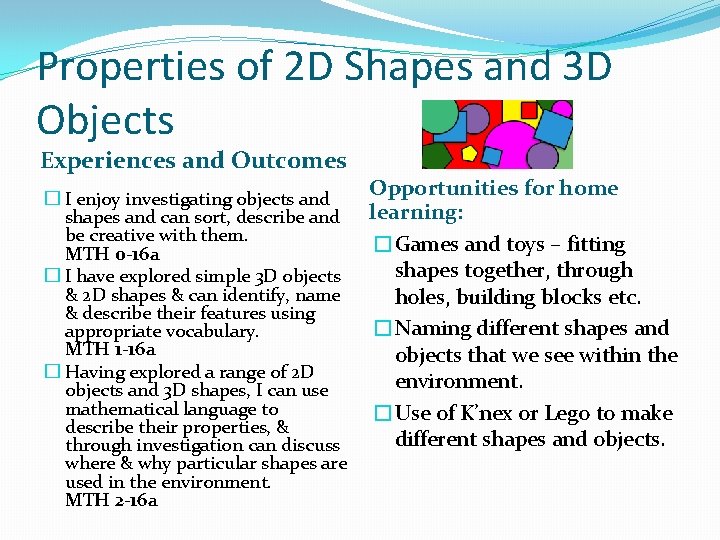
Properties of 2 D Shapes and 3 D Objects Experiences and Outcomes Opportunities for home � I enjoy investigating objects and shapes and can sort, describe and learning: be creative with them. �Games and toys – fitting MTH 0 -16 a shapes together, through � I have explored simple 3 D objects & 2 D shapes & can identify, name holes, building blocks etc. & describe their features using �Naming different shapes and appropriate vocabulary. MTH 1 -16 a objects that we see within the � Having explored a range of 2 D environment. objects and 3 D shapes, I can use mathematical language to �Use of K’nex or Lego to make describe their properties, & different shapes and objects. through investigation can discuss where & why particular shapes are used in the environment. MTH 2 -16 a
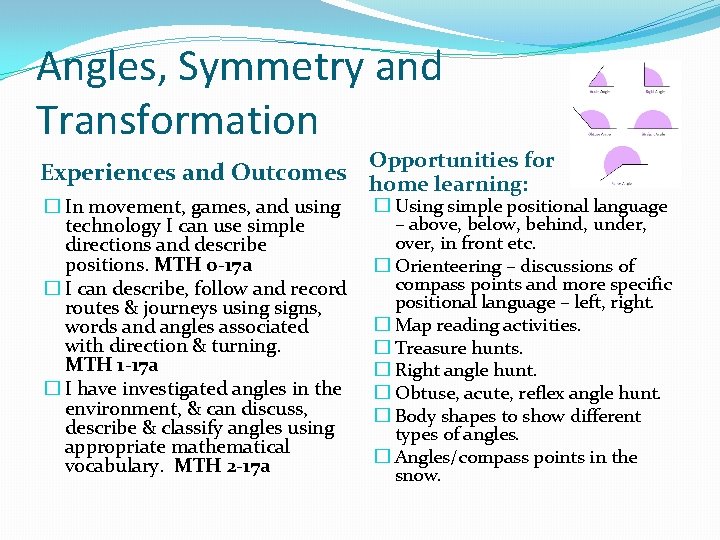
Angles, Symmetry and Transformation Opportunities for Experiences and Outcomes home learning: � In movement, games, and using technology I can use simple directions and describe positions. MTH 0 -17 a � I can describe, follow and record routes & journeys using signs, words and angles associated with direction & turning. MTH 1 -17 a � I have investigated angles in the environment, & can discuss, describe & classify angles using appropriate mathematical vocabulary. MTH 2 -17 a � Using simple positional language – above, below, behind, under, over, in front etc. � Orienteering – discussions of compass points and more specific positional language – left, right. � Map reading activities. � Treasure hunts. � Right angle hunt. � Obtuse, acute, reflex angle hunt. � Body shapes to show different types of angles. � Angles/compass points in the snow.
Ideas of Chance and Uncertainty Opportunities for home Experiences and Outcomes learning: � I can use appropriate vocabulary to describe the likelihood of events occurring, using the knowledge and experiences of myself and others to guide me. MNU 1 -22 a � I can conduct simple experiments involving chance and communicate my predictions and findings using the vocabulary of probability. MNU 2 -22 a � Discuss the likelihood of things happening, for example, snow in June or rain in November. � Discuss ratios, for example, blondes: brunettes, boys: girls or 9 yrs: 10 yrs. � Experiment and explore – cards games – chances of turning a red one or dice games – rolling an even number. � Certain, Likely, Even Chance, Unlikely, Impossible.
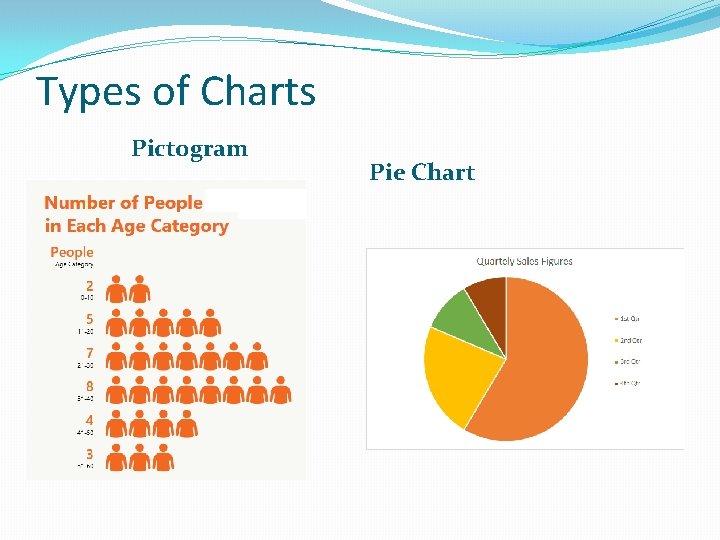
Data and Analysis �Graphs and Charts �A picture, so they say, will tell a thousand words. But what about a graph or chart? �A good graph or chart can show as much as several paragraphs of words. But how do you choose which style of graph to use? Examples: � Bar graphs to show numbers that are independent of each other. Example data might include things like the number of people who preferred each of Chinese takeaways, Indian takeaways and fish and chips. � Pie charts to show you how a whole is divided into different parts. You might, for example, want to show a budget had been spent on different items in a particular year. � Line graphs show you how numbers have changed over time. They are used when you have data that are connected, and to show trends, for example, average night time temperature in each month of the year. � Venn Diagrams � Scatter Graphs � Pictograms � Timetables � Co-ordinates
Types of Charts Pictogram Pie Chart
Links Across the Curriculum/School: � Estimating and Rounding – Money in Enterprise, Rough amounts of resources the school needs to purchase, Quickly adding to get the rough totals of i. e. rationing costs in the War, Costs of smoking 20 cigarettes a day, Rough time to play a game if each child’s turn takes ~5 mins � Fractions/Decimal Fractions/Percentages – Accessing info from sources i. e. ‘First News’ newspaper, Tax, Being able to interpret charts, Comparing parts of a whole or two bits of data � Shapes and Patterns – Tiling & mosaics in Roman Britain, Islamic patterns, Poems, Patterns in numbers (1. 2, 1. 4, 1. 6…), Patterns in music (i. e. clapping a rhythm), Patterns in Art (Escher/Klimt) � Money – Comparing costs of i. e. recently sold works of art, Understanding how to budget (enterprise), Counting up money raised during a charity fundraiser, Coins from around the world (display), Costs of things mentioned in the news/Newsround, Need vs. Want, Ways to save � Measurement – Measuring shelving for refurbishing library, Measuring area for new Polytunnel, Deciding how long the perimeter fence might need to be, Length/width/area of new class carpet � Time – When things happened in history/how long ago, How long until lunch/PE/Election, When certain events happen/in which season (Sports Day, Christmas Song Showcase), How to say the months/days in French, When different clubs are on (and on what days), Dates for Diary � Shapes/Angles/Symmetry – Designing, Making 3 D shapes/pie charts, Engineering skills and Problem solving, Looking at architecture and Still Life in Art, Making body shapes in dance, Finding symmetry in nature studies (leaves, butterfly wings)
Recent Research/Maths in the News �A poll for the Maths Anxiety Trust, conducted in 2018, found more than a third of 15 - to 24 - year-olds feel anxious when shown a maths problem. The same applies to one in five British adults. �“Doing mathematics is a bit like playing sport or learning a musical instrument. You can’t do it well immediately – it requires practice. Think of having a mathematical muscle in your mind that with practice gradually gets stronger. Mathematics is everywhere, so whatever you enjoy doing you might find interesting mathematics bubbling underneath. ” Article ‘Reckon you were born without a brain for maths? Highly unlikely’ (March 2019) �“Whilst studying the relation between brain size and brain power, scientists have discovered that bees, even with tiny brains, can do basic mathematics. ” (Feb 2019) �Article: If you can follow a simple cake recipe. . . then you can do applied mathematics (Dr Cheng, May 2015) �US professor becomes the first woman to win prestigious Abel Prize for mathematics (March 2019)
Take Home Messages: �Say your thinking/workings out loud (‘I’m trying to decide if it’s better value to buy the 200 ml or 500 ml jar. ’/ ‘I’m trying to work out how much time and money a dog would cost if we do get one for Christmas…’) �Point out maths in ‘real life’ – it’s actually everywhere! �Talk about how you use maths in your job/life/on the news �Talk about how hard it would be to do things/the consequences if you did not understand maths – ‘If I couldn’t (understand the time)…. I wouldn’t be able to (read the cinema timetable)…. and that might mean that I (miss the start of the film/miss the last bus home)…. ’ �A little and often can really make an impact �Make it fun and relevant to the child – ‘I hear you go on Santa’s naughty list if you’re not good 85% of the time…’