AFSC RPA Ecosystem Surveys Gulf of Alaska Eastern

- Slides: 12
AFSC RPA Ecosystem Surveys: Gulf of Alaska, Eastern Bering Sea, Arctic Alaska Fisheries Science Center Presenter: Janet Duffy-Anderson (Eco. FOCI) SSC Workshop – Research Priorities January 28, 2020 Seattle, WA
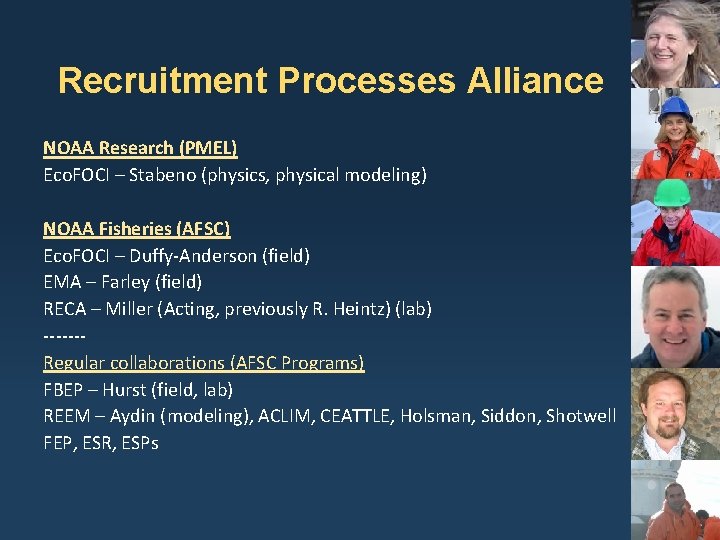
Recruitment Processes Alliance NOAA Research (PMEL) Eco. FOCI – Stabeno (physics, physical modeling) NOAA Fisheries (AFSC) Eco. FOCI – Duffy-Anderson (field) EMA – Farley (field) RECA – Miller (Acting, previously R. Heintz) (lab) ------Regular collaborations (AFSC Programs) FBEP – Hurst (field, lab) REEM – Aydin (modeling), ACLIM, CEATTLE, Holsman, Siddon, Shotwell FEP, ESR, ESPs
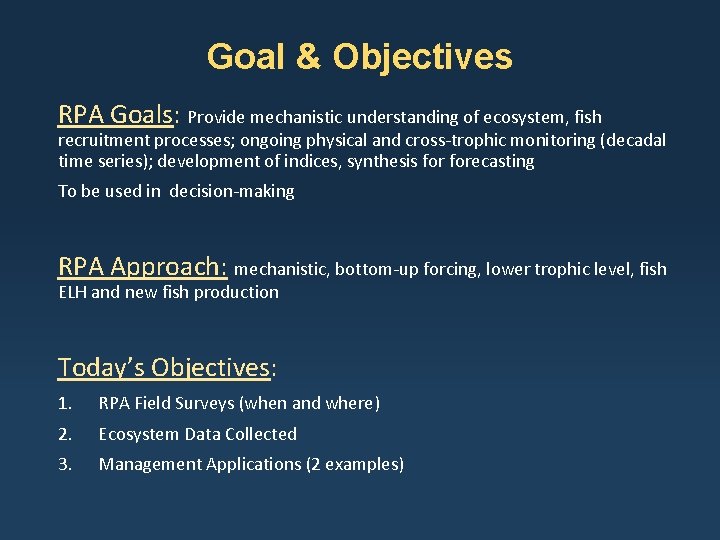
Goal & Objectives RPA Goals: Provide mechanistic understanding of ecosystem, fish recruitment processes; ongoing physical and cross-trophic monitoring (decadal time series); development of indices, synthesis forecasting To be used in decision-making RPA Approach: mechanistic, bottom-up forcing, lower trophic level, fish ELH and new fish production Today’s Objectives: 1. RPA Field Surveys (when and where) 2. Ecosystem Data Collected 3. Management Applications (2 examples)
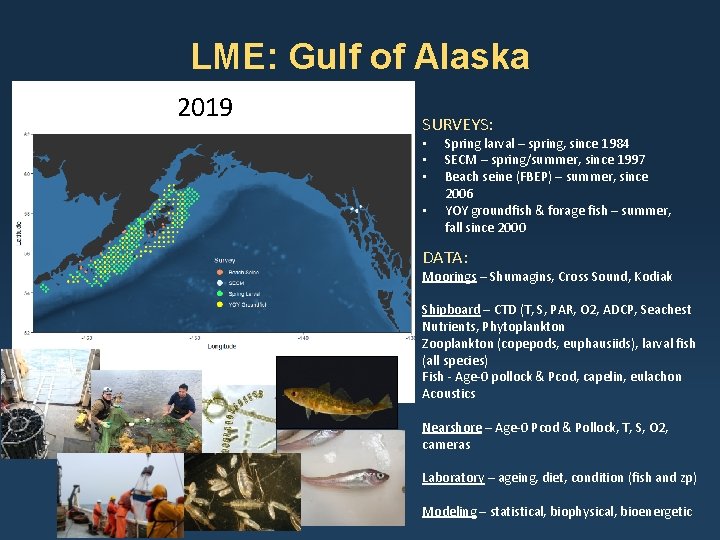
LME: Gulf of Alaska 2019 SURVEYS: • • Spring larval – spring, since 1984 SECM – spring/summer, since 1997 Beach seine (FBEP) – summer, since 2006 YOY groundfish & forage fish – summer, fall since 2000 DATA: Moorings – Shumagins, Cross Sound, Kodiak Shipboard – CTD (T, S, PAR, O 2, ADCP, Seachest Nutrients, Phytoplankton Zooplankton (copepods, euphausiids), larval fish (all species) Fish - Age-0 pollock & Pcod, capelin, eulachon Acoustics Nearshore – Age-0 Pcod & Pollock, T, S, O 2, cameras Laboratory – ageing, diet, condition (fish and zp) Modeling – statistical, biophysical, bioenergetic
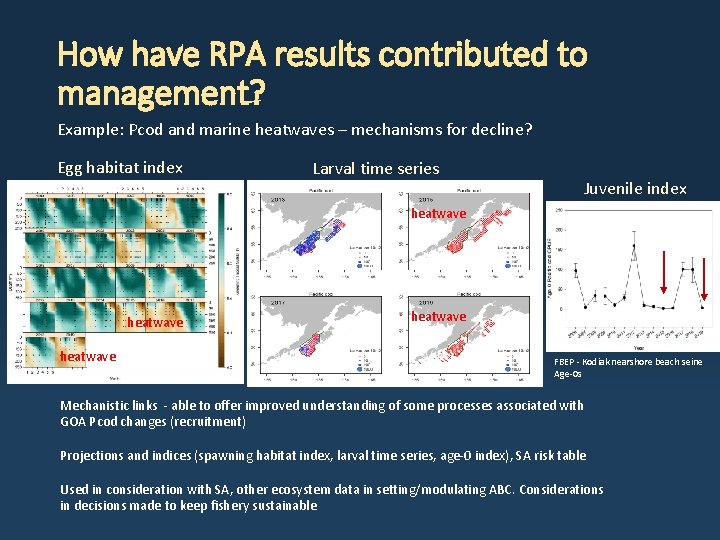
How have RPA results contributed to management? Example: Pcod and marine heatwaves – mechanisms for decline? Egg habitat index Larval time series Juvenile index heatwave FBEP - Kodiak nearshore beach seine Age-0 s Mechanistic links - able to offer improved understanding of some processes associated with GOA Pcod changes (recruitment) Projections and indices (spawning habitat index, larval time series, age-0 index), SA risk table Used in consideration with SA, other ecosystem data in setting/modulating ABC. Considerations in decisions made to keep fishery sustainable
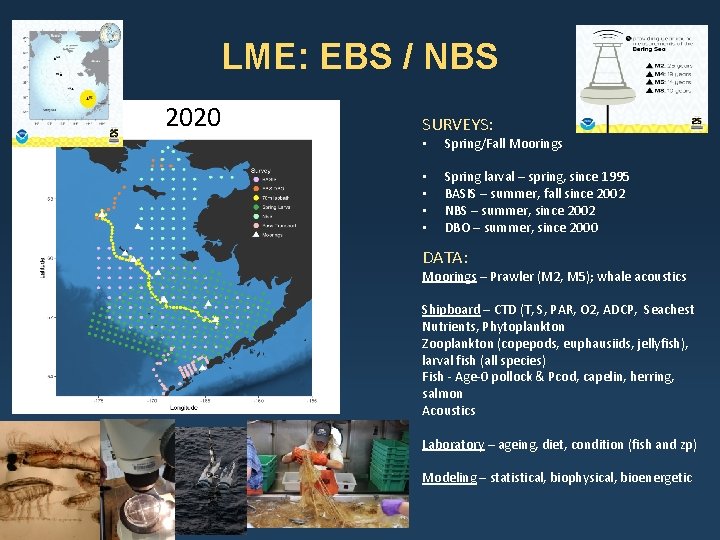
LME: EBS / NBS 2020 SURVEYS: • Spring/Fall Moorings • • Spring larval – spring, since 1995 BASIS – summer, fall since 2002 NBS – summer, since 2002 DBO – summer, since 2000 DATA: Moorings – Prawler (M 2, M 5); whale acoustics Shipboard – CTD (T, S, PAR, O 2, ADCP, Seachest Nutrients, Phytoplankton Zooplankton (copepods, euphausiids, jellyfish), larval fish (all species) Fish - Age-0 pollock & Pcod, capelin, herring, salmon Acoustics Laboratory – ageing, diet, condition (fish and zp) Modeling – statistical, biophysical, bioenergetic
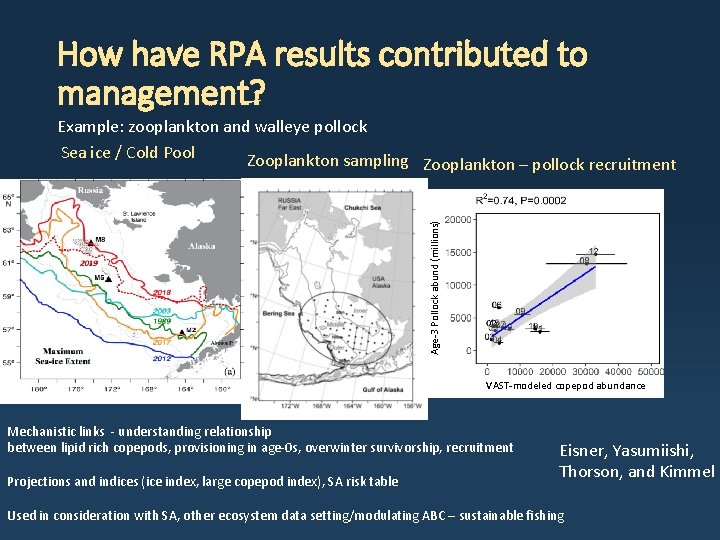
How have RPA results contributed to management? Zooplankton – pollock recruitment Age-3 Pollock abund (millions) Example: zooplankton and walleye pollock Sea ice / Cold Pool Zooplankton sampling VAST-modeled copepod abundance Mechanistic links - understanding relationship between lipid rich copepods, provisioning in age-0 s, overwinter survivorship, recruitment Projections and indices (ice index, large copepod index), SA risk table Eisner, Yasumiishi, Thorson, and Kimmel Used in consideration with SA, other ecosystem data setting/modulating ABC – sustainable fishing
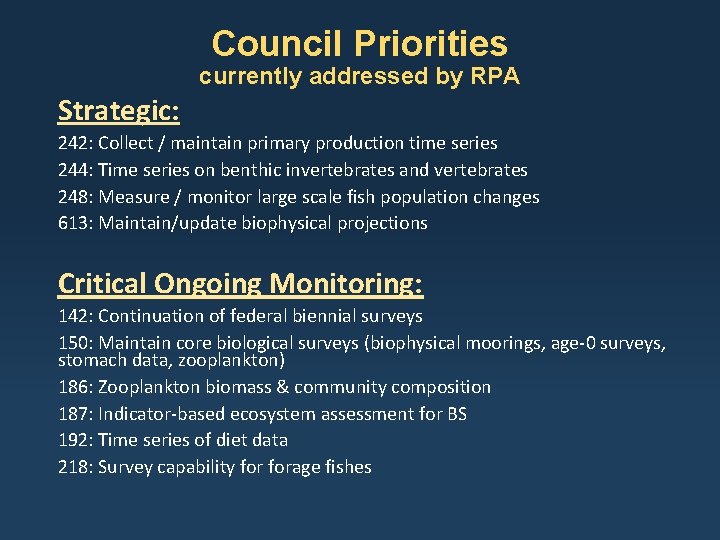
Council Priorities currently addressed by RPA Strategic: 242: Collect / maintain primary production time series 244: Time series on benthic invertebrates and vertebrates 248: Measure / monitor large scale fish population changes 613: Maintain/update biophysical projections Critical Ongoing Monitoring: 142: Continuation of federal biennial surveys 150: Maintain core biological surveys (biophysical moorings, age-0 surveys, stomach data, zooplankton) 186: Zooplankton biomass & community composition 187: Indicator-based ecosystem assessment for BS 192: Time series of diet data 218: Survey capability forage fishes
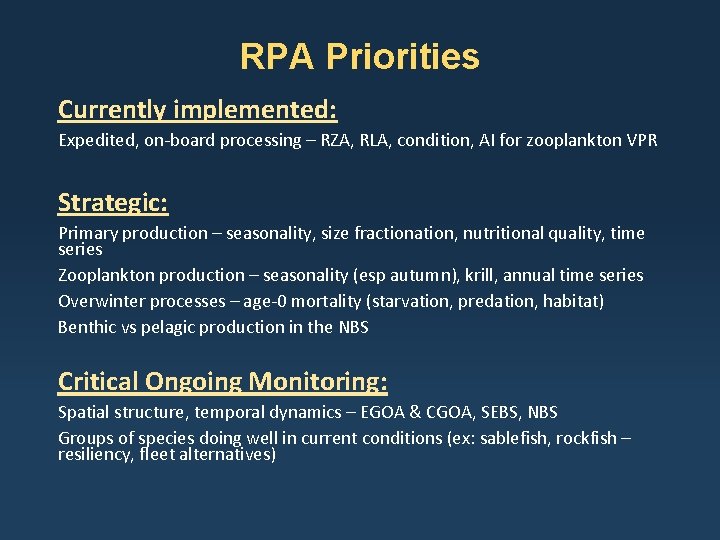
RPA Priorities Currently implemented: Expedited, on-board processing – RZA, RLA, condition, AI for zooplankton VPR Strategic: Primary production – seasonality, size fractionation, nutritional quality, time series Zooplankton production – seasonality (esp autumn), krill, annual time series Overwinter processes – age-0 mortality (starvation, predation, habitat) Benthic vs pelagic production in the NBS Critical Ongoing Monitoring: Spatial structure, temporal dynamics – EGOA & CGOA, SEBS, NBS Groups of species doing well in current conditions (ex: sablefish, rockfish – resiliency, fleet alternatives)
THANK YOU
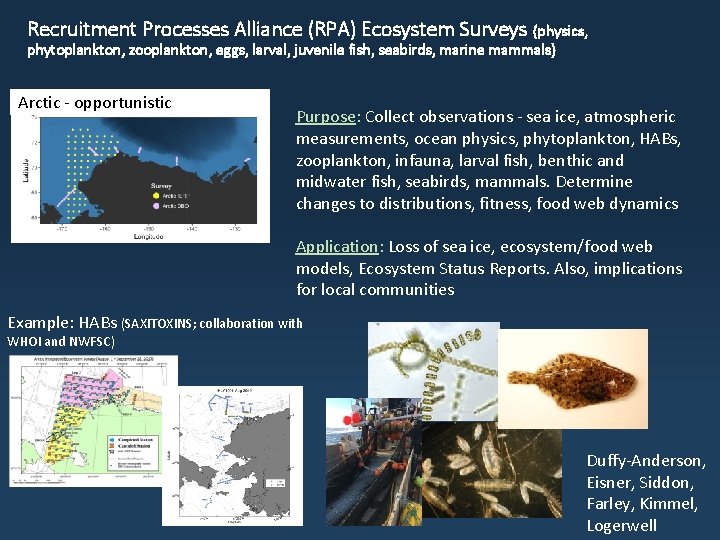
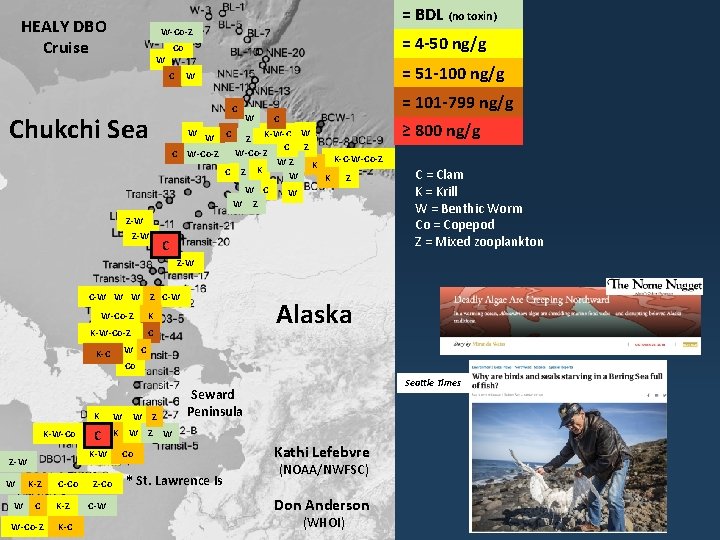
Recruitment Processes Alliance (RPA) Ecosystem Surveys (physics, phytoplankton, zooplankton, eggs, larval, juvenile fish, seabirds, marine mammals) Arctic - opportunistic Purpose: Collect observations - sea ice, atmospheric measurements, ocean physics, phytoplankton, HABs, zooplankton, infauna, larval fish, benthic and midwater fish, seabirds, mammals. Determine changes to distributions, fitness, food web dynamics Application: Loss of sea ice, ecosystem/food web models, Ecosystem Status Reports. Also, implications for local communities Example: HABs (SAXITOXINS; collaboration with WHOI and NWFSC) Duffy-Anderson, Eisner, Siddon, Farley, Kimmel, Logerwell
= BDL (no toxin) HEALY DBO Cruise W-Co-Z Co W = 51 -100 ng/g W C C Chukchi Sea Z-W = 4 -50 ng/g W C W W C Z K-W-C C Z W-Co-Z C W-Co-Z K-C-W-Co-Z WZ K C Z K W K Z W C W W Z W C = 101 -799 ng/g ≥ 800 ng/g C = Clam K = Krill W = Benthic Worm Co = Copepod Z = Mixed zooplankton Z-W C-W W W Z C-W W-Co-Z K K-W-Co-Z C K-C K K-W-Co K-W Z-W W W C K-Z C-Co C K-Z W-Co-Z K-C Z-Co C-W Alaska W C Co W W Z K W Z W Seattle Times Seward Peninsula Co * St. Lawrence Is Kathi Lefebvre (NOAA/NWFSC) Don Anderson (WHOI)