AFM 31130 STDM Cost Volume Profit Analysis CVP

- Slides: 18
AFM 31130 STDM Cost Volume Profit Analysis (CVP) By Isuru Manawadu B. Sc in Accounting Sp. (USJP), ACA, 1
Learning Outcomes After studying this session you will be able to: üUnderstanding Marginal Costing üUnderstand Absorption Costing üDistinguish between marginal costing and absorption costing üDetermine BEP and margin of safety üPrepare different types of break even charts
Marginal Costing Marginal costing is a costing technique where only variable or direct cost will be charged to the cost unit produced. In Marginal costing, fixed costs are never charged to production. They are treated as period charge and is written off to the comprehensive income statement (P & L) in the period incurred. 3
Marginal Costing Cont… Ø Under variable or direct costing, the fixed manufacturing overhead costs are not allocated or assigned to (not absorbed by) the products manufactured. Ø Variable costing is often management's decision-making. useful for
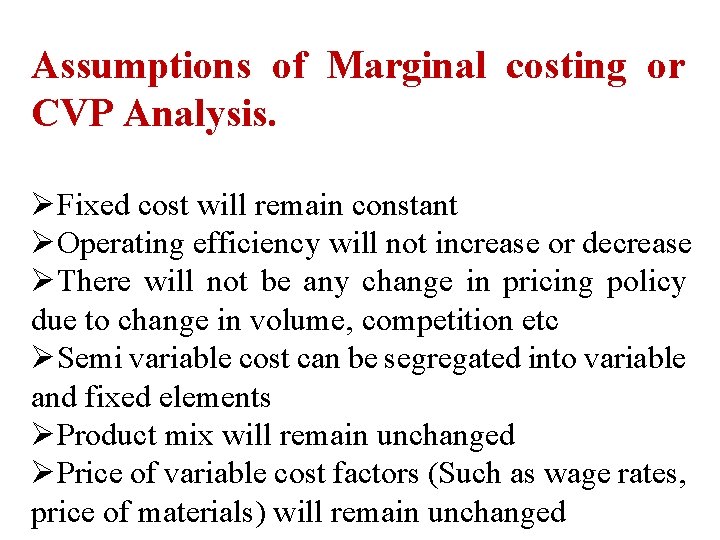
Assumptions of Marginal costing or CVP Analysis. ØFixed cost will remain constant ØOperating efficiency will not increase or decrease ØThere will not be any change in pricing policy due to change in volume, competition etc ØSemi variable cost can be segregated into variable and fixed elements ØProduct mix will remain unchanged ØPrice of variable cost factors (Such as wage rates, price of materials) will remain unchanged
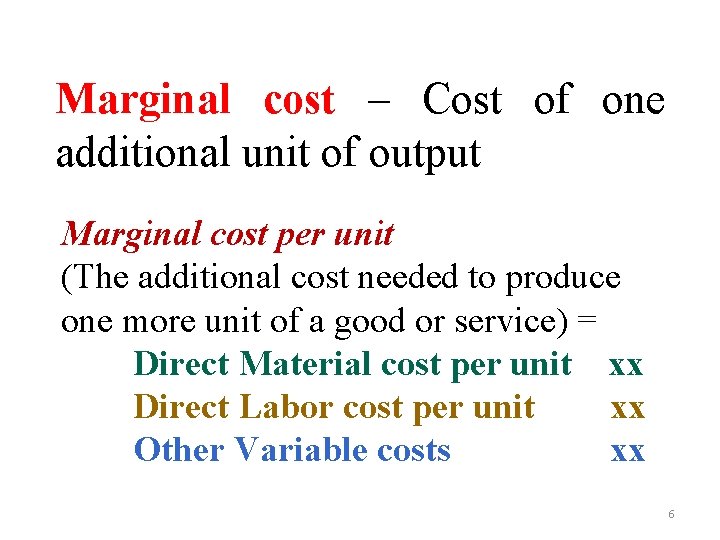
Marginal cost – Cost of one additional unit of output Marginal cost per unit (The additional cost needed to produce one more unit of a good or service) = Direct Material cost per unit xx Direct Labor cost per unit xx Other Variable costs xx 6
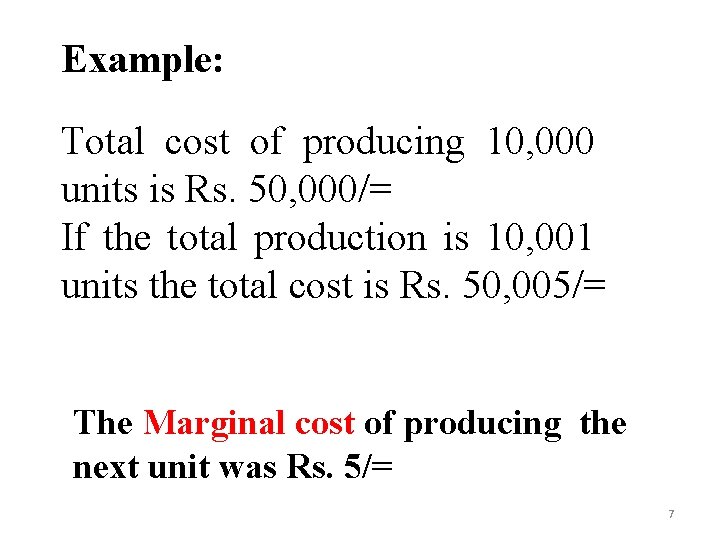
Example: Total cost of producing 10, 000 units is Rs. 50, 000/= If the total production is 10, 001 units the total cost is Rs. 50, 005/= The Marginal cost of producing the next unit was Rs. 5/= 7
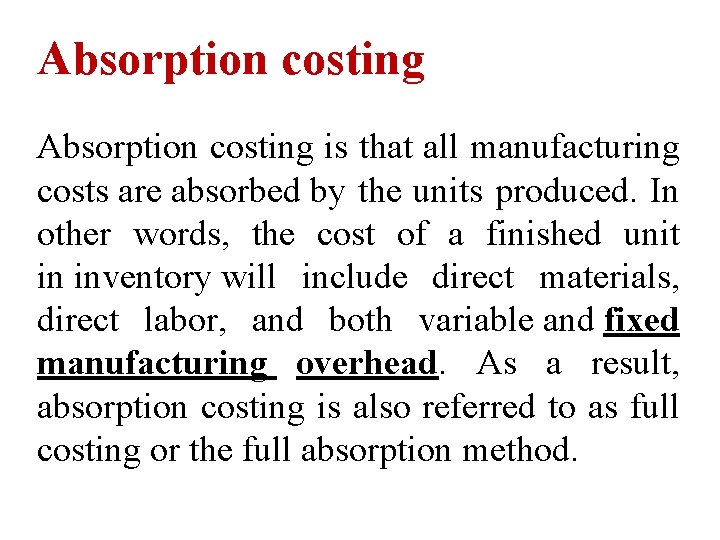
Absorption costing is that all manufacturing costs are absorbed by the units produced. In other words, the cost of a finished unit in inventory will include direct materials, direct labor, and both variable and fixed manufacturing overhead. As a result, absorption costing is also referred to as full costing or the full absorption method.
Absorption costing Cont… Ø Absorption costing is often contrasted with variable costing or direct costing. Ø Absorption costing is required for external financial reporting and for income tax reporting.
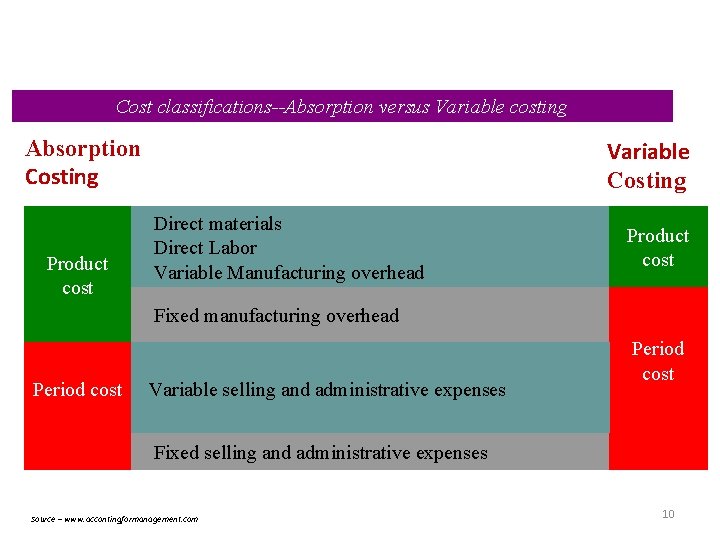
Cost classifications--Absorption versus Variable costing Absorption Costing Product cost Variable Costing Direct materials Direct Labor Variable Manufacturing overhead Product cost Fixed manufacturing overhead Period cost Variable selling and administrative expenses Period cost Fixed selling and administrative expenses Source – www. accontingformanagement. com 10
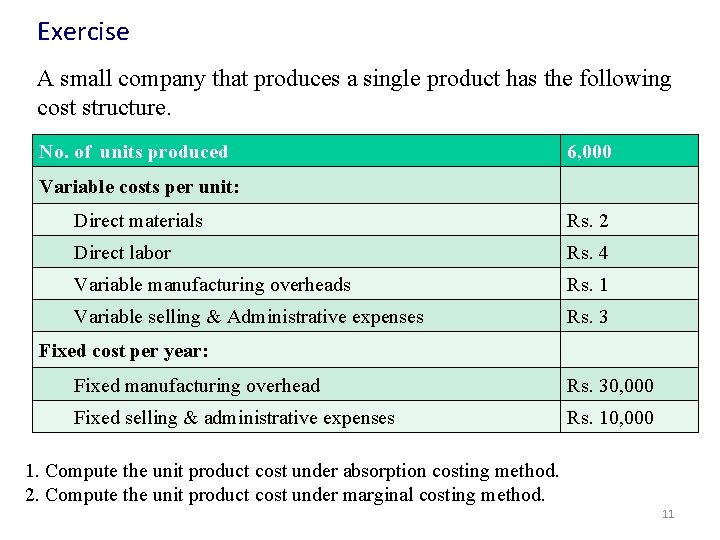
Exercise A small company that produces a single product has the following cost structure. No. of units produced 6, 000 Variable costs per unit: Direct materials Rs. 2 Direct labor Rs. 4 Variable manufacturing overheads Rs. 1 Variable selling & Administrative expenses Rs. 3 Fixed cost per year: Fixed manufacturing overhead Rs. 30, 000 Fixed selling & administrative expenses Rs. 10, 000 1. Compute the unit product cost under absorption costing method. 2. Compute the unit product cost under marginal costing method. 11
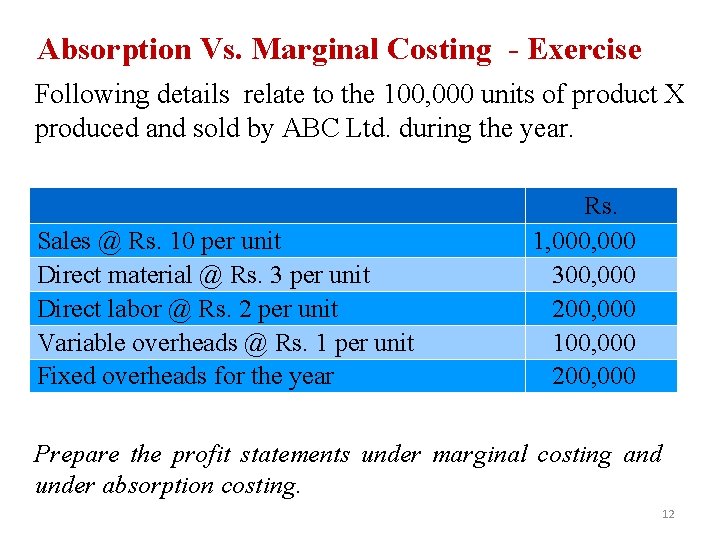
Absorption Vs. Marginal Costing - Exercise Following details relate to the 100, 000 units of product X produced and sold by ABC Ltd. during the year. Sales @ Rs. 10 per unit Direct material @ Rs. 3 per unit Direct labor @ Rs. 2 per unit Variable overheads @ Rs. 1 per unit Fixed overheads for the year Rs. 1, 000 300, 000 200, 000 100, 000 200, 000 Prepare the profit statements under marginal costing and under absorption costing. 12
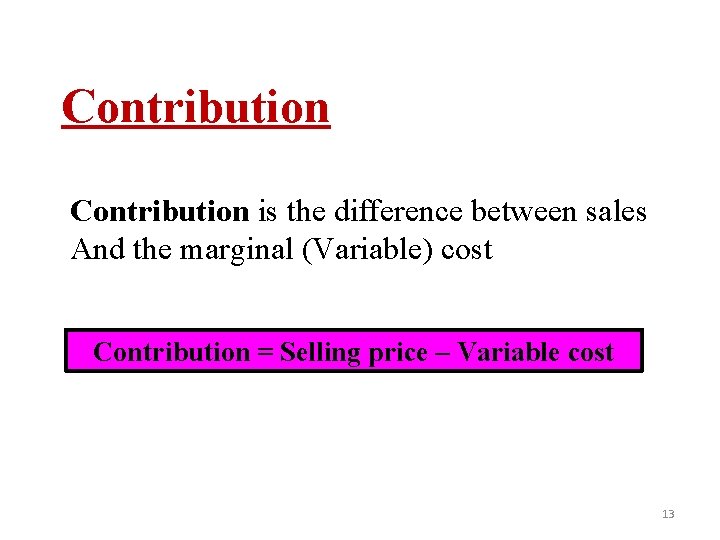
Contribution is the difference between sales And the marginal (Variable) cost Contribution = Selling price – Variable cost 13
Break Even Point (BEP) Break Even is the point where businesses are not making profits At this stage; TR = TC BEP (units) = Fixed cost Contribution per unit 14
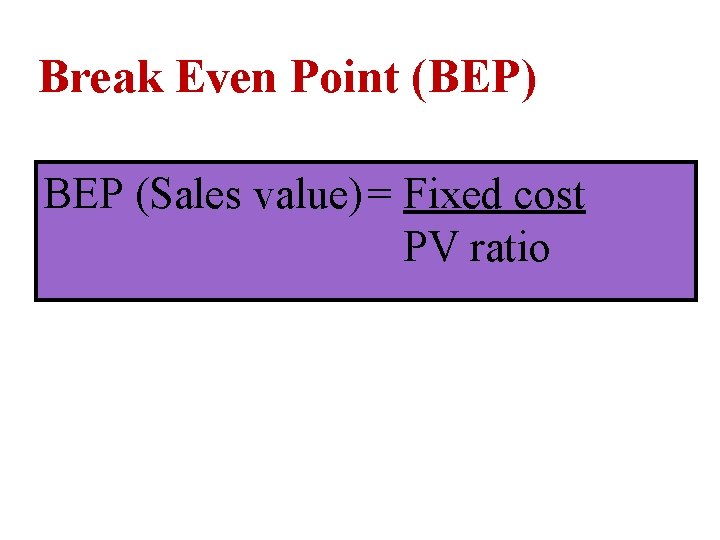
Break Even Point (BEP) BEP (Sales value)= Fixed cost PV ratio
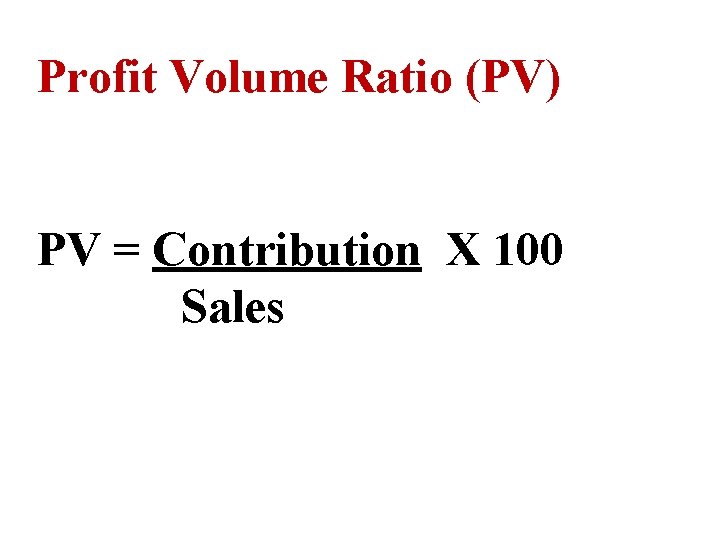
Profit Volume Ratio (PV) PV = Contribution X 100 Sales
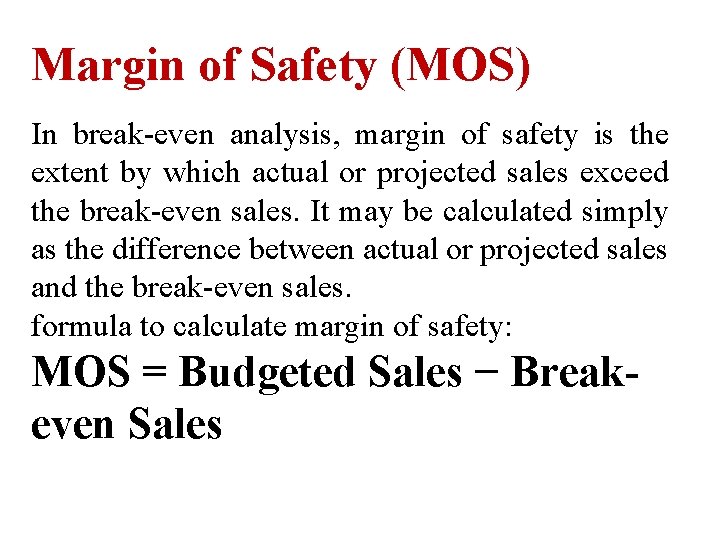
Margin of Safety (MOS) In break-even analysis, margin of safety is the extent by which actual or projected sales exceed the break-even sales. It may be calculated simply as the difference between actual or projected sales and the break-even sales. formula to calculate margin of safety: MOS = Budgeted Sales − Breakeven Sales
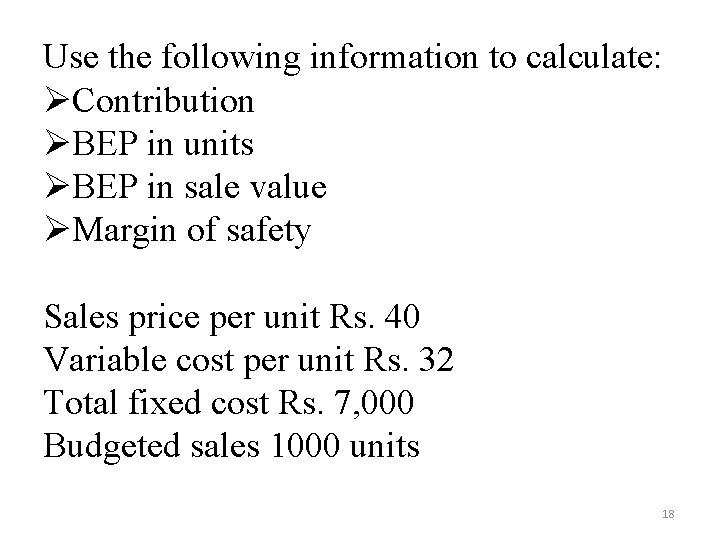
Use the following information to calculate: ØContribution ØBEP in units ØBEP in sale value ØMargin of safety Sales price per unit Rs. 40 Variable cost per unit Rs. 32 Total fixed cost Rs. 7, 000 Budgeted sales 1000 units 18