Adapted from We the People The Citizen and

- Slides: 29
Adapted from We the People: The Citizen and the Constitution , Level 2, Lesson 18 and The American Journey: A History of the United States by Goldfield et al. Fed Up – Debating the Constitution Federalists and Anti-Federalists © The Florida Law Related Education Association, Inc.
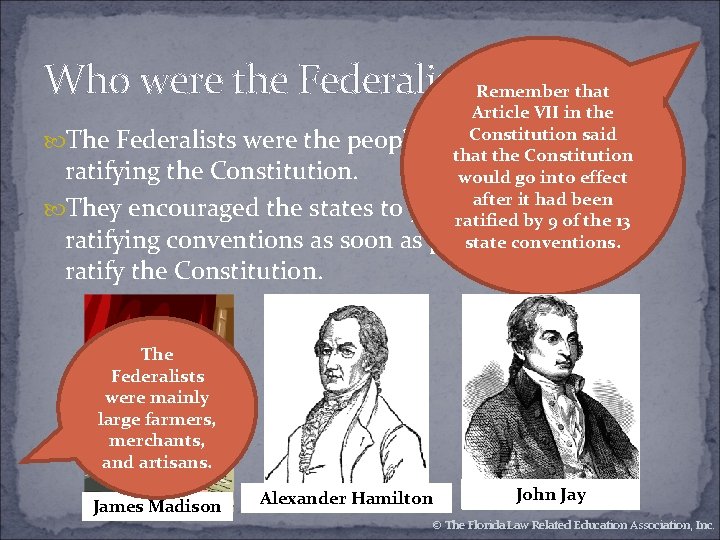
Who were the Federalists? Remember that Article VII in the said The Federalists were the people who. Constitution supported that the Constitution ratifying the Constitution. would go into effect after it had been They encouraged the states to put together their ratified by 9 of the 13 ratifying conventions as soon as possible in order to state conventions. ratify the Constitution. The Federalists were mainly large farmers, merchants, and artisans. James Madison Alexander Hamilton John Jay © The Florida Law Related Education Association, Inc.
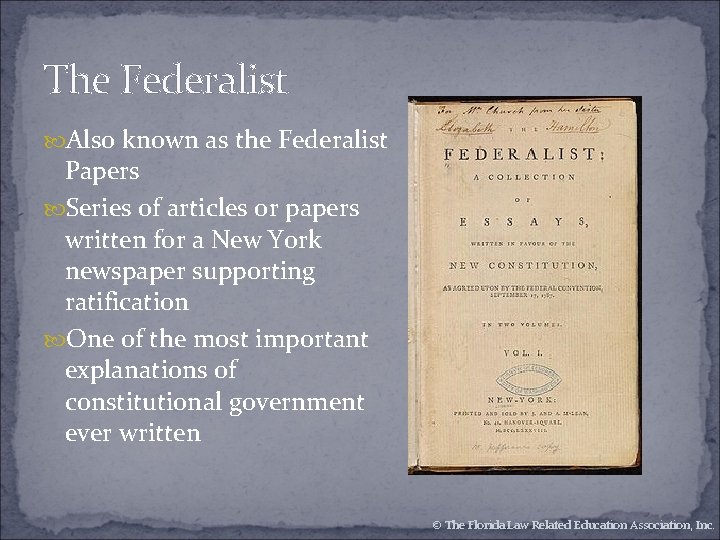
The Federalist Also known as the Federalist Papers Series of articles or papers written for a New York newspaper supporting ratification One of the most important explanations of constitutional government ever written © The Florida Law Related Education Association, Inc.
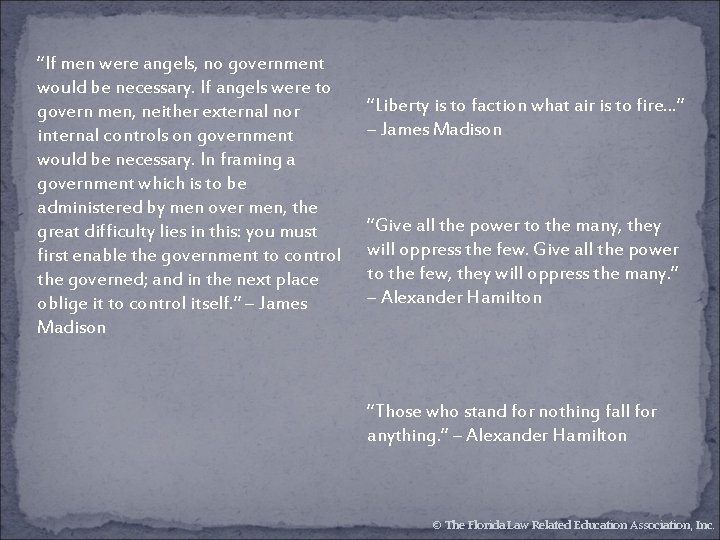
“If men were angels, no government would be necessary. If angels were to govern men, neither external nor internal controls on government would be necessary. In framing a government which is to be administered by men over men, the great difficulty lies in this: you must first enable the government to control the governed; and in the next place oblige it to control itself. ” – James Madison “Liberty is to faction what air is to fire…” – James Madison “Give all the power to the many, they will oppress the few. Give all the power to the few, they will oppress the many. ” – Alexander Hamilton “Those who stand for nothing fall for anything. ” – Alexander Hamilton © The Florida Law Related Education Association, Inc.
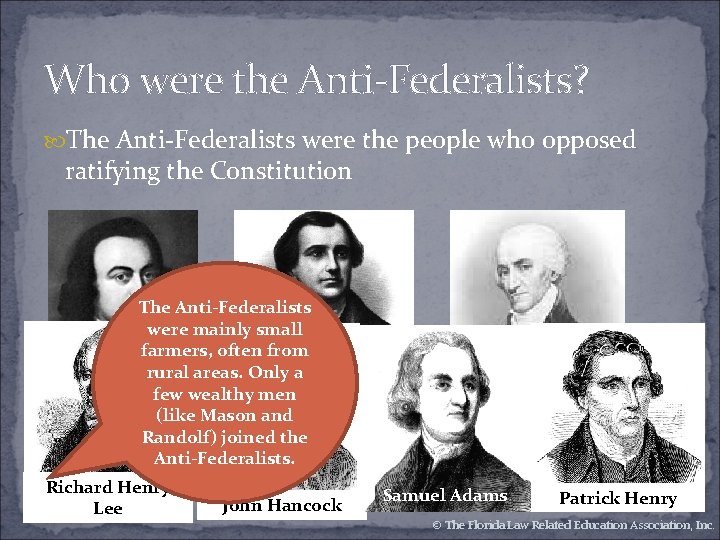
Who were the Anti-Federalists? The Anti-Federalists were the people who opposed ratifying the Constitution The Anti-Federalists were mainly small farmers, often from Edmund rural areas. Only a Randolf George Mason few wealthy men (like Mason and Randolf) joined the Anti-Federalists. Richard Henry Lee John Hancock Elbridge Gerry Samuel Adams Patrick Henry © The Florida Law Related Education Association, Inc.
Anti-Federalist Papers While the Federalist Papers presented arguments in favor of ratifying the Constitution, the Anti-Federalist papers presented arguments against ratification These articles were mostly written by authors with pseudonyms They were warning the people of the dangers of tyranny that were not protected by the Constitution © The Florida Law Related Education Association, Inc.
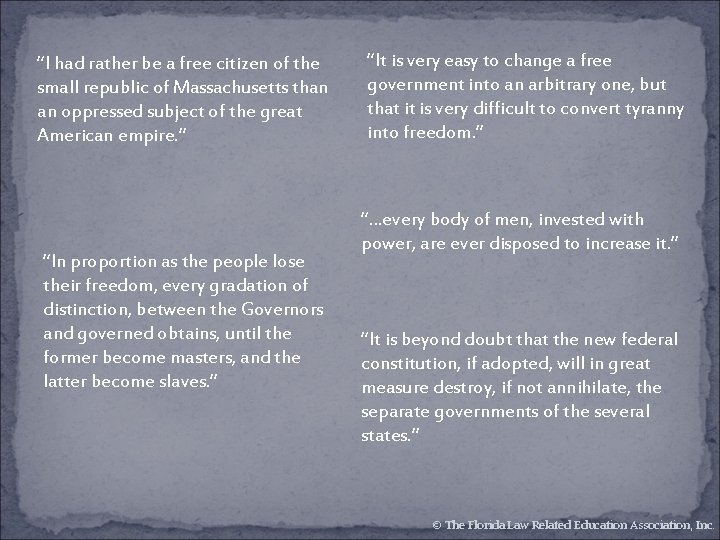
“I had rather be a free citizen of the small republic of Massachusetts than an oppressed subject of the great American empire. ” “In proportion as the people lose their freedom, every gradation of distinction, between the Governors and governed obtains, until the former become masters, and the latter become slaves. ” “It is very easy to change a free government into an arbitrary one, but that it is very difficult to convert tyranny into freedom. ” “…every body of men, invested with power, are ever disposed to increase it. ” “It is beyond doubt that the new federal constitution, if adopted, will in great measure destroy, if not annihilate, the separate governments of the several states. ” © The Florida Law Related Education Association, Inc.
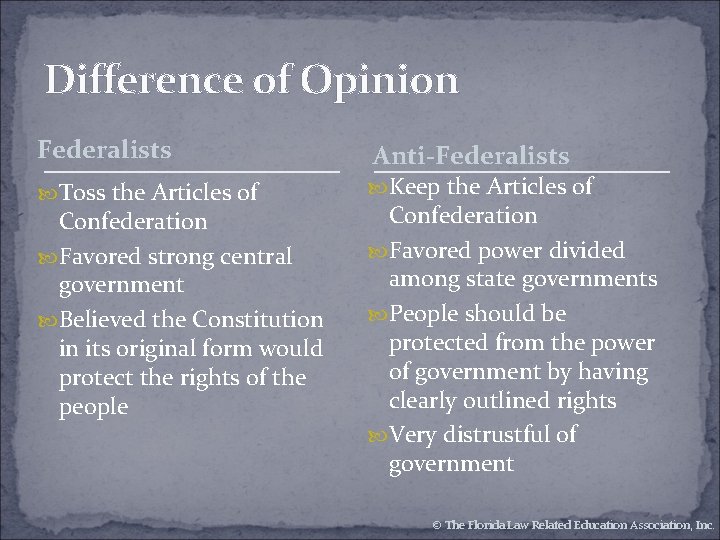
Difference of Opinion The main thing Federalists and Anti-Federalists had conflict over was whether to throw out the Articles of Confederation or to keep the Articles of Confederation Other areas where they disagreed: The concentration of power Should the power be concentrated in one strong national government or divided among the separate state governments? Inclusion of a Bill of Rights Does the Constitution in its original composition protect the rights of the people or should the rights of the people be clearly outlined? © The Florida Law Related Education Association, Inc.
Difference of Opinion Federalists Anti-Federalists Toss the Articles of Keep the Articles of Confederation Favored strong central government Believed the Constitution in its original form would protect the rights of the people Confederation Favored power divided among state governments People should be protected from the power of government by having clearly outlined rights Very distrustful of government © The Florida Law Related Education Association, Inc.
Classifying Arguments On your Fed Up: Classifying Arguments Handout, you should have written down some general information about the Federalists and Anti-Federalists. • Your job: INDIVIDUALLY decide which arguments in Part II are arguments of the Federalists (mark with an F) and which are arguments of the Anti. Federalists (mark with an A) © The Florida Law Related Education Association, Inc.
Fed Up: Classifying Arguments Get into a group of 4 people. Discuss your responses and come to an agreement on which arguments belong to the Federalist and Anti. Federalists. Your group will have two signs: F A When the argument comes up on the slide, hold up the “F” if it is an argument made by the Federalists or the “A” if it is an argument made by the Anti. Federalists. © The Florida Law Related Education Association, Inc.
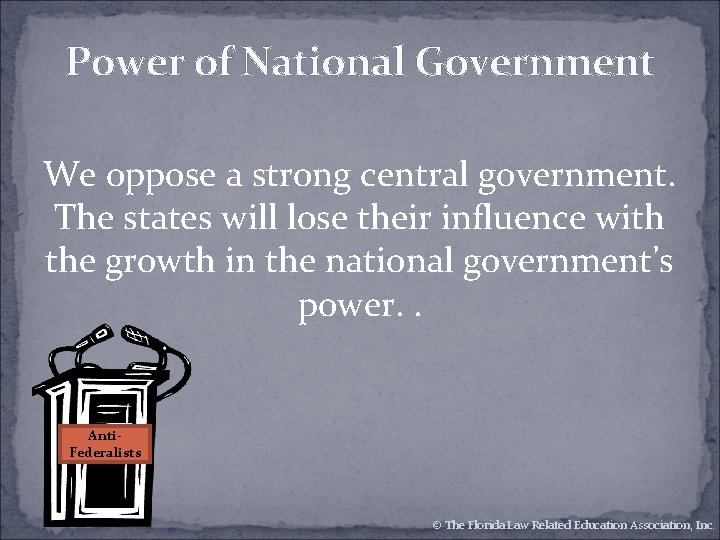
Power of National Government We oppose a strong central government. The states will lose their influence with the growth in the national government’s power. . Anti. Federalists © The Florida Law Related Education Association, Inc.
Necessary and Proper Clause The necessary and proper clause (Article I, Section 8 of the U. S. Constitution) is needed if the national government is to do the things it is responsible for doing. Federalists © The Florida Law Related Education Association, Inc.
Tyranny The national government cannot become a tyranny because there are limits placed on it through separation of powers and checks and balances. Government will protect the rights of the people in return for their loyalty and support. Federalists © The Florida Law Related Education Association, Inc.
Articles of Confederation We oppose the Articles of Confederation. It isn’t effective as a governing document. We need a stronger central government. We need to ratify the new government framed by the Constitution. Federalists © The Florida Law Related Education Association, Inc.
Supremacy Clause The Constitution’s supremacy clause makes the national government’s laws superior to the state governments’ laws. This will destroy the state governments in favor of the national government. Anti. Federalists © The Florida Law Related Education Association, Inc.
Power of National Government We support a strong central government. The national government needs to be strong to function. Federalists © The Florida Law Related Education Association, Inc.
Republic governments only worked in small communities where the people had similar wealth and the same values. The new nation will be too large and diverse, and the people will be unable to work toward the common good. Anti. Federalists © The Florida Law Related Education Association, Inc.
Executive Branch A strong executive is needed if the national government is to fulfill its responsibilities. There are checks and balances on the branches of government so no one branch, including the executive branch, can have too much power. Federalists © The Florida Law Related Education Association, Inc.
Bill of Rights It is essential to include a Bill of Rights to protect people from the national government. The absence of a Bill of Rights is a real threat to individual liberties of citizens. There is no mention of freedoms like religion, speech, press, or assembly. Anti. Federalists © The Florida Law Related Education Association, Inc.
Articles of Confederation The Articles of Confederation need to be amended, not abandoned. The Constitution goes too far. A stronger national government will threaten state power. This new Constitution will create a government the people cannot control. Anti. Federalists © The Florida Law Related Education Association, Inc.
Supremacy Clause The Supremacy Clause (Article I, Section 8 of the U. S. Constitution) is an assurance that the Constitution is the Supreme law of the land. The Constitution will protect state governments by giving them certain powers. This will keep the national government from intruding on the powers left to the states. Federalists © The Florida Law Related Education Association, Inc.
Necessary and Proper Clause The necessary and proper clause is too general and gives too much power to the national government. All of the powers of government should be listed so appropriate limits can be placed on them. Anti. Federalists © The Florida Law Related Education Association, Inc.
Executive Branch The Constitution gives too much power to the executive branch. There is the threat that it will become a monarchy. Anti. Federalists © The Florida Law Related Education Association, Inc.
Tyranny Free government requires participation of all the people. If the national government is far from where the people live, the people will not be able to participate. This may result in tyranny. Anti. Federalists © The Florida Law Related Education Association, Inc.
Republic Federalists A large republic where power is divided between the national and state governments will be a better solution than the small republics of the past that were destroyed by self-interested citizens that did not work for the common good. A large republic is the best protection for individual freedoms. © The Florida Law Related Education Association, Inc.
Bill of Rights A Bill of Rights is not necessary. The Constitution gives government only limited power. If we have a Bill of Rights, then only those rights listed may be presumed to be protected. We cannot list every right. Federalists © The Florida Law Related Education Association, Inc.
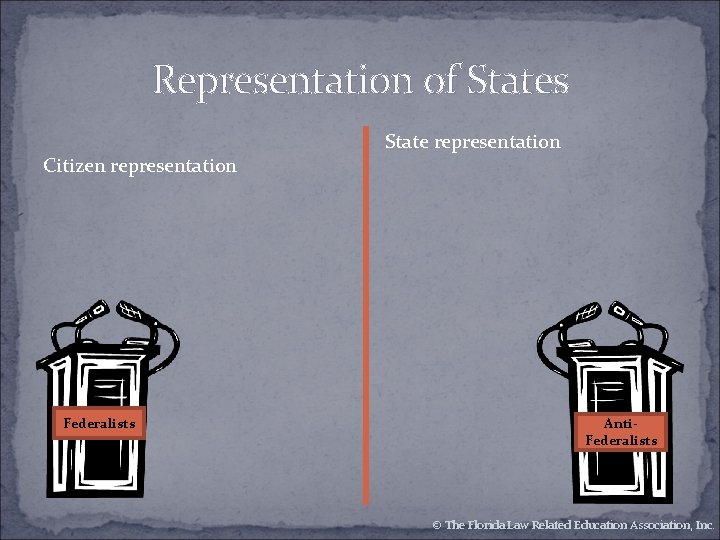
Representation of States Citizen representation Federalists State representation Anti. Federalists © The Florida Law Related Education Association, Inc.
Image Citations http: //upload. wikimedia. org/wikipedia/commons/thumb/2/23/Federalist. jpg/ 220 px-Federalist. jpg http: //www. acps. k 12. va. us/mason/images/george_mason. jpg http: //memory. loc. gov/ammem/collections/continental/images/photo 35. jpg http: //t 2. gstatic. com/images? q=tbn: ANd 9 Gc. RWmxh. YQpee 0 T 9_1 fgkvr. HCq. K 5 cy 9 FYsp. P 0 Jt. Ct. JG 3 p 3 AWYJrjee. E 4 Iq. Clkd. A http: //etc. usf. edu/clipart/300/349/adams_10_lg. gif http: //www. gutenberg. org/files/25093 -h/images/image 8. jpg © The Florida Law Related Education Association, Inc.