ACS Colorectal Cancer Screening Guideline for Average Risk

- Slides: 23
ACS Colorectal Cancer Screening Guideline for Average Risk Adults, 2018 Robert A. Smith, Ph. D American Cancer Society Fifth Annual EAO—CRC Summit New York City, May 2 -3, 2019 1
I HAVE NO CONFLICTS OF INTEREST TO DECLARE 2
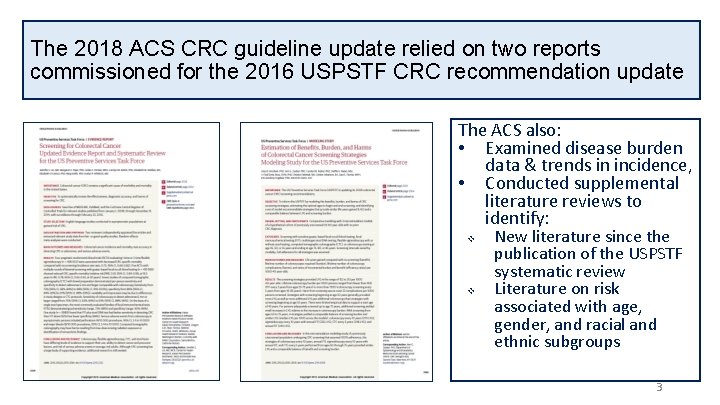
The 2018 ACS CRC guideline update relied on two reports commissioned for the 2016 USPSTF CRC recommendation update The ACS also: • Examined disease burden data & trends in incidence, • Conducted supplemental literature reviews to identify: v v New literature since the publication of the USPSTF systematic review Literature on risk associated with age, gender, and racial and ethnic subgroups 3
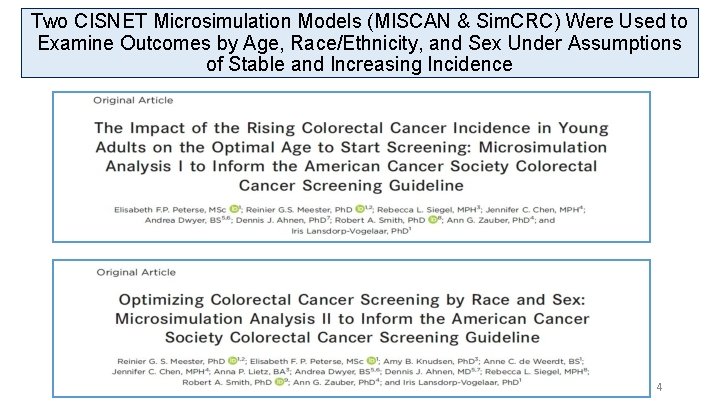
Two CISNET Microsimulation Models (MISCAN & Sim. CRC) Were Used to Examine Outcomes by Age, Race/Ethnicity, and Sex Under Assumptions of Stable and Increasing Incidence 4
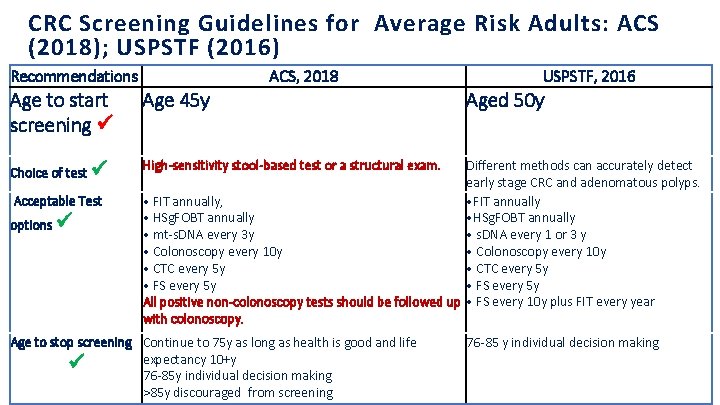
CRC Screening Guidelines for Average Risk Adults: ACS (2018); USPSTF (2016) Recommendations ACS, 2018 Age to start screening Age 45 y Choice of test High-sensitivity stool-based test or a structural exam. Acceptable Test options USPSTF, 2016 Aged 50 y Different methods can accurately detect early stage CRC and adenomatous polyps. • FIT annually, • FIT annually • HSg. FOBT annually • mt-s. DNA every 3 y • s. DNA every 1 or 3 y • Colonoscopy every 10 y • CTC every 5 y • FS every 5 y All positive non-colonoscopy tests should be followed up • FS every 10 y plus FIT every year with colonoscopy. Age to stop screening Continue to 75 y as long as health is good and life expectancy 10+y 76 -85 y individual decision making >85 y discouraged from screening 76 -85 y individual decision making
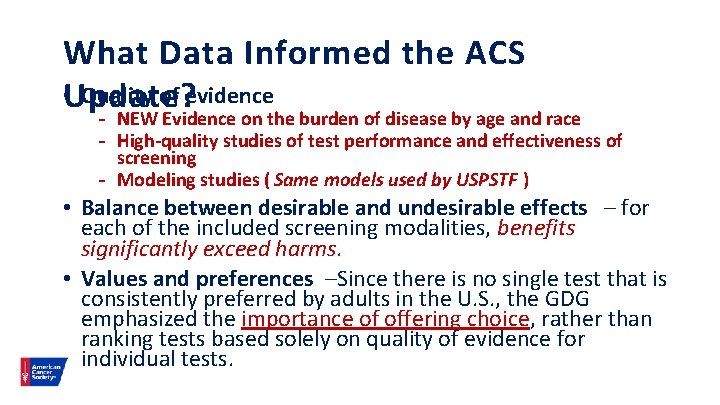
What Data Informed the ACS • Update? Quality of evidence - NEW Evidence on the burden of disease by age and race - High-quality studies of test performance and effectiveness of screening - Modeling studies ( Same models used by USPSTF ) • Balance between desirable and undesirable effects – for each of the included screening modalities, benefits significantly exceed harms. • Values and preferences –Since there is no single test that is consistently preferred by adults in the U. S. , the GDG emphasized the importance of offering choice, rather than ranking tests based solely on quality of evidence for individual tests.
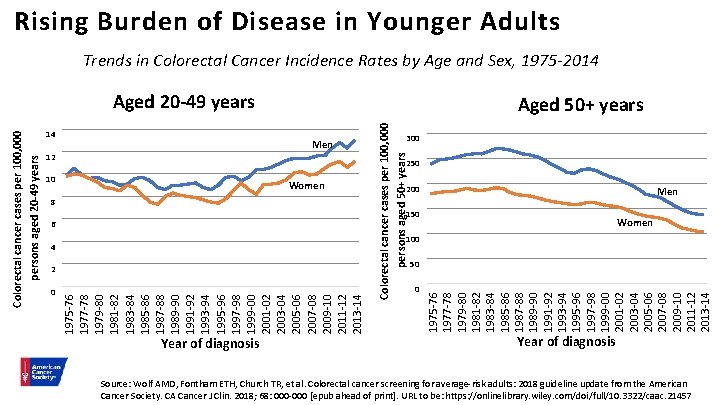
Rising Burden of Disease in Younger Adults Trends in Colorectal Cancer Incidence Rates by Age and Sex, 1975 -2014 Men 12 300 250 10 Women 8 200 Men 150 6 Women 100 2 Year of diagnosis 50 0 1975 -76 1977 -78 1979 -80 1981 -82 1983 -84 1985 -86 1987 -88 1989 -90 1991 -92 1993 -94 1995 -96 1997 -98 1999 -00 2001 -02 2003 -04 2005 -06 2007 -08 2009 -10 2011 -12 2013 -14 4 0 Colorectal cancer cases per 100, 000 persons aged 50+ years 14 Aged 50+ years 1975 -76 1977 -78 1979 -80 1981 -82 1983 -84 1985 -86 1987 -88 1989 -90 1991 -92 1993 -94 1995 -96 1997 -98 1999 -00 2001 -02 2003 -04 2005 -06 2007 -08 2009 -10 2011 -12 2013 -14 Colorectal cancer cases per 100, 000 persons aged 20 -49 years Aged 20 -49 years Year of diagnosis Source: Wolf AMD, Fontham ETH, Church TR, et al. Colorectal cancer screening for average-risk adults: 2018 guideline update from the American Cancer Society. CA Cancer J Clin. 2018; 68: 000 -000 [epub ahead of print]. URL to be: https: //onlinelibrary. wiley. com/doi/full/10. 3322/caac. 21457
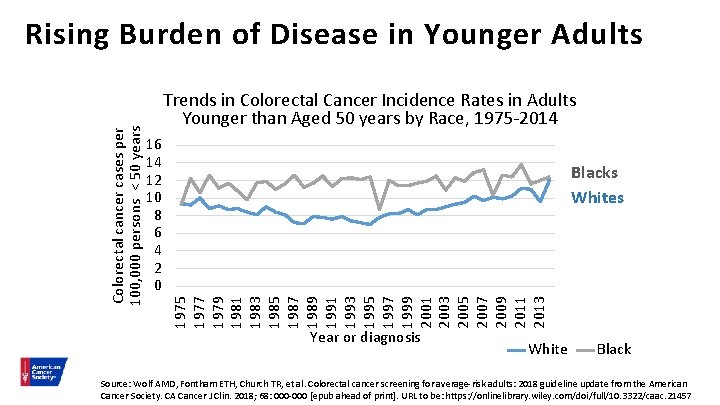
Trends in Colorectal Cancer Incidence Rates in Adults Younger than Aged 50 years by Race, 1975 -2014 16 14 12 10 8 6 4 2 0 Blacks Whites 1975 1977 1979 1981 1983 1985 1987 1989 1991 1993 1995 1997 1999 2001 2003 2005 2007 2009 2011 2013 Colorectal cancer cases per 100, 000 persons < 50 years Rising Burden of Disease in Younger Adults Year or diagnosis White Black Source: Wolf AMD, Fontham ETH, Church TR, et al. Colorectal cancer screening for average-risk adults: 2018 guideline update from the American Cancer Society. CA Cancer J Clin. 2018; 68: 000 -000 [epub ahead of print]. URL to be: https: //onlinelibrary. wiley. com/doi/full/10. 3322/caac. 21457
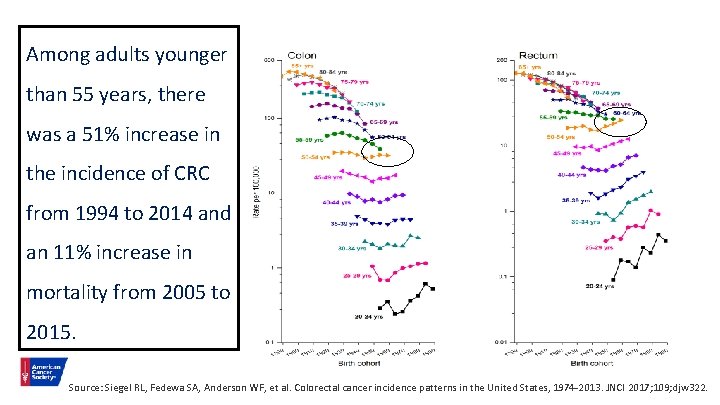
Among adults younger than 55 years, there was a 51% increase Trends in CRCin Incidence the incidence ofby CRC Age 1994 andto. Year from 2014 and of Birth an 11% increase in mortality from 2005 to 2015. Source: Siegel RL, Fedewa SA, Anderson WF, et al. Colorectal cancer incidence patterns in the United States, 1974 -2013. JNCI 2017; 109; djw 322.
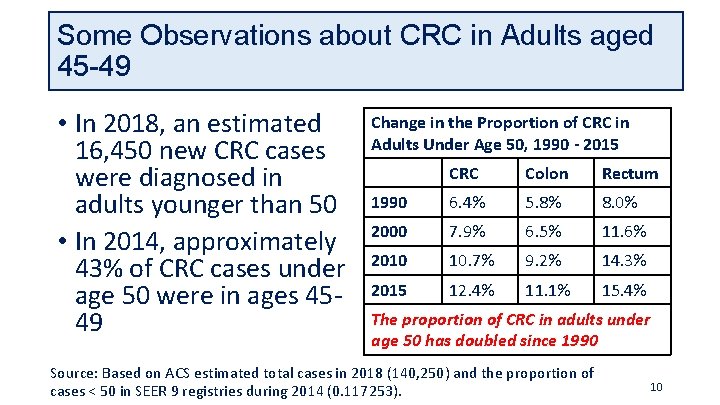
Some Observations about CRC in Adults aged 45 -49 • In 2018, an estimated 16, 450 new CRC cases were diagnosed in adults younger than 50 • In 2014, approximately 43% of CRC cases under age 50 were in ages 4549 Change in the Proportion of CRC in Adults Under Age 50, 1990 - 2015 CRC Colon Rectum 1990 6. 4% 5. 8% 8. 0% 2000 7. 9% 6. 5% 11. 6% 2010 10. 7% 9. 2% 14. 3% 2015 12. 4% 11. 1% 15. 4% The proportion of CRC in adults under age 50 has doubled since 1990 Source: Based on ACS estimated total cases in 2018 (140, 250) and the proportion of cases < 50 in SEER 9 registries during 2014 (0. 117253). 10
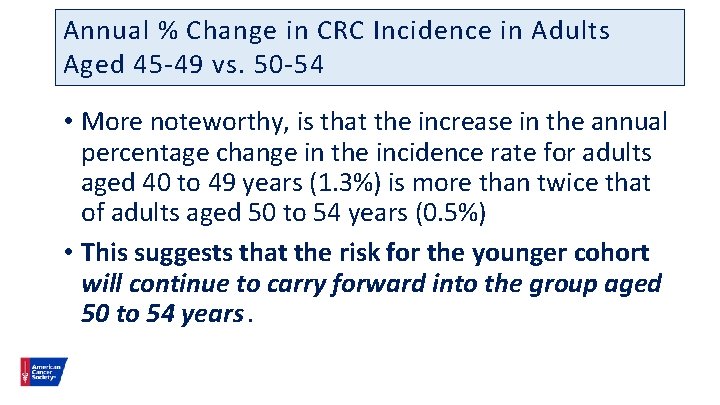
Annual % Change in CRC Incidence in Adults Aged 45 -49 vs. 50 -54 • More noteworthy, is that the increase in the annual percentage change in the incidence rate for adults aged 40 to 49 years (1. 3%) is more than twice that of adults aged 50 to 54 years (0. 5%) • This suggests that the risk for the younger cohort will continue to carry forward into the group aged 50 to 54 years.
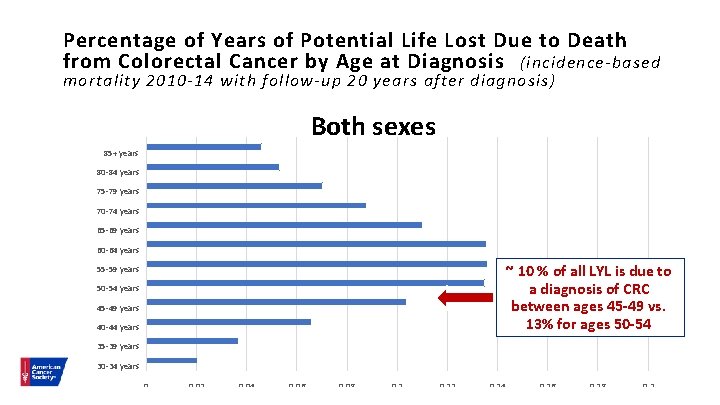
Percentage of Years of Potential Life Lost Due to Death from Colorectal Cancer by Age at Diagnosis (incidence-based mortality 2010 -14 with follow-up 20 years after diagnosis) Both sexes 85+ years 80 -84 years 75 -79 years 70 -74 years 65 -69 years 60 -64 years ~ 10 % of all LYL is due to a diagnosis of CRC between ages 45 -49 vs. 13% for ages 50 -54 55 -59 years 50 -54 years 45 -49 years 40 -44 years 35 -39 years 30 -34 years 0 0. 02 0. 04 0. 06 0. 08 0. 12 0. 14 0. 16 0. 18 0. 2
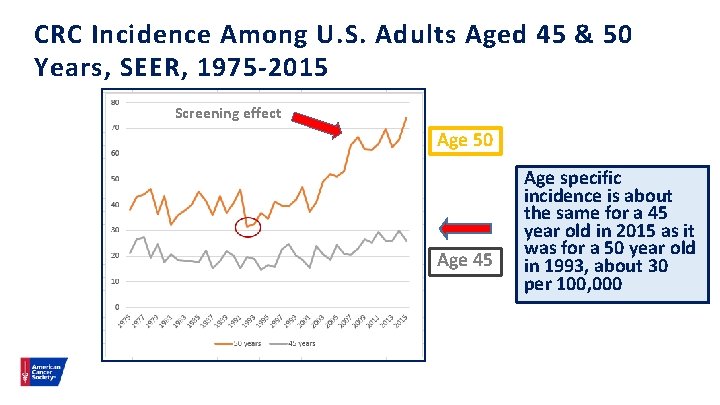
CRC Incidence Among U. S. Adults Aged 45 & 50 Years, SEER, 1975 -2015 Screening effect Age 50 Age 45 Age specific incidence is about the same for a 45 year old in 2015 as it was for a 50 year old in 1993, about 30 per 100, 000
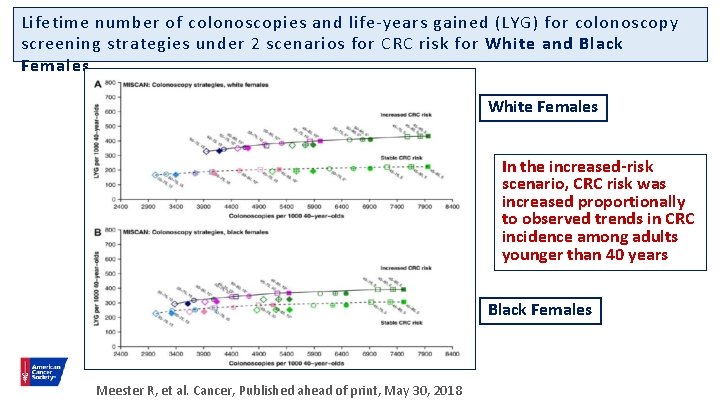
Lifetime number of colonoscopies and life-years gained (LYG) for colonoscopy screening strategies under 2 scenarios for CRC risk for White and Black Females White Females In the increased-risk scenario, CRC risk was increased proportionally to observed trends in CRC incidence among adults younger than 40 years Black Females Meester R, et al. Cancer, Published ahead of print, May 30, 2018
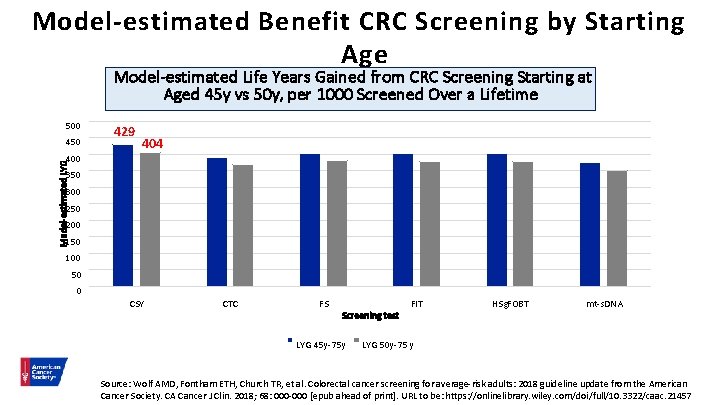
Model-estimated Benefit CRC Screening by Starting Age Model-estimated Life Years Gained from CRC Screening Starting at Aged 45 y vs 50 y, per 1000 Screened Over a Lifetime 500 450 429 404 Model-estimated LYG 400 350 300 250 200 150 100 50 0 CSY CTC FS Screening test LYG 45 y-75 y FIT HSg. FOBT mt-s. DNA LYG 50 y-75 y Source: Wolf AMD, Fontham ETH, Church TR, et al. Colorectal cancer screening for average-risk adults: 2018 guideline update from the American Cancer Society. CA Cancer J Clin. 2018; 68: 000 -000 [epub ahead of print]. URL to be: https: //onlinelibrary. wiley. com/doi/full/10. 3322/caac. 21457
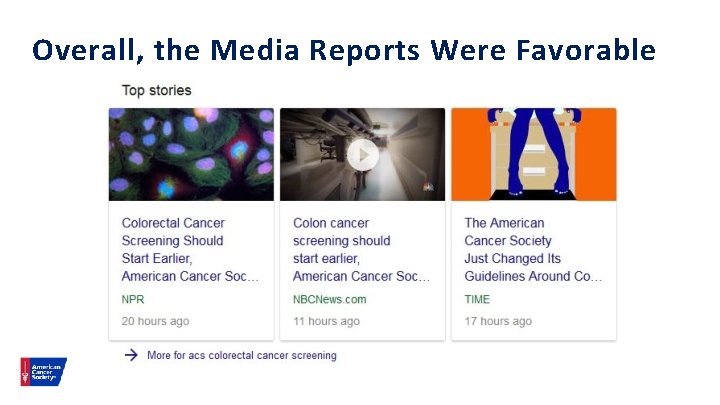
Overall, the Media Reports Were Favorable
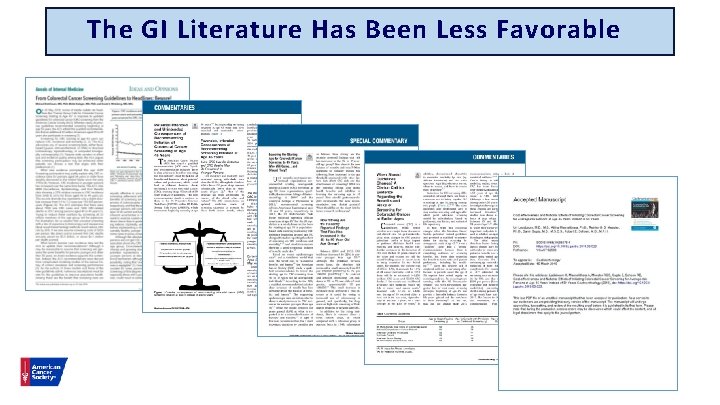
The GI Literature Has Been Less Favorable
What concerns have been raised about the new guideline? • CRC is a different disease in adults under 50 - We found no evidence to indicate that CRC is “different” in the 5 years from 45 -49 • Burden of disease is very small in this age group; high costs and many harms for a small benefit - The burden of disease is not very small; (1) 45 is the new 50; (2) Diagnosis between 45 -49 accounts for 1 in 10 life years lost each year from CRC death • No empirical evidence; recommendations based on modeling - We applied the same models that contribute to the USPSTF recommendations; Screening beginning at age 45 is more efficient than beginning at age 50. - We also found no evidence that stool testing or structural exams perform less effectively in adults aged 45 -49 than adults in their 50 s.
What concerns have been raised about the new guideline? • Important that we concentrate further on adults 50+ - Agree, but this is an empty critique. • The new guideline will worsen existing disparities - A real possibility in some geographic areas, and settings where existing services are stressed. We must have a mission oriented approach to increase access
What concerns have been raised about the new guideline? • The new guideline will strain existing capacity - In some areas this is a real possibility - Further, there is a greater emphasis on high sensitivity stool testing, which will exert less pressure on colonoscopy capacity - Since most adults do not begin screening at age 50 today, it is unlikely that most will begin screening at age 45. This means starting at 45 vs. 50 still results in 3 lifetime colonoscopies. - Finally, the argument was advanced without any data on capacity
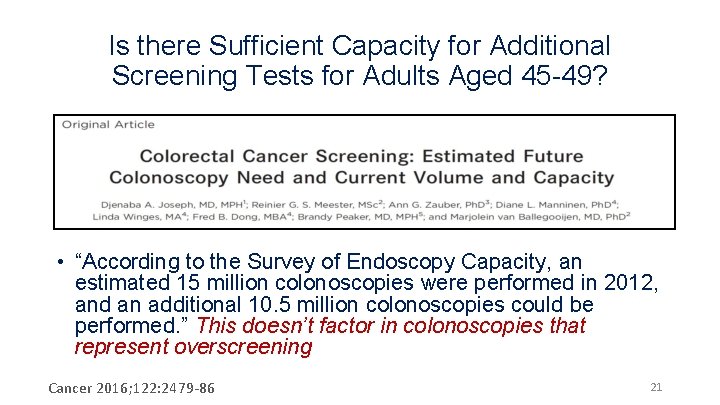
Is there Sufficient Capacity for Additional Screening Tests for Adults Aged 45 -49? • “According to the Survey of Endoscopy Capacity, an estimated 15 million colonoscopies were performed in 2012, and an additional 10. 5 million colonoscopies could be performed. ” This doesn’t factor in colonoscopies that represent overscreening Cancer 2016; 122: 2479 -86 21
Starting CRC Screening at Age 45: Conclusions • Modeling convincingly demonstrates that, due to the rising incidence of CRC in younger individuals, screening all average-risk persons between the ages of 45 and 75 reduces mortality from CRC with an acceptable risk (as measured by number of colonoscopies per LYG ). • The trend of increasing CRC incidence in successively younger birth cohorts suggests that the recommended starting age of 45 will continue to be appropriate. • The benefit-burden balance strongly favors changing the starting age from 50 to 45. • If you accepted screening beginning at age 50 over the past 25 years, you should accept beginning screening at age 45 today.
Acknowledgements • ACS Guideline Development Group • External Expert Advisors • Cancer Intervention and Surveillance Modeling Network (MISCAN & Sim. CRC) Amy Knudsen, Ph. D; Iris Lansdorp-Vogelaar, Ph. D; Reinier Meester, Ph. D; Elisabeth Peterse, MSc; and Ann Zauber, Ph. D) • ACS Cancer Control Department Staff • ACS Surveillance and Health Services Research Staff