A Tale of Two Counties JK Costello MD
- Slides: 58
A Tale of Two Counties JK Costello, MD, MPH Lesley Brooks, MD CBHC Conference, Breckenridge October 13, 2018
“It was the best of times, it was the worst of times, it was the age of wisdom, it was the age of foolishness, it was the epoch of belief, it was the epoch of incredulity, it was the season of light, it was the season of darkness, it was the spring of hope, it was the winter of despair. ”
Objectives ● Table setting ● Barrier ● MAT Intro ● Hub-and-Spoke Model ● Pathways to improved care: Western Slope vs Front Range ● Preparing for the next challenge: Agnostic SUD treatment ● Next steps
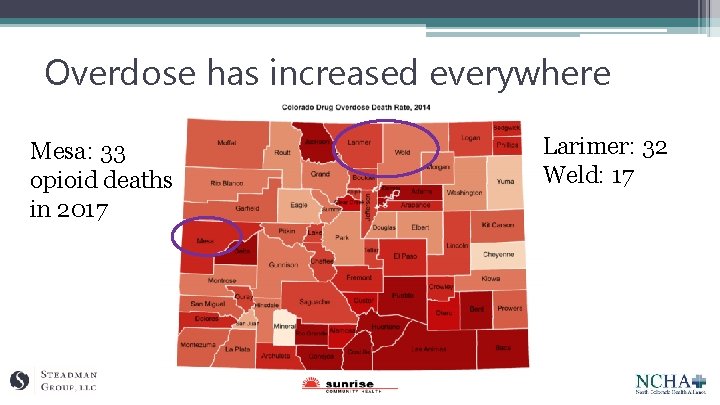
Overdose has increased everywhere Mesa: 33 opioid deaths in 2017 Larimer: 32 Weld: 17
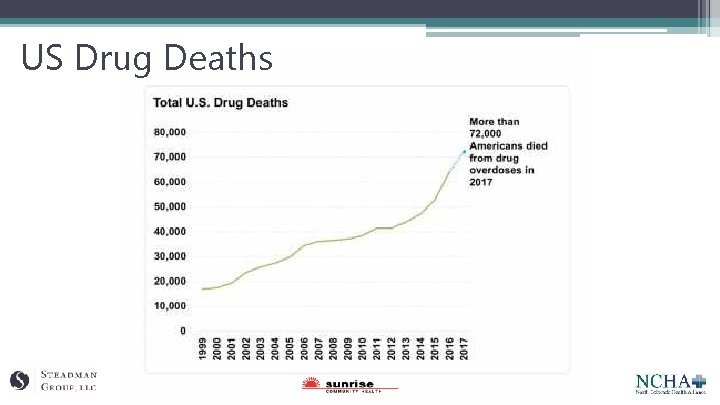
US Drug Deaths
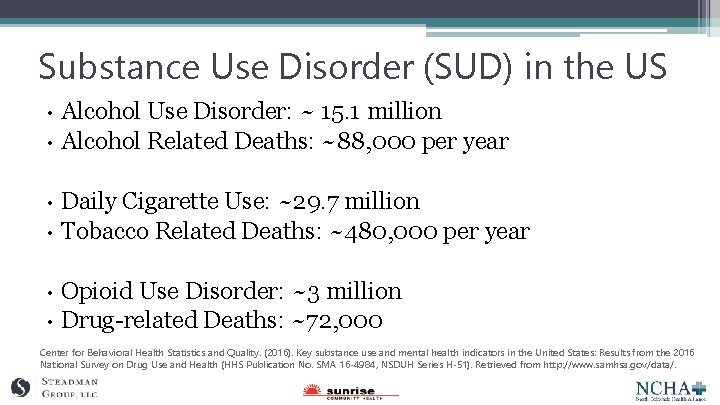
Substance Use Disorder (SUD) in the US • • • Alcohol Use Disorder: ~ 15. 1 million Alcohol Related Deaths: ~88, 000 per year Daily Cigarette Use: ~29. 7 million Tobacco Related Deaths: ~480, 000 per year Opioid Use Disorder: ~3 million Drug-related Deaths: ~72, 000 Center for Behavioral Health Statistics and Quality. (2016). Key substance use and mental health indicators in the United States: Results from the 2016 National Survey on Drug Use and Health (HHS Publication No. SMA 16 -4984, NSDUH Series H-51). Retrieved from http: //www. samhsa. gov/data/.
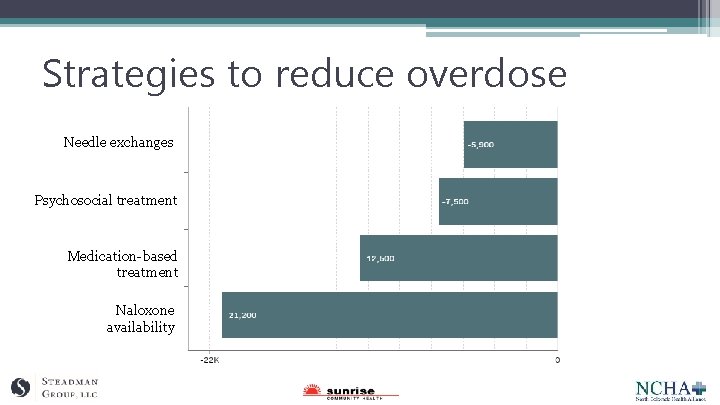
Strategies to reduce overdose Needle exchanges Psychosocial treatment Medication-based treatment Naloxone availability
“There is prodigious strength in sorrow and despair. ”
Barriers
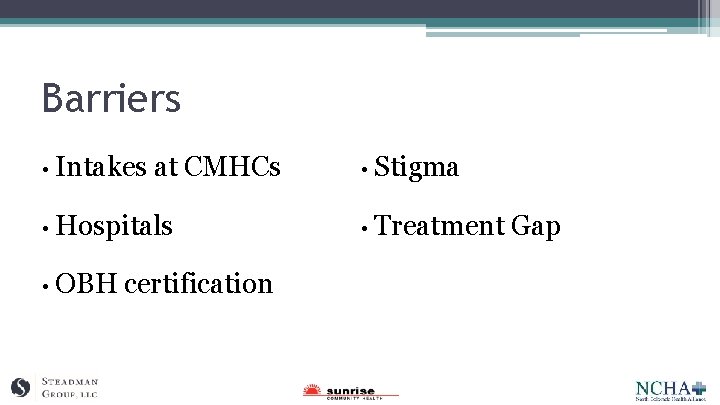
Barriers • Intakes at CMHCs • Hospitals • OBH certification • Stigma • Treatment Gap
Stigma • Self-stigma • Public stigma • Institutional stigma
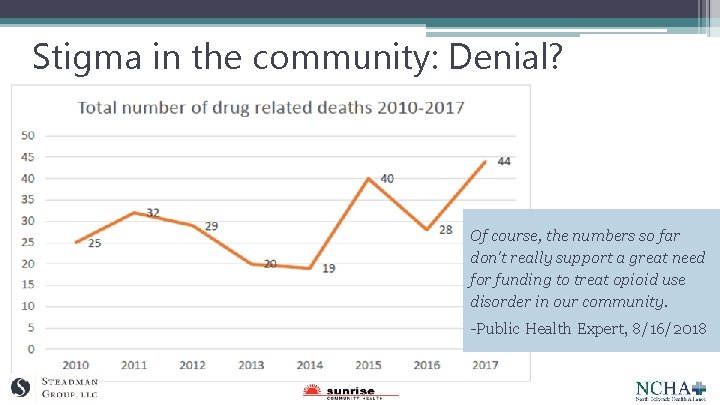
Stigma in the community: Denial? Of course, the numbers so far don't really support a great need for funding to treat opioid use disorder in our community. -Public Health Expert, 8/16/2018
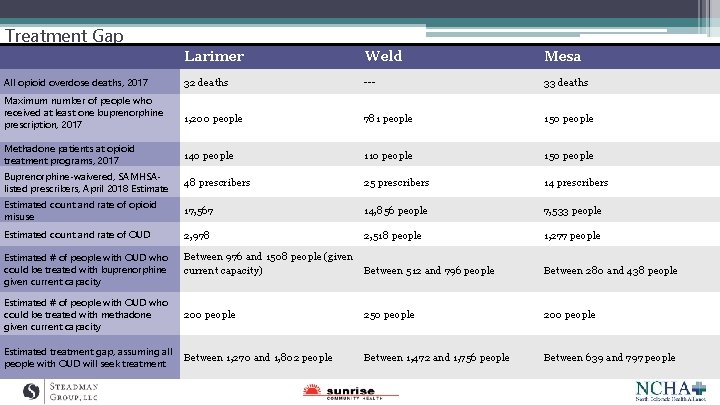
Treatment Gap Larimer Weld Mesa 32 deaths --- 33 deaths 1, 200 people 781 people 150 people Methadone patients at opioid treatment programs, 2017 140 people 110 people 150 people Buprenorphine-waivered, SAMHSAlisted prescribers, April 2018 Estimate 48 prescribers 25 prescribers 14 prescribers Estimated count and rate of opioid misuse 17, 567 14, 856 people 7, 533 people Estimated count and rate of OUD 2, 978 2, 518 people 1, 277 people Estimated # of people with OUD who could be treated with buprenorphine given current capacity Between 976 and 1508 people (given current capacity) Between 512 and 796 people Between 280 and 438 people Estimated # of people with OUD who could be treated with methadone given current capacity 200 people 250 people 200 people Estimated treatment gap, assuming all people with OUD will seek treatment Between 1, 270 and 1, 802 people Between 1, 472 and 1, 756 people Between 639 and 797 people All opioid overdose deaths, 2017 Maximum number of people who received at least one buprenorphine prescription, 2017
Medication-Assisted Treatment
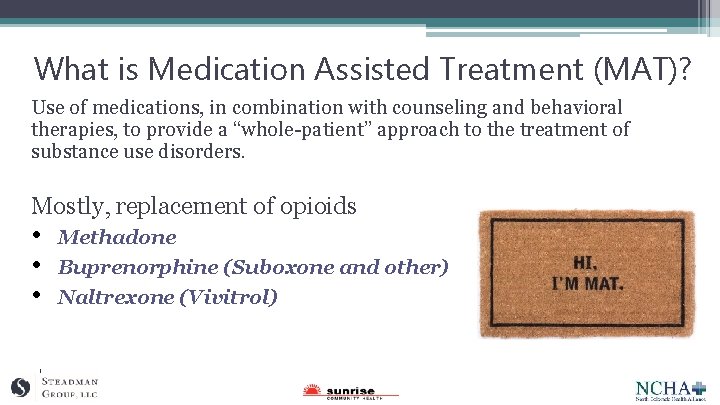
What is Medication Assisted Treatment (MAT)? Use of medications, in combination with counseling and behavioral therapies, to provide a “whole-patient” approach to the treatment of substance use disorders. Mostly, replacement of opioids • • • Methadone Buprenorphine (Suboxone and other) Naltrexone (Vivitrol)
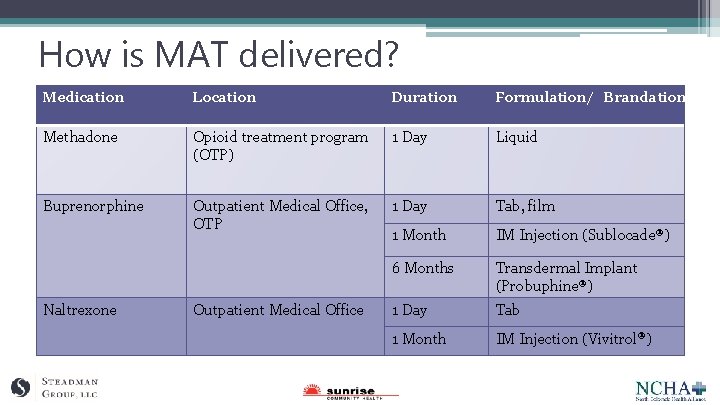
How is MAT delivered? Medication Location Duration Formulation/ Brandation Methadone Opioid treatment program (OTP) 1 Day Liquid Buprenorphine Outpatient Medical Office, OTP 1 Day Tab, film 1 Month IM Injection (Sublocade ) 6 Months Transdermal Implant (Probuphine ) 1 Day Tab 1 Month IM Injection (Vivitrol ) Naltrexone Outpatient Medical Office
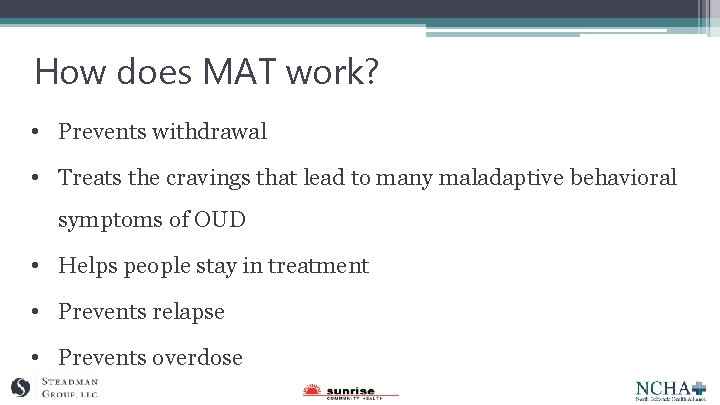
How does MAT work? • Prevents withdrawal • Treats the cravings that lead to many maladaptive behavioral symptoms of OUD • Helps people stay in treatment • Prevents relapse • Prevents overdose
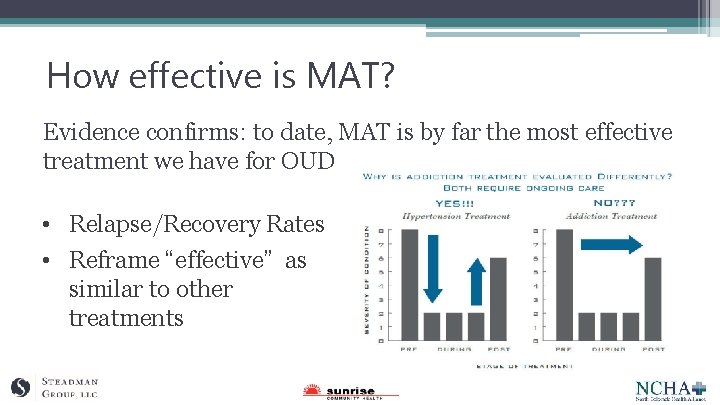
How effective is MAT? Evidence confirms: to date, MAT is by far the most effective treatment we have for OUD • Relapse/Recovery Rates • Reframe “effective” as similar to other treatments
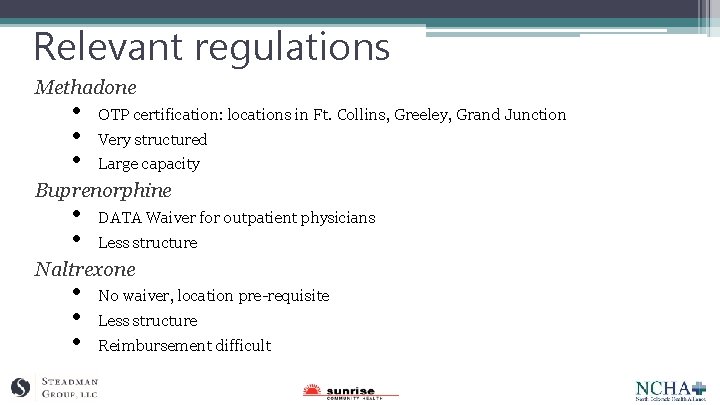
Relevant regulations Methadone • • • OTP certification: locations in Ft. Collins, Greeley, Grand Junction Very structured Large capacity Buprenorphine • • DATA Waiver for outpatient physicians Less structure Naltrexone • • • No waiver, location pre-requisite Less structure Reimbursement difficult
“A multitude of people and yet a solitude. ”
Hub & Spoke Model
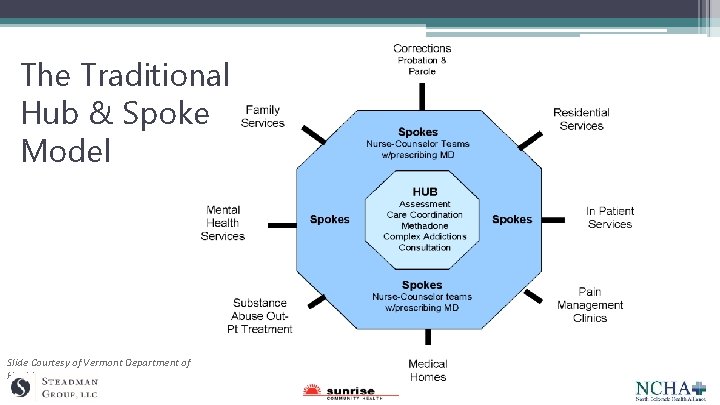
The Traditional Hub & Spoke Model Slide Courtesy of Vermont Department of Health
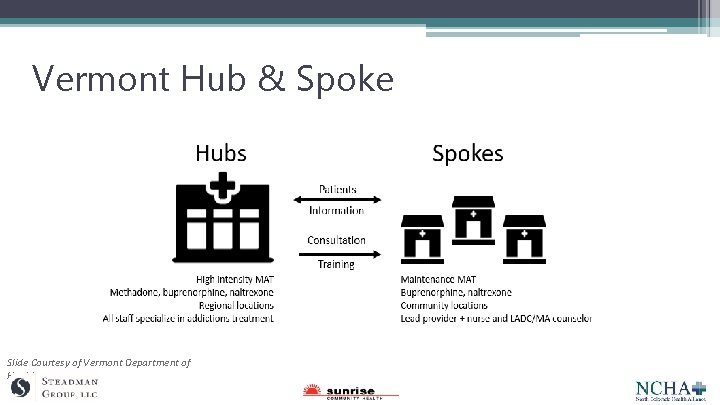
Vermont Hub & Spoke Slide Courtesy of Vermont Department of Health
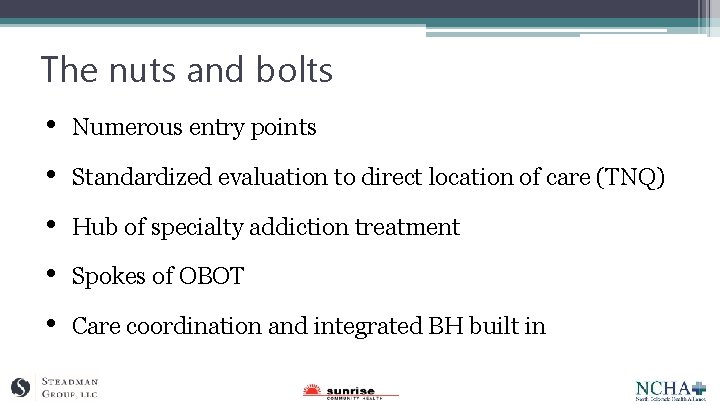
The nuts and bolts • Numerous entry points • Standardized evaluation to direct location of care (TNQ) • Hub of specialty addiction treatment • Spokes of OBOT • Care coordination and integrated BH built in
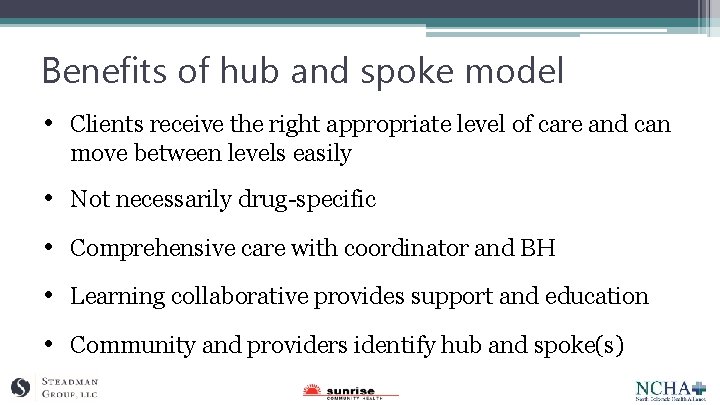
Benefits of hub and spoke model • Clients receive the right appropriate level of care and can move between levels easily • Not necessarily drug-specific • Comprehensive care with coordinator and BH • Learning collaborative provides support and education • Community and providers identify hub and spoke(s)
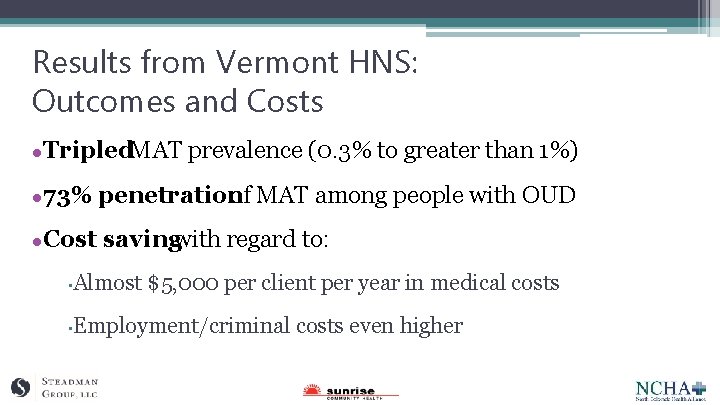
Results from Vermont HNS: Outcomes and Costs ●Tripled. MAT prevalence (0. 3% to greater than 1%) ● 73% penetration of MAT among people with OUD ●Cost savingwith regard to: • Almost $5, 000 per client per year in medical costs • Employment/criminal costs even higher
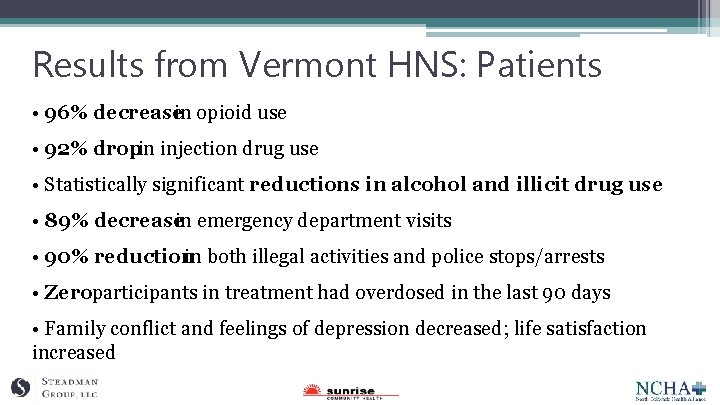
Results from Vermont HNS: Patients • 96% decreasein opioid use • 92% dropin injection drug use • Statistically significant reductions in alcohol and illicit drug use • 89% decreasein emergency department visits • 90% reduction in both illegal activities and police stops/arrests • Zeroparticipants in treatment had overdosed in the last 90 days • Family conflict and feelings of depression decreased; life satisfaction increased
“Sadly, sadly, the sun rose; it rose upon no sadder sight than the man of good abilities and good emotions, incapable of their directed exercise, incapable of his own help and his own happiness, sensible of the blight on him, and resigning himself to let it eat him away. ”
Pathways to improved care for the community in Northern Colorado Western Slope
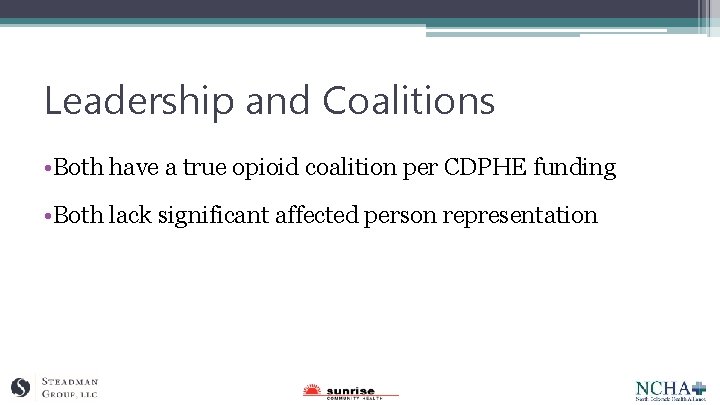
Leadership and Coalitions • Both have a true opioid coalition per CDPHE funding • Both lack significant affected person representation
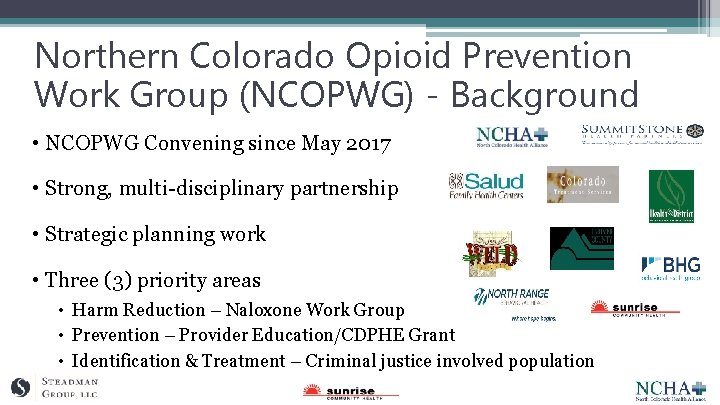
Northern Colorado Opioid Prevention Work Group (NCOPWG) - Background • NCOPWG Convening since May 2017 • Strong, multi-disciplinary partnership • Strategic planning work • Three (3) priority areas • Harm Reduction – Naloxone Work Group • Prevention – Provider Education/CDPHE Grant • Identification & Treatment – Criminal justice involved population
32 Larimer County Substance Abuse and Mental Health Alliance • Convened • Leadership • Membership • Strategic goals
33 Mesa County • Behavioral Health Coalition: specific, most providers attend • Opioid advisory group: main purpose is to seek funding, more community-oriented, arranged like a typical opioid coalition
“nd yet I have had the weakness, and have still the weakness, to wish you to know with what a sudden mastery you kindled me, heap of ashes that I am, into fire. ”
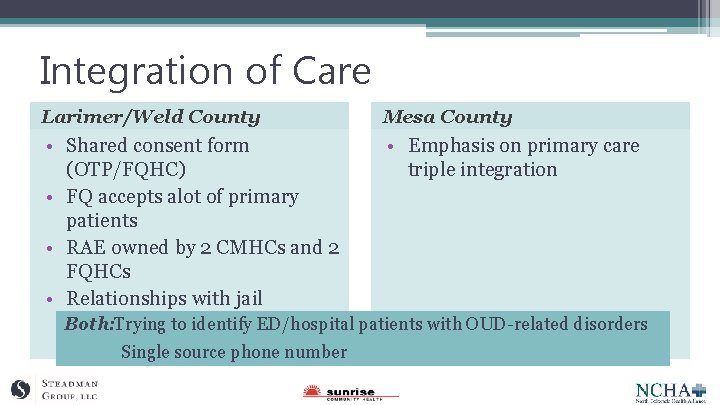
Integration of Care Larimer/Weld County Mesa County • Shared consent form (OTP/FQHC) • FQ accepts alot of primary patients • RAE owned by 2 CMHCs and 2 FQHCs • Relationships with jail • Emphasis on primary care triple integration Both: Trying to identify ED/hospital patients with OUD-related disorders Single source phone number
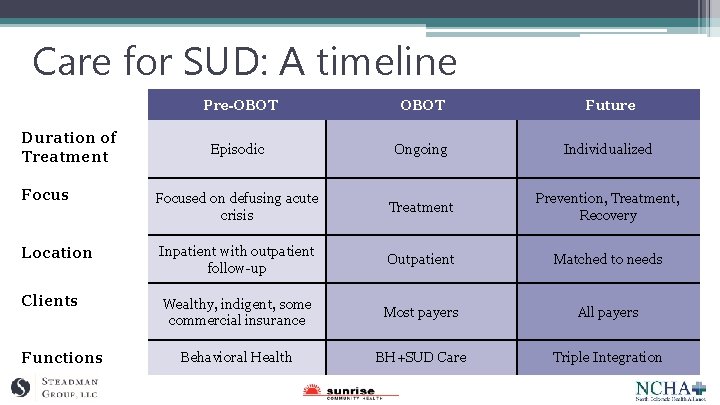
Care for SUD: A timeline Pre-OBOT Future Episodic Ongoing Individualized Focused on defusing acute crisis Treatment Prevention, Treatment, Recovery Location Inpatient with outpatient follow-up Outpatient Matched to needs Clients Wealthy, indigent, some commercial insurance Most payers All payers Behavioral Health BH+SUD Care Triple Integration Duration of Treatment Functions
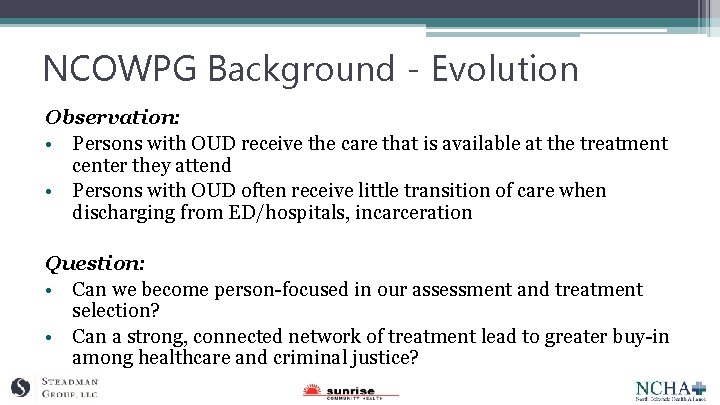
NCOWPG Background - Evolution Observation: • Persons with OUD receive the care that is available at the treatment center they attend • Persons with OUD often receive little transition of care when discharging from ED/hospitals, incarceration Question: • Can we become person-focused in our assessment and treatment selection? • Can a strong, connected network of treatment lead to greater buy-in among healthcare and criminal justice?
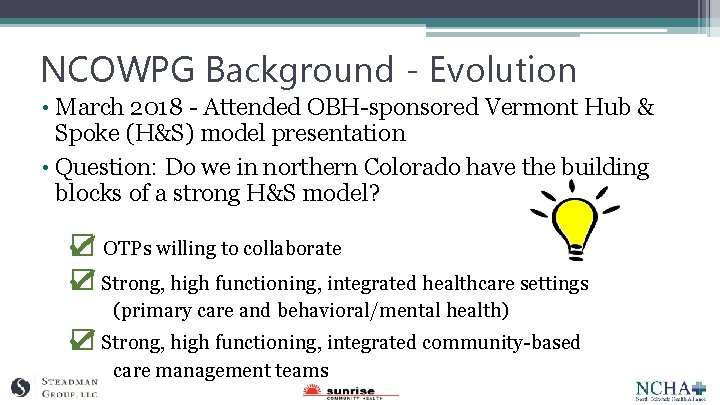
NCOWPG Background - Evolution • March 2018 - Attended OBH-sponsored Vermont Hub & Spoke (H&S) model presentation • Question: Do we in northern Colorado have the building blocks of a strong H&S model? ☑ OTPs willing to collaborate ☑ Strong, high functioning, integrated healthcare settings (primary care and behavioral/mental health) ☑ Strong, high functioning, integrated community-based care management teams
Northern Colorado Hub & Spoke – Phased Approach • Phase I – Close, Coordinated Collaboration • Phase II – Coordinated Transitions of Care (Hosp/ED, Incarceration) • Phase III – Hub Operations
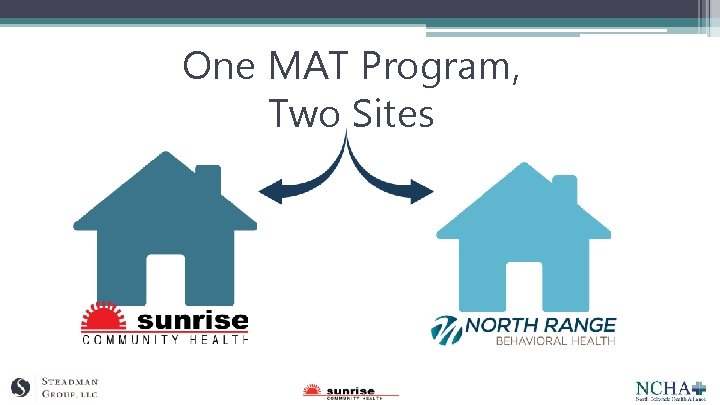
One MAT Program, Two Sites
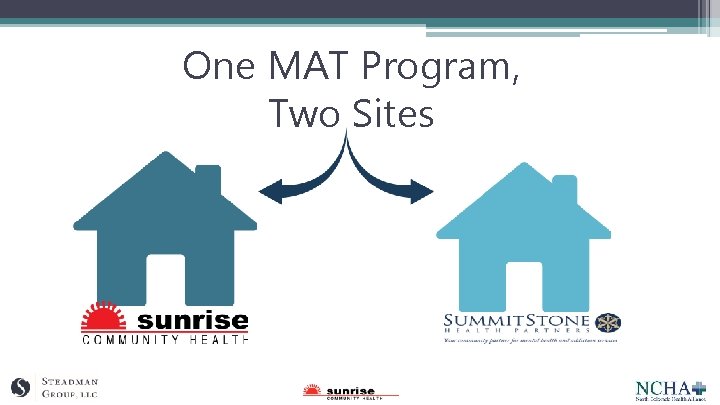
One MAT Program, Two Sites
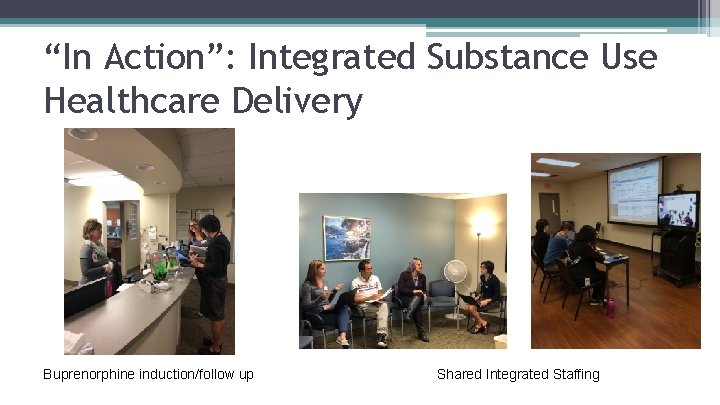
“In Action”: Integrated Substance Use Healthcare Delivery Buprenorphine induction/follow up Shared Integrated Staffing
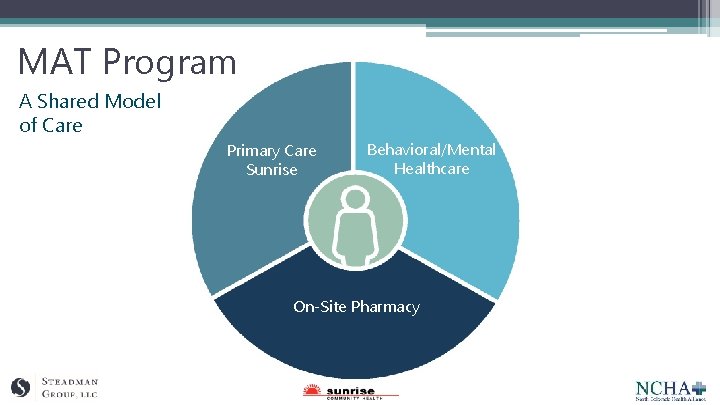
MAT Program A Shared Model of Care Primary Care Sunrise Behavioral/Mental Healthcare On-Site Pharmacy
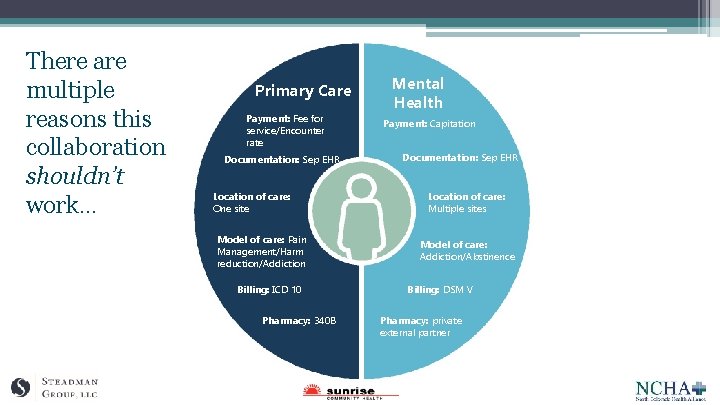
There are multiple reasons this collaboration shouldn’t work… Primary Care Payment: Fee for service/Encounter rate Documentation: Sep EHR Location of care: One site Model of care: Pain Management/Harm reduction/Addiction Billing: ICD 10 Pharmacy: 340 B Mental Health Payment: Capitation Documentation: Sep EHR Location of care: Multiple sites Model of care: Addiction/Abstinence Billing: DSM V Pharmacy: private external partner
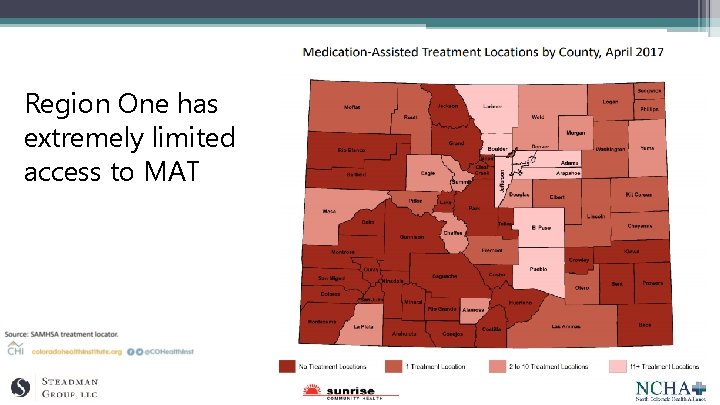
Region One has extremely limited access to MAT
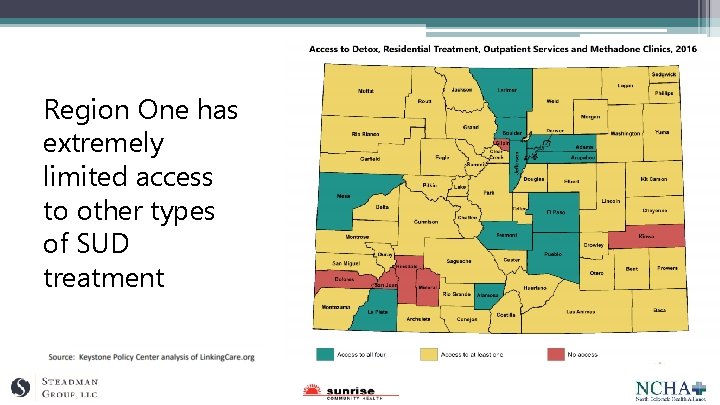
Region One has extremely limited access to other types of SUD treatment
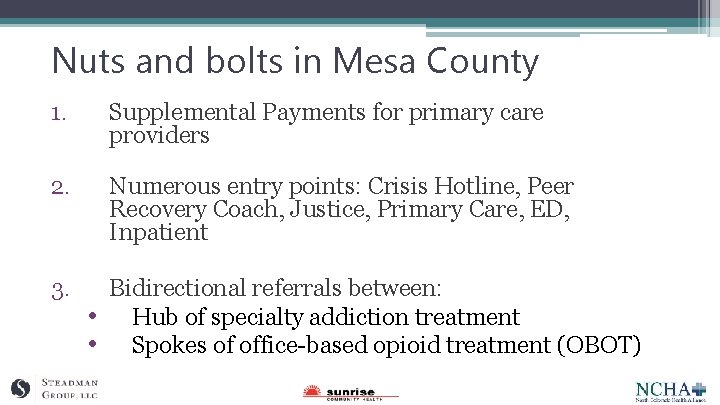
Nuts and bolts in Mesa County 1. Supplemental Payments for primary care providers 2. Numerous entry points: Crisis Hotline, Peer Recovery Coach, Justice, Primary Care, ED, Inpatient 3. Bidirectional referrals between: • Hub of specialty addiction treatment • Spokes of office-based opioid treatment (OBOT)
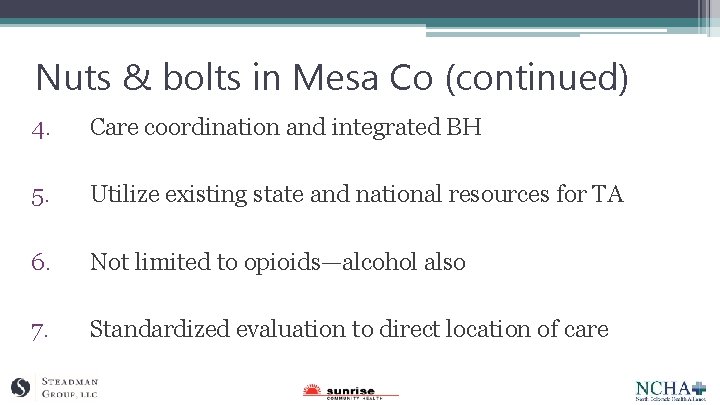
Nuts & bolts in Mesa Co (continued) 4. Care coordination and integrated BH 5. Utilize existing state and national resources for TA 6. Not limited to opioids—alcohol also 7. Standardized evaluation to direct location of care
“Since I knew you, I have been troubled by a remorse that I thought would never reproach me again, and have heard whispers from old voices impelling me upward, that I thought were silent for ever. I have had unformed ideas of striving afresh, beginning anew, shaking off sloth and sensuality, and fighting out the abandoned fight. A dream, all a dream, that ends in nothing, and leaves the sleeper where he lay down, but I wish you to know that you inspired it. ”
Opioids today, then what?
Next steps • Substance-agnostic systems of care • Opioids today, something else tomorrow • Not a competition for different SUDs • Elsewhere around the state: Fort Collins • Payment reform
Available Resources
Resources in Colorado • IT-MATTTRS (both provider and prescribers) • Peer recovery coaches and training • STR-TA grant • Colorado Rx Consortium • Crisis Hotline • SAMHSA grant
Funding • Larimer: SAMHSA, 202, HRSA, Medicaid • Mesa: Medicaid
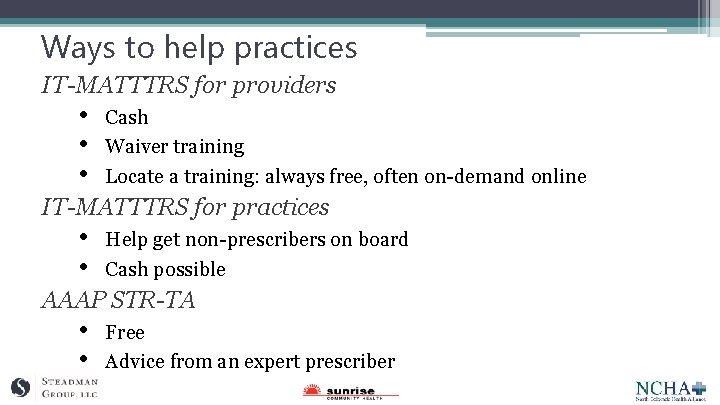
Ways to help practices IT-MATTTRS for providers • • • Cash Waiver training Locate a training: always free, often on-demand online IT-MATTTRS for practices • • Help get non-prescribers on board Cash possible AAAP STR-TA • • Free Advice from an expert prescriber
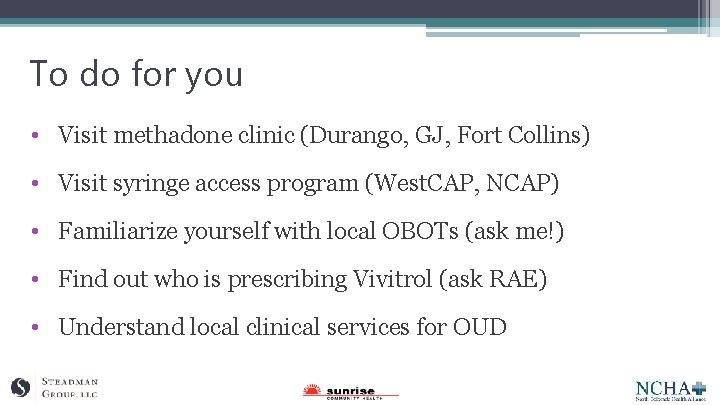
To do for you • Visit methadone clinic (Durango, GJ, Fort Collins) • Visit syringe access program (West. CAP, NCAP) • Familiarize yourself with local OBOTs (ask me!) • Find out who is prescribing Vivitrol (ask RAE) • Understand local clinical services for OUD
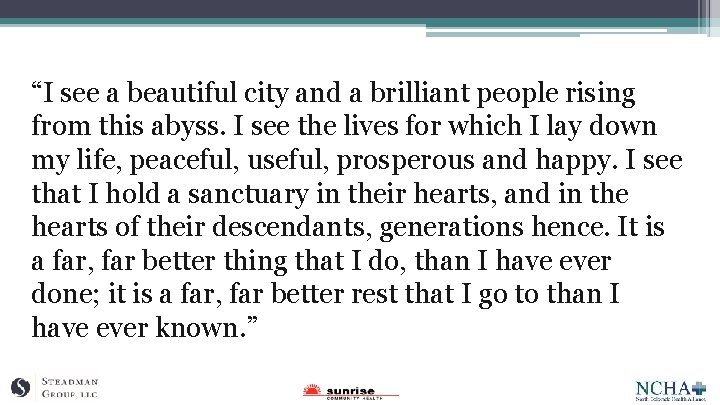
“I see a beautiful city and a brilliant people rising from this abyss. I see the lives for which I lay down my life, peaceful, useful, prosperous and happy. I see that I hold a sanctuary in their hearts, and in the hearts of their descendants, generations hence. It is a far, far better thing that I do, than I have ever done; it is a far, far better rest that I go to than I have ever known. ”
Thank you JKCostello@Steadman. Group. com lbrooks. alliance@nocoha. org