A Spill A Slip A Hospital Trip Safety


- Slides: 15
A Spill, A Slip, A Hospital Trip Safety & Worker’s Compensation
Reporting Worker’s Compensation Claims Today we are going to cover: • How and when to report Worker’s Compensation Claims • How to document and update claims in Paylocity • Important information to remember when handling Worker’s Compensation Claims
Reporting Worker’s Comp Claims When a workplace injury occurs, always take care of the employee first. If it’s an emergency, call 911. Contact Accident Fund’s Claims Express service as soon as possible, and within 24 hours of the incident. Notify Human Resources. Communicate with your injured employee.
Phone: 1 -866 -206 -5851 Accident Fund Contact Information Email: claimsexpress@accidentfund. com Fax: 1 -866 -814 -5595 Online: www. accidentfund. com
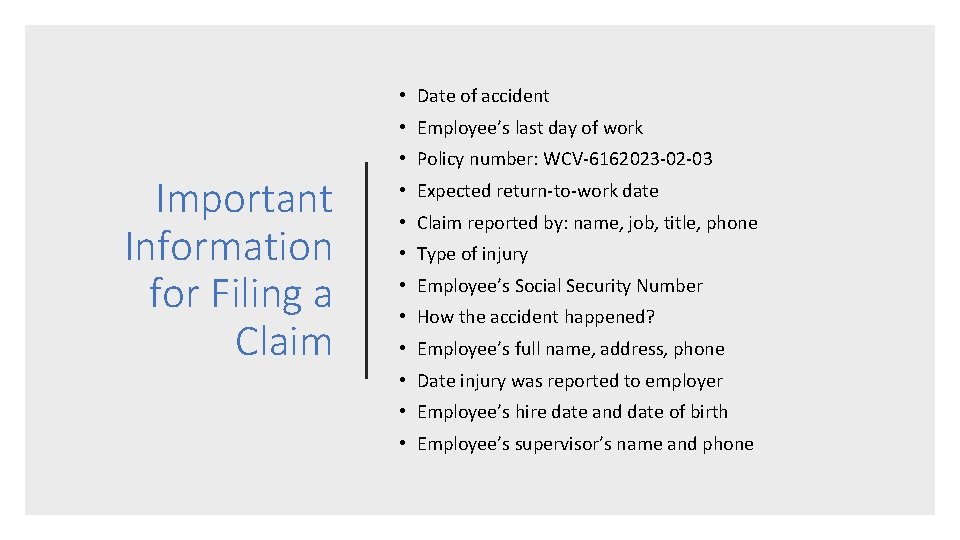
• Date of accident • Employee’s last day of work Important Information for Filing a Claim • Policy number: WCV-6162023 -02 -03 • Expected return-to-work date • Claim reported by: name, job, title, phone • Type of injury • Employee’s Social Security Number • How the accident happened? • Employee’s full name, address, phone • Date injury was reported to employer • Employee’s hire date and date of birth • Employee’s supervisor’s name and phone
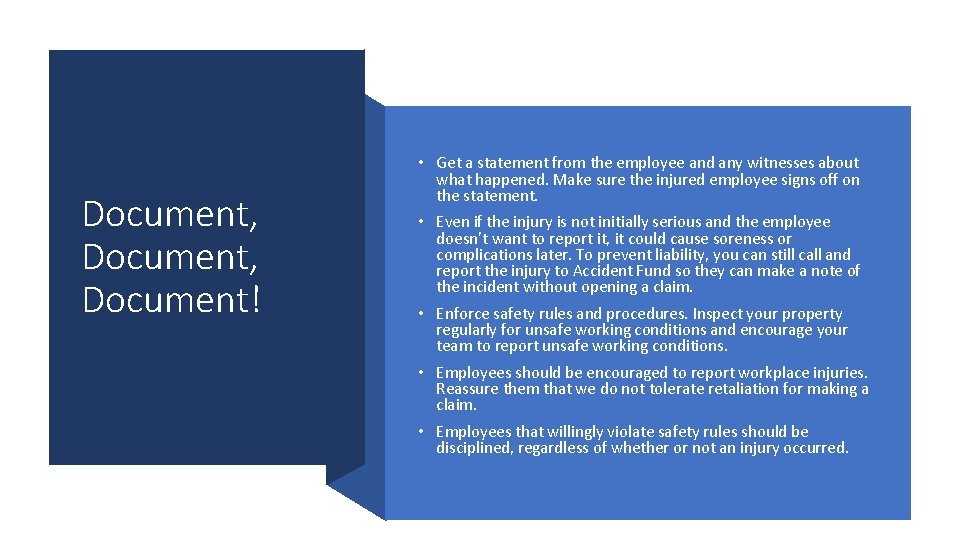
Document, Document! • Get a statement from the employee and any witnesses about what happened. Make sure the injured employee signs off on the statement. • Even if the injury is not initially serious and the employee doesn’t want to report it, it could cause soreness or complications later. To prevent liability, you can still call and report the injury to Accident Fund so they can make a note of the incident without opening a claim. • Enforce safety rules and procedures. Inspect your property regularly for unsafe working conditions and encourage your team to report unsafe working conditions. • Employees should be encouraged to report workplace injuries. Reassure them that we do not tolerate retaliation for making a claim. • Employees that willingly violate safety rules should be disciplined, regardless of whether or not an injury occurred.
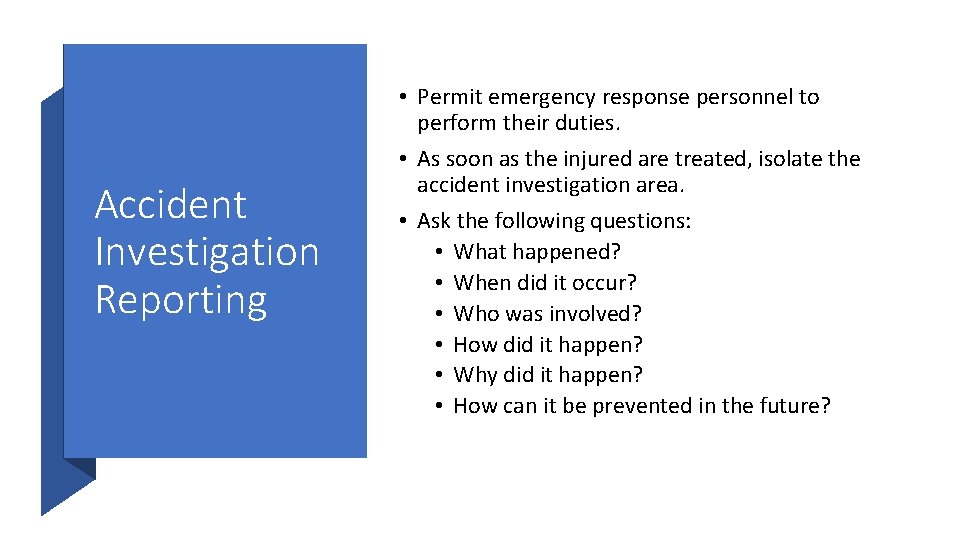
Accident Investigation Reporting • Permit emergency response personnel to perform their duties. • As soon as the injured are treated, isolate the accident investigation area. • Ask the following questions: • What happened? • When did it occur? • Who was involved? • How did it happen? • Why did it happen? • How can it be prevented in the future?
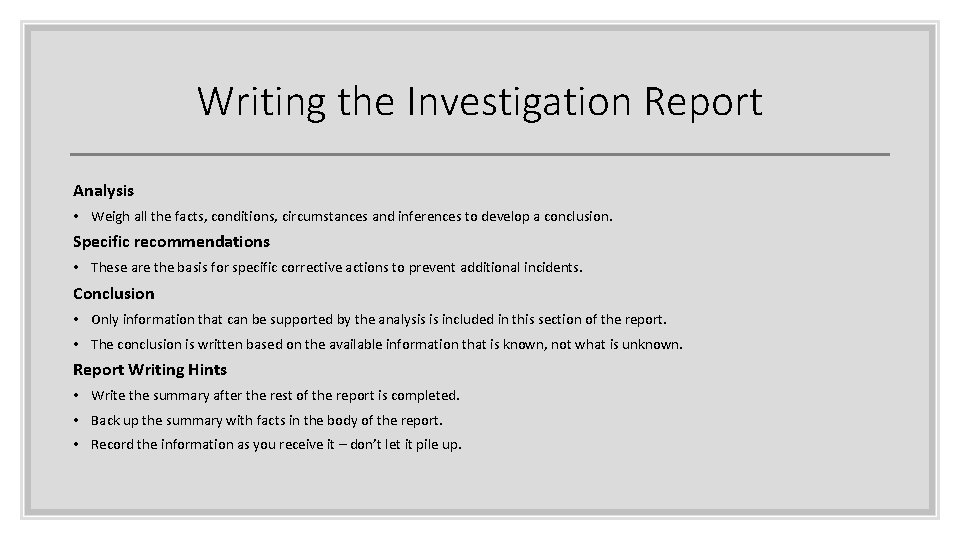
Writing the Investigation Report Analysis • Weigh all the facts, conditions, circumstances and inferences to develop a conclusion. Specific recommendations • These are the basis for specific corrective actions to prevent additional incidents. Conclusion • Only information that can be supported by the analysis is included in this section of the report. • The conclusion is written based on the available information that is known, not what is unknown. Report Writing Hints • Write the summary after the rest of the report is completed. • Back up the summary with facts in the body of the report. • Record the information as you receive it – don’t let it pile up.
• It is very important to make sure the injured employee has a return to work release from their physician prior to returning to work. Return to Work • Often with Workers Compensation claims, there are certain restrictions on returning to work such as light duty. • Always reach out to the claims adjuster that has been assigned to the case with any questions regarding an injured employee’s restrictions. • If the injured employee’s restrictions limit them from performing the essential functions of their job, we can create solutions for alternative work assignments.
Report Worker’s Compensation Insurance Fraud If you see or suspect fraudulent activity by a co-worker, employer or medical care provider, or if you know about a fraudulent claim, call the Accident Fund anonymous tip line. 1 -800 -944 -3728
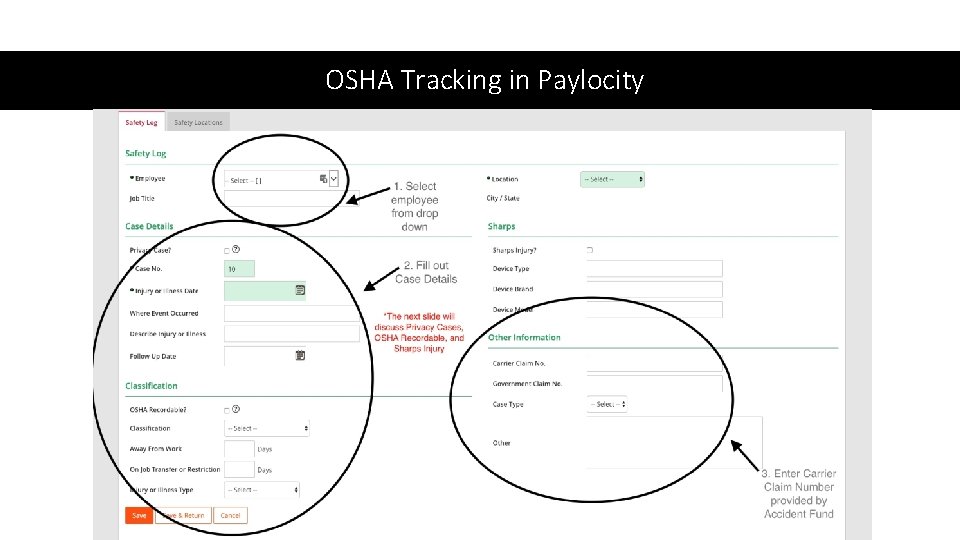
OSHA Tracking in Paylocity
Privacy Cases & Sharps Injury Per OSHA Regulation, employers may not display the employee’s name on the OSHA 300 log if the safety incident is a privacy concern case. The following reasons are criteria for privacy concern cases: 1. An injury or illness to an intimate body part of the reproductive system; 2. An injury or illness resulting from a sexual assault; 3. Mental illness 4. HIV infection, hepatitis, or tuberculosis; 5. Needlestick injuries and cuts from sharp objects that are contaminated with another person’s blood or other potentially infectious material; (Sharps Injury) 6. Other illnesses, if the employee voluntarily requests that his or her name not be entered on the log.
OSHA Recordable Per OSHA Regulation, you must consider an injury or illness to meet the general recording criteria, and therefore to be recordable, if it results in any of the following: 1. Death, 2. Days away from work, 3. Restricted work or transfer to another job, 4. Medical treatment beyond first aid, or 5. Loss of consciousness 6. A significant injury or illness diagnosed by a physician or other licensed health care professional.
Stay Alert – Don’t Get Hurt!
QUESTIONS?