A Professional Development Workshop Preparing your CV Getting





- Slides: 44
A Professional Development Workshop Preparing your CV & Getting Ready for Your Job Interview Prof. Dr. M. A Pasha Chairman Department of CS & IT University of Sargodha 5/23/2013 Delivered at Dept. of CS & IT , UOS 1
Some Quotes • “Find out what you really love to do, and then find a way to make a good living doing it. “ [Napoleon Hill] • “Everybody has talent; it's just a matter of moving around until you've discovered what it is. ” [George Lucas] • “As tools become rusty, so does the mind; a garden uncared for soon becomes smothered in weeds; a talent neglected withers and dies. ” [Ethel R. Page] • “Your earning ability today is largely dependent upon your knowledge, skill and your ability to combine that knowledge and skill in such a way that you contribute value for which customers are going to pay. ” [Brian Tracy] 5/23/2013 Delivered at Dept. of CS & IT , UOS 2
Key to Success You need to be the best you can at describing your best qualities, particularly your key strengths. And this is the key to success. "What are you good at? ” Your answer to this should be your key strengths statement 5/23/2013 Delivered at Dept. of CS & IT , UOS 3
Key Strengths Statement • Highlights your most important skills and abilities • Differentiates you from others • Avoids generalizations • Provides examples of your achievements In interviews • Spoken naturally should take no more than two minutes • Rehearse it so that it sounds completely spontaneous 5/23/2013 Delivered at Dept. of CS & IT , UOS 4
For Example • "I have very good communication skills; I work well either leading or being part of a team and I am self-motivated and capable of working on several tasks at once. As a leader of small teams I respect democratic values and involve people in the decision making so that they can put on their contribute. " 5/23/2013 Delivered at Dept. of CS & IT , UOS 5
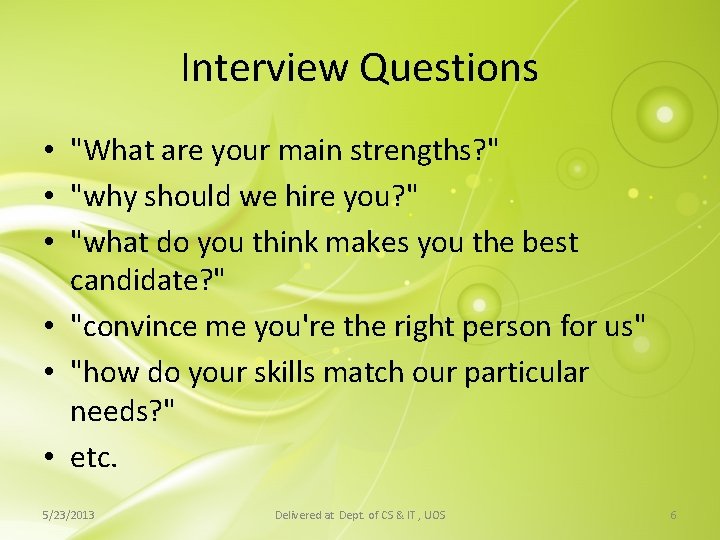
Interview Questions • "What are your main strengths? " • "why should we hire you? " • "what do you think makes you the best candidate? " • "convince me you're the right person for us" • "how do your skills match our particular needs? " • etc. 5/23/2013 Delivered at Dept. of CS & IT , UOS 6
Some key strengths/skills to put in a resume • Communication Skills • Flexibility and Adaptability • Learning agility: Quick learner • Tolerance: Stress tolerance • Critical thinking: Decision making skills • Creating Ideas: Creativity • Positive Attitude: Creating a positive work environment • Financial management 5/23/2013 • • • Intelligent Leadership Responsible Listening Goal oriented: results achiever, Meeting deadlines Motivating people Self Motivated Delegating tasks Personal Management Delivered at Dept. of CS & IT , UOS 7
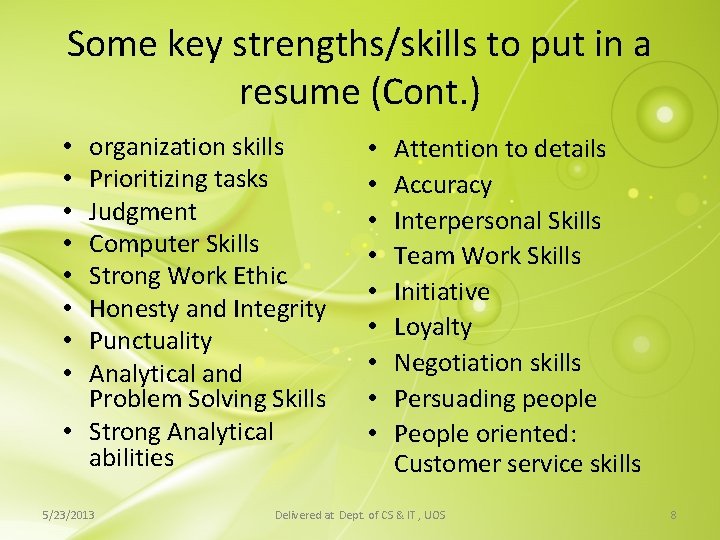
Some key strengths/skills to put in a resume (Cont. ) organization skills Prioritizing tasks Judgment Computer Skills Strong Work Ethic Honesty and Integrity Punctuality Analytical and Problem Solving Skills • Strong Analytical abilities • • 5/23/2013 • • • Attention to details Accuracy Interpersonal Skills Team Work Skills Initiative Loyalty Negotiation skills Persuading people People oriented: Customer service skills Delivered at Dept. of CS & IT , UOS 8
For Example: Project Management Key Skills • Team leader with the ability to initiate/manage cross-functional teams and multi-disciplinary projects • Critical thinking, decision making and problem solving skills • Planning and organizing • Excellent Personal Communication skills 5/23/2013 Delivered at Dept. of CS & IT , UOS 9
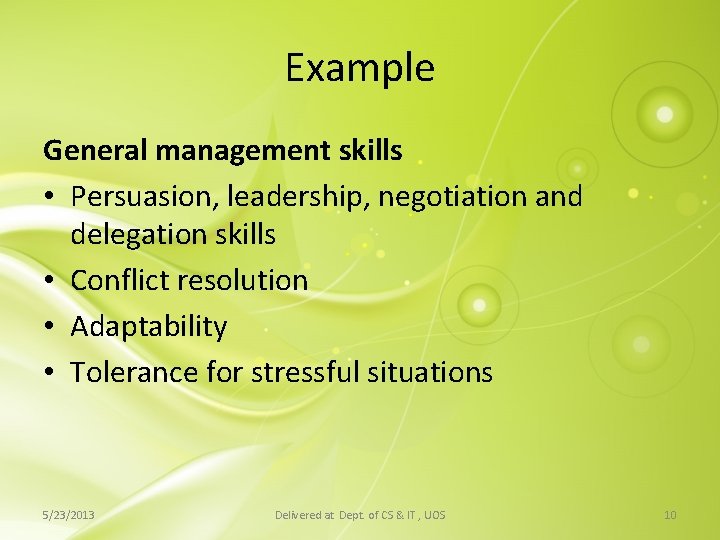
Example General management skills • Persuasion, leadership, negotiation and delegation skills • Conflict resolution • Adaptability • Tolerance for stressful situations 5/23/2013 Delivered at Dept. of CS & IT , UOS 10
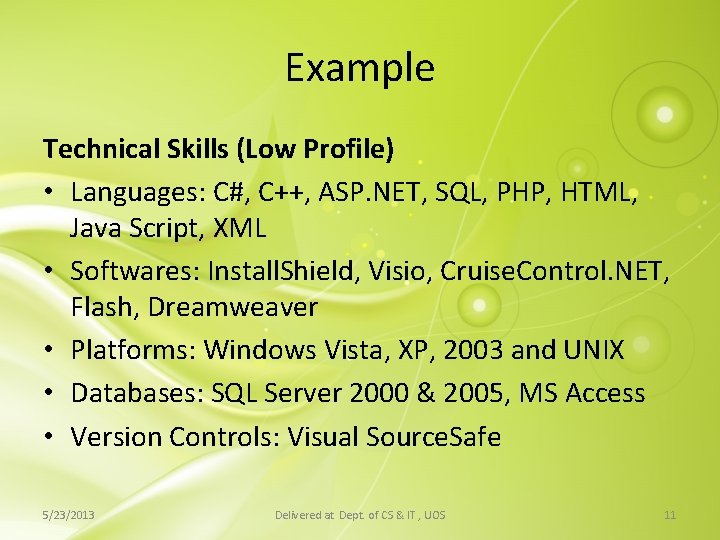
Example Technical Skills (Low Profile) • Languages: C#, C++, ASP. NET, SQL, PHP, HTML, Java Script, XML • Softwares: Install. Shield, Visio, Cruise. Control. NET, Flash, Dreamweaver • Platforms: Windows Vista, XP, 2003 and UNIX • Databases: SQL Server 2000 & 2005, MS Access • Version Controls: Visual Source. Safe 5/23/2013 Delivered at Dept. of CS & IT , UOS 11
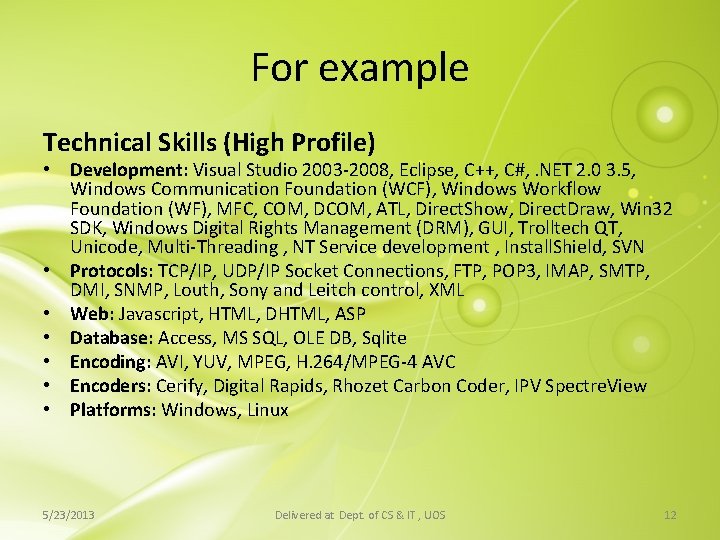
For example Technical Skills (High Profile) • Development: Visual Studio 2003 -2008, Eclipse, C++, C#, . NET 2. 0 3. 5, Windows Communication Foundation (WCF), Windows Workflow Foundation (WF), MFC, COM, DCOM, ATL, Direct. Show, Direct. Draw, Win 32 SDK, Windows Digital Rights Management (DRM), GUI, Trolltech QT, Unicode, Multi-Threading , NT Service development , Install. Shield, SVN • Protocols: TCP/IP, UDP/IP Socket Connections, FTP, POP 3, IMAP, SMTP, DMI, SNMP, Louth, Sony and Leitch control, XML • Web: Javascript, HTML, DHTML, ASP • Database: Access, MS SQL, OLE DB, Sqlite • Encoding: AVI, YUV, MPEG, H. 264/MPEG-4 AVC • Encoders: Cerify, Digital Rapids, Rhozet Carbon Coder, IPV Spectre. View • Platforms: Windows, Linux 5/23/2013 Delivered at Dept. of CS & IT , UOS 12
How To Find Your Strengths Finding your strengths and weaknesses is part and parcel of developing yourself. With a better understanding of your abilities, expressing your life purpose using skills that you're good at becomes easier. 5/23/2013 Delivered at Dept. of CS & IT , UOS 13
How Do We Define What A Strength Is? A strength consists of 4 components: 1. Your natural talent & abilities 2. The education you had 3. Your experiences in life, either working or otherwise 4. Your skills 5/23/2013 Delivered at Dept. of CS & IT , UOS 14
4 Components • Natural talent and abilities are something that you tend to do so naturally you don't realize that you're good at it. It happens to everybody all the time. • Your education helps to build your strength, because it gives you additional background and knowledge that others might not have. • Your experiences give you a real life participation to understand the actual events and requirements to make something happen. • Skills are something that we aren't born with. Skills are abilities that you hone and polish over time, continually and deliberately refining your ability to execute till you do it unconsciously with a high degree of competency. 5/23/2013 Delivered at Dept. of CS & IT , UOS 15
Practice: Finding Your Strengths • On a daily basis, take a piece of paper and write down what you think your top 10 - 15 strengths are. Just take note of what you do naturally, and what you enjoy doing. During the process, you'll experience several "aha!" moments about what your strengths are, and you'll find that you tend to write certain things over and over again, indicating to you that you already "know" your strengths, just that you weren't consciously aware of them. • After 2 - 3 weeks, compile your notes and look for the items that keep coming up over and over again. These are very likely what you think your strengths are. 5/23/2013 Delivered at Dept. of CS & IT , UOS 16
Do You Know You are Special • Your level of self-belief and the conversations you have with yourself has a tremendous impact on the outcomes you will enjoy in your life. • You are the creator of your future, you write the script of your life with every thought you think, word you speak and action you take or fail to take. • The more self-belief, self-worth and love you have for yourself, the more prosperity and success you will achieve • You can never truly believe in your-self or have a complete understanding of your real value, unless you conduct a real in-depth audit of your strengths, weaknesses, skills, abilities, opportunities and threats. 5/23/2013 Delivered at Dept. of CS & IT , UOS 17
Practical Steps Select five to ten people that you trust and that are secure enough to offer you honest feedback and meaningful input. Ask them to offer you honest answers to the following questions: • What distinct advantages or strengths do you think I have? • What weaknesses do you see me exhibit? • Where do you think I have unique leverage or gearing? • What skills do you think I am lacking? • What knowledge do you think I need to acquire? • What weaknesses do you believe I have and how can I reduce their effect on my future outcomes? • Who can I get to help me in the areas where I have weaknesses? • What potential hazards do you think lie ahead? • What opportunities can you see that I am missing? This self-audit will help you to patronize your strengths and make plans to overcome your weaknesses. 5/23/2013 Delivered at Dept. of CS & IT , UOS 18
What you were good at? • Strengths are the qualities and characteristics you demonstrate, which may include areas such as patience, determination or drive, and skills include your ability to do certain activities well. • If you know what you are good at you can behave accordingly and make the most of your abilities, and if you know what you are not so good at, you can either take steps to improve these areas or ditch or delegate these tasks to others! 5/23/2013 Delivered at Dept. of CS & IT , UOS 19
If you do not have answer ! • Complete a personal SWOT analysis - taking a large piece of paper, break it down into four areas labeled strengths, weaknesses, opportunities and threats, then reflect on each area and complete the grid. • Reflect on activities and events during your life - review what have been your strengths during these times and if you have one, record these strengths in your success diary. • Think about the strengths that you exhibit at work or in your business. • Ask your friends, family or colleagues to tell you what you are good at - you may find this difficult, but often other people will see things that you don't see yourself. • Take a personality profile, one that I use is the DISC personal profile and there are other personality profiles you can complete online. 5/23/2013 Delivered at Dept. of CS & IT , UOS 20
Build your Skills Inventory • Education and Training – What courses have you taken? – What additional training have you participated in? – What are your skills and expertise from education and training? • Hobbies and Creative Projects – What hobbies do you enjoy? – What artistic or creative projects have you been involved in? – What skills and talents were used? (Consider: writing, painting, drawings, singing, music, woodworking, sculpting, sewing, knitting, gardening and outdoor activities. 5/23/2013 Delivered at Dept. of CS & IT , UOS 21
Build your Skills Inventory Volunteering and Community Activities – – Where have you volunteered? What role did you play in a community project? What skills did you use? What did you enjoy about the volunteer duties? (Consider: Coaching, mentoring, fund raising, sales, record keepin Family Projects and Household Responsibilities g, and serving. ) – Family, parenting, and household responsibilities all require talents and skills. – What skills do you use at home? – Consider: caring for others, first-aid, meal planning, coordinating schedules, budgeting, decorating, painting, maintenance and repairs. 5/23/2013 Delivered at Dept. of CS & IT , UOS 22
How to Find a Talent • Think about what you love to do. • Play (Experiment, explore, investigate. Try doing different things and entertain different activities. ) • Try taking some personality tests. • Learn about your learning style (visual, auditory, reading/writing, and tactile/ kinesthetic) • Notice what people tell you about yourself. • Consider your interests. • Notice what you're not good at, too. • Keep a journal or notebook of some sort. (capture your thoughts now and then. It can help you to spot patterns and themes within your life. ) • Practice (the thing you love to do. ) • Share your talent with others. • Use your talent. Make the world a better place, or just show off. 5/23/2013 Delivered at Dept. of CS & IT , UOS 23
Important Tips • Try doing many different things and reading about many more. If something doesn't resonate, move on; if it does, explore it more deeply. • Be patient, too. It can take a lot of time and many false starts to find out what you're best at. • Be open-minded about what your talent might be. It may not be quite what you expect. • Just because you're good at something does not mean its a talent. To be a talent you must enjoy it as well. • Three C's in life. . . Take a "Chance" to make a "Choice" to bring a "Change" in your life. • Don't expect to find your talent right away, it takes time! • Don't lose hope. Keep practicing, practice makes perfect. 5/23/2013 Delivered at Dept. of CS & IT , UOS 24
Plan your Career 5/23/2013 Delivered at Dept. of CS & IT , UOS 25
Vocation & Career The word “vocation” refers to a strong feeling within an individual that they are meant to do a certain job. It can also be used to refer to a trade or profession. • The word “career” is used to refer to one’s progress through his/her working life, particularly in a certain profession or line of work. • The goals that one has for one’s working life are called “career goals, ” and • planning how we will reach them is called setting a “career path. ” 5/23/2013 Delivered at Dept. of CS & IT , UOS 26
Knowing Yourself Assess your current situation. Get to know your interests, skills and values and think about both the personal and the broader economic factors that could influence your work and learning choices. Where do I start? Think about where you are at, where you want to go and how you are going to get there. – What are my interests? Explore your work interests. – What are my skills? Explore your abilities. – What is important now? Clarify what is important to you in your work and your life. – What else do I need to think about? Think about the other factors that will affect your work and learning decisions. 5/23/2013 Delivered at Dept. of CS & IT , UOS 27
Find out Explore the occupations and learning opportunities on offer and find out about the occupations that interest you. – – – – For each occupation you explore ask yourself: What are the daily tasks and duties? What are the working conditions? What are the personal requirements? What skills and training do I need? What career paths are available? Where is the work? How do I find out more about my preferred occupations? Once you have a selection of occupations that interest you, start researching specific occupations. 5/23/2013 Delivered at Dept. of CS & IT , UOS 28
Decision Making Before you make a decision ask yourself: – What are my preferred work/learning options? – How do they match with my skills, interests and values? – How do they fit with the current labour market? – How do they fit with my current situation and responsibilities? – What are the advantages and disadvantages of each option? – What will help and what will hinder me? – What will I do about it? 5/23/2013 Delivered at Dept. of CS & IT , UOS 29
Decision Making (Cont. ) • Speak to people working in your preferred occupations. • Search occupation list/resources to narrow down your choices. • Compare your options – narrow down your choices (pros and cons) and choose the best option for you now. 5/23/2013 Delivered at Dept. of CS & IT , UOS 30
Action Plan The most effective action plans are: • based on up-to-date information; • specific and detailed; • tied to timelines with specific completion dates; • challenging but achievable; and • aligned with your goals and values. • set yourself a key task like arranging work experience or speaking to someone that works in the field; and • find out about study or training pathways that would help you to achieve a specific qualification for a preferred occupation. 5/23/2013 Delivered at Dept. of CS & IT , UOS 31
Tips for job interview • Research the industry and company. • Clarify your "selling points" and the reasons you want the job. (three to five key selling points in mind) • Anticipate the interviewer's concerns and reservations. (Put yourself in their shoes and ask yourself why they might not want to hire you) 5/23/2013 Delivered at Dept. of CS & IT , UOS 32
Tips for job interview (Cont. ) • Prepare for common interview questions. (Anticipate questions and prepare your answers so you won't have to fumble for them during the actual interview. • Line up your questions for the interviewer. (for example, "What do you think is the best thing about working here? " and "What kind of person would you most like to see fill this position? ") 5/23/2013 Delivered at Dept. of CS & IT , UOS 33
Tips for job interview (Cont. ) • Practice, practice. ("Why should we hire you? “; practice interview with your friend) • Score a success in the first five minutes. (interviewers make up their minds about candidates in the first five minutes of the interview) • Get on the same side as the interviewer. 5/23/2013 Delivered at Dept. of CS & IT , UOS 34
Tips for job interview (Cont. ) • Be assertive and take responsibility for the interview. ( Be polite but Do not become passive during interview) • Be ready to handle illegal and inappropriate questions. (questions about your race, age, gender, religion, marital status, and sexual orientation) • Make your selling points clear. (tell the interviewer what your selling point is first, then give the example. ) 5/23/2013 Delivered at Dept. of CS & IT , UOS 35
Tips for job interview (Cont. ) • Think positive. ("What courses have you liked least? " or "What did you like least about that previous job? " don't answer the question. Instead, say something like "Well, actually I've found [class] to be very tough, I liked the fact that [positive point about the class]“ • Listen. From the very beginning of the interview, your interviewer is giving you information, either directly or indirectly. If you are not hearing it, you are missing a major opportunity. Good communication skills include listening and letting the person know you heard what was said. Observe your interviewer, and match that style and pace. 5/23/2013 Delivered at Dept. of CS & IT , UOS 36
Tips for job interview (Cont. ) • Don't Talk Too Much. Telling the interviewer more than he needs to know could be a fatal mistake. • Don't Be Too Familiar. The interview is a professional meeting to talk business. It is important to bring energy and enthusiasm to the interview and to ask questions, but do not overstep your place as a candidate looking for a job. • Use Appropriate Language. It's a given that you should use professional language during the interview. Be aware of any inappropriate slang words or references to age, race, religion, politics or sexual orientation -- these topics could send you out the door very quickly. 5/23/2013 Delivered at Dept. of CS & IT , UOS 37
Tips for job interview (Cont. ) • Don't Be Cocky. Attitude plays a key role in your interview success. There is a fine balance between confidence, professionalism and modesty. Even if you're putting on a performance to demonstrate your ability, overconfidence is as bad, if not worse, as being too reserved. • Don't Appear Desperate. When you interview with the "please, please hire me" approach, you appear desperate and less confident. Reflect the three Cs during the interview: cool, calm and confidence. 5/23/2013 Delivered at Dept. of CS & IT , UOS 38
Tips for job interview (Cont. ) • Close on a positive note. (explain why you think this is the job for you; explain your strongest abilities; you'll be asking for the job, explaining why you think it's a good match, displaying your thoughtfulness and maturity) • Bring a copy of your resume to every interview. 5/23/2013 Delivered at Dept. of CS & IT , UOS 39
Tips for job interview (Cont. ) • Don't worry about sounding "canned" (overly polished or glib) If you're well prepared, you'll sound smooth and articulate, not canned. • Make the most of the "Tell me about yourself" question. ("Well, obviously I could tell you about lots of things, and if I'm missing what you want, please let me know. But the three things I think are most important for you to know about me are [your selling points]. "Well, regarding the first point, [give your example]. This question is the golden opportunity; you must cash it 5/23/2013 Delivered at Dept. of CS & IT , UOS 40
Tips for job interview (Cont. ) • Speak the right body language. Dress appropriately, make eye contact, give a firm handshake, have good posture, speak clearly, and don't wear perfume or cologne! Sometimes interview locations are small rooms that may lack good air circulation. • Be ready for "behavior-based" interviews". (You might be asked to talk about a time when you made an unpopular decision, displayed a high level of persistence, or made a decision under time pressure and with limited information - (Situation-Action. Result)) 5/23/2013 Delivered at Dept. of CS & IT , UOS 41
Tips for job interview (Cont. ) • Send thank-you notes. (Write a thank-you note after every interview. Type each note on paper or send them by email) To write a good thank-you note, you'll need to take time after each interview to jot down a few things about what the interviewer said. Also, write down what you could have done better in the interview, and make adjustments before you head off for your next interview. 5/23/2013 Delivered at Dept. of CS & IT , UOS 42
Don't give up! Try and Try Again 5/23/2013 Delivered at Dept. of CS & IT , UOS 43
5/23/2013 Delivered at Dept. of CS & IT , UOS 44