
Continuous Professional Development Dr Kamran Sattar MBBS MMed
Continuous Professional Development Dr. Kamran Sattar MBBS MMed. Ed Uo. D (UK FAcad. MEd Ao. ME (UK) College of Medicine King Saud University


TO HELP
• https: //www. cartoonstock. com/directory/c/competence. asp

http: //www. healthandsafetyatwork. com/hsw/risk-assessment/competence
Objectives Students should be able to; 1. Understand what is Competence and differentiate its Levels? 2. To plan for their own Continuous Prof: Devp: (CPD)? 3. Appraise, What is Reflective Learning and how to utilize it in day to day learning ?
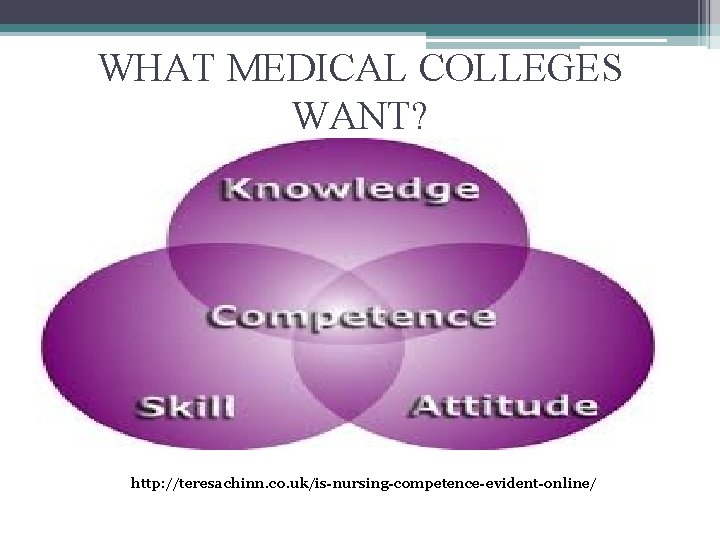
WHAT MEDICAL COLLEGES WANT? http: //teresachinn. co. uk/is-nursing-competence-evident-online/
WHAT MEDICAL COLLEGES WANT? Competence Cont: • • • Proficiency Communication skills Interpersonal skills Confidence Critical thinking & problem solving skills Flexibility Self motivation Leadership Teamwork
Deanship of all Medical Colleges In Saudi Arabia, a national call to define the competencies of medical graduates has been given a higher priority with the expansion of medical education in the Kingdom (Bin. Abdulrahman 2008, 2011). Saudi-Med Documents
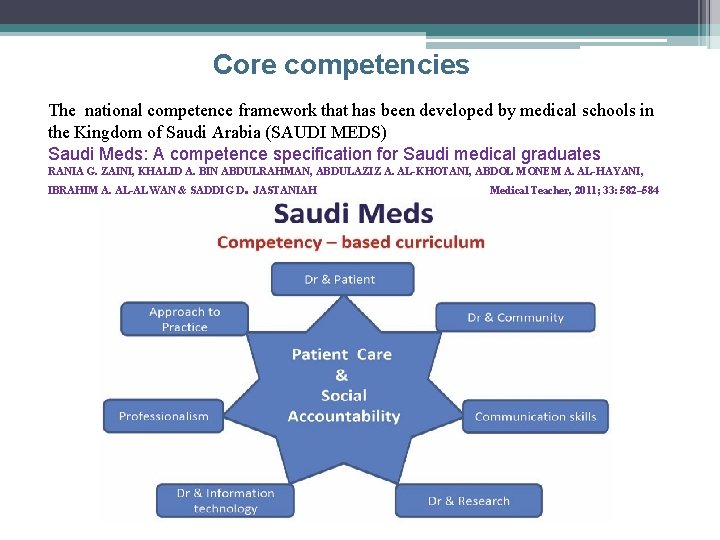
Core competencies The national competence framework that has been developed by medical schools in the Kingdom of Saudi Arabia (SAUDI MEDS) Saudi Meds: A competence specification for Saudi medical graduates RANIA G. ZAINI, KHALID A. BIN ABDULRAHMAN, ABDULAZIZ A. AL-KHOTANI, ABDOL MONEM A. AL-HAYANI, . IBRAHIM A. AL-ALWAN & SADDIG D JASTANIAH Medical Teacher, 2011; 33: 582– 584
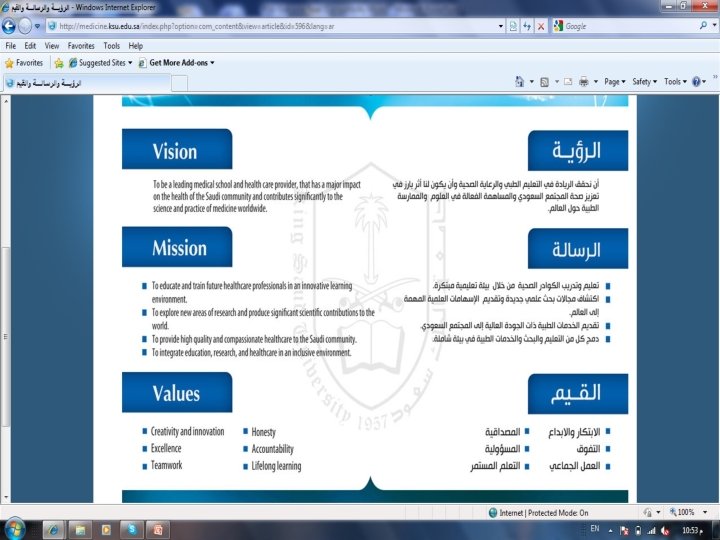
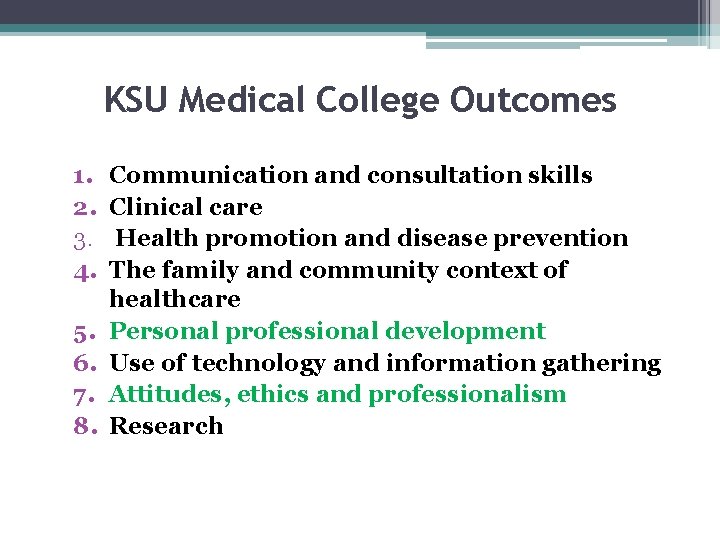
KSU Medical College Outcomes 1. 2. 3. 4. 5. 6. 7. 8. Communication and consultation skills Clinical care Health promotion and disease prevention The family and community context of healthcare Personal professional development Use of technology and information gathering Attitudes, ethics and professionalism Research
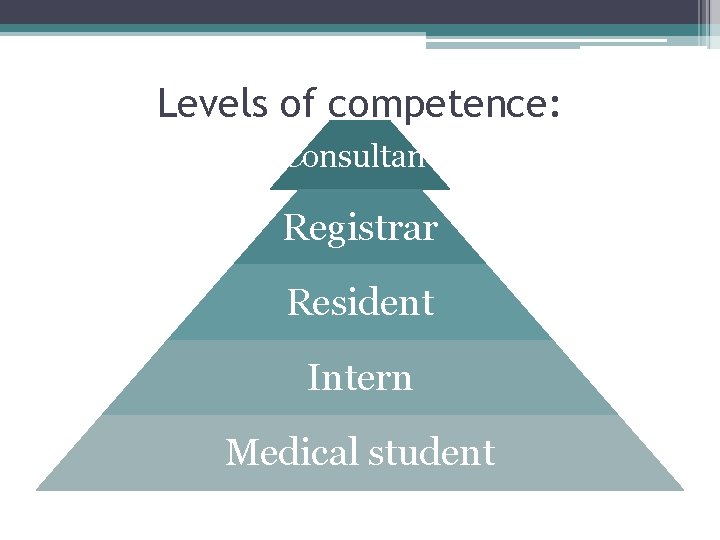
Levels of competence: Consultant Registrar Resident Intern Medical student
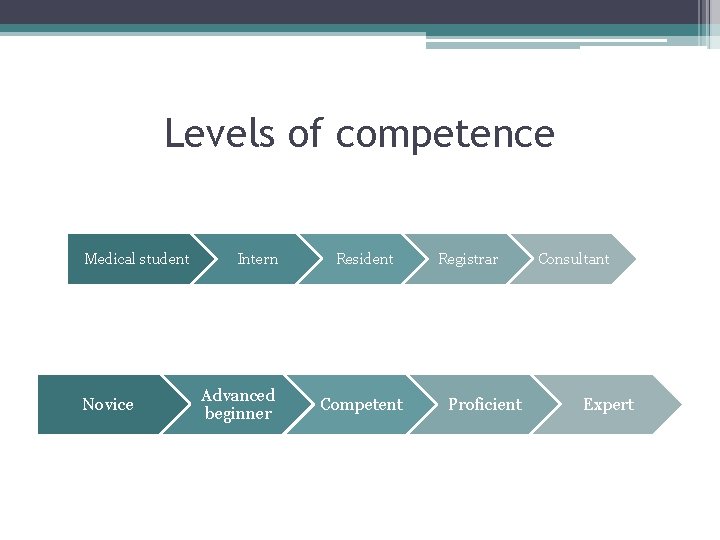
Levels of competence Medical student Novice Intern Advanced beginner Resident Competent Registrar Proficient Consultant Expert
Think, Pair & Share Every five of you. What is your definition of COMPETENCE ?
Definition of competence: “ The ability to perform a specific task in a manner that yields desirable outcomes”.
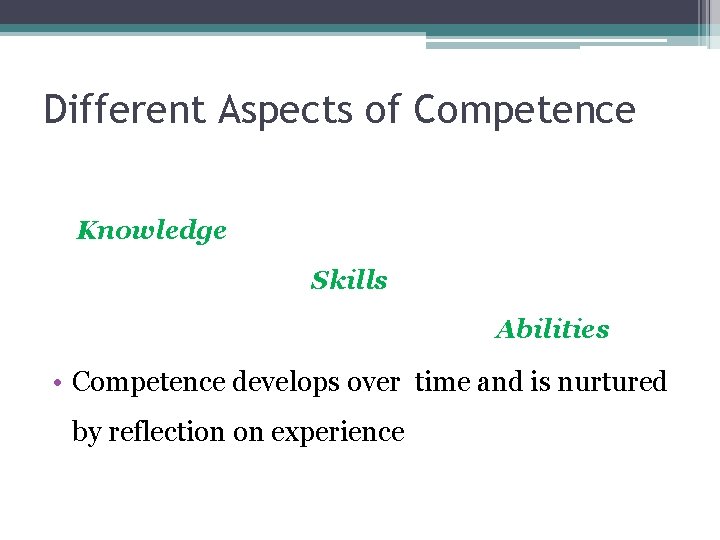
Different Aspects of Competence Knowledge Skills Abilities • Competence develops over time and is nurtured by reflection on experience
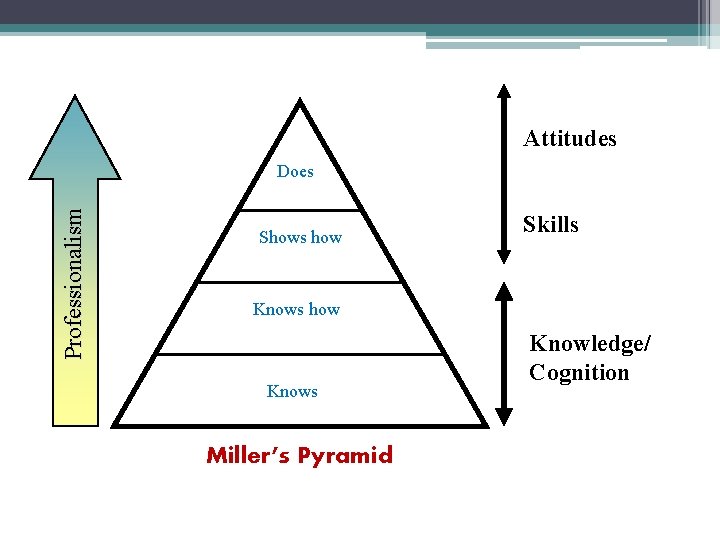
Attitudes Professionalism Does Shows how Skills Knows how Knows Miller’s Pyramid Knowledge/ Cognition
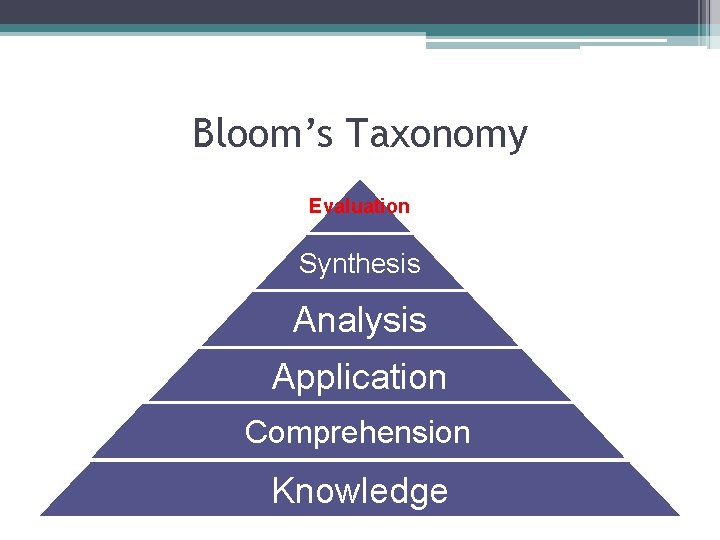
Bloom’s Taxonomy Evaluation Synthesis Analysis Application Comprehension Knowledge
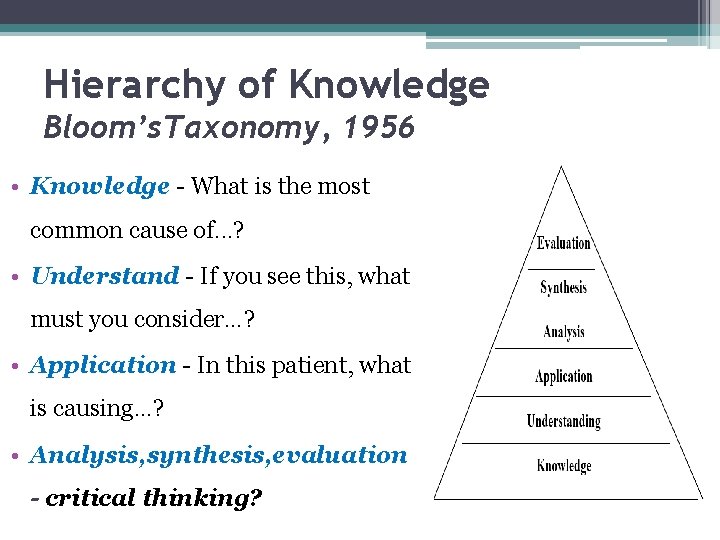
Hierarchy of Knowledge Bloom’s. Taxonomy, 1956 • Knowledge - What is the most common cause of. . . ? • Understand - If you see this, what must you consider…? • Application - In this patient, what is causing…? • Analysis, synthesis, evaluation - critical thinking?
Think, Pair & Share Every five of you. What is your definition of Skills ?
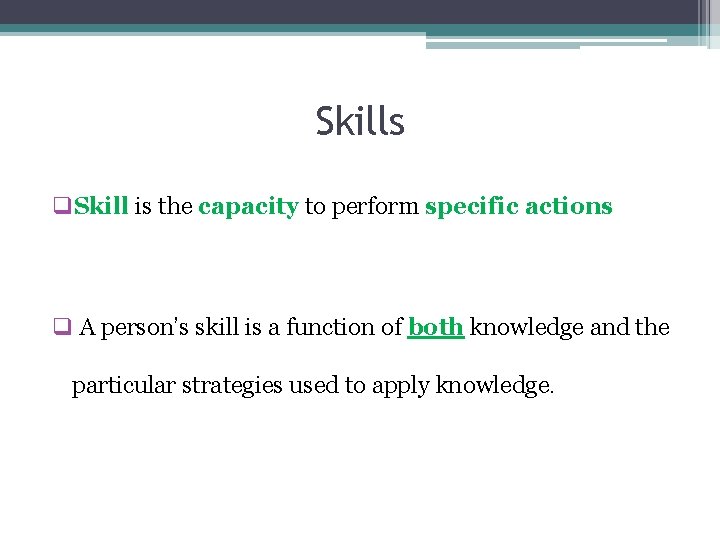
Skills q. Skill is the capacity to perform specific actions q A person’s skill is a function of both knowledge and the particular strategies used to apply knowledge.
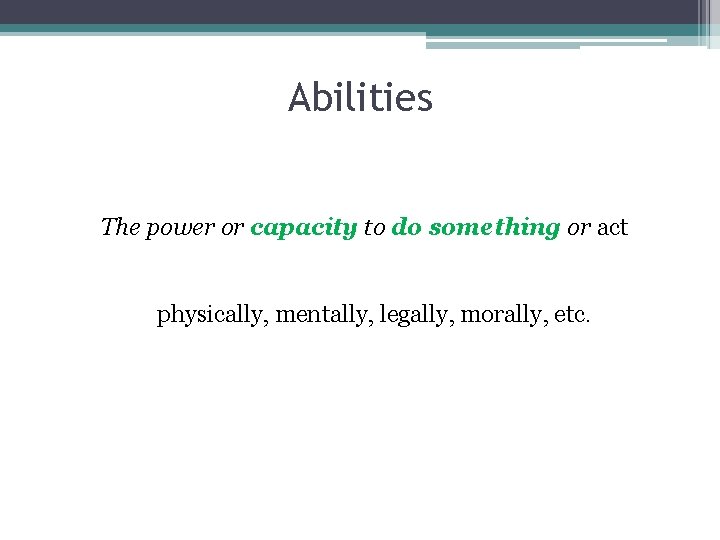
Abilities The power or capacity to do something or act physically, mentally, legally, morally, etc.
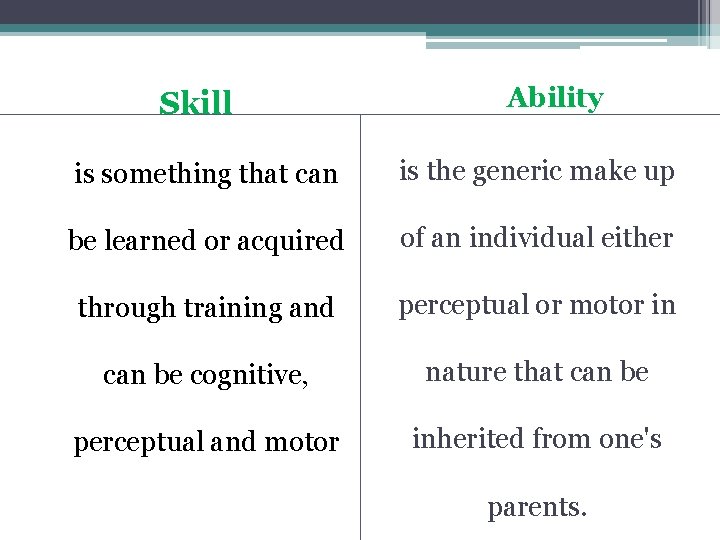
Skill Ability is something that can is the generic make up be learned or acquired of an individual either through training and perceptual or motor in can be cognitive, nature that can be perceptual and motor inherited from one's parents.
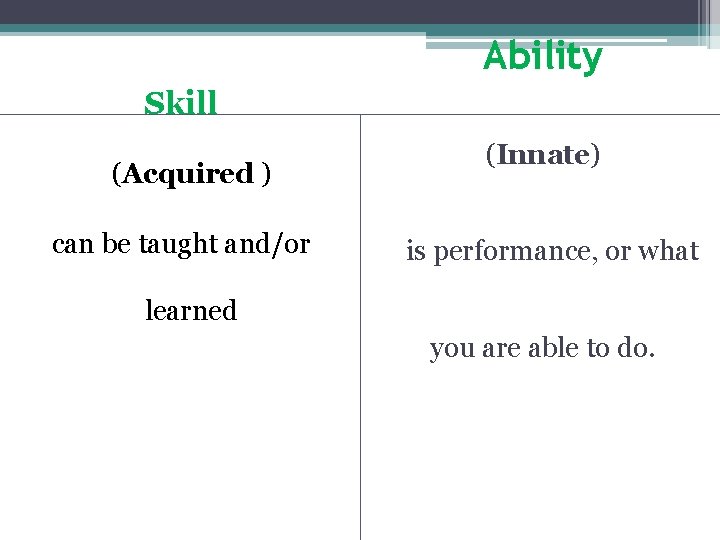
Ability Skill (Acquired ) can be taught and/or (Innate) is performance, or what learned you are able to do.
Skill + Ability What you have learned to do and What you can actually do!
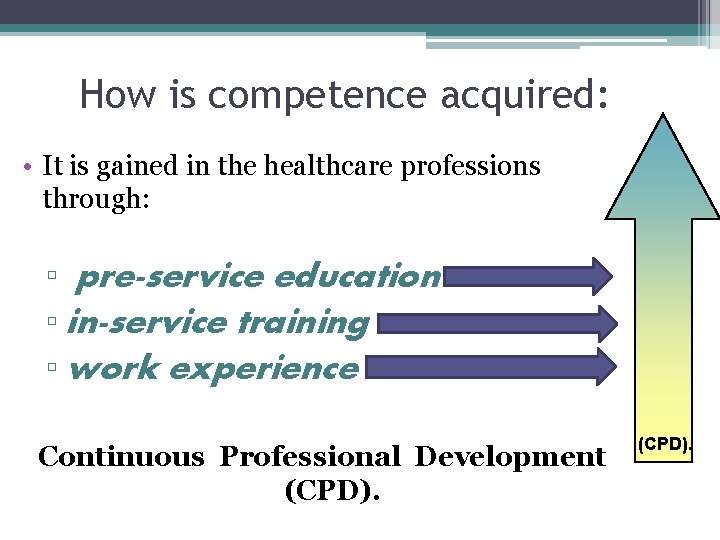
How is competence acquired: • It is gained in the healthcare professions through: ▫ pre-service education ▫ in-service training ▫ work experience Continuous Professional Development (CPD).
Think Pair & Share Every five of you Are you involved in CPD
Continuing Professional Development (CPD)
What is CPD? The conscious updating of professional knowledge and the improvement of professional competence throughout a person's working life.
What is CPD? Cont: It is a commitment to being professional, keeping up to date and continuously seeking to improve. It is the key to optimizing a person's career opportunities, both today and for the future.
Why CPD? Requirement by the governing bodies of the profession This is only a ostensible reason
Why CPD? Cardinal reasons: Half-life of what we learn is very short. If we do not update, we will practice obsolete medicine. There is a high chance that patients will not get optimal care.
Why CPD? Cardinal reasons: cont: Because as PROFESSIONALS We are Students, Teachers, Doctors & Leaders We all are helping others /dealing with patients
How is CPD different? CPD is for professionals but not in a formal educational setting There are no class rooms, prescribed curricula, prescribed learning events, etc. Therefore, the learner needs to learn from whatever he/she does in the workplace Also, there are no formal examinations Motivation to learning comes from the necessity to improve practice.
How can we achieve CPD? .
q Lecture programs q. Conferences q. Workshops q. CME courses q. Others …. .
How can we achieve CPD? Many methods have been tried in the past Currently, Reflective Practice/Learning is the most favoured
What is the Reflective Learning
Reflection • Reflection relates to a complex and deliberate process of thinking about and interpreting experience, in order to learn from it. • Reflection : stages e. g. An awareness of uncomfortable feeling Examination of situation Exploration of alternative actions Reflective thoughts results in action
What is Reflective Learning? Cont: Systematic revisiting of a learning experience with a view to learning from it Why reflection? Key to become a lifelong learner – if not most learning opportunities are lost
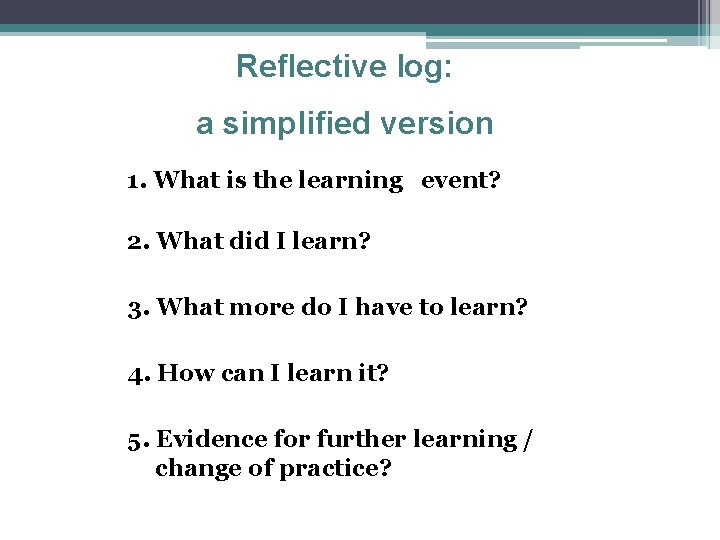
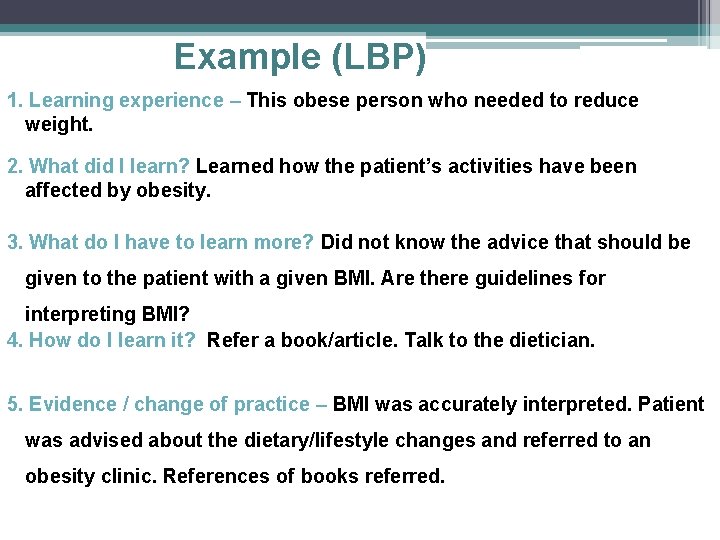
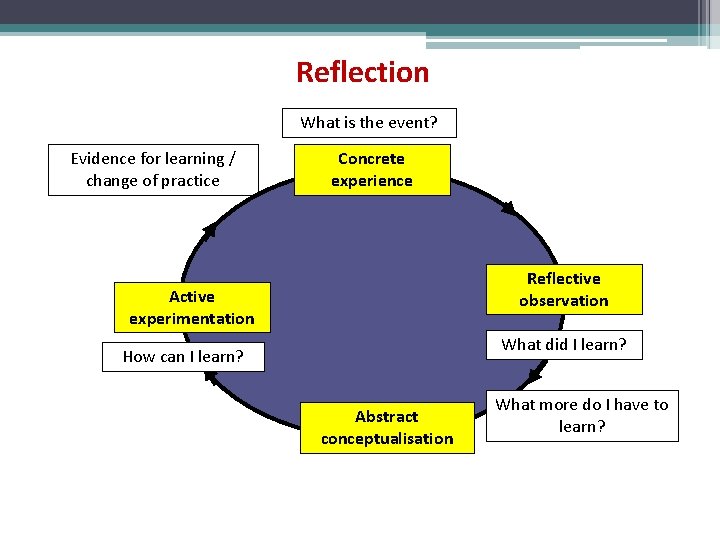
Reflective log: a simplified version 1. What is the learning event? 2. What did I learn? 3. What more do I have to learn? 4. How can I learn it? 5. Evidence for further learning / change of practice?
A scenario (3) : • A 55 year old man came to clinic with complaint of low back pain (LBP). • You have examined his back which was ok. His height was 160 cm, and weight is 100 kg. • You would like to manage this patient’s LBP contributed due to his excess body weight.
Example (LBP) 1. Learning experience – This obese person who needed to reduce weight. 2. What did I learn? Learned how the patient’s activities have been affected by obesity. 3. What do I have to learn more? Did not know the advice that should be given to the patient with a given BMI. Are there guidelines for interpreting BMI? 4. How do I learn it? Refer a book/article. Talk to the dietician. 5. Evidence / change of practice – BMI was accurately interpreted. Patient was advised about the dietary/lifestyle changes and referred to an obesity clinic. References of books referred.
Reflective practice 1. Reflection-in action 2. Reflection-on action
Reflection - cyclical process Kolb’s cycle Concrete experience Reflective observation Active experimentation Abstract conceptualisation
Reflection What is the event? Evidence for learning / change of practice Concrete experience Reflective observation Active experimentation What did I learn? How can I learn? Abstract conceptualisation What more do I have to learn?
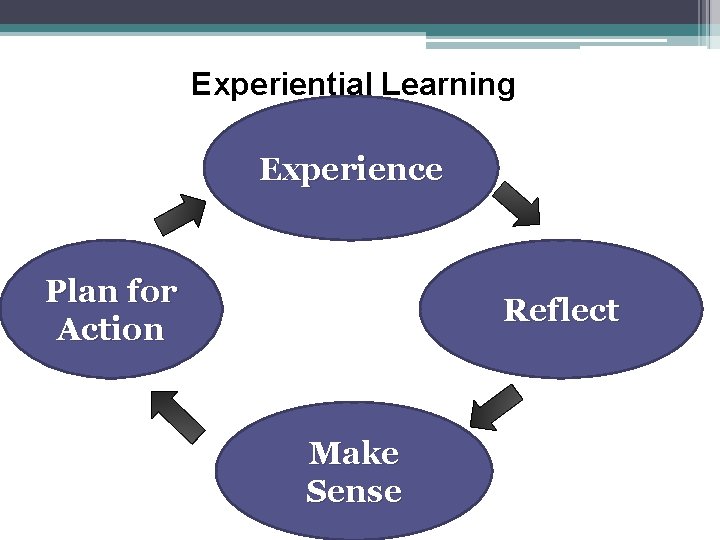
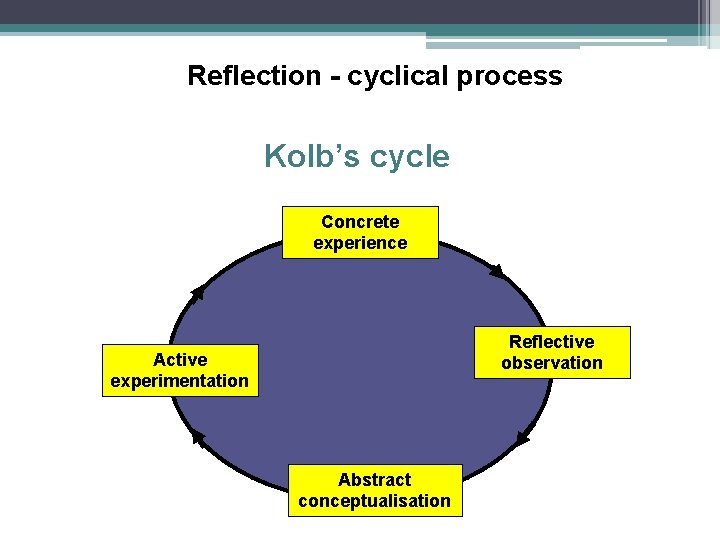
Experiential Learning Experience Plan for Action Reflect Make Sense
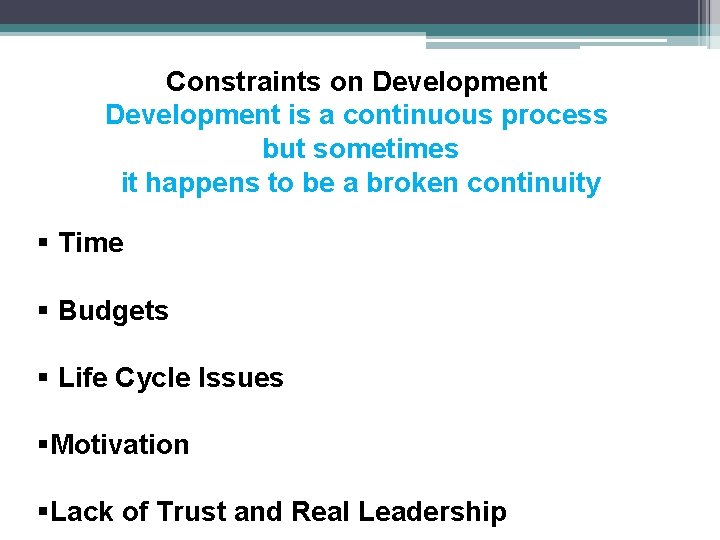
Constraints on Development is a continuous process but sometimes it happens to be a broken continuity § Time § Budgets § Life Cycle Issues §Motivation §Lack of Trust and Real Leadership
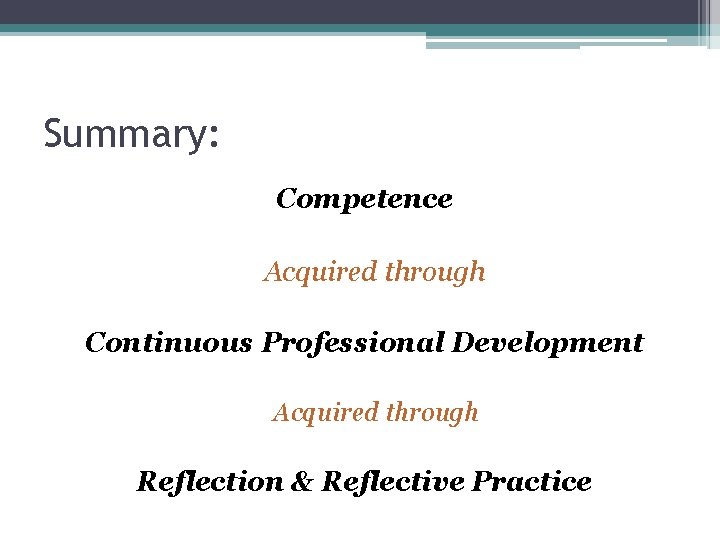
Summary: Competence Acquired through Continuous Professional Development Acquired through Reflection & Reflective Practice
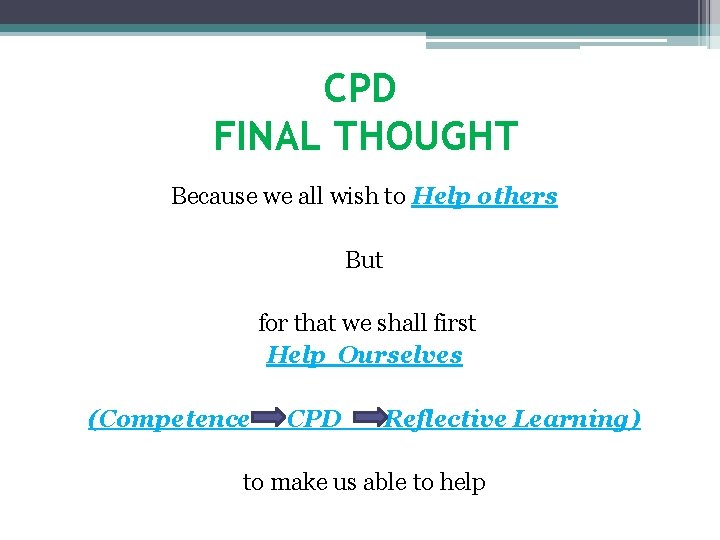
CPD FINAL THOUGHT Because we all wish to Help others But for that we shall first Help Ourselves (Competence CPD Reflective Learning) to make us able to help
References • Bin Abdulrahman KA. 2011. Saudi Arabia does not need an Abraham Flexner. Med Teach 33: 74– 75. • Bin Abdulrahman KA. 2008. The current status of medical education in the Gulf Cooperation Council countries. Ann Saudi Med 28(2): 83– 88 • Saudi Meds: A competence specification for Saudi medical graduates RANIA G. ZAINI, KHALID A. BIN ABDULRAHMAN, ABDULAZIZ A. AL-KHOTANI, ABDOL MONEM A. AL-HAYANI, IBRAHIM A. AL - ALWAN & SADDIG D. JASTANIAH Medical Teacher, 2011; 33: 582– 584

THANK YOU VERY MUCH & &
- Slides: 54