3 3 Dividing Polynomials Warm Up Lesson Presentation
- Slides: 39
3 -3 Dividing Polynomials Warm Up Lesson Presentation Lesson Quiz Holt Mc. Dougal Algebra 2 Algebra 22 Holt Mc. Dougal
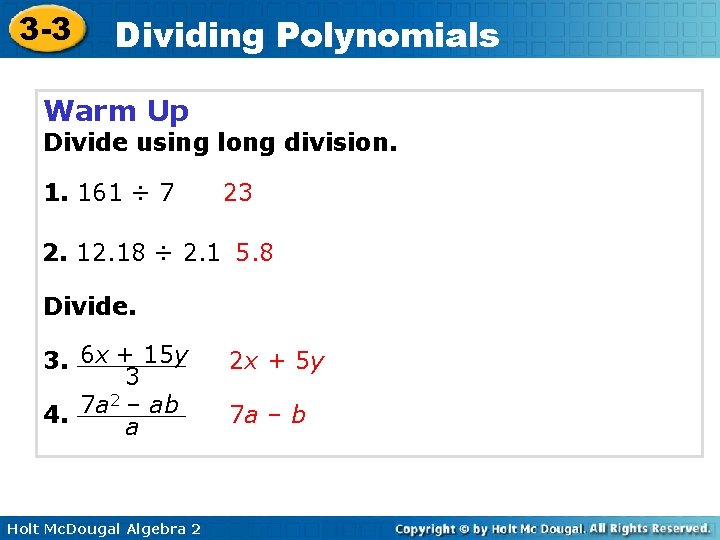
3 -3 Dividing Polynomials Warm Up Divide using long division. 1. 161 ÷ 7 23 2. 18 ÷ 2. 1 5. 8 Divide. 3. 6 x + 15 y 3 2 – ab 7 a 4. a Holt Mc. Dougal Algebra 2 2 x + 5 y 7 a – b
3 -3 Dividing Polynomials Objective Use long division to divide polynomials. Holt Mc. Dougal Algebra 2
3 -3 Dividing Polynomials Essential Question • How do you divide polynomials using long division? Holt Mc. Dougal Algebra 2
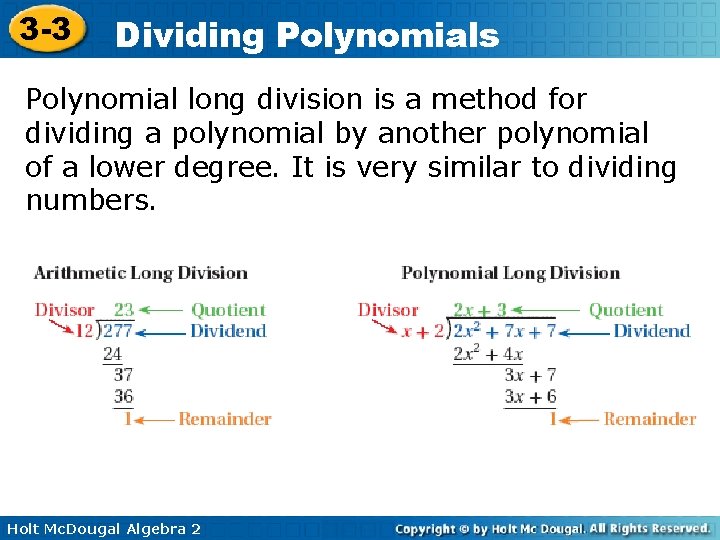
3 -3 Dividing Polynomials Polynomial long division is a method for dividing a polynomial by another polynomial of a lower degree. It is very similar to dividing numbers. Holt Mc. Dougal Algebra 2
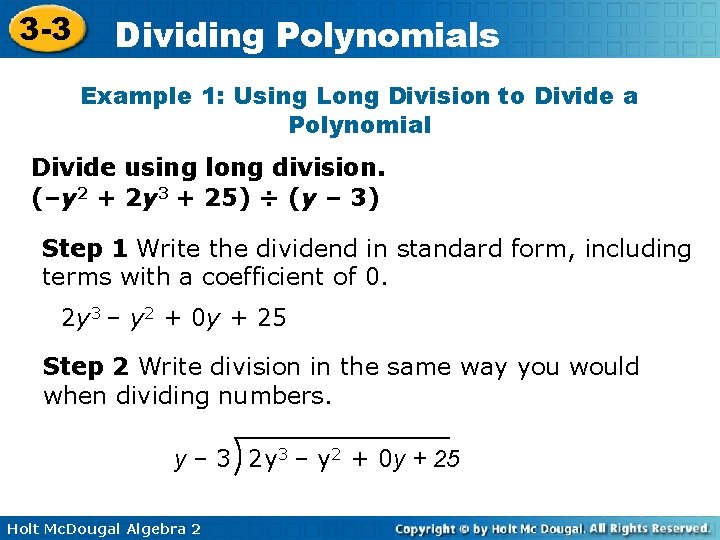
3 -3 Dividing Polynomials Example 1: Using Long Division to Divide a Polynomial Divide using long division. (–y 2 + 2 y 3 + 25) ÷ (y – 3) Step 1 Write the dividend in standard form, including terms with a coefficient of 0. 2 y 3 – y 2 + 0 y + 25 Step 2 Write division in the same way you would when dividing numbers. y – 3 2 y 3 – y 2 + 0 y + 25 Holt Mc. Dougal Algebra 2
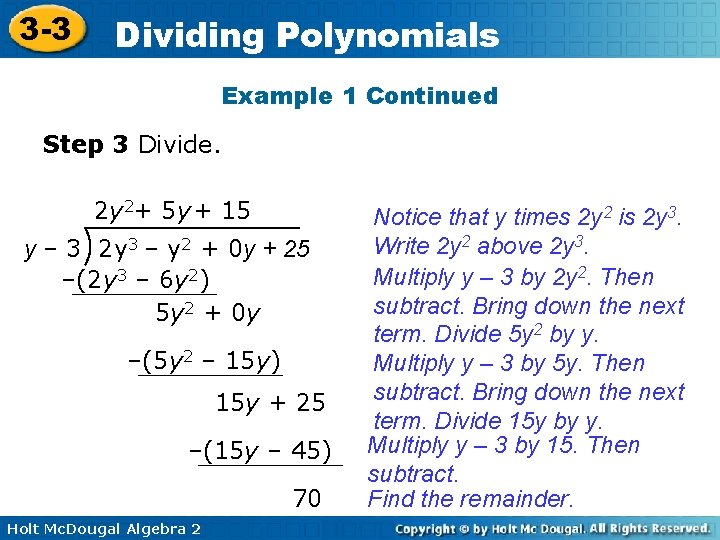
3 -3 Dividing Polynomials Example 1 Continued Step 3 Divide. 2 y 2+ 5 y + 15 y – 3 2 y 3 – y 2 + 0 y + 25 –(2 y 3 – 6 y 2) 5 y 2 + 0 y –(5 y 2 – 15 y) 15 y + 25 –(15 y – 45) 70 Holt Mc. Dougal Algebra 2 Notice that y times 2 y 2 is 2 y 3. Write 2 y 2 above 2 y 3. Multiply y – 3 by 2 y 2. Then subtract. Bring down the next term. Divide 5 y 2 by y. Multiply y – 3 by 5 y. Then subtract. Bring down the next term. Divide 15 y by y. Multiply y – 3 by 15. Then subtract. Find the remainder.
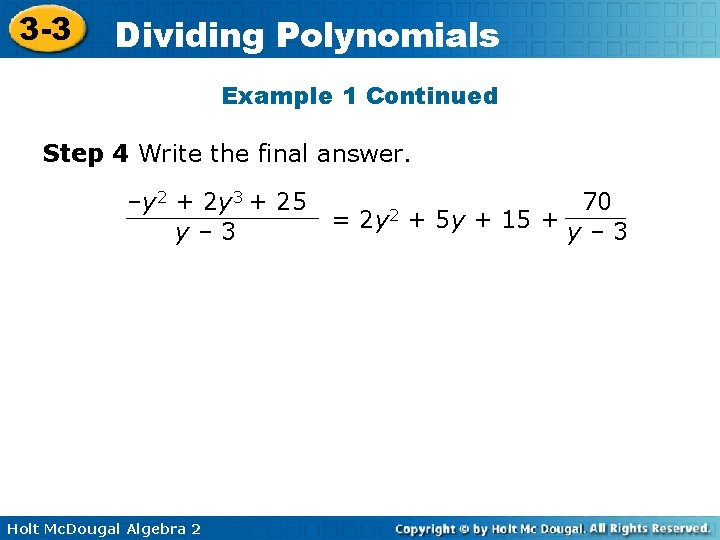
3 -3 Dividing Polynomials Example 1 Continued Step 4 Write the final answer. –y 2 + 2 y 3 + 25 y– 3 Holt Mc. Dougal Algebra 2 = 2 y 2 70 + 5 y + 15 + y – 3
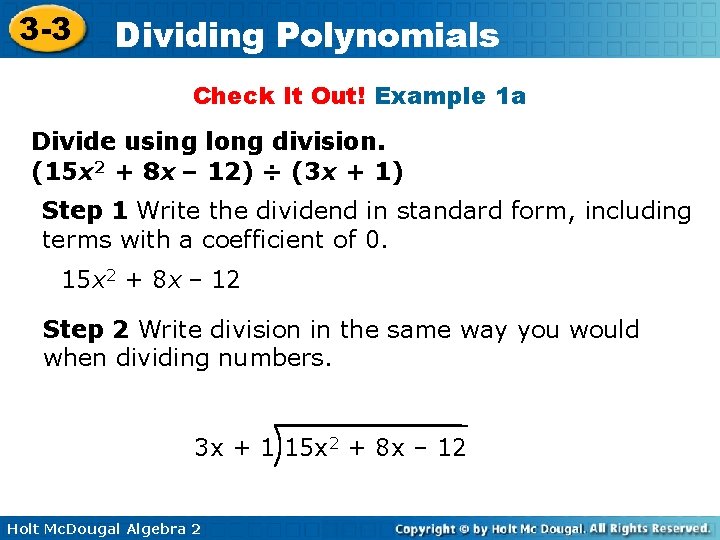
3 -3 Dividing Polynomials Check It Out! Example 1 a Divide using long division. (15 x 2 + 8 x – 12) ÷ (3 x + 1) Step 1 Write the dividend in standard form, including terms with a coefficient of 0. 15 x 2 + 8 x – 12 Step 2 Write division in the same way you would when dividing numbers. 3 x + 1 15 x 2 + 8 x – 12 Holt Mc. Dougal Algebra 2
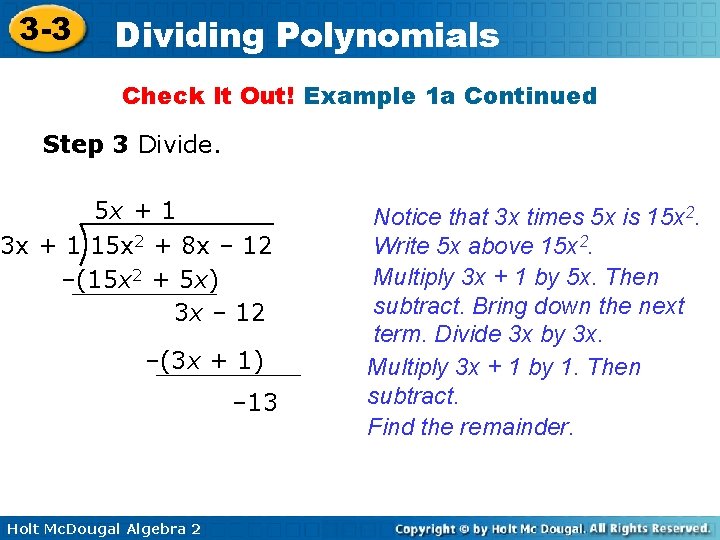
3 -3 Dividing Polynomials Check It Out! Example 1 a Continued Step 3 Divide. 5 x + 1 3 x + 1 15 x 2 + 8 x – 12 –(15 x 2 + 5 x) 3 x – 12 –(3 x + 1) – 13 Holt Mc. Dougal Algebra 2 Notice that 3 x times 5 x is 15 x 2. Write 5 x above 15 x 2. Multiply 3 x + 1 by 5 x. Then subtract. Bring down the next term. Divide 3 x by 3 x. Multiply 3 x + 1 by 1. Then subtract. Find the remainder.
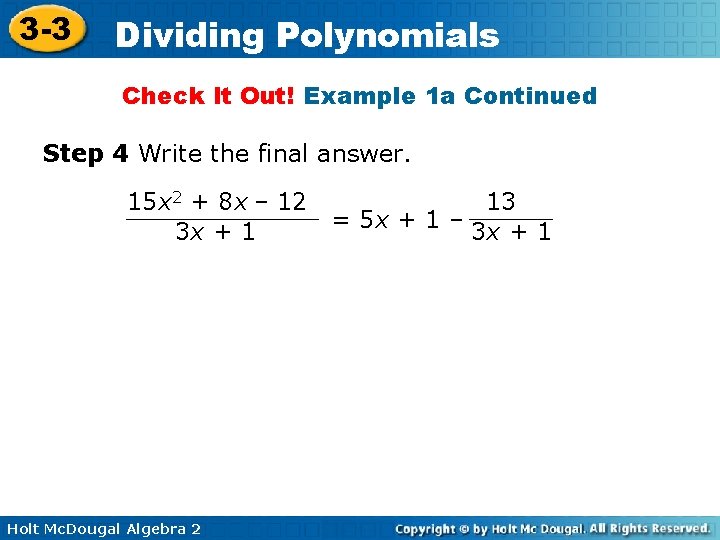
3 -3 Dividing Polynomials Check It Out! Example 1 a Continued Step 4 Write the final answer. 15 x 2 + 8 x – 12 13 = 5 x + 1 – 3 x + 1 Holt Mc. Dougal Algebra 2
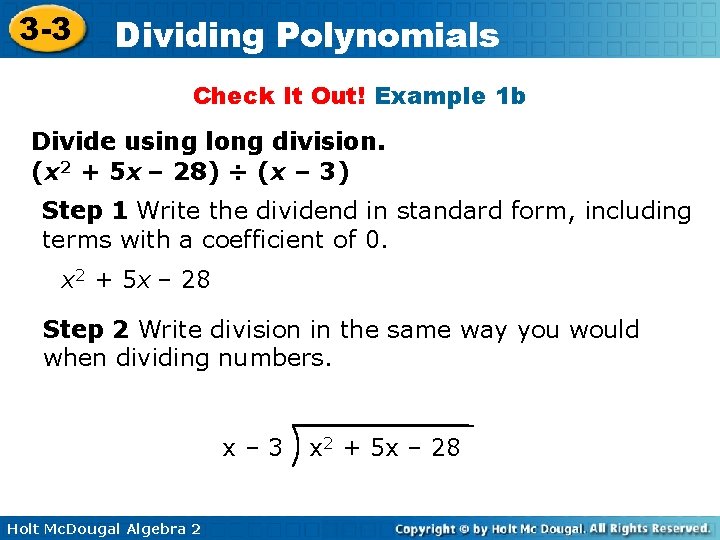
3 -3 Dividing Polynomials Check It Out! Example 1 b Divide using long division. (x 2 + 5 x – 28) ÷ (x – 3) Step 1 Write the dividend in standard form, including terms with a coefficient of 0. x 2 + 5 x – 28 Step 2 Write division in the same way you would when dividing numbers. x– 3 Holt Mc. Dougal Algebra 2 x 2 + 5 x – 28
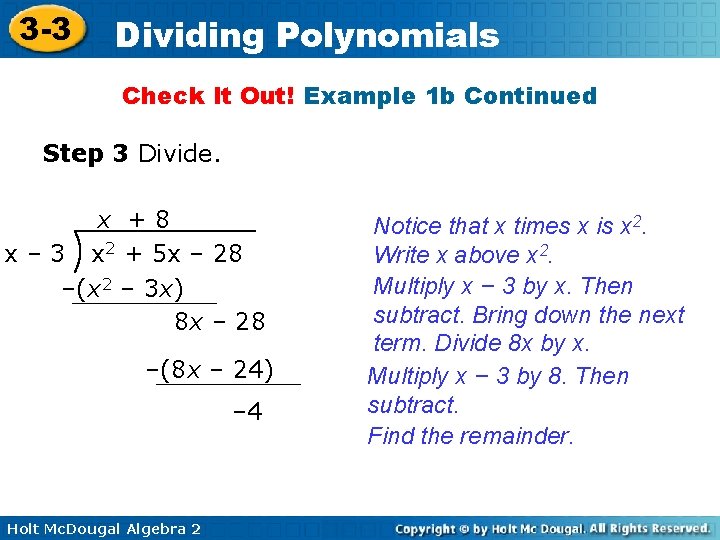
3 -3 Dividing Polynomials Check It Out! Example 1 b Continued Step 3 Divide. x +8 x – 3 x 2 + 5 x – 28 –(x 2 – 3 x) 8 x – 28 –(8 x – 24) – 4 Holt Mc. Dougal Algebra 2 Notice that x times x is x 2. Write x above x 2. Multiply x – 3 by x. Then subtract. Bring down the next term. Divide 8 x by x. Multiply x – 3 by 8. Then subtract. Find the remainder.
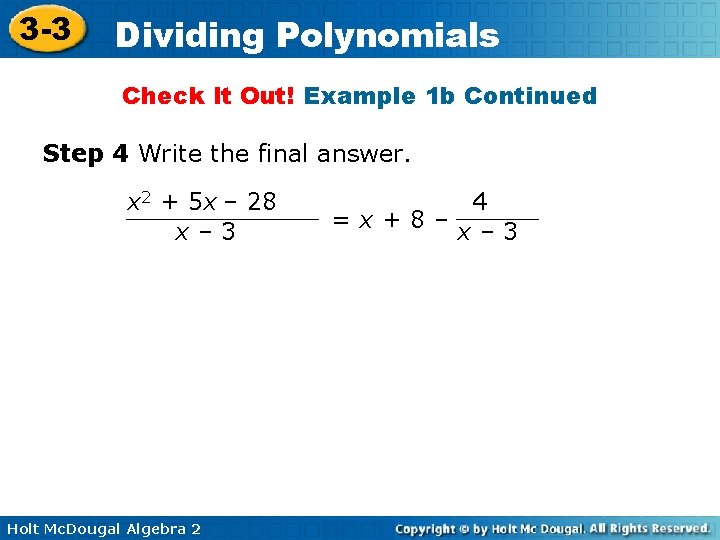
3 -3 Dividing Polynomials Check It Out! Example 1 b Continued Step 4 Write the final answer. x 2 + 5 x – 28 x– 3 Holt Mc. Dougal Algebra 2 4 =x+8–x– 3
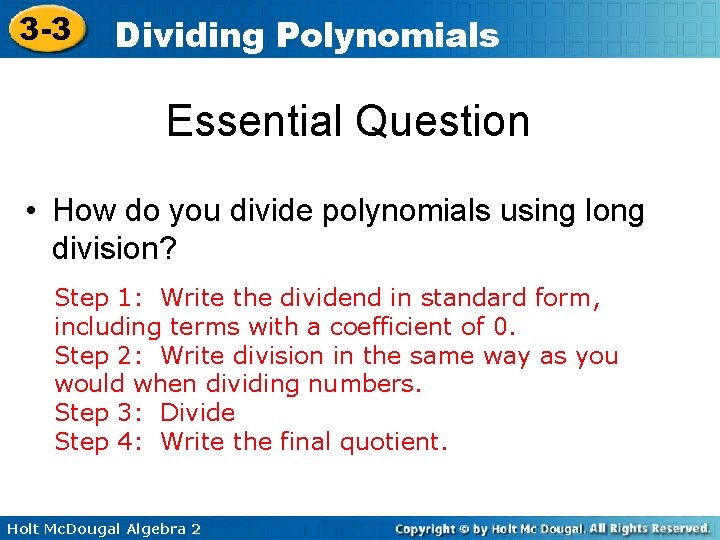
3 -3 Dividing Polynomials Essential Question • How do you divide polynomials using long division? Step 1: Write the dividend in standard form, including terms with a coefficient of 0. Step 2: Write division in the same way as you would when dividing numbers. Step 3: Divide Step 4: Write the final quotient. Holt Mc. Dougal Algebra 2
3 -3 Dividing Polynomials Objective Use synthetic division to divide polynomials. Holt Mc. Dougal Algebra 2
3 -3 Dividing Polynomials Vocabulary synthetic division Holt Mc. Dougal Algebra 2
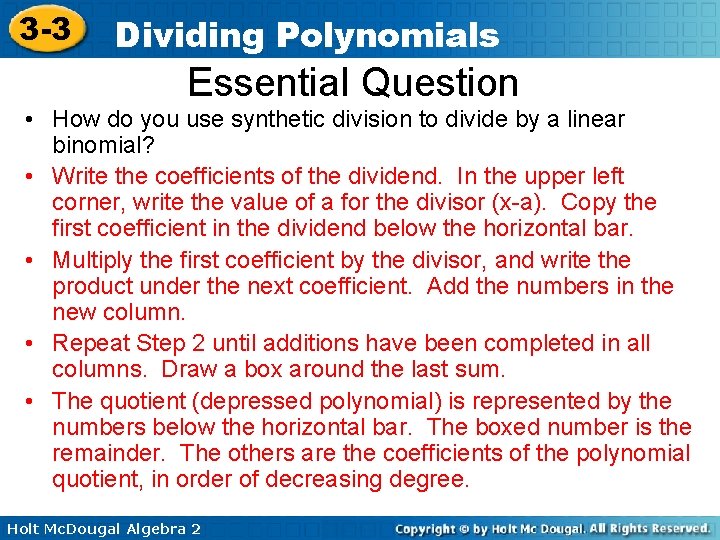
3 -3 Dividing Polynomials Essential Question • How do you use synthetic division to divide by a linear binomial? Holt Mc. Dougal Algebra 2
3 -3 Dividing Polynomials Synthetic division is a shorthand method of dividing a polynomial by a linear binomial by using only the coefficients. For synthetic division to work, the polynomial must be written in standard form, using 0 and a coefficient for any missing terms, and the divisor must be in the form (x – a). Holt Mc. Dougal Algebra 2
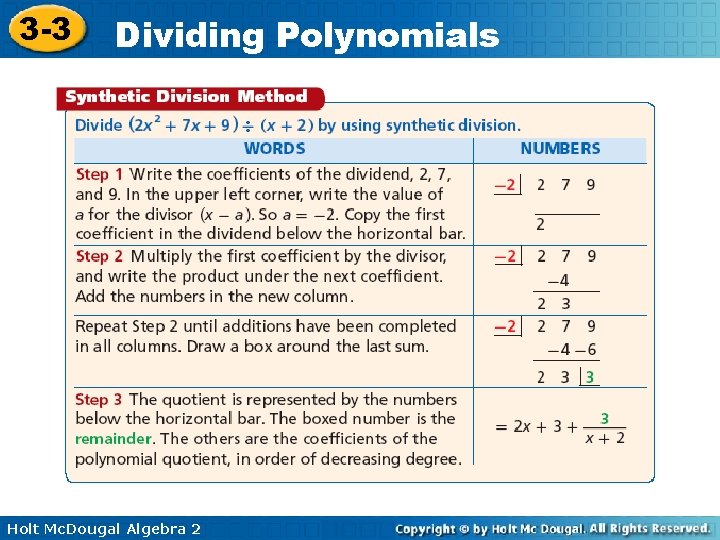
3 -3 Dividing Polynomials Holt Mc. Dougal Algebra 2
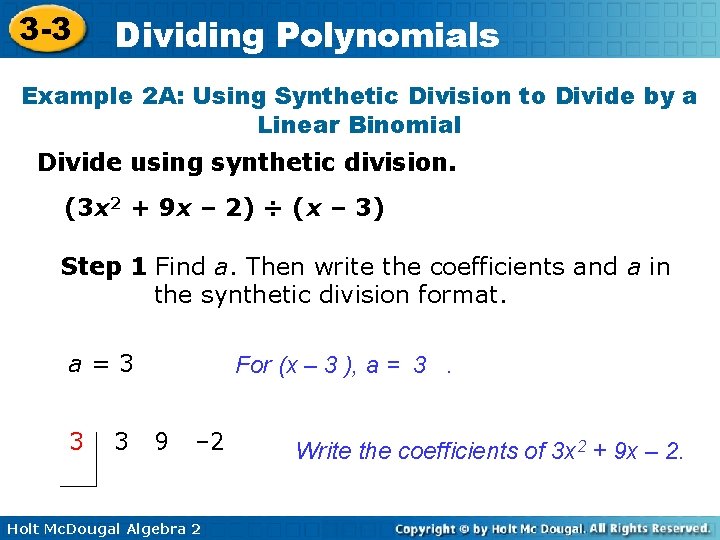
3 -3 Dividing Polynomials Example 2 A: Using Synthetic Division to Divide by a Linear Binomial Divide using synthetic division. (3 x 2 + 9 x – 2) ÷ (x – 3) Step 1 Find a. Then write the coefficients and a in the synthetic division format. a=3 3 3 For (x – 3 ), a = 3. 9 – 2 Holt Mc. Dougal Algebra 2 Write the coefficients of 3 x 2 + 9 x – 2.
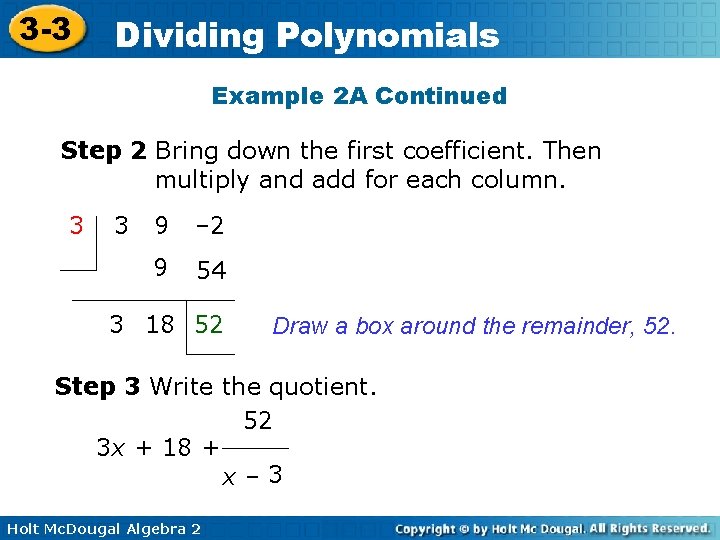
3 -3 Dividing Polynomials Example 2 A Continued Step 2 Bring down the first coefficient. Then multiply and add for each column. 3 3 9 – 2 9 54 3 18 52 Draw a box around the remainder, 52. Step 3 Write the quotient. 52 3 x + 18 + x– 3 Holt Mc. Dougal Algebra 2
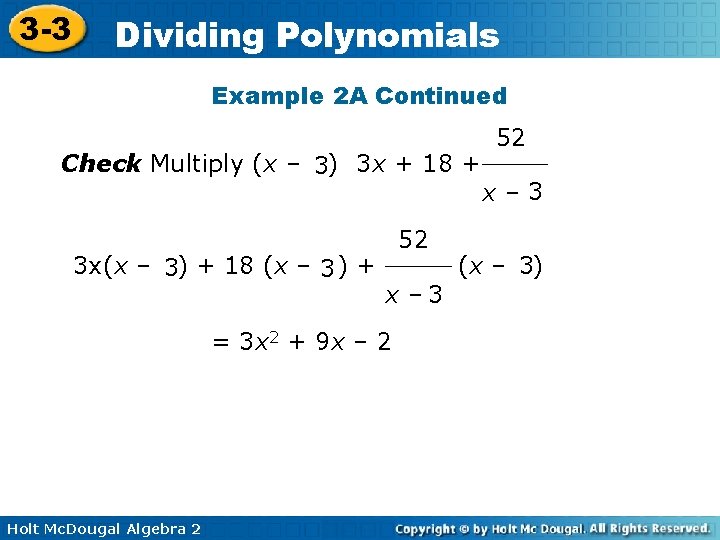
3 -3 Dividing Polynomials Example 2 A Continued Check Multiply (x – 3) 3 x + 18 + 3 x(x – 3) + 18 (x – 3 ) + 52 x – 3 = 3 x 2 + 9 x – 2 Holt Mc. Dougal Algebra 2 52 x– 3 (x – 3)
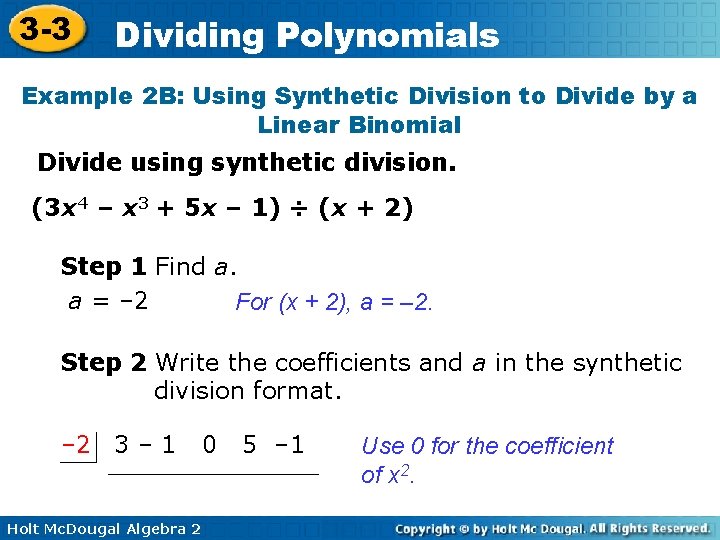
3 -3 Dividing Polynomials Example 2 B: Using Synthetic Division to Divide by a Linear Binomial Divide using synthetic division. (3 x 4 – x 3 + 5 x – 1) ÷ (x + 2) Step 1 Find a. a = – 2 For (x + 2), a = – 2. Step 2 Write the coefficients and a in the synthetic division format. – 2 3 – 1 Holt Mc. Dougal Algebra 2 0 5 – 1 Use 0 for the coefficient of x 2.
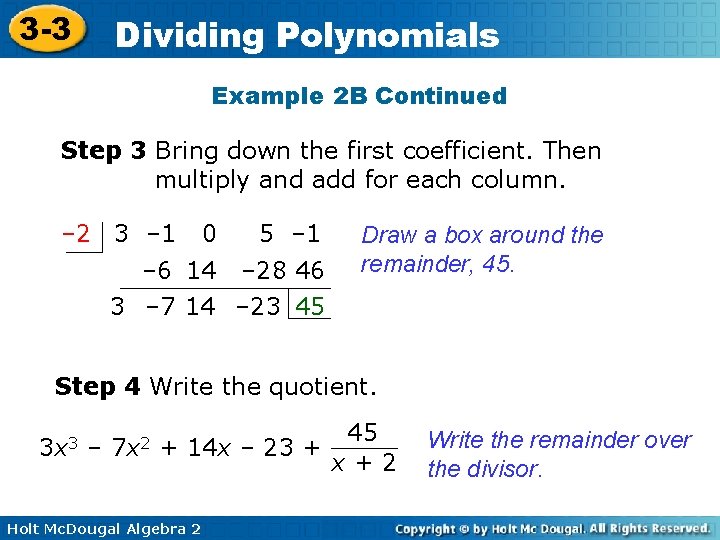
3 -3 Dividing Polynomials Example 2 B Continued Step 3 Bring down the first coefficient. Then multiply and add for each column. – 2 3 – 1 0 5 – 1 – 6 14 – 28 46 Draw a box around the remainder, 45. 3 – 7 14 – 23 45 Step 4 Write the quotient. 3 x 3 – 7 x 2 + 14 x – 23 + Holt Mc. Dougal Algebra 2 45 x+2 Write the remainder over the divisor.
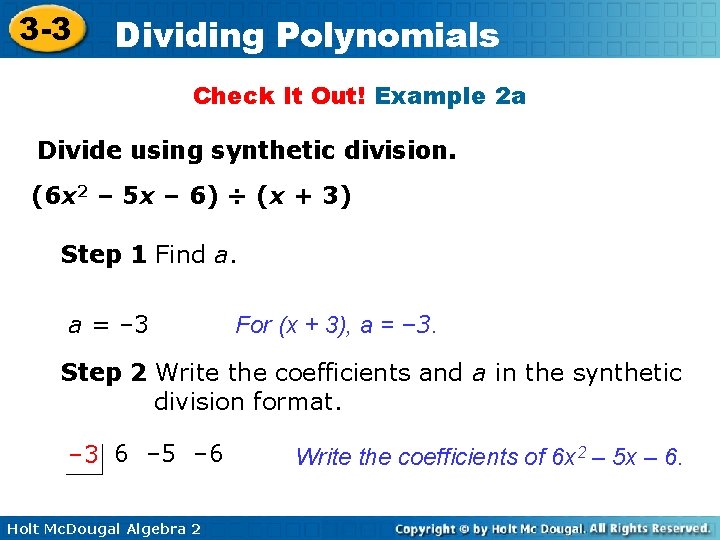
3 -3 Dividing Polynomials Check It Out! Example 2 a Divide using synthetic division. (6 x 2 – 5 x – 6) ÷ (x + 3) Step 1 Find a. a = – 3 For (x + 3), a = – 3. Step 2 Write the coefficients and a in the synthetic division format. – 3 6 – 5 – 6 Holt Mc. Dougal Algebra 2 Write the coefficients of 6 x 2 – 5 x – 6.
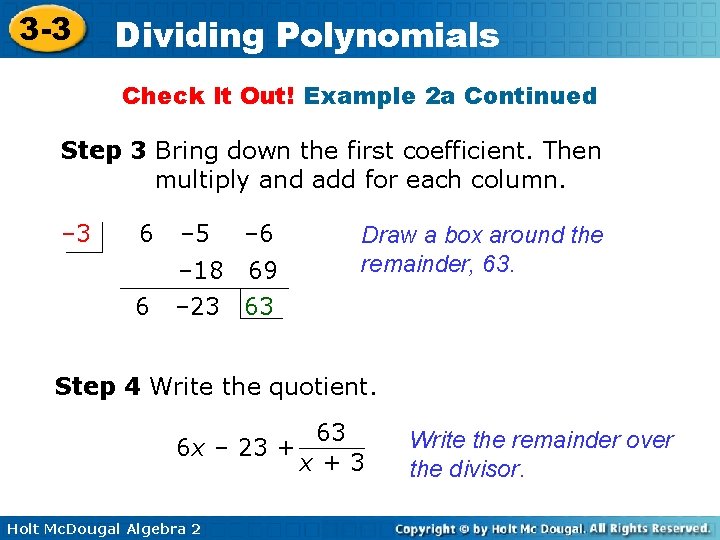
3 -3 Dividing Polynomials Check It Out! Example 2 a Continued Step 3 Bring down the first coefficient. Then multiply and add for each column. – 3 6 – 5 – 6 – 18 69 6 Draw a box around the remainder, 63. – 23 63 Step 4 Write the quotient. 6 x – 23 + Holt Mc. Dougal Algebra 2 63 x+3 Write the remainder over the divisor.
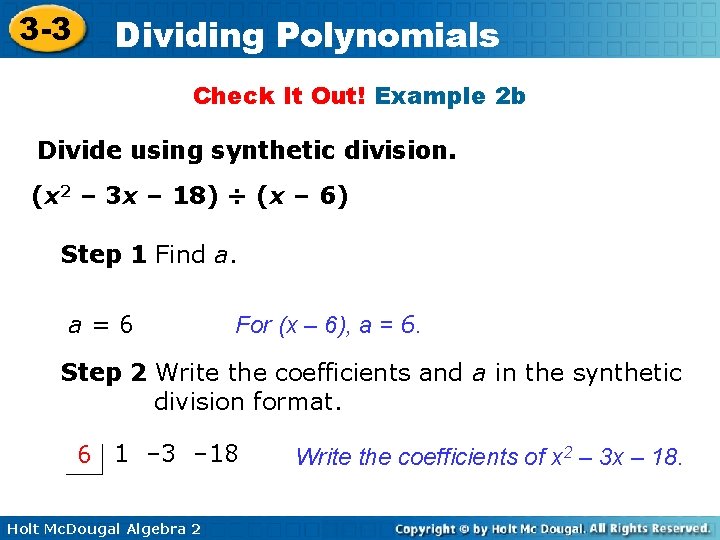
3 -3 Dividing Polynomials Check It Out! Example 2 b Divide using synthetic division. (x 2 – 3 x – 18) ÷ (x – 6) Step 1 Find a. a=6 For (x – 6), a = 6. Step 2 Write the coefficients and a in the synthetic division format. 6 1 – 3 – 18 Holt Mc. Dougal Algebra 2 Write the coefficients of x 2 – 3 x – 18.
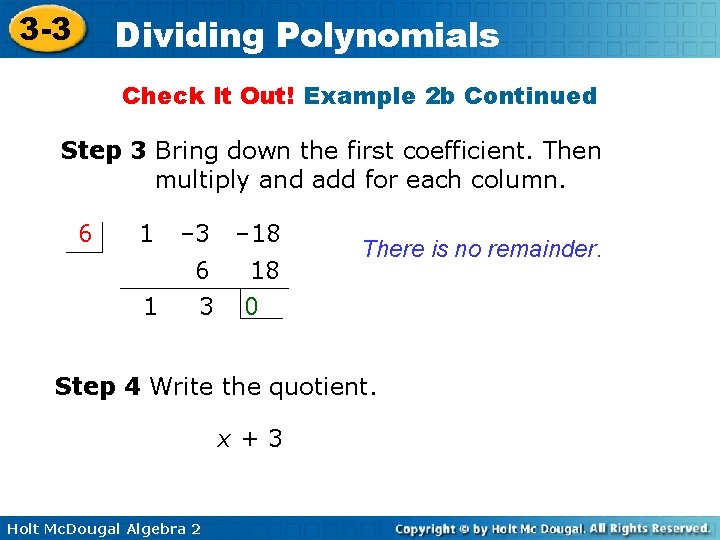
3 -3 Dividing Polynomials Check It Out! Example 2 b Continued Step 3 Bring down the first coefficient. Then multiply and add for each column. 6 1 1 – 3 – 18 6 18 3 0 There is no remainder. Step 4 Write the quotient. x+3 Holt Mc. Dougal Algebra 2
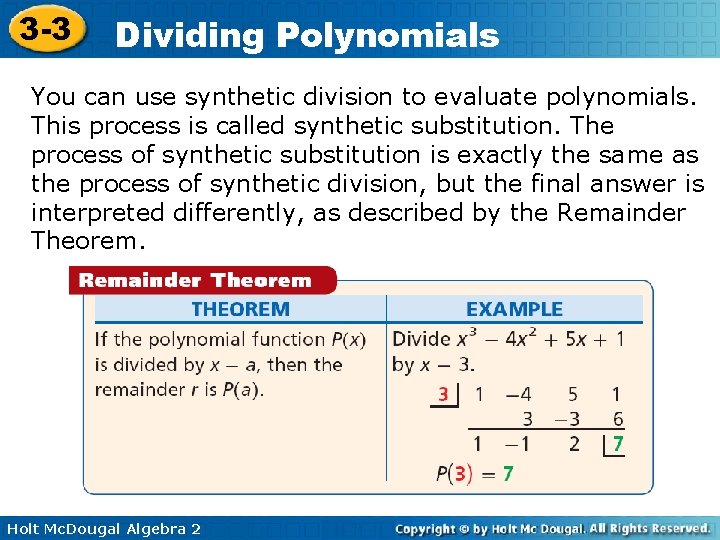
3 -3 Dividing Polynomials You can use synthetic division to evaluate polynomials. This process is called synthetic substitution. The process of synthetic substitution is exactly the same as the process of synthetic division, but the final answer is interpreted differently, as described by the Remainder Theorem. Holt Mc. Dougal Algebra 2
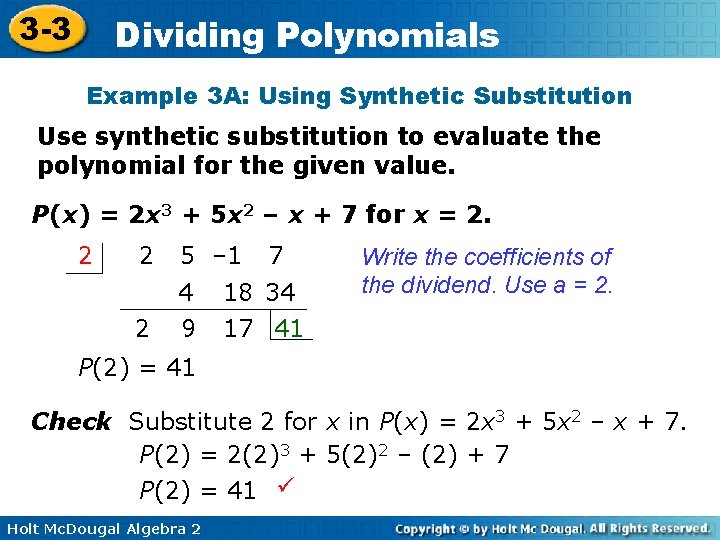
3 -3 Dividing Polynomials Example 3 A: Using Synthetic Substitution Use synthetic substitution to evaluate the polynomial for the given value. P(x) = 2 x 3 + 5 x 2 – x + 7 for x = 2. 2 2 5 – 1 2 4 9 7 18 34 17 41 Write the coefficients of the dividend. Use a = 2. P(2) = 41 Check Substitute 2 for x in P(x) = 2 x 3 + 5 x 2 – x + 7. P(2) = 2(2)3 + 5(2)2 – (2) + 7 P(2) = 41 Holt Mc. Dougal Algebra 2
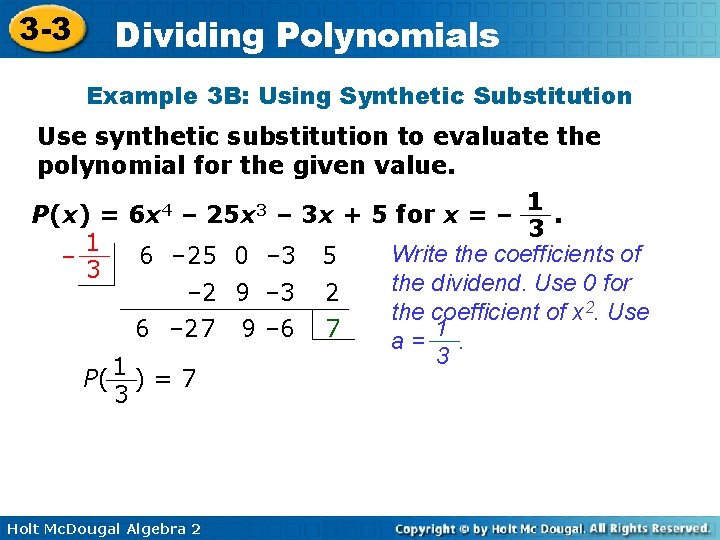
3 -3 Dividing Polynomials Example 3 B: Using Synthetic Substitution Use synthetic substitution to evaluate the polynomial for the given value. 1 P(x) = 6 x 4 – 25 x 3 – 3 x + 5 for x = –. 3 1 Write the coefficients of 6 – 25 0 – 3 5 – 3 the dividend. Use 0 for – 2 9 – 3 2 the coefficient of x 2. Use 1 6 – 27 9 – 6 7 a=. 3 1 P( ) = 7 3 Holt Mc. Dougal Algebra 2
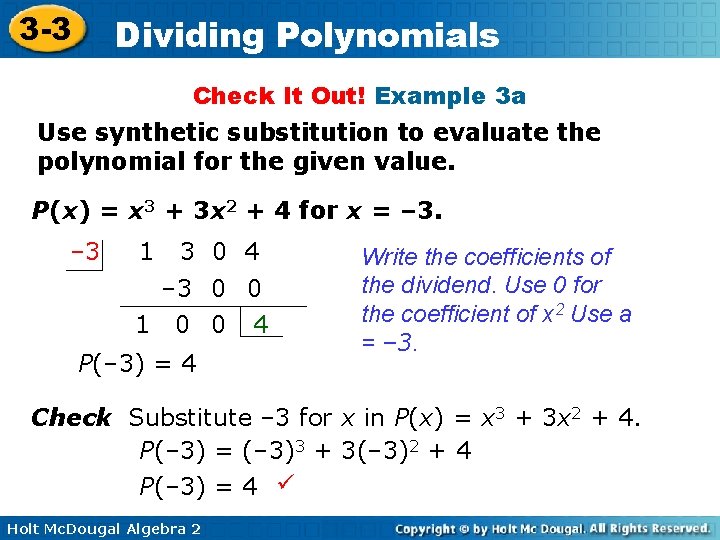
3 -3 Dividing Polynomials Check It Out! Example 3 a Use synthetic substitution to evaluate the polynomial for the given value. P(x) = x 3 + 3 x 2 + 4 for x = – 3 1 3 0 4 – 3 0 0 1 0 0 4 P(– 3) = 4 Write the coefficients of the dividend. Use 0 for the coefficient of x 2 Use a = – 3. Check Substitute – 3 for x in P(x) = x 3 + 3 x 2 + 4. P(– 3) = (– 3)3 + 3(– 3)2 + 4 P(– 3) = 4 Holt Mc. Dougal Algebra 2
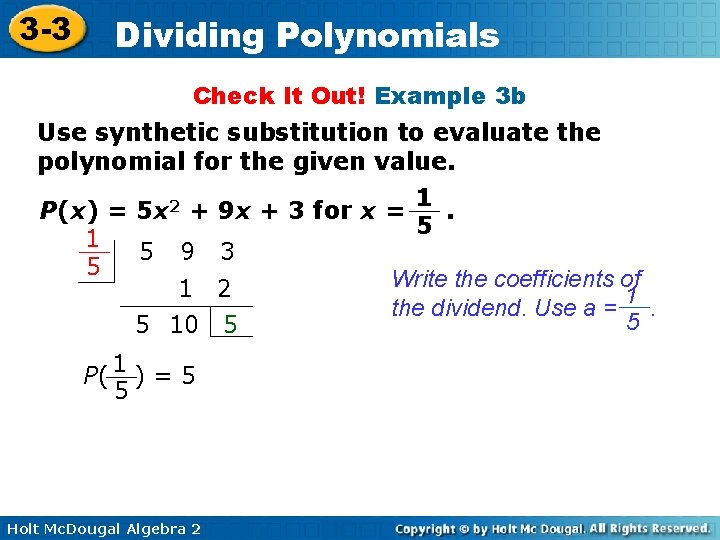
3 -3 Dividing Polynomials Check It Out! Example 3 b Use synthetic substitution to evaluate the polynomial for the given value. P(x) = 5 x 2 + 1 5 9 5 10 P( 1 ) = 5 5 Holt Mc. Dougal Algebra 2 9 x + 3 for x = 3 2 5 1. 5 Write the coefficients of 1 the dividend. Use a =. 5
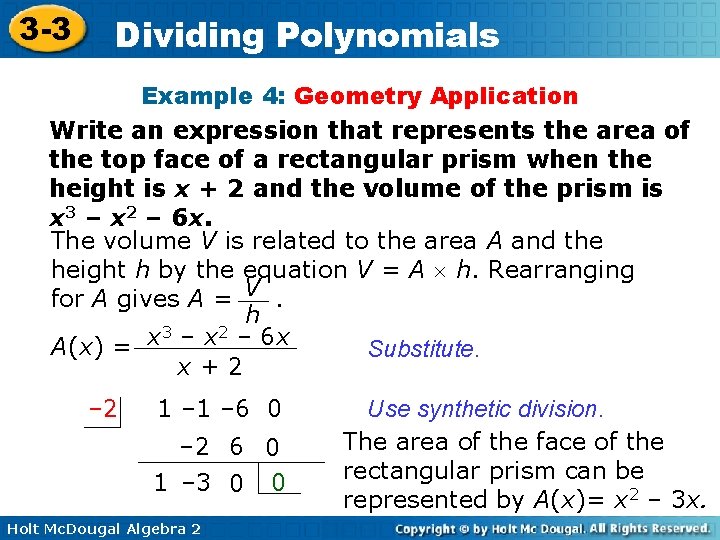
3 -3 Dividing Polynomials Example 4: Geometry Application Write an expression that represents the area of the top face of a rectangular prism when the height is x + 2 and the volume of the prism is x 3 – x 2 – 6 x. The volume V is related to the area A and the height h by the equation V = A h. Rearranging for A gives A = V. h 3 – x 2 – 6 x x A(x) = Substitute. x+2 – 2 1 – 6 0 – 2 6 0 1 – 3 0 0 Holt Mc. Dougal Algebra 2 Use synthetic division. The area of the face of the rectangular prism can be represented by A(x)= x 2 – 3 x.
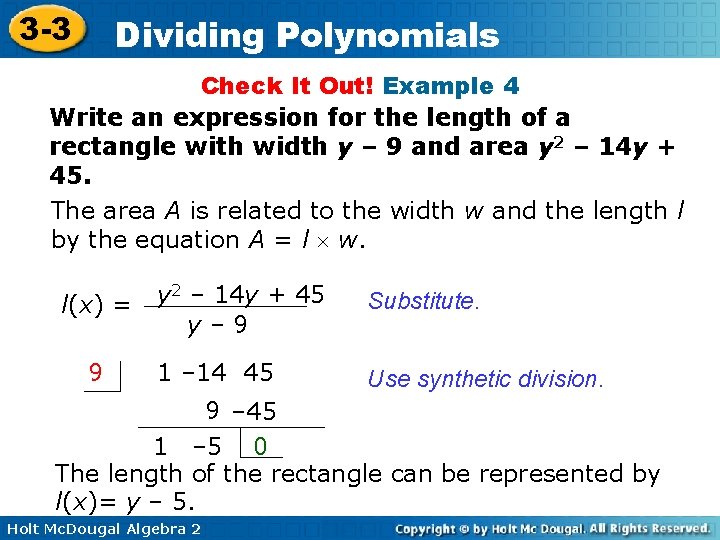
3 -3 Dividing Polynomials Check It Out! Example 4 Write an expression for the length of a rectangle with width y – 9 and area y 2 – 14 y + 45. The area A is related to the width w and the length l by the equation A = l w. l(x) = 9 y 2 – 14 y + 45 y– 9 Substitute. 1 – 14 45 Use synthetic division. 9 – 45 1 – 5 0 The length of the rectangle can be represented by l(x)= y – 5. Holt Mc. Dougal Algebra 2
3 -3 Dividing Polynomials Essential Question • How do you use synthetic division to divide by a linear binomial? • Write the coefficients of the dividend. In the upper left corner, write the value of a for the divisor (x-a). Copy the first coefficient in the dividend below the horizontal bar. • Multiply the first coefficient by the divisor, and write the product under the next coefficient. Add the numbers in the new column. • Repeat Step 2 until additions have been completed in all columns. Draw a box around the last sum. • The quotient (depressed polynomial) is represented by the numbers below the horizontal bar. The boxed number is the remainder. The others are the coefficients of the polynomial quotient, in order of decreasing degree. Holt Mc. Dougal Algebra 2
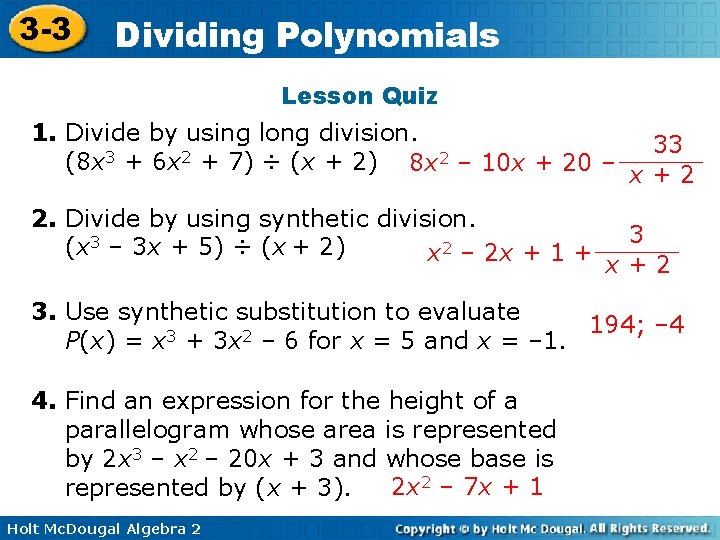
3 -3 Dividing Polynomials Lesson Quiz 1. Divide by using long division. 33 3 2 2 (8 x + 6 x + 7) ÷ (x + 2) 8 x – 10 x + 20 – x+2 2. Divide by using synthetic division. 3 2 (x 3 – 3 x + 5) ÷ (x + 2) x – 2 x + 1 + x + 2 3. Use synthetic substitution to evaluate 194; – 4 3 2 P(x) = x + 3 x – 6 for x = 5 and x = – 1. 4. Find an expression for the height of a parallelogram whose area is represented by 2 x 3 – x 2 – 20 x + 3 and whose base is 2 x 2 – 7 x + 1 represented by (x + 3). Holt Mc. Dougal Algebra 2
3 -3 Dividing Polynomials Teacher: Why didn’t you do your homework? Student: The long division took too long, and the synthetic division just wasn’t real. Holt Mc. Dougal Algebra 2