
Dividing Polynomials n r a e ll l
- Slides: 14
Dividing Polynomials n r a e ’ll l u o y t a h W To divide polynomials using long division. To divide polynomials using synthetic division. y r a l u b a Voc Synthetic division Copyright © 2012, 2008, 2004 Pearson Education, Inc.
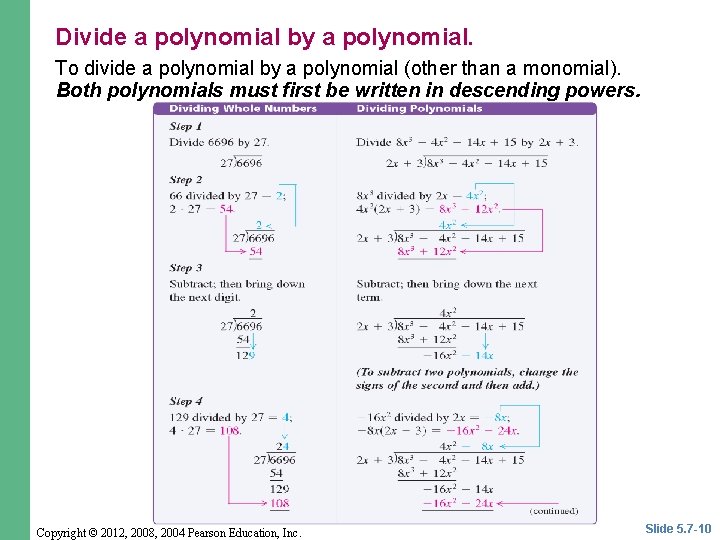
Divide a polynomial by a polynomial. To divide a polynomial by a polynomial (other than a monomial). Both polynomials must first be written in descending powers. Copyright © 2012, 2008, 2004 Pearson Education, Inc. Slide 5. 7 -10
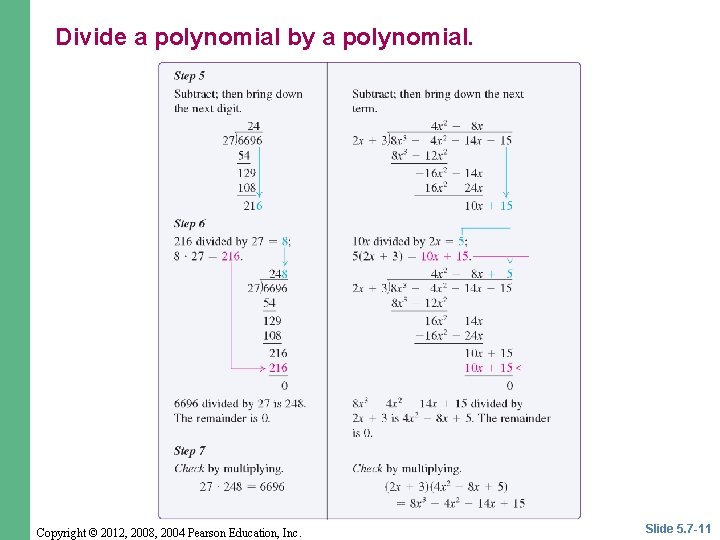
Divide a polynomial by a polynomial. Copyright © 2012, 2008, 2004 Pearson Education, Inc. Slide 5. 7 -11
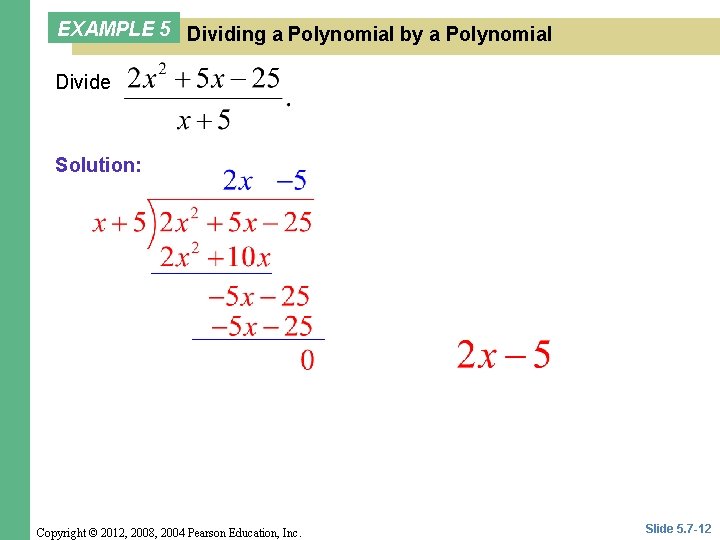
EXAMPLE 5 Dividing a Polynomial by a Polynomial Divide Solution: Copyright © 2012, 2008, 2004 Pearson Education, Inc. Slide 5. 7 -12
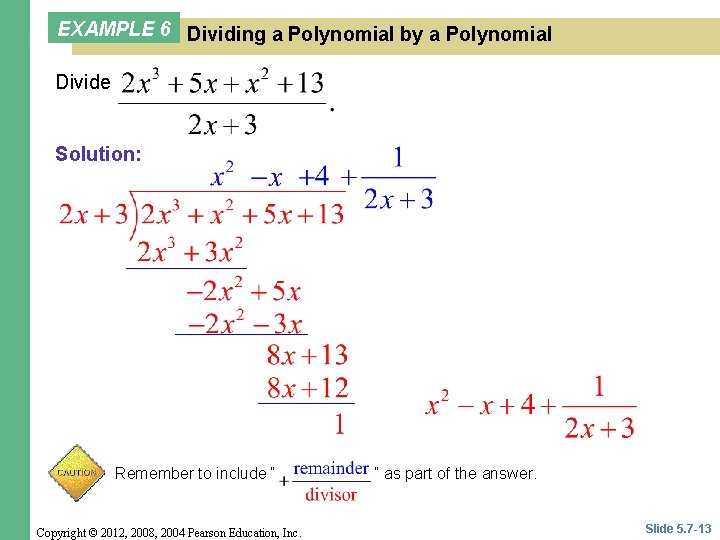
EXAMPLE 6 Dividing a Polynomial by a Polynomial Divide Solution: Remember to include “ Copyright © 2012, 2008, 2004 Pearson Education, Inc. ” as part of the answer. Slide 5. 7 -13
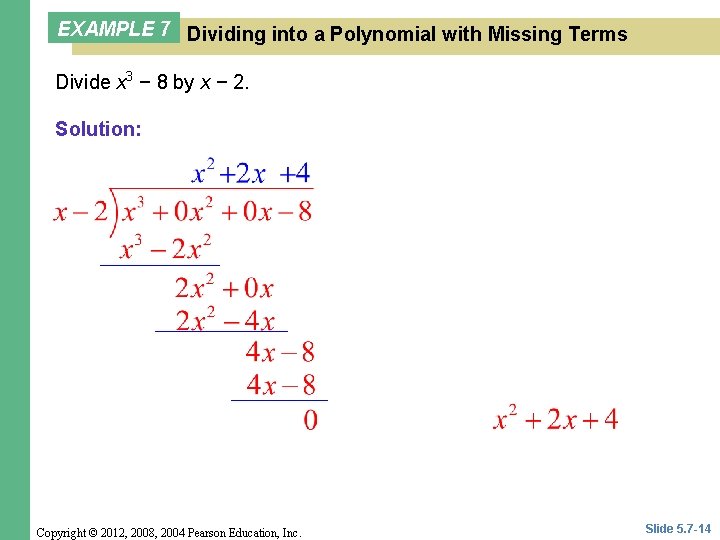
EXAMPLE 7 Dividing into a Polynomial with Missing Terms Divide x 3 − 8 by x − 2. Solution: Copyright © 2012, 2008, 2004 Pearson Education, Inc. Slide 5. 7 -14
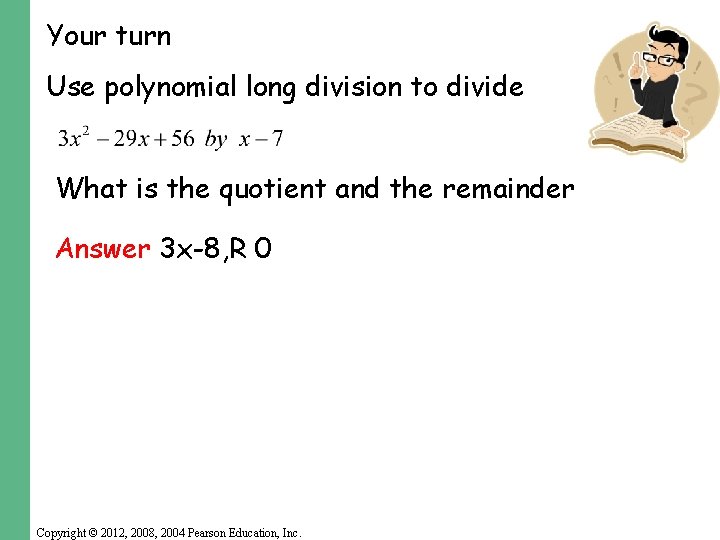
Your turn Use polynomial long division to divide What is the quotient and the remainder Answer 3 x-8, R 0 Copyright © 2012, 2008, 2004 Pearson Education, Inc.
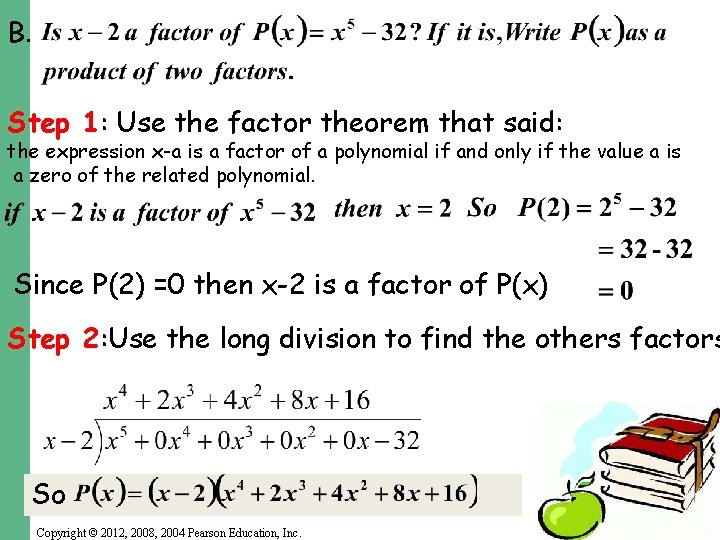
B. Step 1: Use the factor theorem that said: the expression x-a is a factor of a polynomial if and only if the value a is a zero of the related polynomial. Since P(2) =0 then x-2 is a factor of P(x) Step 2: Use the long division to find the others factors So Copyright © 2012, 2008, 2004 Pearson Education, Inc.
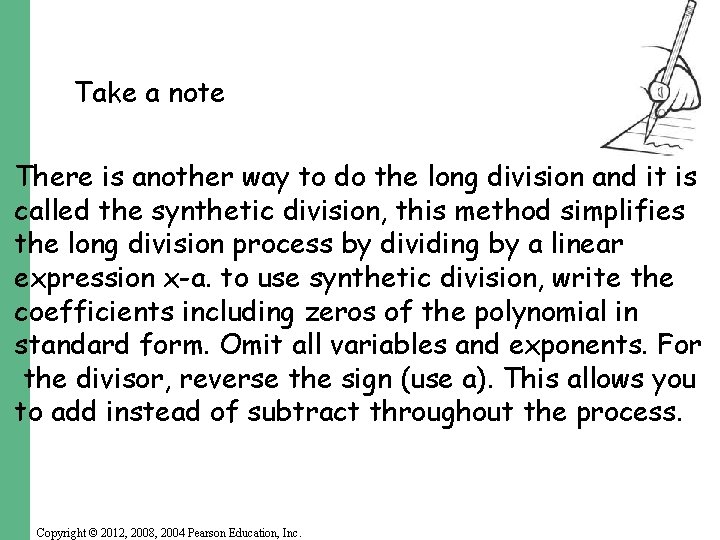
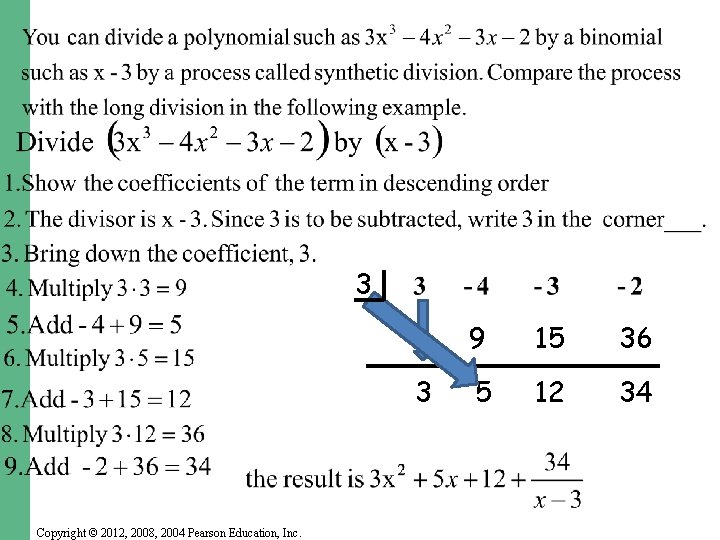
Take a note There is another way to do the long division and it is called the synthetic division, this method simplifies the long division process by dividing by a linear expression x-a. to use synthetic division, write the coefficients including zeros of the polynomial in standard form. Omit all variables and exponents. For the divisor, reverse the sign (use a). This allows you to add instead of subtract throughout the process. Copyright © 2012, 2008, 2004 Pearson Education, Inc.
3 3 Copyright © 2012, 2008, 2004 Pearson Education, Inc. 9 15 36 5 12 34
To check your answer use the long division. Copyright © 2012, 2008, 2004 Pearson Education, Inc.
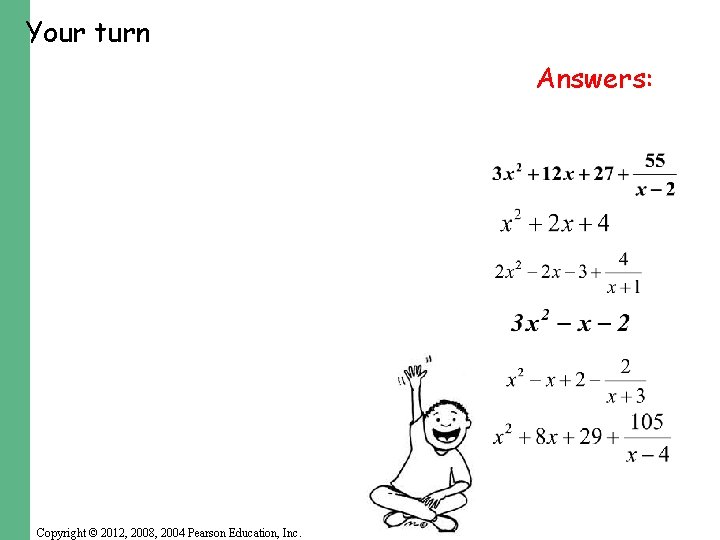
Your turn Answers: Copyright © 2012, 2008, 2004 Pearson Education, Inc.
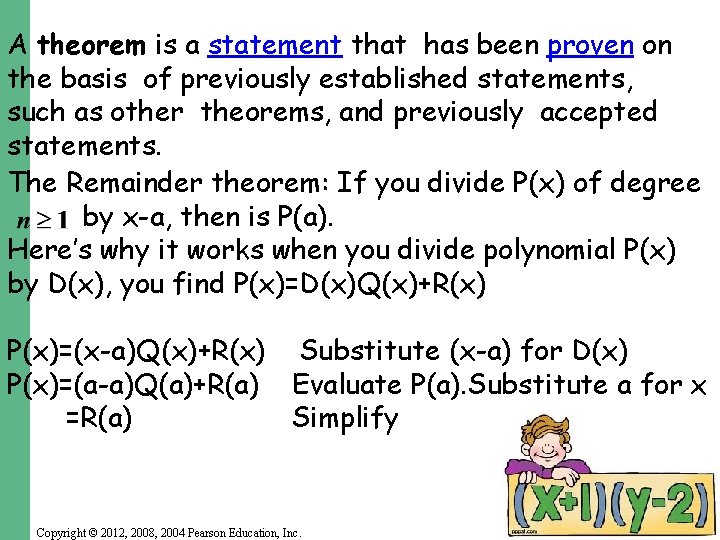
A theorem is a statement that has been proven on the basis of previously established statements, such as other theorems, and previously accepted statements. The Remainder theorem: If you divide P(x) of degree by x-a, then is P(a). Here’s why it works when you divide polynomial P(x) by D(x), you find P(x)=D(x)Q(x)+R(x) P(x)=(x-a)Q(x)+R(x) Substitute (x-a) for D(x) P(x)=(a-a)Q(a)+R(a) Evaluate P(a). Substitute a for x =R(a) Simplify Copyright © 2012, 2008, 2004 Pearson Education, Inc.
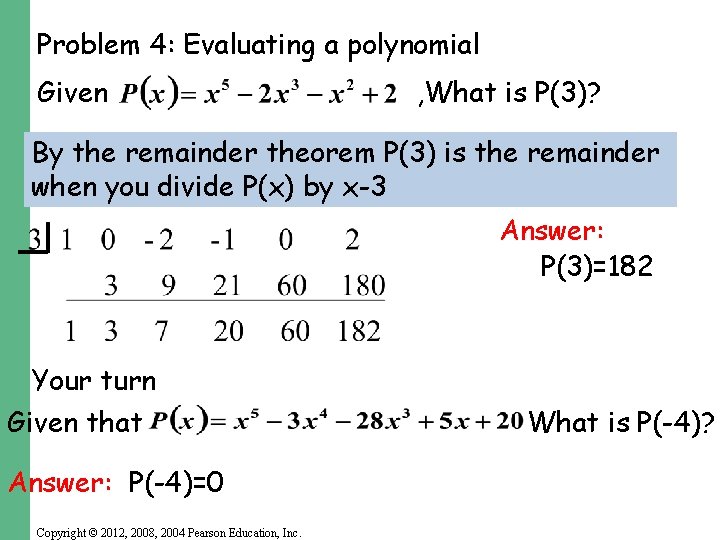
Problem 4: Evaluating a polynomial Given , What is P(3)? By the remainder theorem P(3) is the remainder when you divide P(x) by x-3 Answer: P(3)=182 Your turn Given that Answer: P(-4)=0 Copyright © 2012, 2008, 2004 Pearson Education, Inc. What is P(-4)?