6 1 Polynomials Warm Up Lesson Presentation Lesson

- Slides: 22
6 -1 Polynomials Warm Up Lesson Presentation Lesson Quiz Holt Algebra 22
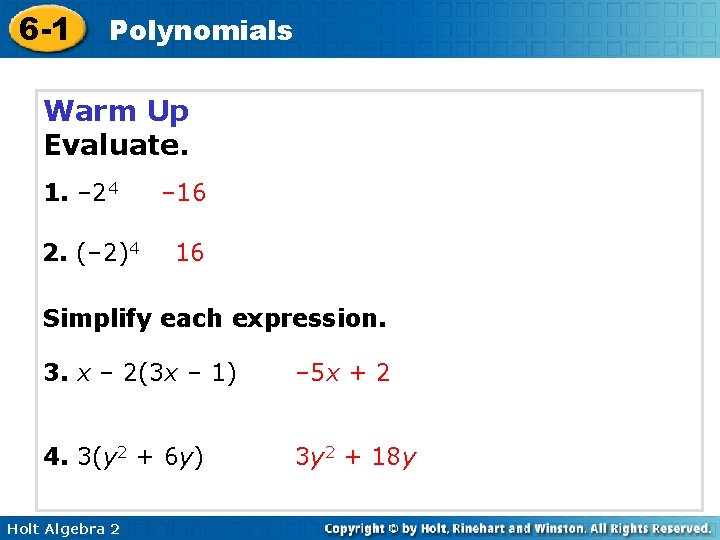
6 -1 Polynomials Warm Up Evaluate. 1. – 24 2. (– 2)4 – 16 16 Simplify each expression. 3. x – 2(3 x – 1) – 5 x + 2 4. 3(y 2 + 6 y) 3 y 2 + 18 y Holt Algebra 2
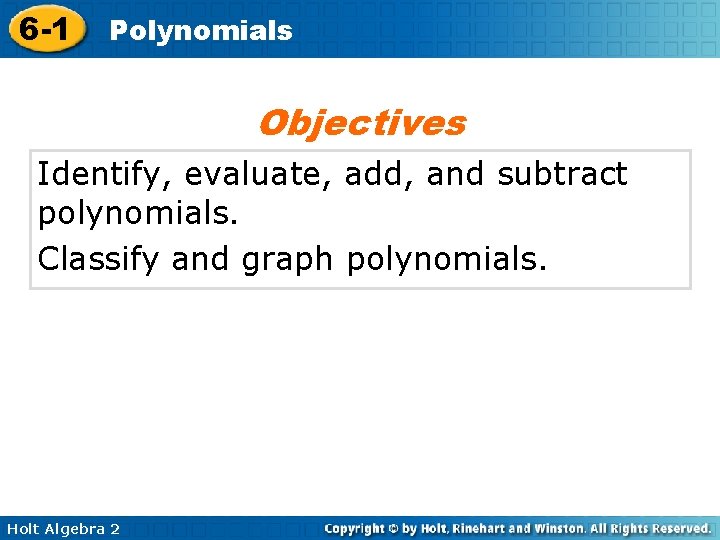
6 -1 Polynomials Objectives Identify, evaluate, add, and subtract polynomials. Classify and graph polynomials. Holt Algebra 2
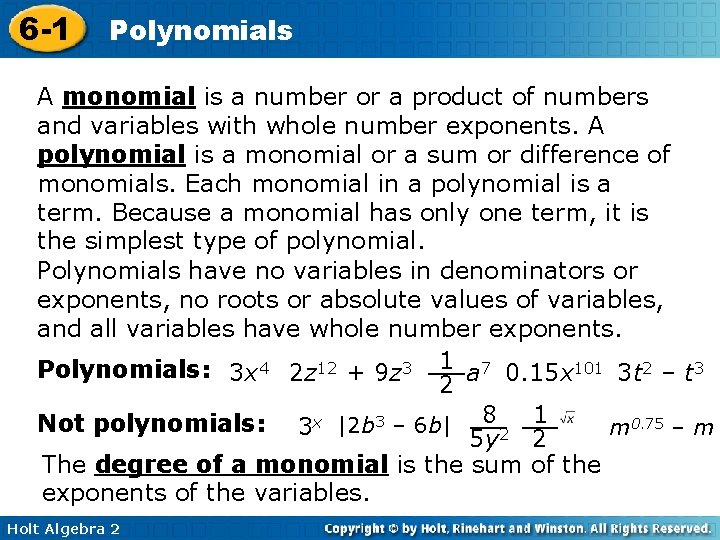
6 -1 Polynomials A monomial is a number or a product of numbers and variables with whole number exponents. A polynomial is a monomial or a sum or difference of monomials. Each monomial in a polynomial is a term. Because a monomial has only one term, it is the simplest type of polynomial. Polynomials have no variables in denominators or exponents, no roots or absolute values of variables, and all variables have whole number exponents. Polynomials: 3 x 4 2 z 12 + 9 z 3 1 a 7 0. 15 x 101 3 t 2 – t 3 2 Not polynomials: 3 x |2 b 3 – 6 b| 8 2 1 m 0. 75 – m 5 y 2 The degree of a monomial is the sum of the exponents of the variables. Holt Algebra 2
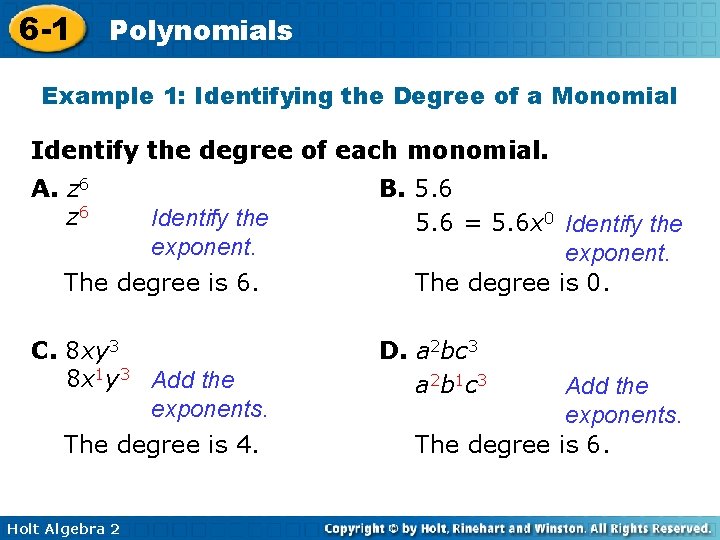
6 -1 Polynomials Example 1: Identifying the Degree of a Monomial Identify the degree of each monomial. A. z 6 Identify the exponent. The degree is 6. C. 8 xy 3 8 x 1 y 3 Add the exponents. The degree is 4. Holt Algebra 2 B. 5. 6 = 5. 6 x 0 Identify the exponent. The degree is 0. D. a 2 bc 3 a 2 b 1 c 3 Add the exponents. The degree is 6.
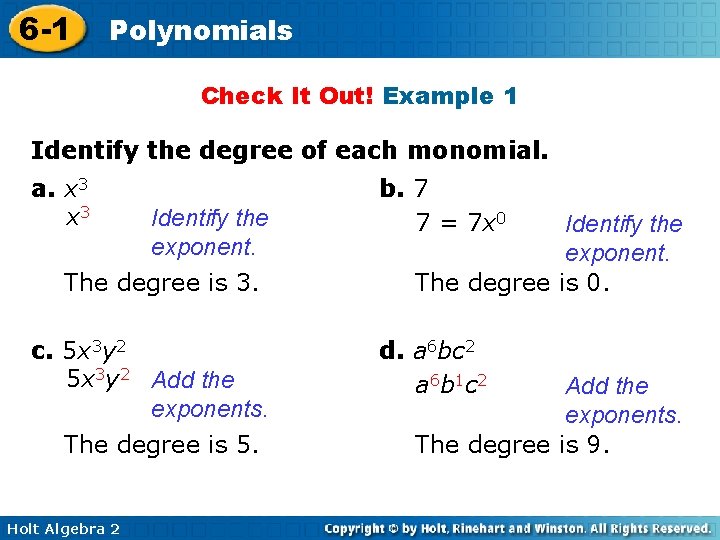
6 -1 Polynomials Check It Out! Example 1 Identify the degree of each monomial. a. x 3 Identify the exponent. The degree is 3. c. 5 x 3 y 2 Add the exponents. The degree is 5. Holt Algebra 2 b. 7 7 = 7 x 0 Identify the exponent. The degree is 0. d. a 6 bc 2 a 6 b 1 c 2 Add the exponents. The degree is 9.
6 -1 Polynomials An degree of a polynomial is given by the term with the greatest degree. A polynomial with one variable is in standard form when its terms are written in descending order by degree. So, in standard form, the degree of the first term indicates the degree of the polynomial, and the leading coefficient is the coefficient of the first term. Holt Algebra 2
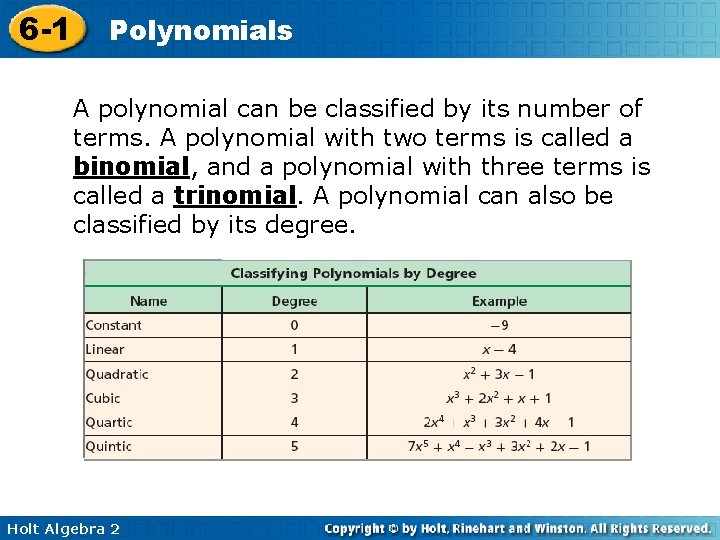
6 -1 Polynomials A polynomial can be classified by its number of terms. A polynomial with two terms is called a binomial, and a polynomial with three terms is called a trinomial. A polynomial can also be classified by its degree. Holt Algebra 2
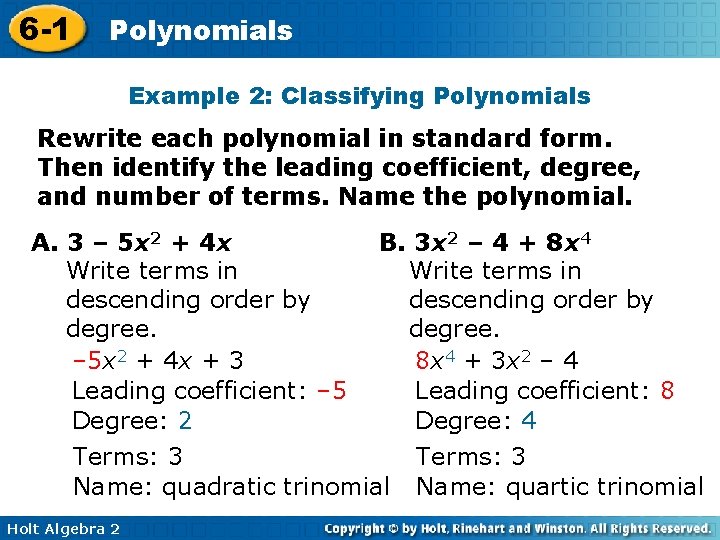
6 -1 Polynomials Example 2: Classifying Polynomials Rewrite each polynomial in standard form. Then identify the leading coefficient, degree, and number of terms. Name the polynomial. A. 3 – 5 x 2 + 4 x B. 3 x 2 – 4 + 8 x 4 Write terms in descending order by degree. – 5 x 2 + 4 x + 3 8 x 4 + 3 x 2 – 4 Leading coefficient: – 5 Leading coefficient: 8 Degree: 2 Degree: 4 Terms: 3 Name: quadratic trinomial Name: quartic trinomial Holt Algebra 2
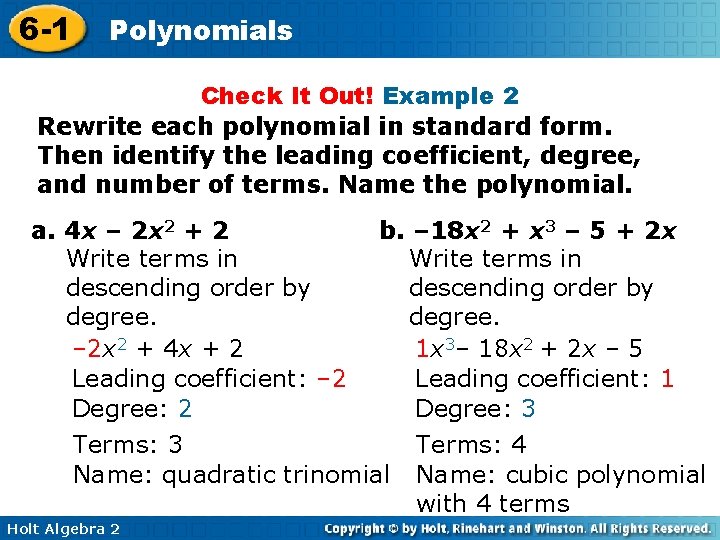
6 -1 Polynomials Check It Out! Example 2 Rewrite each polynomial in standard form. Then identify the leading coefficient, degree, and number of terms. Name the polynomial. a. 4 x – 2 x 2 + 2 b. – 18 x 2 + x 3 – 5 + 2 x Write terms in descending order by degree. – 2 x 2 + 4 x + 2 1 x 3– 18 x 2 + 2 x – 5 Leading coefficient: – 2 Leading coefficient: 1 Degree: 2 Degree: 3 Terms: 4 Name: quadratic trinomial Name: cubic polynomial with 4 terms Holt Algebra 2
6 -1 Polynomials To add or subtract polynomials, combine like terms. You can add or subtract horizontally or vertically. Holt Algebra 2
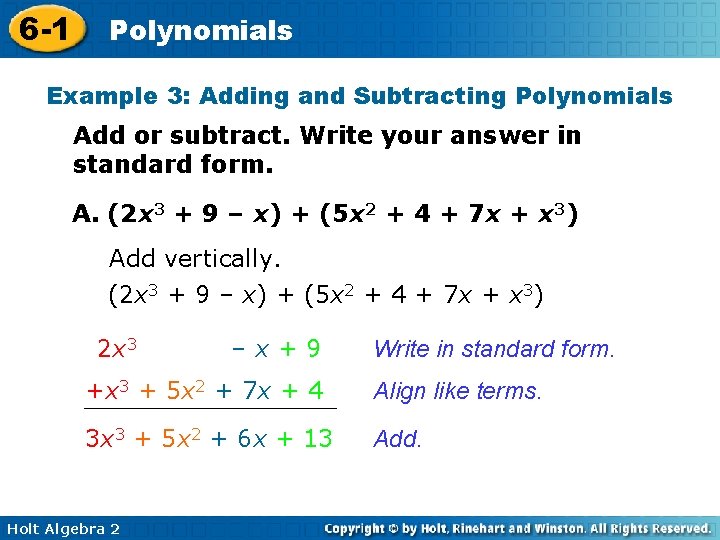
6 -1 Polynomials Example 3: Adding and Subtracting Polynomials Add or subtract. Write your answer in standard form. A. (2 x 3 + 9 – x) + (5 x 2 + 4 + 7 x + x 3) Add vertically. (2 x 3 + 9 – x) + (5 x 2 + 4 + 7 x + x 3) 2 x 3 –x+9 Write in standard form. +x 3 + 5 x 2 + 7 x + 4 Align like terms. 3 x 3 + 5 x 2 + 6 x + 13 Add. Holt Algebra 2
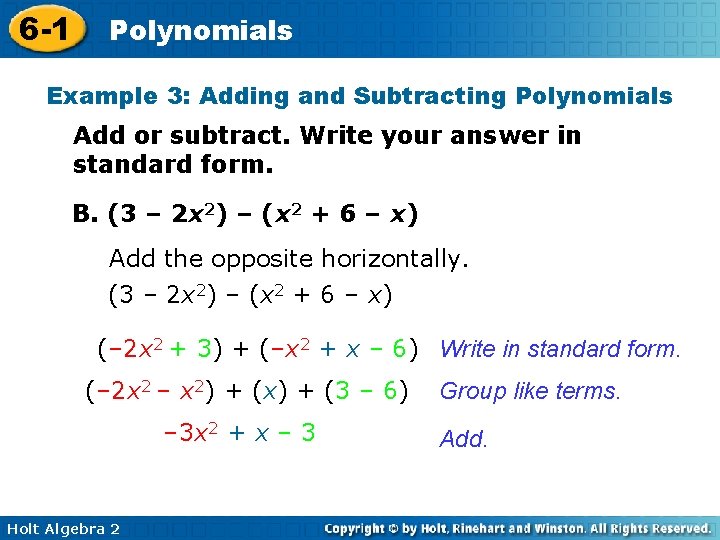
6 -1 Polynomials Example 3: Adding and Subtracting Polynomials Add or subtract. Write your answer in standard form. B. (3 – 2 x 2) – (x 2 + 6 – x) Add the opposite horizontally. (3 – 2 x 2) – (x 2 + 6 – x) (– 2 x 2 + 3) + (–x 2 + x – 6) Write in standard form. (– 2 x 2 – x 2) + (x) + (3 – 6) – 3 x 2 + x – 3 Holt Algebra 2 Group like terms. Add.
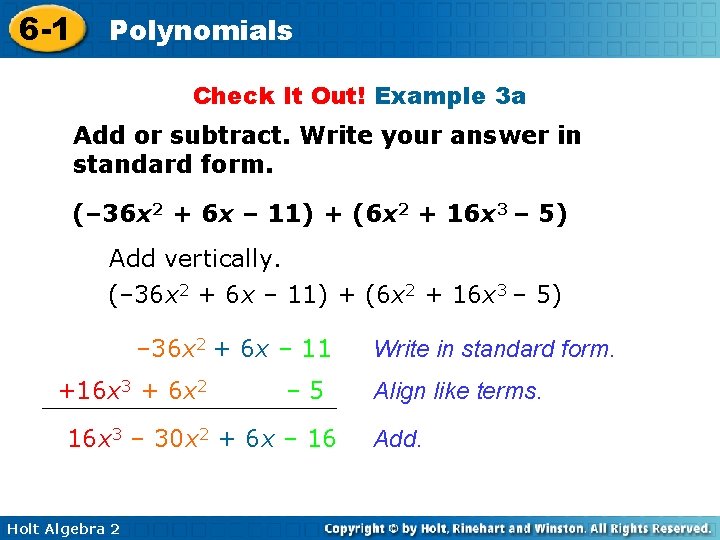
6 -1 Polynomials Check It Out! Example 3 a Add or subtract. Write your answer in standard form. (– 36 x 2 + 6 x – 11) + (6 x 2 + 16 x 3 – 5) Add vertically. (– 36 x 2 + 6 x – 11) + (6 x 2 + 16 x 3 – 5) – 36 x 2 + 6 x – 11 +16 x 3 + 6 x 2 – 5 16 x 3 – 30 x 2 + 6 x – 16 Holt Algebra 2 Write in standard form. Align like terms. Add.
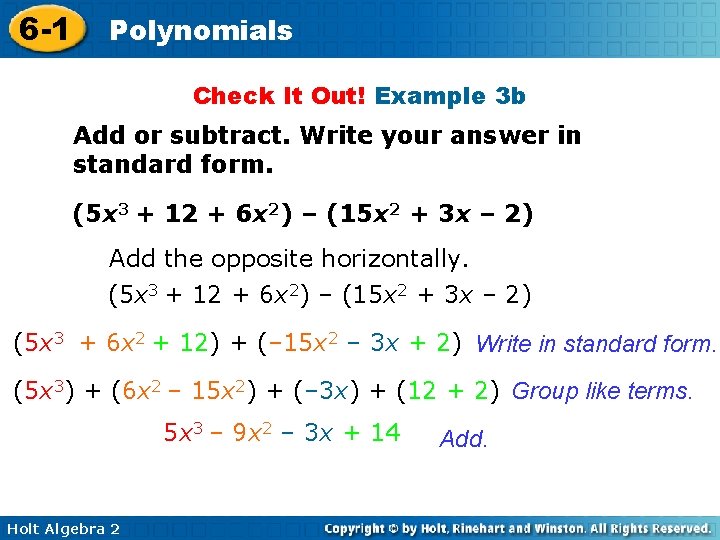
6 -1 Polynomials Check It Out! Example 3 b Add or subtract. Write your answer in standard form. (5 x 3 + 12 + 6 x 2) – (15 x 2 + 3 x – 2) Add the opposite horizontally. (5 x 3 + 12 + 6 x 2) – (15 x 2 + 3 x – 2) (5 x 3 + 6 x 2 + 12) + (– 15 x 2 – 3 x + 2) Write in standard form. (5 x 3) + (6 x 2 – 15 x 2) + (– 3 x) + (12 + 2) Group like terms. 5 x 3 – 9 x 2 – 3 x + 14 Holt Algebra 2 Add.
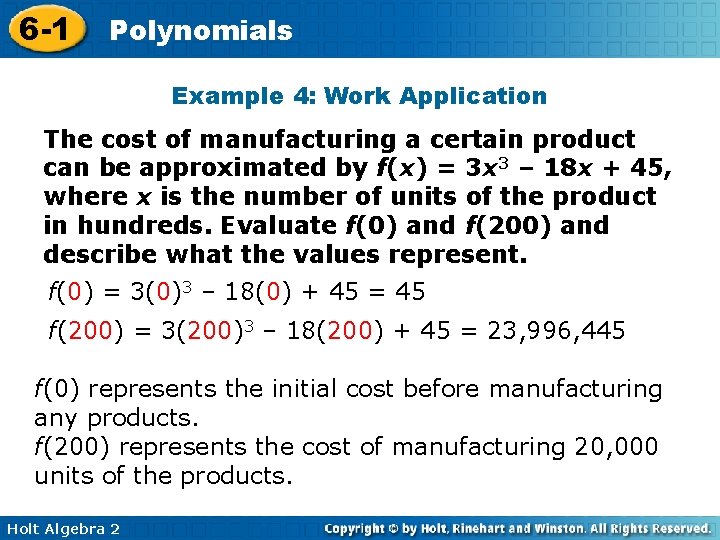
6 -1 Polynomials Example 4: Work Application The cost of manufacturing a certain product can be approximated by f(x) = 3 x 3 – 18 x + 45, where x is the number of units of the product in hundreds. Evaluate f(0) and f(200) and describe what the values represent. f(0) = 3(0)3 – 18(0) + 45 = 45 f(200) = 3(200)3 – 18(200) + 45 = 23, 996, 445 f(0) represents the initial cost before manufacturing any products. f(200) represents the cost of manufacturing 20, 000 units of the products. Holt Algebra 2
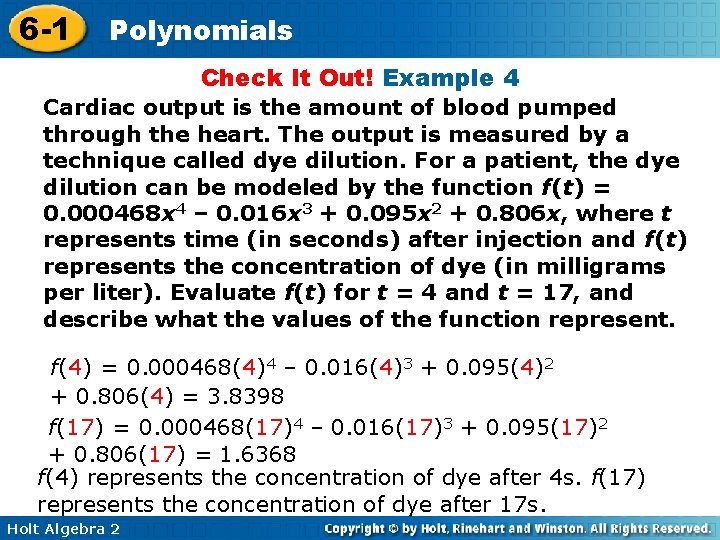
6 -1 Polynomials Check It Out! Example 4 Cardiac output is the amount of blood pumped through the heart. The output is measured by a technique called dye dilution. For a patient, the dye dilution can be modeled by the function f(t) = 0. 000468 x 4 – 0. 016 x 3 + 0. 095 x 2 + 0. 806 x, where t represents time (in seconds) after injection and f(t) represents the concentration of dye (in milligrams per liter). Evaluate f(t) for t = 4 and t = 17, and describe what the values of the function represent. f(4) = 0. 000468(4)4 – 0. 016(4)3 + 0. 095(4)2 + 0. 806(4) = 3. 8398 f(17) = 0. 000468(17)4 – 0. 016(17)3 + 0. 095(17)2 + 0. 806(17) = 1. 6368 f(4) represents the concentration of dye after 4 s. f(17) represents the concentration of dye after 17 s. Holt Algebra 2
6 -1 Polynomials Throughout this chapter, you will learn skills for analyzing, describing, and graphing higherdegree polynomials. Until then, the graphing calculator will be a useful tool. Holt Algebra 2
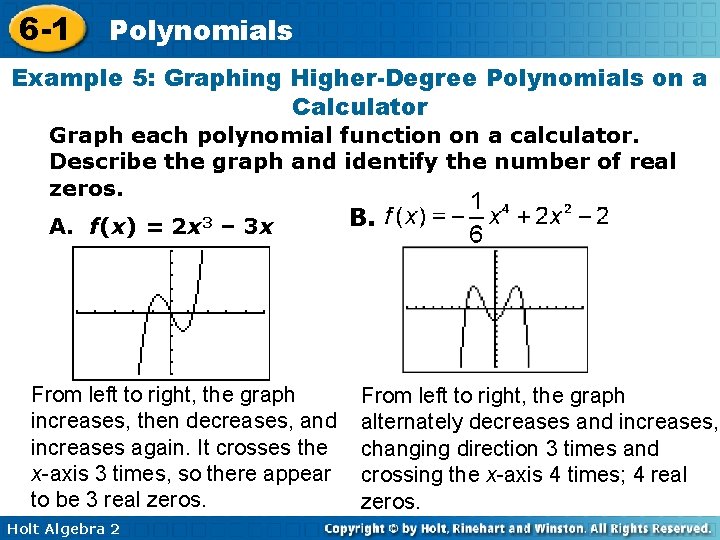
6 -1 Polynomials Example 5: Graphing Higher-Degree Polynomials on a Calculator Graph each polynomial function on a calculator. Describe the graph and identify the number of real zeros. A. f(x) = 2 x 3 – 3 x From left to right, the graph increases, then decreases, and increases again. It crosses the x-axis 3 times, so there appear to be 3 real zeros. Holt Algebra 2 B. From left to right, the graph alternately decreases and increases, changing direction 3 times and crossing the x-axis 4 times; 4 real zeros.
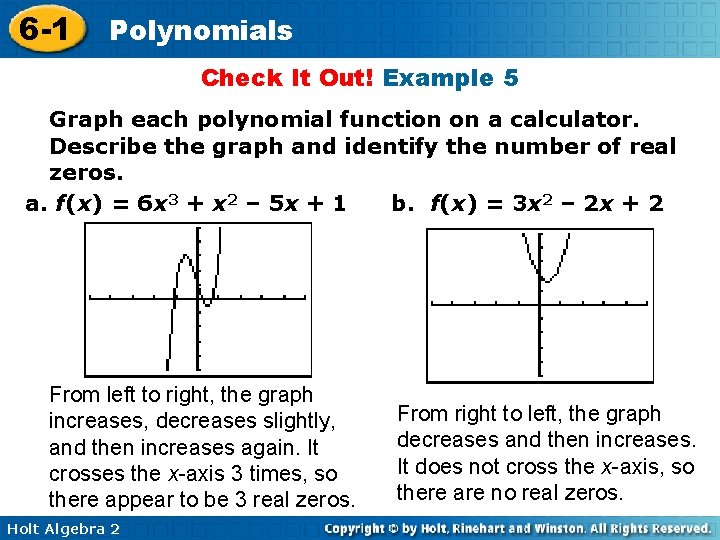
6 -1 Polynomials Check It Out! Example 5 Graph each polynomial function on a calculator. Describe the graph and identify the number of real zeros. a. f(x) = 6 x 3 + x 2 – 5 x + 1 b. f(x) = 3 x 2 – 2 x + 2 From left to right, the graph increases, decreases slightly, and then increases again. It crosses the x-axis 3 times, so there appear to be 3 real zeros. Holt Algebra 2 From right to left, the graph decreases and then increases. It does not cross the x-axis, so there are no real zeros.
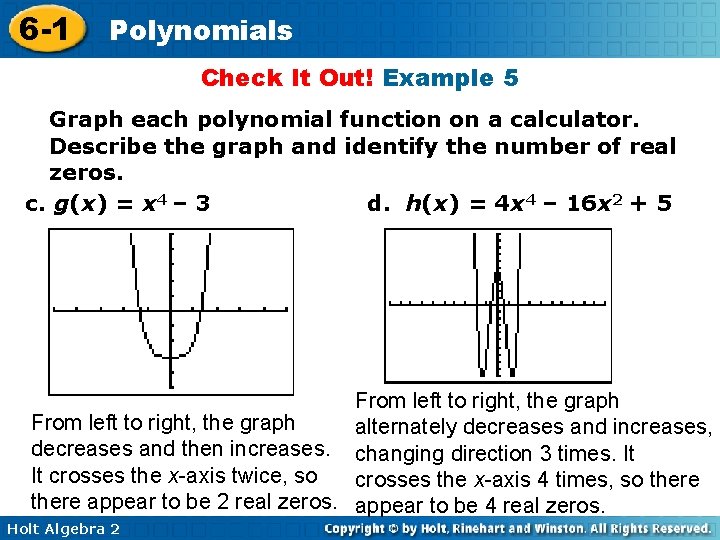
6 -1 Polynomials Check It Out! Example 5 Graph each polynomial function on a calculator. Describe the graph and identify the number of real zeros. c. g(x) = x 4 – 3 d. h(x) = 4 x 4 – 16 x 2 + 5 From left to right, the graph alternately decreases and increases, decreases and then increases. changing direction 3 times. It It crosses the x-axis twice, so crosses the x-axis 4 times, so there appear to be 2 real zeros. appear to be 4 real zeros. Holt Algebra 2
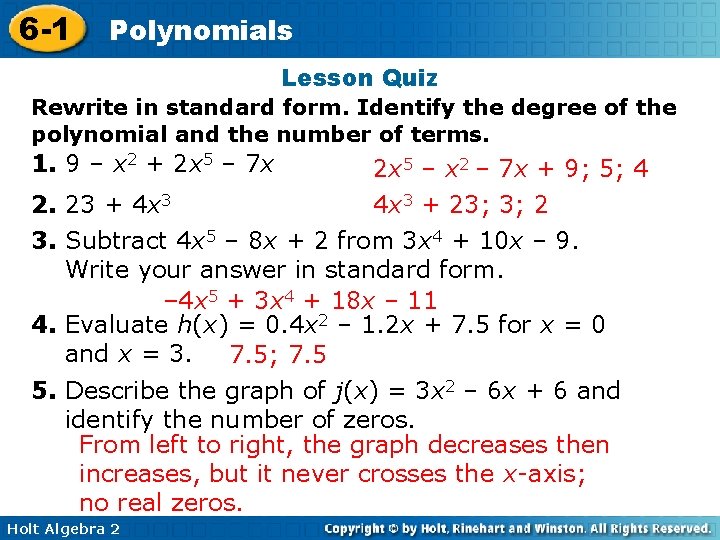
6 -1 Polynomials Lesson Quiz Rewrite in standard form. Identify the degree of the polynomial and the number of terms. 1. 9 – x 2 + 2 x 5 – 7 x 2. 3. 4. 5. 2 x 5 – x 2 – 7 x + 9; 5; 4 23 + 4 x 3 + 23; 3; 2 Subtract 4 x 5 – 8 x + 2 from 3 x 4 + 10 x – 9. Write your answer in standard form. – 4 x 5 + 3 x 4 + 18 x – 11 Evaluate h(x) = 0. 4 x 2 – 1. 2 x + 7. 5 for x = 0 and x = 3. 7. 5; 7. 5 Describe the graph of j(x) = 3 x 2 – 6 x + 6 and identify the number of zeros. From left to right, the graph decreases then increases, but it never crosses the x-axis; no real zeros. Holt Algebra 2