12 Steps to Application Integration IST 421 12
- Slides: 18
12 Steps to Application Integration IST 421
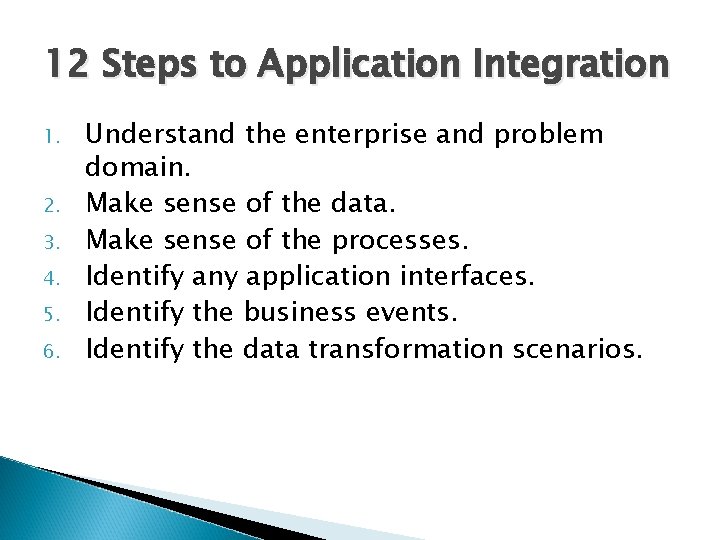
12 Steps to Application Integration 1. 2. 3. 4. 5. 6. Understand the enterprise and problem domain. Make sense of the data. Make sense of the processes. Identify any application interfaces. Identify the business events. Identify the data transformation scenarios.
12 Steps to Application Integration 7. 8. 9. 10. 11. 12. Map information movement. Apply technology. Test, test. Consider performance. Define the value. Create maintenance procedures.
Step 1 � Understand domain ◦ ◦ the enterprise and problem Structure and content of information systems Business requirements of each organization What’s important and what’s not Basic requirements-gathering problem
Step 2 � Make Sense of the Data ◦ Understand where the data exists ◦ Gather information about the data �Schema ◦ Apply business principles to determine which data flows where and why
Step 2 �Identify the data List of candidate systems Who owns the databases Physical location Database technology uses Data Dictionary Integrity issues with the data Data latency – how current the information needs to be ◦ There is no standard for cataloging data within integration projects ◦ ◦ ◦ ◦
Step 2 � Build the Enterprise Metadata Model ◦ Defines the data structure in the enterprise ◦ Defines how data structures will interact within integration solution ◦ Contains rules and logic that apply to the data � Logical Model - ERD � Physical Model
Step 2 � Normalize the model ◦ Reduce redundant data ◦ Decompose complex data structures ◦ Questions if changes are to be made to source and target databases �Risk �Expense �Time
Step 3 � Make Sense of the Processes ◦ Process-modeling techniques like UML to create business processes ◦ Document existing processes first ◦ Process Catalog – list of business processes that exist within the problem domain ◦ Common Business Model – UML
Step 4 � Identify any Application Interfaces – interfaces exposed from applications to gain access to various levels or services of those applications ◦ Application interface directory ◦ Application semantics, i. e. , student I. D. = S. S. #
Step 5 � Identify the Business Events ◦ For each event there is a reaction ◦ Example: customer signing up for credit at an online web site ◦ These events can be both automatic and manual ◦ Integration project will automate the events across systems
Step 6 � Identify the Data Transformation Scenarios
Step 7 � Map Information Movement ◦ What system the data element is moving from ◦ Where data ultimately moves to
Step 8 � Apply Technology ◦ Technology selection is difficult process ◦ May require a “pilot” project to prove technology works ◦ EDI, message brokers, application servers, etc.
Step 9 � Test, test, test ◦ Expensive and time consuming ◦ Develop a test plan – step-by-step procedure articulating how the solution will be tested when complete
Step 10 � Consider Performance ◦ Poor performance will kill an integration solution ◦ Solution must scale ◦ Design performance into the solution, don’t try to fix it after solution is live
Step 11 � Define the Value ◦ Evaluate the dollars that will be saved by a successful application integration solution ◦ Soft dollars – difficult to define, increased productivity, employee retention rate increase, customer satisfaction ◦ Hard dollars – automate manual processes, reducing errors, processing customer orders more quickly
Step 12 � Create ◦ ◦ ◦ Maintenance Procedures Manage security Administer message broker server Monitor system performance Assign activities to staff Disaster recovery issues