
IST 421 Advanced Enterprise Integration Penn State Harrisburg
IST 421 Advanced Enterprise Integration Penn State Harrisburg Spring 2007
Introduction n Course Syllabus - cms. psu. edu (Angel) Student Information PSU e-mail accounts
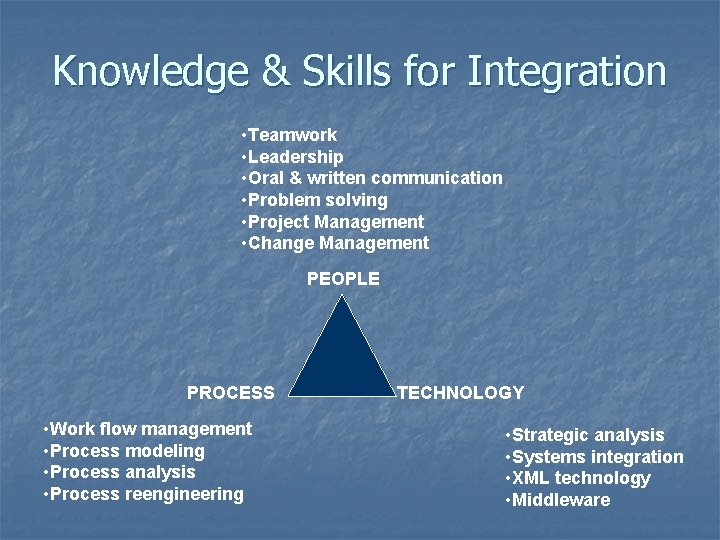
Knowledge & Skills for Integration • Teamwork • Leadership • Oral & written communication • Problem solving • Project Management • Change Management PEOPLE PROCESS • Work flow management • Process modeling • Process analysis • Process reengineering TECHNOLOGY • Strategic analysis • Systems integration • XML technology • Middleware
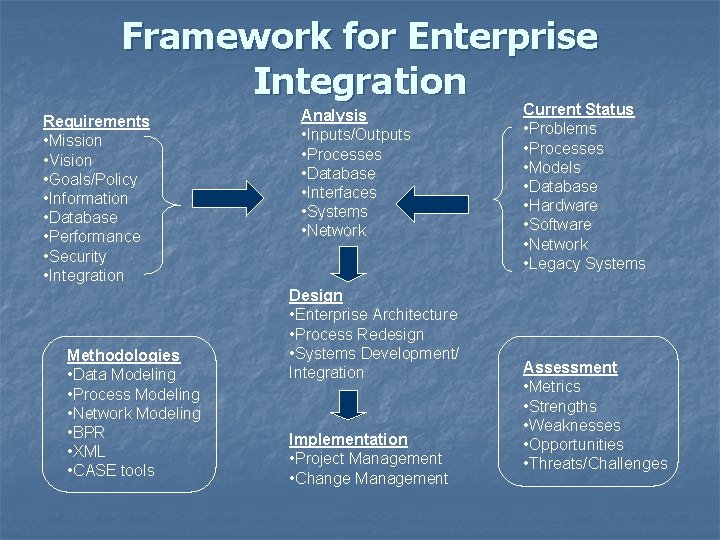
Framework for Enterprise Integration Requirements • Mission • Vision • Goals/Policy • Information • Database • Performance • Security • Integration Methodologies • Data Modeling • Process Modeling • Network Modeling • BPR • XML • CASE tools Analysis • Inputs/Outputs • Processes • Database • Interfaces • Systems • Network Design • Enterprise Architecture • Process Redesign • Systems Development/ Integration Implementation • Project Management • Change Management Current Status • Problems • Processes • Models • Database • Hardware • Software • Network • Legacy Systems Assessment • Metrics • Strengths • Weaknesses • Opportunities • Threats/Challenges
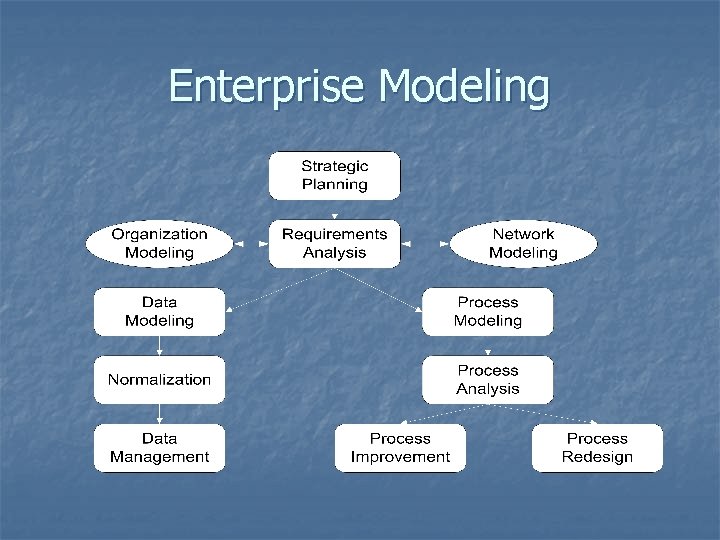
Enterprise Modeling
Business Functions n n n Name the main functional areas of operation in a business Identify the kinds of data that each functional area needs Identify the kinds of data that each functional area produces
Business Process n A business process is a collection of activities that takes one or more kinds of input and creates an output that is of value to the customer.
n What’s the difference between a business function and a business process?
Application Integration
Application Integration n Integrate disparate applications Share processes n Share data n Seamlessly n Competitive advantage n n Example: ?
Integration n “Application integration is the controlled sharing of data and business processes among any connected applications and data sources, intra- or inter-company. ” Type 1: Enterprise Application Integration – EAI Type 2: Business-to-Business Application Integration – B 2 B
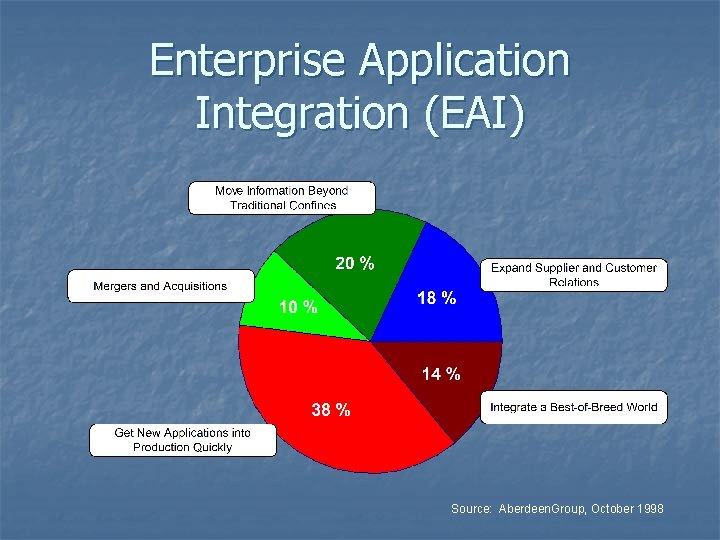
Enterprise Application Integration (EAI) Source: Aberdeen. Group, October 1998
Business Process n Collection of activities that takes one or more kinds of input and creates an output that is of value to the customer.
Business Process n n n n Customer’s order processed by Sales Manufacture scheduled by Production Logistics schedules & carries out delivery Production needs more raw materials, Purchasing arranges purchase & delivery Logistics receives raw materials, verifies condition to Accounting for payment Logistics delivers the raw materials to Production Accounting records & tracks appropriate transaction records
Business Process n n Business managers try to think in terms of business processes that integrate functional areas. Promotes efficiency and competitiveness More customer choices n Dramatically lowered costs n Brand importance n
Extended Enterprise n Extended enterprise consists of electronic interfaces that link computer systems of: Selling business n Partners that finance or manage transactions n External suppliers, carriers, & support operations n
Event-Driven Economy n n Demand driven Instantaneous – all systems updated realtime (or almost real-time) of a demand Participating systems communicate in any directions Benefits? ? ?
Event-Driven Economy n Systems bound at data level and process level Share data n Share business rules, processes, & sequences n Enforce integrity constraints n Common business model n
Event-Driven Economy n n “Relevant information existing in any participating system is accessible by any other participating system. ” Requires: Understanding n Planning n Integration n
Evolution n Traditional systems (“legacy systems”) Centralized processing n Terminal-based n Support large user and processing load n
Evolution n Microcomputer Systems (PC’s) Hundreds within an organization n Contain valuable information and processes n Accessing both the processes and data may require rehosting to a centralized server n
Evolution n Distributed Systems Any number of workstation servers and hosts n Support any number of applications n Benefits include scalability and fault-tolerance n
Evolution n Packaged Applications Purchased rather than developed in-house n Represent Best-of-Breed business models n Enterprise Resource Planning (ERP) n General Ledger n Inventory control n n Difficult to integrate
Evolution to Integration n n Shorter application life cycles Leverage existing databases and application servers rather re-create repeatedly Financial prudence – profits Create a competitive edge
Business Case n n Justify the expense Measure success Each organization must establish criteria to determine success n Can be tied to corporate strategic goals n Gains in user productivity n Reductions in error rates n
Applying Technology – B 2 B n n Integrate business-level processes and data Reuse and distribute business processes and data between linked enterprises Application-to-application, near real-time Allows users who understand little of the application to integrate the application
Applying Technology – B 2 B n n Common agreements between trading partners Source and target systems cannot be altered – integration must be non-intrusive Supports process model for both inter- and intraintegration Advanced security standards ensure information remains private
Applying Technology n n n File transfer Electronic Data Interchange (EDI) Middleware Point-to-point link between 2 systems n Requires changes to source and target systems n Hides the complexities of the underlying operating system and network n
- Slides: 28