10 5 Surface Area of Pyramids and Cones
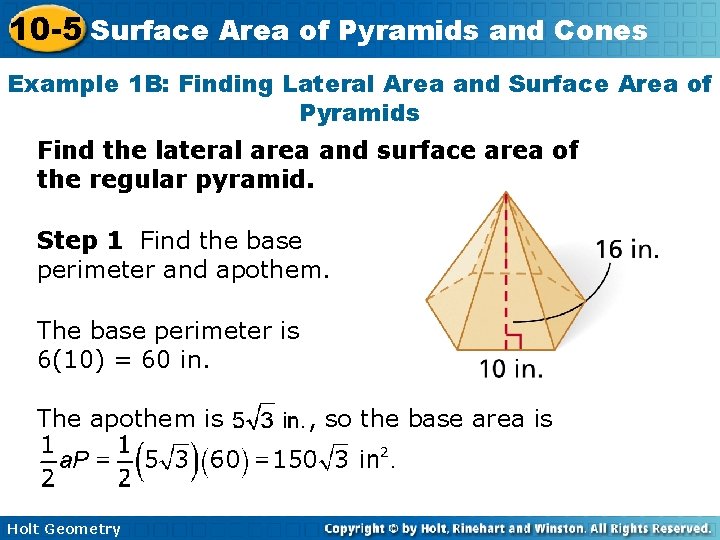
- Slides: 20
10 -5 Surface Area of Pyramids and Cones Warm Up( Add to HW) Find the missing side length of each right triangle with legs a and b and hypotenuse c. 1. a = 7, b = 24 c = 25 2. c = 15, a = 9 b = 12 Holt Geometry
10 -5 Surface Area of Pyramids and Cones Holt Geometry
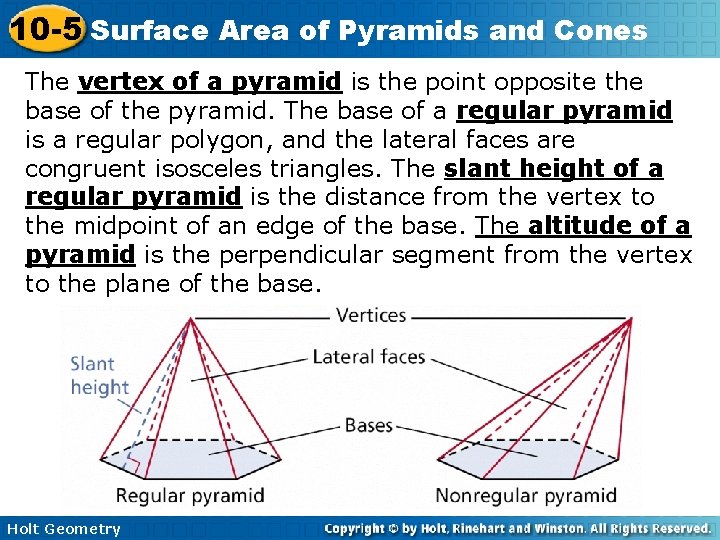
10 -5 Surface Area of Pyramids and Cones The vertex of a pyramid is the point opposite the base of the pyramid. The base of a regular pyramid is a regular polygon, and the lateral faces are congruent isosceles triangles. The slant height of a regular pyramid is the distance from the vertex to the midpoint of an edge of the base. The altitude of a pyramid is the perpendicular segment from the vertex to the plane of the base. Holt Geometry
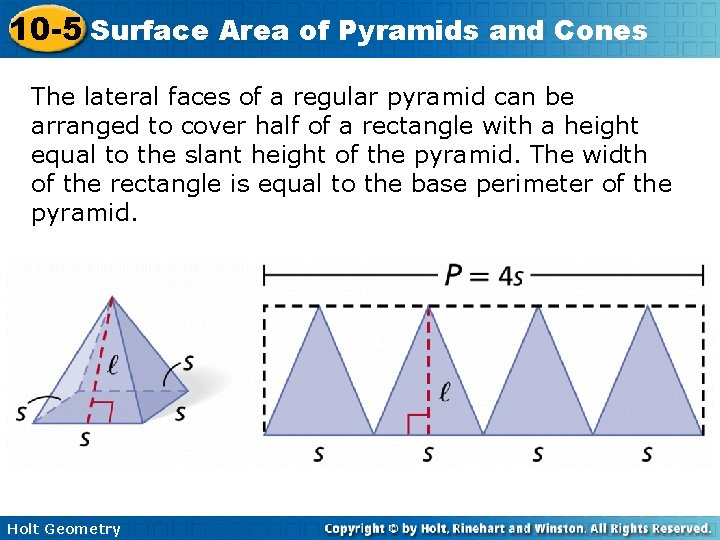
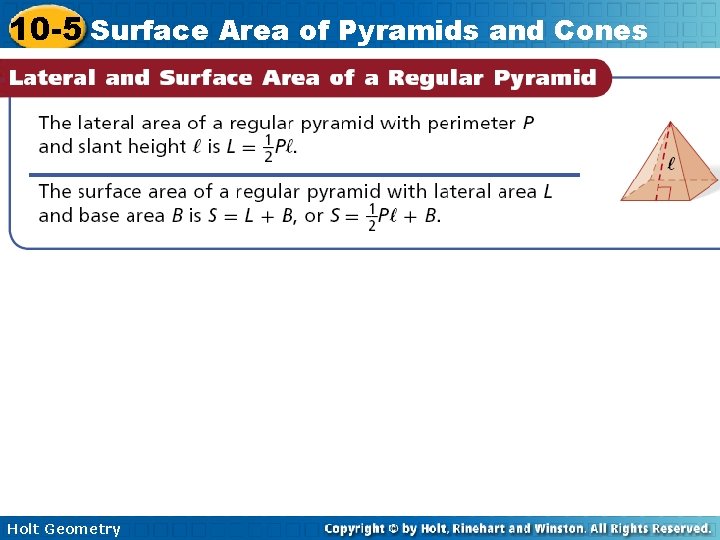
10 -5 Surface Area of Pyramids and Cones The lateral faces of a regular pyramid can be arranged to cover half of a rectangle with a height equal to the slant height of the pyramid. The width of the rectangle is equal to the base perimeter of the pyramid. Holt Geometry
10 -5 Surface Area of Pyramids and Cones Holt Geometry
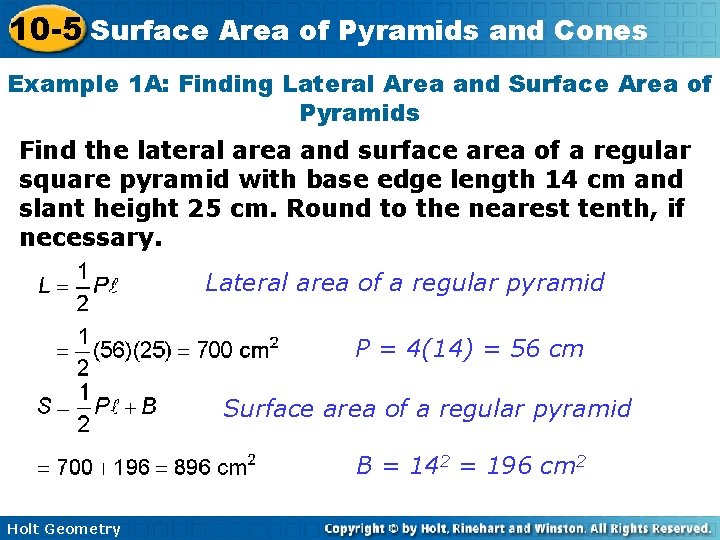
10 -5 Surface Area of Pyramids and Cones Example 1 A: Finding Lateral Area and Surface Area of Pyramids Find the lateral area and surface area of a regular square pyramid with base edge length 14 cm and slant height 25 cm. Round to the nearest tenth, if necessary. Lateral area of a regular pyramid P = 4(14) = 56 cm Surface area of a regular pyramid B = 142 = 196 cm 2 Holt Geometry
10 -5 Surface Area of Pyramids and Cones Example 1 B: Finding Lateral Area and Surface Area of Pyramids Find the lateral area and surface area of the regular pyramid. Step 1 Find the base perimeter and apothem. The base perimeter is 6(10) = 60 in. The apothem is Holt Geometry , so the base area is
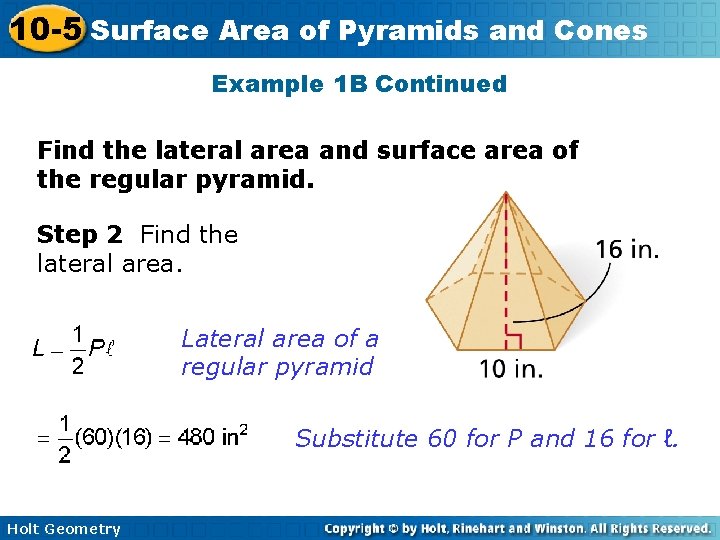
10 -5 Surface Area of Pyramids and Cones Example 1 B Continued Find the lateral area and surface area of the regular pyramid. Step 2 Find the lateral area. Lateral area of a regular pyramid Substitute 60 for P and 16 for ℓ. Holt Geometry
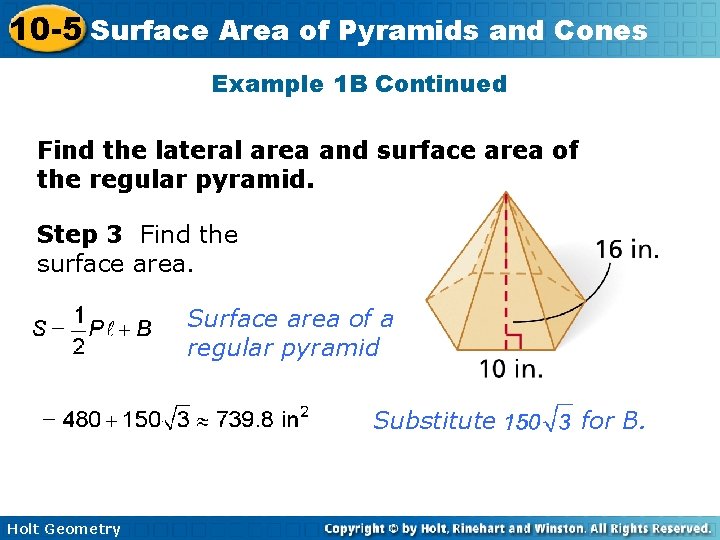
10 -5 Surface Area of Pyramids and Cones Example 1 B Continued Find the lateral area and surface area of the regular pyramid. Step 3 Find the surface area. Surface area of a regular pyramid Substitute Holt Geometry for B.
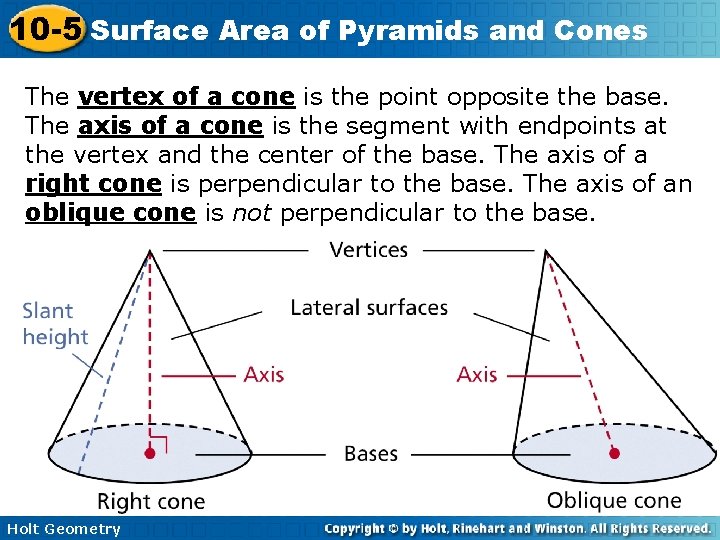
10 -5 Surface Area of Pyramids and Cones The vertex of a cone is the point opposite the base. The axis of a cone is the segment with endpoints at the vertex and the center of the base. The axis of a right cone is perpendicular to the base. The axis of an oblique cone is not perpendicular to the base. Holt Geometry
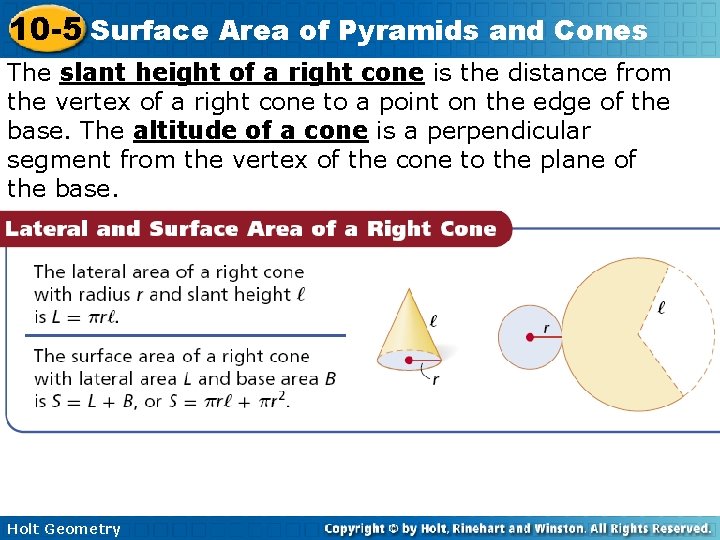
10 -5 Surface Area of Pyramids and Cones The slant height of a right cone is the distance from the vertex of a right cone to a point on the edge of the base. The altitude of a cone is a perpendicular segment from the vertex of the cone to the plane of the base. Holt Geometry
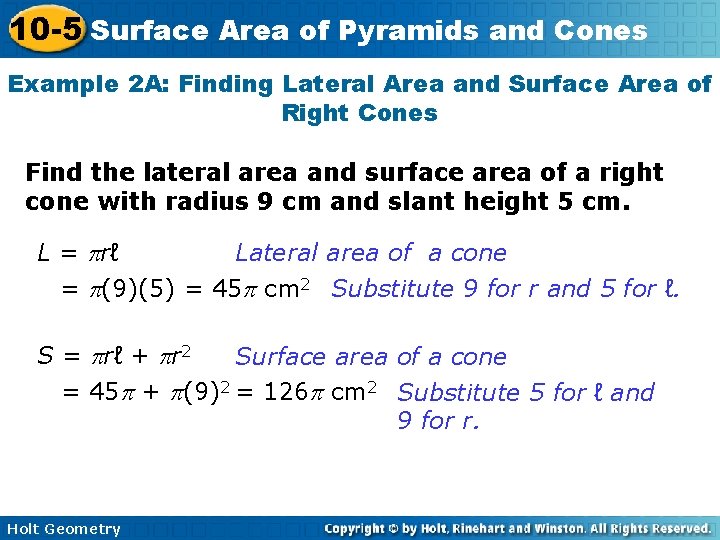
10 -5 Surface Area of Pyramids and Cones Example 2 A: Finding Lateral Area and Surface Area of Right Cones Find the lateral area and surface area of a right cone with radius 9 cm and slant height 5 cm. L = rℓ Lateral area of a cone = (9)(5) = 45 cm 2 Substitute 9 for r and 5 for ℓ. S = rℓ + r 2 Surface area of a cone = 45 + (9)2 = 126 cm 2 Substitute 5 for ℓ and 9 for r. Holt Geometry
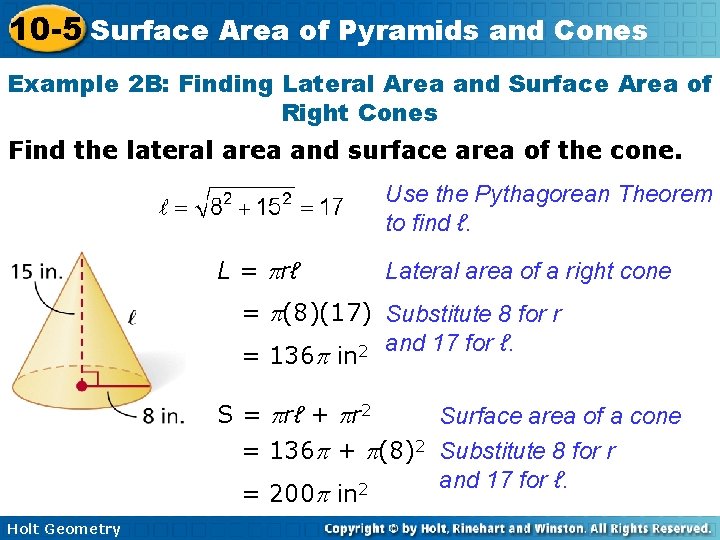
10 -5 Surface Area of Pyramids and Cones Example 2 B: Finding Lateral Area and Surface Area of Right Cones Find the lateral area and surface area of the cone. Use the Pythagorean Theorem to find ℓ. L = rℓ Lateral area of a right cone = (8)(17) Substitute 8 for r and 17 for ℓ. 2 = 136 in S = rℓ + r 2 = 136 + (8)2 = 200 in 2 Holt Geometry Surface area of a cone Substitute 8 for r and 17 for ℓ.
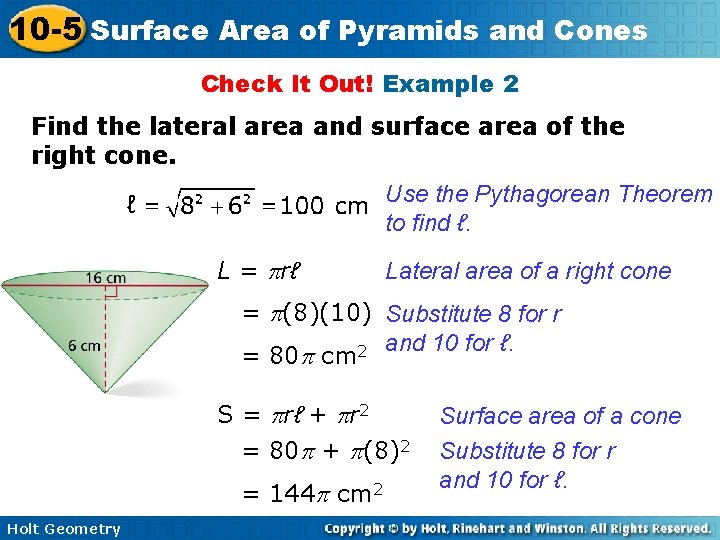
10 -5 Surface Area of Pyramids and Cones Check It Out! Example 2 Find the lateral area and surface area of the right cone. Use the Pythagorean Theorem to find ℓ. ℓ L = rℓ Lateral area of a right cone = (8)(10) Substitute 8 for r and 10 for ℓ. 2 = 80 cm S = rℓ + r 2 = 80 + (8)2 = 144 cm 2 Holt Geometry Surface area of a cone Substitute 8 for r and 10 for ℓ.
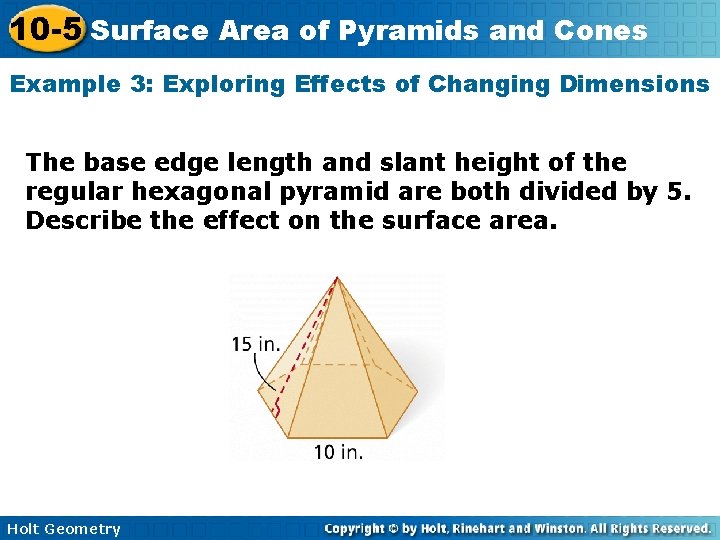
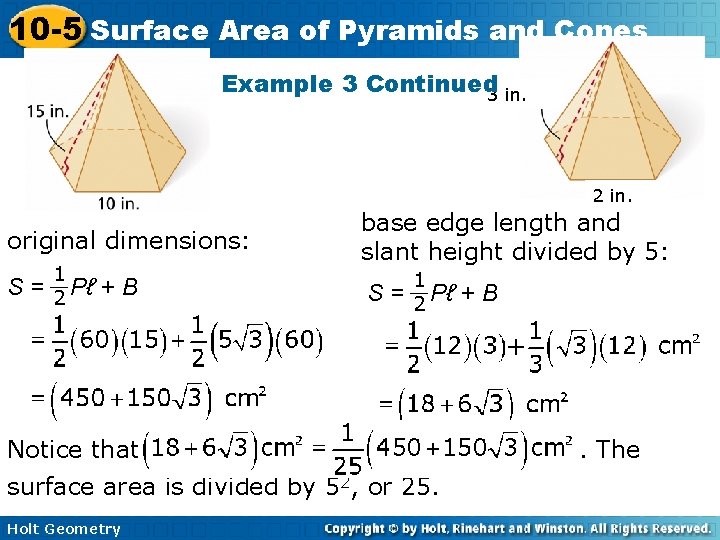
10 -5 Surface Area of Pyramids and Cones Example 3: Exploring Effects of Changing Dimensions The base edge length and slant height of the regular hexagonal pyramid are both divided by 5. Describe the effect on the surface area. Holt Geometry
10 -5 Surface Area of Pyramids and Cones Example 3 Continued 3 in. 2 in. original dimensions: 1 S = 2 Pℓ + B base edge length and slant height divided by 5: S= 1 Pℓ 2 Notice that surface area is divided by 52, or 25. Holt Geometry +B . The
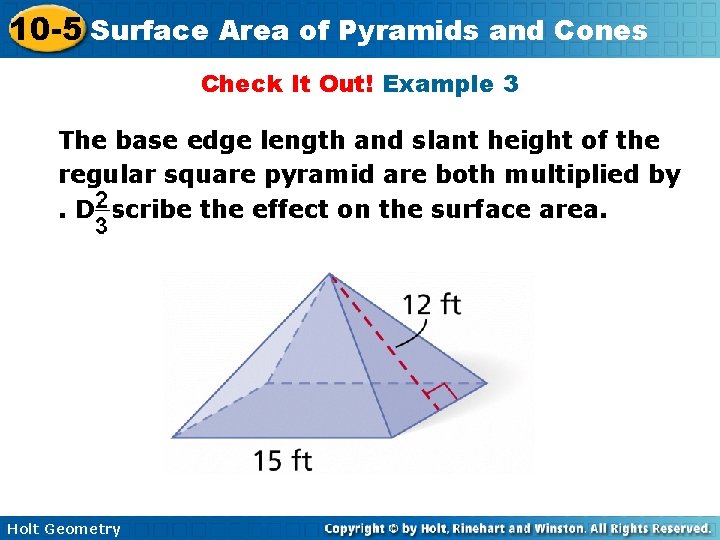
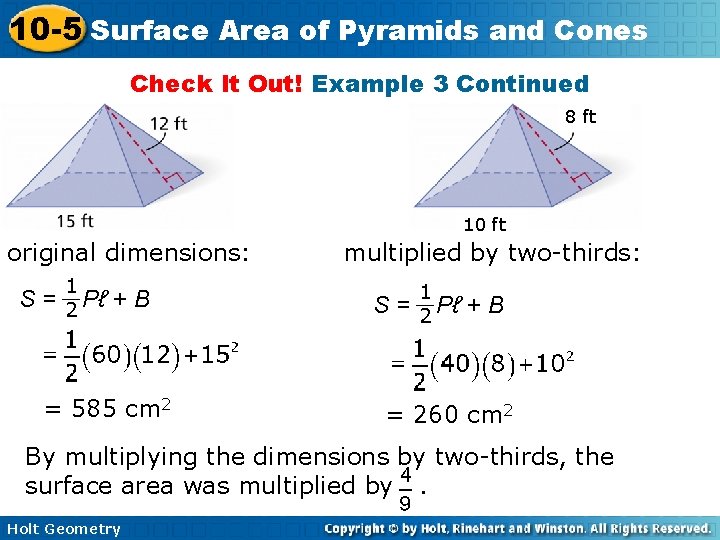
10 -5 Surface Area of Pyramids and Cones Check It Out! Example 3 The base edge length and slant height of the regular square pyramid are both multiplied by. Describe the effect on the surface area. Holt Geometry
10 -5 Surface Area of Pyramids and Cones Check It Out! Example 3 Continued 8 ft 10 ft original dimensions: 1 S = 2 Pℓ + B = 585 cm 2 multiplied by two-thirds: S= 1 Pℓ 2 +B = 260 cm 2 By multiplying the dimensions by two-thirds, the surface area was multiplied by. Holt Geometry
10 -5 Surface Area of Pyramids and Cones Lesson Quiz: Part I Find the lateral area and surface area of each figure. Round to the nearest tenth, if necessary. 1. a regular square pyramid with base edge length 9 ft and slant height 12 ft L = 216 ft 2; S = 297 ft 2 2. a regular triangular pyramid with base edge length 12 cm and slant height 10 cm L = 180 cm 2; S ≈ 242. 4 cm 2 Holt Geometry
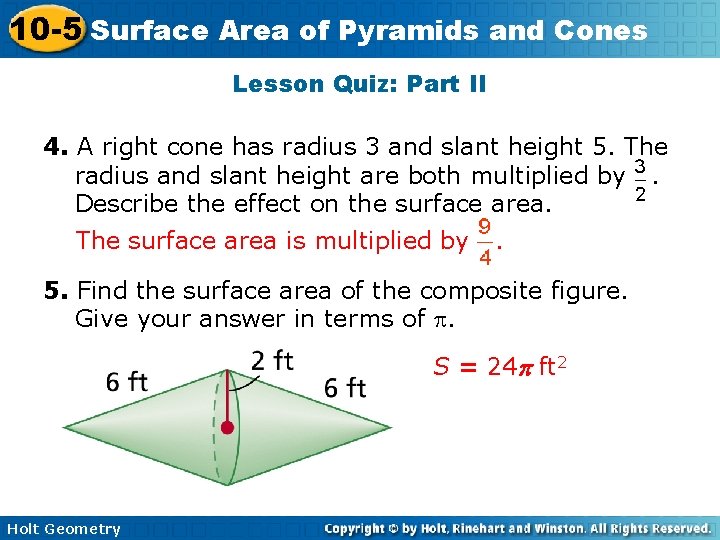
10 -5 Surface Area of Pyramids and Cones Lesson Quiz: Part II 4. A right cone has radius 3 and slant height 5. The radius and slant height are both multiplied by. Describe the effect on the surface area. The surface area is multiplied by . 5. Find the surface area of the composite figure. Give your answer in terms of . S = 24 ft 2 Holt Geometry