Workshop Method Validation in Analytical Sciences Current practices
- Slides: 9
Workshop Method Validation in Analytical Sciences Current practices and future challenges Gent, 9 -10 May 2016 Report from WG 4
Challenges in validation of multiparameter methods – Securing that a method is valid for a wide range of analytes § Moderator: – Elin Gjengedal, Norwegian University of Life Sciences, Norway
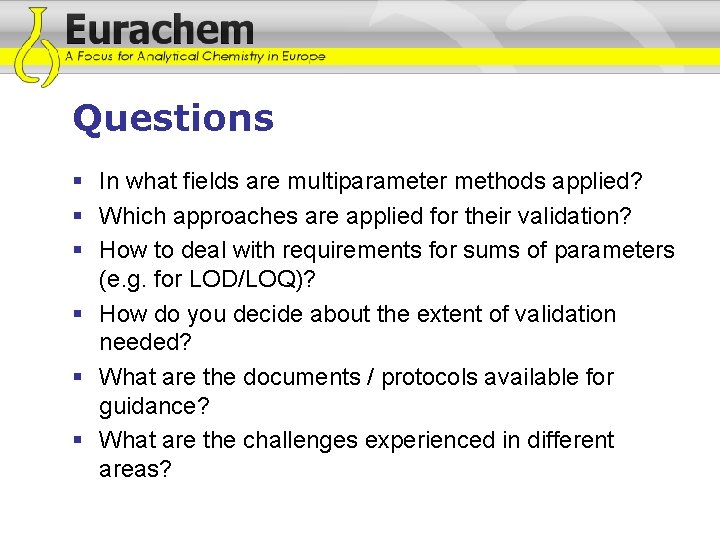
Questions § In what fields are multiparameter methods applied? § Which approaches are applied for their validation? § How to deal with requirements for sums of parameters (e. g. for LOD/LOQ)? § How do you decide about the extent of validation needed? § What are the documents / protocols available for guidance? § What are the challenges experienced in different areas?
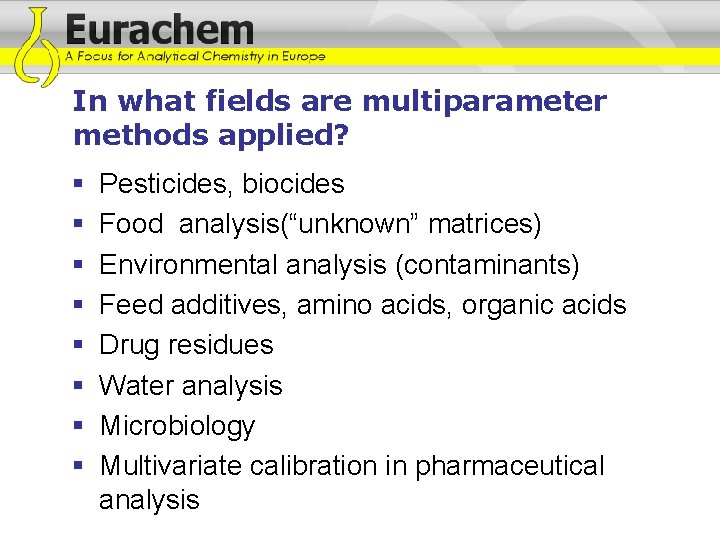
In what fields are multiparameter methods applied? § § § § Pesticides, biocides Food analysis(“unknown” matrices) Environmental analysis (contaminants) Feed additives, amino acids, organic acids Drug residues Water analysis Microbiology Multivariate calibration in pharmaceutical analysis
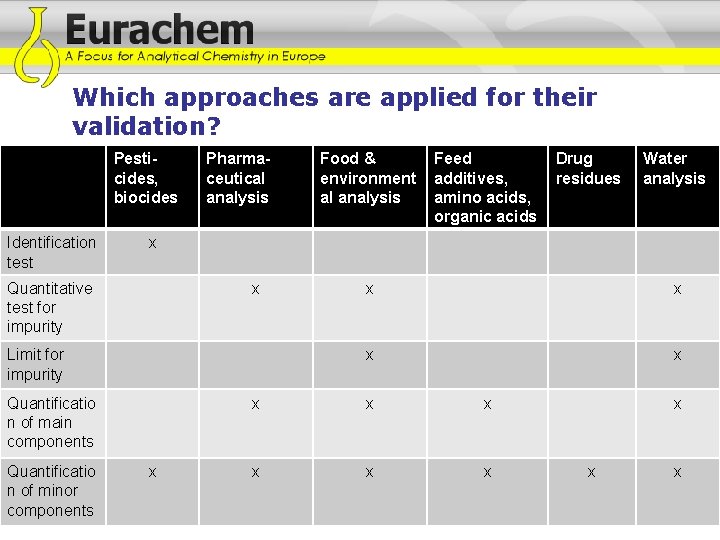
Which approaches are applied for their validation? Pesticides, biocides Identification test Pharmaceutical analysis Feed additives, amino acids, organic acids Drug residues Water analysis x Quantitative test for impurity x Limit for impurity Quantificatio n of main components Quantificatio n of minor components Food & environment al analysis x x x x
How to deal with requirements for sums of parameters (e. g. for LOD/LOQ)? § Guidelines for summing parameters are given in different legislation e. g. water directive, pesticides, vet drug residues. § Challenges: level at which sum is considered non-compliant may need to be calculated each time a positive sample is found. § MU may also need to be calculated each time.
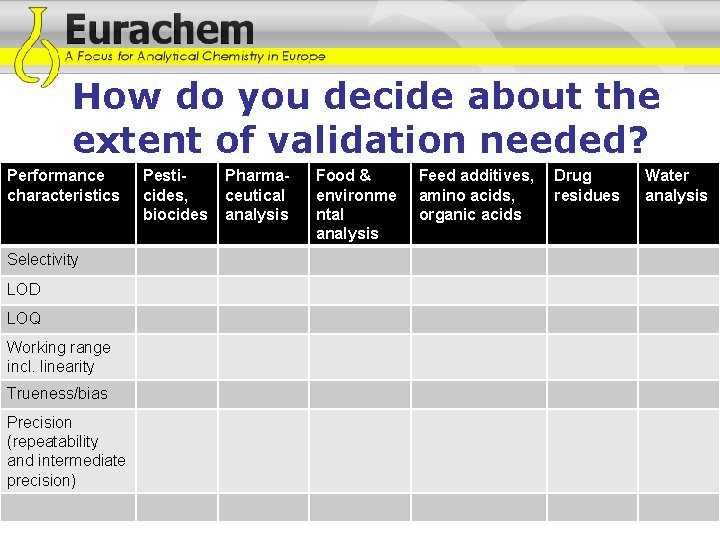
How do you decide about the extent of validation needed? Performance characteristics Selectivity LOD LOQ Working range incl. linearity Trueness/bias Precision (repeatability and intermediate precision) Pesticides, biocides Pharmaceutical analysis Food & environme ntal analysis Feed additives, amino acids, organic acids Drug residues Water analysis
What are the documents/protocols available for guidance? § NEN 7777 (In Dutch, Method validation practical guide; NEN 7779: How to calculate the MU) § ISO, SANCO, 2002/657 EC, Water Directive, ICH, IUPAC, Eurachem guide
What are the challenges experienced in different areas? § § Lack of certified reference materials Lack of proficiency tests Validation in multiple matrices Stability of reference materials, calibration standard solutions, samples and sample extracts. § Different permitted limits in different species. § Cost and time